
The bull case for SanDisk is easy.
Artificial intelligence needs storage.
NAND supply is tight.
Prices are rising.
Margins are exploding.
Data Center revenue is growing more than sixfold.
And the stock trades at roughly 6.6 times expected fiscal 2027 earnings.
Case closed.
Except memory stocks often look cheapest immediately before their earnings peak.
SanDisk does not need AI demand to disappear for today’s valuation to prove expensive.
It only needs today’s earnings to prove temporary.
That is the investment.
SanDisk’s fiscal third quarter was extraordinary.
Revenue reached $5.95 billion, up 97% sequentially and 251% year over year.
Non-GAAP gross margin reached 78.4%.
Data Center revenue rose to $1.47 billion, up 233% sequentially and 645% year over year.
Management then guided fiscal fourth-quarter revenue to between $7.75 billion and $8.25 billion, gross margin to between 79% and 81%, and non-GAAP earnings per share to between $30 and $33.
Those numbers are not forecasts of some distant AI opportunity.
The demand is already appearing in the income statement.
At $1,278.23, SanDisk trades at approximately 6.6 times the current fiscal 2027 consensus earnings estimate of $192.82 per share.
That multiple looks absurdly low for a company growing this quickly.
It also looks perfectly reasonable if fiscal 2027 represents the top of another NAND cycle.
The earnings estimate is not the debate.
The durability of the earnings estimate is.
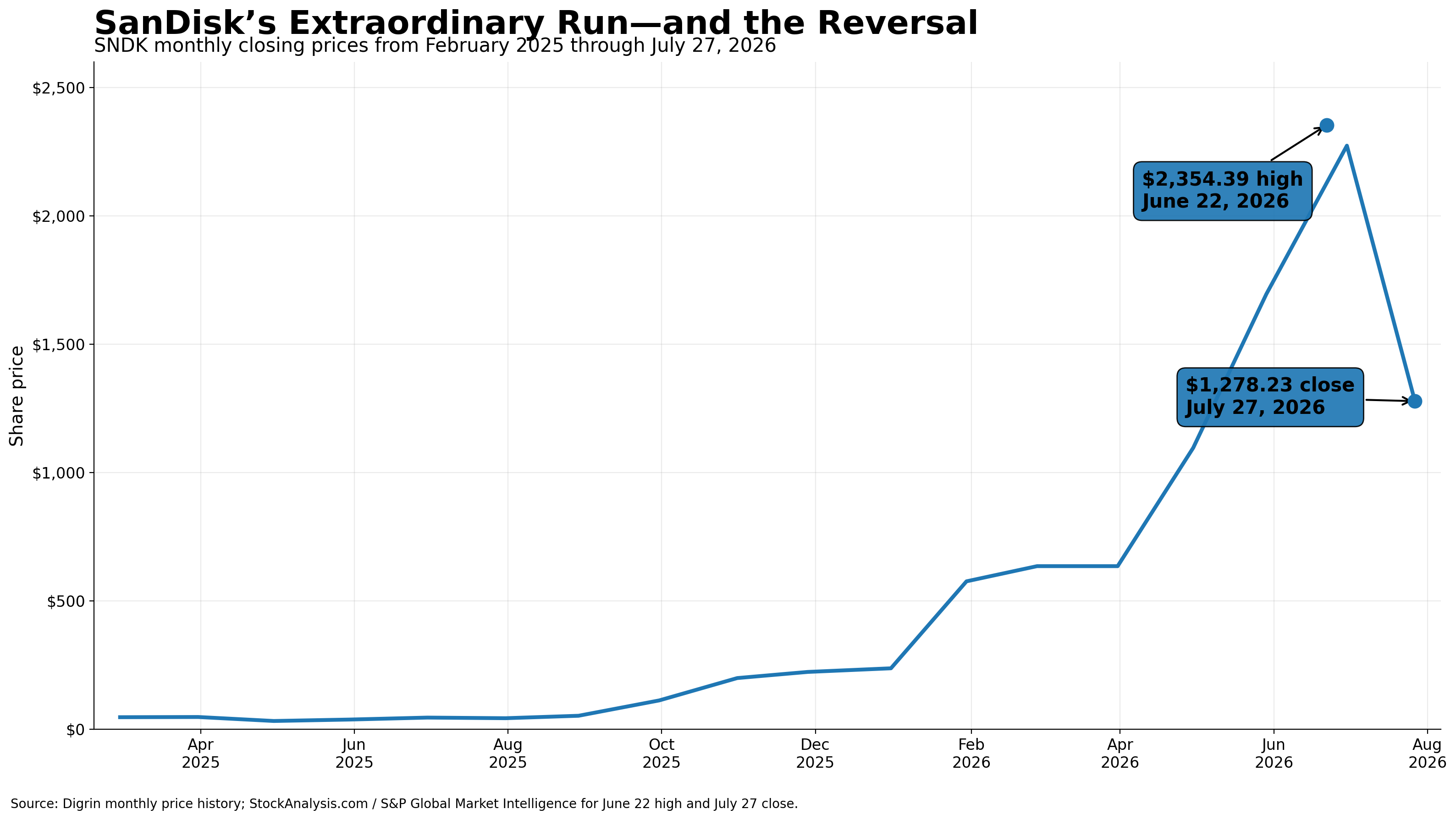
SanDisk climbed from less than $50 in early 2025 to a June 2026 high of $2,354.39 before falling nearly 46% to $1,278.23. The market is not questioning the current earnings. It is questioning how long they can last.
What happens when NAND is no longer scarce?
SanDisk is currently benefiting from an unusually favorable combination.
AI infrastructure demand is rising.
Inventories are lean.
Manufacturers have been cautious about adding capacity.
Capital has been competing with investments in DRAM and other higher-value memory products.
The result is a shortage powerful enough to push SanDisk’s gross margin toward 80%.
That is real earnings power.
It is not necessarily permanent earnings power.
NAND has historically been a terrible place to assume peak margins will last.
Manufacturers reduce supply when prices collapse.
Demand recovers.
Prices rise.
Margins expand.
Capacity and bit production increase.
Eventually, the shortage fixes itself.
SanDisk showed investors the other side of that cycle only three years ago.
In 2023, revenue fell 37%, gross margin dropped to roughly 7%, and operating losses followed.
Today, the company is producing margins approaching 80%.
That is an extraordinary recovery.
It is also why those margins are dangerous to extrapolate.
The stock can work without 80% margins lasting forever.
But those margins cannot collapse on the old schedule if fiscal 2027 earnings are going to deserve a higher valuation.
[CHART: SanDisk quarterly revenue and gross margin from fiscal 2025 through fiscal 2026 Q3.]
SanDisk is trying to change the part of the NAND cycle that has historically hurt memory producers most.
Customers disappear when supply becomes plentiful.
By the end of April, SanDisk had signed five New Business Model agreements.
These are multi-year customer arrangements supported by financial commitments rather than ordinary purchase intentions.
Three of the agreements were already reflected in SanDisk’s April filing.
They produced $41.6 billion of remaining performance obligations.
Only about 15% of that amount was expected to be recognized during the following twelve months.
Most of the contracted revenue therefore extended beyond April 2027.
Together, the five agreements cover more than one-third of expected fiscal 2027 bit shipments and contain more than $11 billion of financial guarantees.
Some extend for as long as five years.
That matters.
The old NAND model depended heavily on customers continuing to buy when market conditions changed.
These agreements create forward demand visibility and impose financial consequences if customers fail to perform.
That is more protection than SanDisk historically had.
But protection is not immunity.
One-third of expected shipments is not the entire company.
A contractual commitment to purchase NAND is also not the same thing as guaranteeing SanDisk an 80% gross margin.
The contracts may change the cycle.
They have not yet eliminated it.
The New Business Model agreements appear to contain combinations of fixed and variable pricing, financial guarantees, prepayments, and other protections.
That should make it harder for customers simply to walk away when NAND prices weaken.
It does not mean SanDisk can escape industry pricing.
The company can deliver every contracted bit and still earn less on those bits if market prices reset lower.
That distinction is critical.
The real test of these agreements does not happen while customers are competing for scarce supply.
It happens when NAND becomes plentiful and customers have alternatives.
Anyone can sign an attractive contract during a shortage.
I want to know what that contract is worth after the shortage ends.
The NAND market remains exceptionally tight.
TrendForce currently estimates that NAND will operate with a 4% to 5% supply deficit in 2026.
AI server demand remains strong.
Inventories remain lean.
Manufacturers have avoided aggressive capacity expansion.
Those conditions explain much of SanDisk’s present earnings power.
But the picture may begin changing during 2027.
Process migrations should increase the number of bits produced from existing wafers.
Existing facilities should produce more output without requiring entirely new plants.
Chinese manufacturers continue adding capacity.
TrendForce expects Chinese suppliers to approach 19% of global NAND bit production.
Its current expectation is that supply growth will overtake demand and move the market back toward excess supply during the second half of 2027.
That is the date I care about.
Not another quarter of spectacular revenue growth.
Not another quarter of 80% gross margins.
If that forecast is approximately right, SanDisk has about a year before investors begin learning whether its new contracts changed the economics of the business or merely extended the current shortage.
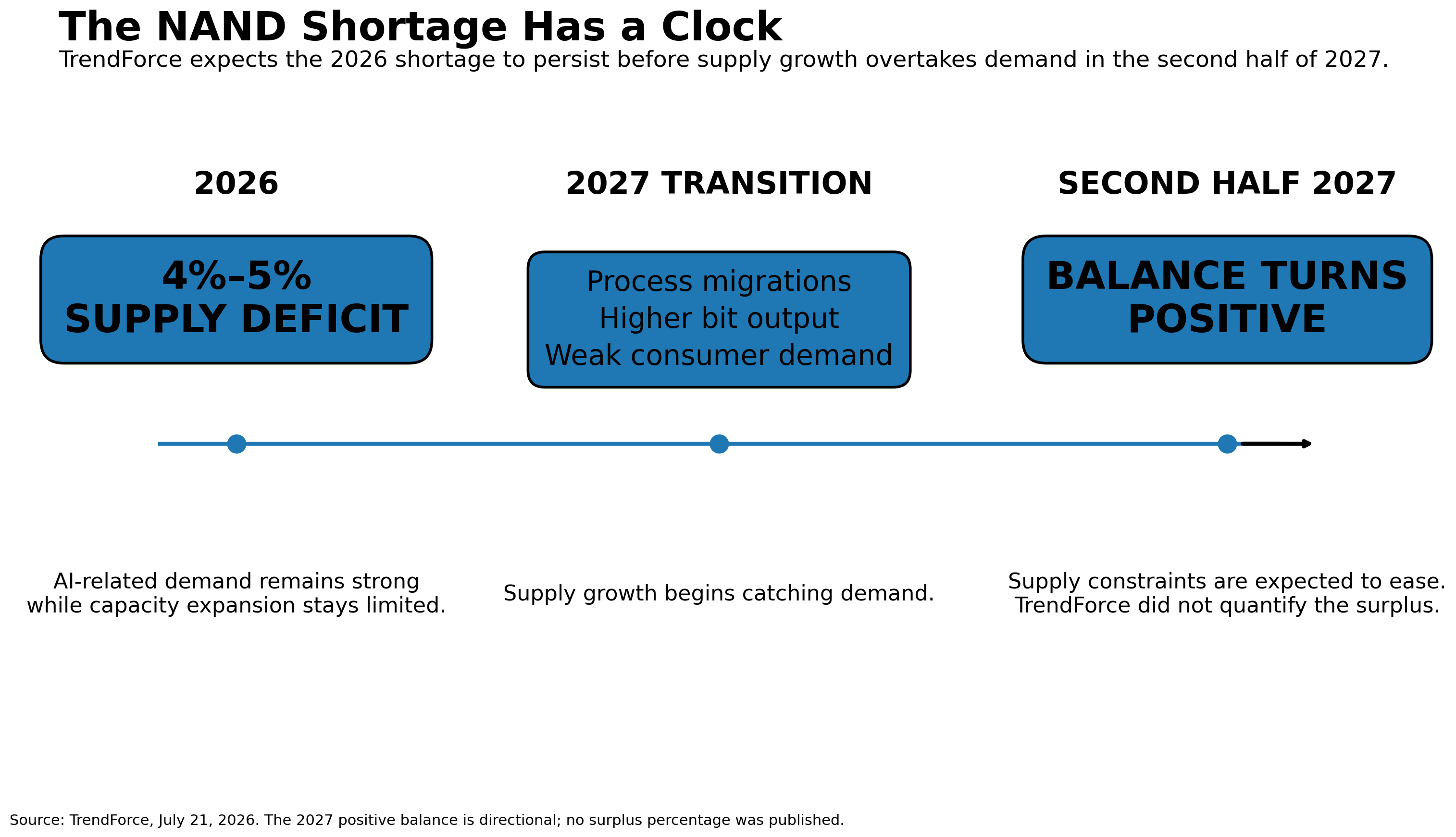
The current shortage supports SanDisk’s earnings, but TrendForce expects supply growth to overtake demand in the second half of 2027. That is when the durability of the company’s contracts and margins will face their first real test.
It is easy to take every increase in AI spending and turn it into a permanent semiconductor demand curve.
We do not need to do that.
Alphabet recently raised its expected 2026 capital spending to between $195 billion and $205 billion while Google Cloud revenue grew 82%.
The major cloud companies continue spending enormous amounts on AI infrastructure.
SanDisk is seeing that demand directly.
Data Center increased from roughly 12% of revenue a year earlier to approximately 25% in fiscal Q3.
Revenue from the segment increased more than sixfold year over year.
So this thesis does not depend on pretending AI demand is imaginary.
The danger sits somewhere else.
AI spending can continue growing while NAND supply grows faster.
Both can be true.
Artificial intelligence can transform the economy while memory producers still experience another pricing cycle.
Demand growth does not guarantee permanent scarcity.
Servers now represent more than 40% of worldwide NAND bit demand.
That is a major structural change.
But smartphones and notebooks together still represent almost another 40%.
Weakness in those markets therefore matters.
AI does not need to disappoint for NAND prices to weaken.
Strong server demand can simply be overwhelmed at the margin by rising supply and weaker demand elsewhere.
That is a more credible bear case than assuming the AI infrastructure boom suddenly disappears.
The question is not whether AI demand remains strong.
The question is whether total demand grows faster than total supply.
SanDisk has a substantial enterprise SSD opportunity.
It is not alone.
Micron is ramping PCIe Gen6 enterprise SSDs, shipping a 245-terabyte QLC drive, and implementing its own longer-term strategic customer agreements.
Samsung is advancing the same transition from the product side.
That tells me the move toward differentiated enterprise storage and longer customer relationships is real.
It also tells me not to call it a SanDisk moat.
If the entire industry moves toward longer-term agreements, SanDisk may become a better business without becoming a uniquely protected one.
The contracts may improve visibility.
They may soften the next downturn.
They may reduce the damage created by customers abruptly disappearing.
But competitors are not standing still while SanDisk changes its business model.
SanDisk has fallen from $2,354.39 to $1,278.23 while analysts still expect the company to earn approximately $193 per share in fiscal 2027.
That $193 figure is not an estimated stock price.
It is projected earnings per share — the amount of annual profit attributed to each outstanding share.
At a share price of $1,278.23, dividing the stock price by the projected $193 of earnings produces a valuation of approximately 6.6 times earnings.
That is an unusually low multiple.
I do not think the market is saying SanDisk cannot produce those fiscal 2027 profits.
I think it is saying those profits may sit near the top of the NAND cycle and will not last.
That is how cyclical stocks become optical bargains.
The earnings denominator reaches its highest point at precisely the moment investors should be most cautious about extrapolating it.
If SanDisk earns close to $193 per share in fiscal 2027 but earnings then fall sharply in fiscal 2028 or 2029, the stock was never genuinely cheap.
It only appeared cheap because the earnings estimate was temporarily enormous.
If the contracts protect pricing, Data Center demand remains strong, and earnings remain near current levels, then 6.6 times earnings would be genuinely cheap.
The fiscal 2027 earnings estimate is not the thesis.
How much of those earnings survives after the NAND shortage ends is the thesis?
The market may be underestimating what happens if SanDisk increases contracted fiscal 2027 bit coverage from more than one-third toward one-half.
It may also be underestimating the value of meaningful customer commitments extending into fiscal 2028 and beyond.
That would tell us something important.
Customers would not merely be securing scarce NAND during a temporary shortage.
They would be changing how they procure storage.
The $41.6 billion of remaining performance obligations already shows substantial contracted demand beyond the next twelve months.
What it does not show is the margin SanDisk will earn on that revenue after industry pricing begins weakening.
That is the missing number.
Backlog and contractual commitments matter.
They do not automatically reveal the economics of fulfilling those commitments.
A large contracted revenue number can still produce disappointing shareholder returns if pricing resets, costs rise, or margins normalize faster than expected.
You are not simply buying AI demand.
You are buying the possibility that SanDisk has transferred part of the NAND cycle risk from itself to its customers.
You are betting contract coverage continues expanding.
You are betting Data Center becomes a larger and more durable part of the business.
You are betting the agreements protect pricing when supply catches demand.
You are betting margins remain materially above historical cycle levels even after the shortage ends.
And you are betting the second half of 2027 looks more like a normalization than a collapse.
Those are very different assumptions from simply believing AI infrastructure spending will keep growing.
My caution will prove too cautious if the contracts create more protection than the market expects.
If contracted fiscal 2027 bit coverage moves toward or above one-half.
If SanDisk adds meaningful fiscal 2028 visibility.
If Data Center remains the fastest-growing part of the business.
If gross margins remain materially above historical cycle levels after NAND supply improves.
If the company proves it can maintain strong earnings even when customers have more alternatives.
Then SanDisk will have done more than benefit from a favorable cycle.
It will have changed how the cycle reaches its income statement.
That deserves a different valuation.
The thesis can also fail in the other direction.
If supply catches demand sooner than expected.
If Chinese NAND production rises aggressively.
If consumer weakness persists.
If contract prices begin falling during 2027.
If customers renegotiate or delay their commitments.
If gross margin falls with industry pricing despite the New Business Model agreements.
Then the contracts did not change the cycle enough.
They merely delayed it.
In that scenario, the 6.6 times multiple was a warning all along.
Reevaluate if contracted fiscal 2027 bit coverage stops expanding.
Reevaluate if management cannot provide meaningful visibility into committed fiscal 2028 demand.
Reevaluate if customers materially renegotiate, delay, or reduce their commitments when NAND pricing weakens.
Reevaluate if gross margin collapses toward historical cycle levels despite the New Business Model agreements.
Reevaluate if industry supply loosens during 2027 without evidence that SanDisk’s pricing protection is working.
Just as importantly, reevaluate if contract coverage rises materially, Data Center mix continues expanding, and margins remain structurally stronger after the market returns to balance.
The thesis is accountable in both directions.
Most investors are watching revenue.
I’m watching what happens to gross margin when supply returns.
During a shortage, nearly every contract looks valuable.
During a balanced or oversupplied market, the differences become visible.
That is when we will learn whether SanDisk secured durable economics or merely secured volume.
The second half of 2027 is not just another forecasting period.
It is the first serious test of the New Business Model.
If margins remain materially above old-cycle levels, the business has changed.
If they collapse with NAND pricing, the cycle is still in control.
SanDisk reports fiscal fourth-quarter results on August 5 and holds its Investor Day on August 13.
Those are not merely earnings events.
I want the contract discussion.
How many additional agreements have been signed?
What percentage of fiscal 2027 bit shipments is now committed?
How far into fiscal 2028 do those commitments extend?
How much of the pricing is fixed?
How much remains tied to market conditions?
And what does pricing protection actually mean when NAND prices begin falling?
Those answers matter more to this thesis than another quarter of spectacular revenue growth.
SanDisk at approximately 6.6 times fiscal 2027 earnings looks cheap because investors are refusing to pay for those earnings beyond the current NAND shortage.
I think they are right to be skeptical.
I also think the contracts make this cycle meaningfully different from the last one.
The mistake would be jumping from different to permanent.
AI demand is real.
The shortage is real.
The contracts are real.
Fiscal 2027 earnings have more support than a simple peak-cycle argument gives them credit for.
But the NAND market is already pointing toward a second-half 2027 supply test.
So this is a Watch, not a buy.
I am not buying the idea that AI has repealed the NAND cycle.
I am watching to see whether SanDisk has finally built a business that can withstand it.
If the contracts protect pricing and margins after supply returns, there will still be time to own the stock.
If they do not, the current valuation is not a bargain.
It is the market refusing to capitalize temporary earnings as though they were permanent.
This is not simply an AI demand story.
It is a supply story, a contract story, and a pricing story.
And ultimately, an earnings-durability story.
The next year will not determine whether artificial intelligence needs more storage.
It will determine whether SanDisk’s shareholders capture the economics of providing it.
That is the investment.
Position: Watch
Data as of July 27, 2026
Most readers see the research after the thesis is written.
Subscribers also see what the market is offering now.
Phaetrix Daily scans the market for the opportunities that have not yet become obvious — the stocks becoming actionable, the setups quietly improving, and the names where the right decision is still to wait.
Every scan starts with the same question:
Is there anything worth doing today?
Sometimes the answer is yes.
Often, it is not.
Knowing the difference is the point.
Subscribers get access to the market state, actionable setups, developing opportunities, and the names the scanner says not to chase.
The public research explains how I think.
Phaetrix Daily shows where that process is finding opportunity in real time.
By the time an idea becomes obvious, the best part of the setup may already be gone.
Subscribers see what is developing before it becomes the next article.
Subscribe to get Phaetrix Daily and the full Phaetrix research process.
Phaetrix publishes research, analysis, and market commentary based on a personal investment process.
Nothing here is financial, investment, tax, or legal advice. Nothing presented is a recommendation to buy, sell, or hold any security.
The content reflects how decisions are analyzed, including what could prove a thesis wrong.
Markets move quickly. Setups fail. Losses, including permanent loss of capital, are possible.
Past performance and historical examples are not guarantees of future results.
Positions and views may change without notice as new information becomes available.
All content is provided for informational and educational purposes only.
Investors are responsible for their own decisions, research, and risk management.
Protect capital first.
Comments
Nothing yet. Say the first thing.
Sign in to join the conversation.