

Austin Kleon is a writer, artist, and designer who has spent his career mapping what it actually looks like to live and work as a creative person. His books — Steal Like an Artist, Show Your Work! and Keep going — have been a lifeline for me at multiple points in my life, and his newsletter is one of the few I read the moment it arrives. What I love most about Austin’s work is his particular mix of wisdom, humor, and generosity. He shares not just his outputs but his process, which is, I think, the reason his work has such broad and enduring appeal. He is beloved by artists and us mortals alike.
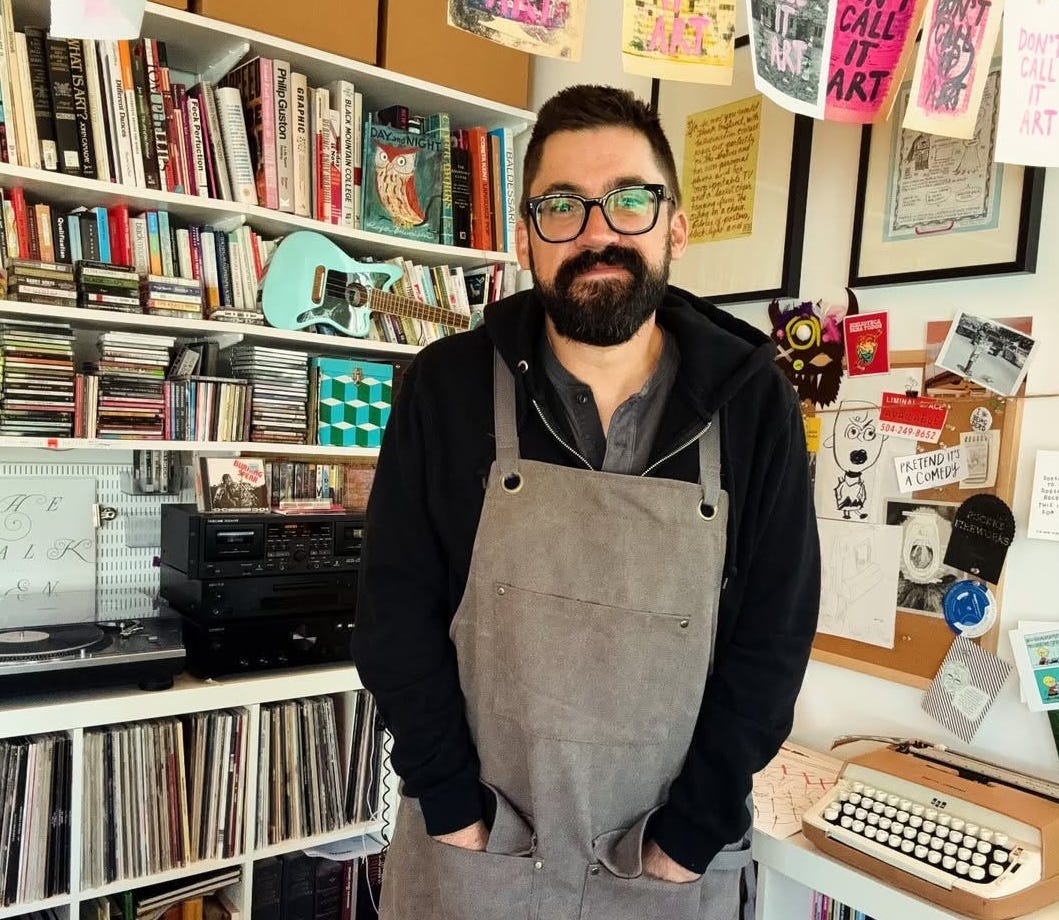
Austin’s writing has been personally meaningful to me at more than one inflection point, and increasingly so as A Reading Life has evolved. What started as a desperate attempt to claw my way back to some intellectual life after being physically and creatively depleted postpartum has grown far beyond what I originally imagined. And throughout that process, I have constantly questioned my right to be doing any of it. The critical voices in my head are NOT quiet and Austin’s work has helped me (keep going) in very concrete ways. He’s the reason I write about books even though I’m not a critic (you don’t have to be a genius), and write about them the way I do (write good stories) — in my own voice and in my imperfect way that if it has any appeal it is because it is mine. And, when I do get in my head, which happens much more frequently than you guys could possibly imagine, I think of a specific reader of this newsletter and (make gifts) write a post specifically to them, clicks and open rates be damned, just writing in a way that I hope will connect for that one person and mean something to them specifically.
Austin is also, for the record, the reason I own a datestamp and begin every day by stamping my notebooks — my work notebook, my personal journal, my junk journal, my commonplace. I genuinely cannot explain why this gives me such distinct joy, but it does. It is one of the main characters of my bliss station.
I love Austin’s work so much… I have been bugging him to do The Reading Life interview since July of 2024!!! And for the longest time he couldn’t (he was deep in a book and needed to stay focused, which I completely understood) but told me to stay in touch. So I kept asking. Austin kept writing. And - guys - as of this week, the book is out.
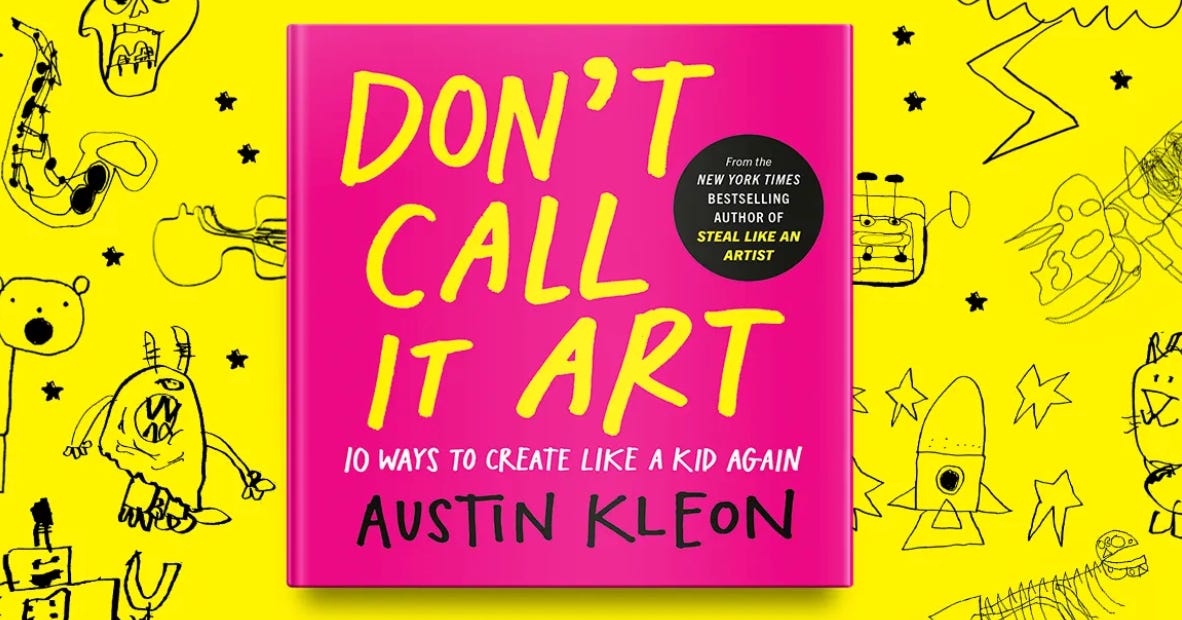
Don’t Call It Art is the fourth book in his artist handbook series, and Austin describes it as:
A creative liberation handbook of art lessons I learned while being a studio assistant to my two young boys.
In his characteristically light-handed way, he has written something that feels, to me, quietly radical and profound. This book is a warning against spending too much time self-mythologizing and performing a creative identity — for the algorithms, for an audience, for ourselves. Doing so unintentionally can put up walls between ourselves and the actual work we need to be doing. The antidote Austin proposes is not discipline or ambition but play: unserious, unlabeled, imperfect making. The idea is that when we stop trying to produce something worthy of our self-image, we create the conditions where real work — surprising, alive, authentic — becomes possible again.
Today, with very little further ado, I am beyond excited to share Austin Kleon’s responses to The Reading Life questionnaire. P.S. All images in the post are used with Austin’s explicit permission.

What are you reading right now?
I’m reading Larry McMurtry’s Lonesome Dove for the second time. I first read it over the 2010-2011 holiday break, so it’s been, oh 15 years? I believe that every time you pick up a book you’re a different person than you were the last time, so it becomes a new book. This time around, I’m struck by how many of McMurtry’s influences I’ve read since then — specifically Don Quixote and Tolstoy’s gigantic novels — and how much more I understand the Stoic/Epicurean tensions that McMurtry highlights in his introduction to the anniversary edition. It’s got stuff that’s as bloody and horrific as McCarthy’s Blood Meridian (which came out the same year!!) but it’s also funny and fun to read. It’s a great book, a classic, a genuine page-turner. I might read it again in 15 years.
On an average week, how much do you read and when?
I couldn’t really say, as it varies greatly depending on the season. I like to read non-fiction in print with a pencil in the morning or afternoon and fiction every night on my e=reader before bed. (Non-fiction wakes me up, fiction puts me into the dream state.)
I read a lot in the summer when the kids are off school. Around 3PM I get into our pool and with a book and just float around and read until dinnertime. Summer is when I tend to tackle big books — I’ve read Don Quixote, Dune, Middlemarch, William James’ The Varieties of Religious Experience, Iain McGilchrist’s massive books, etc.
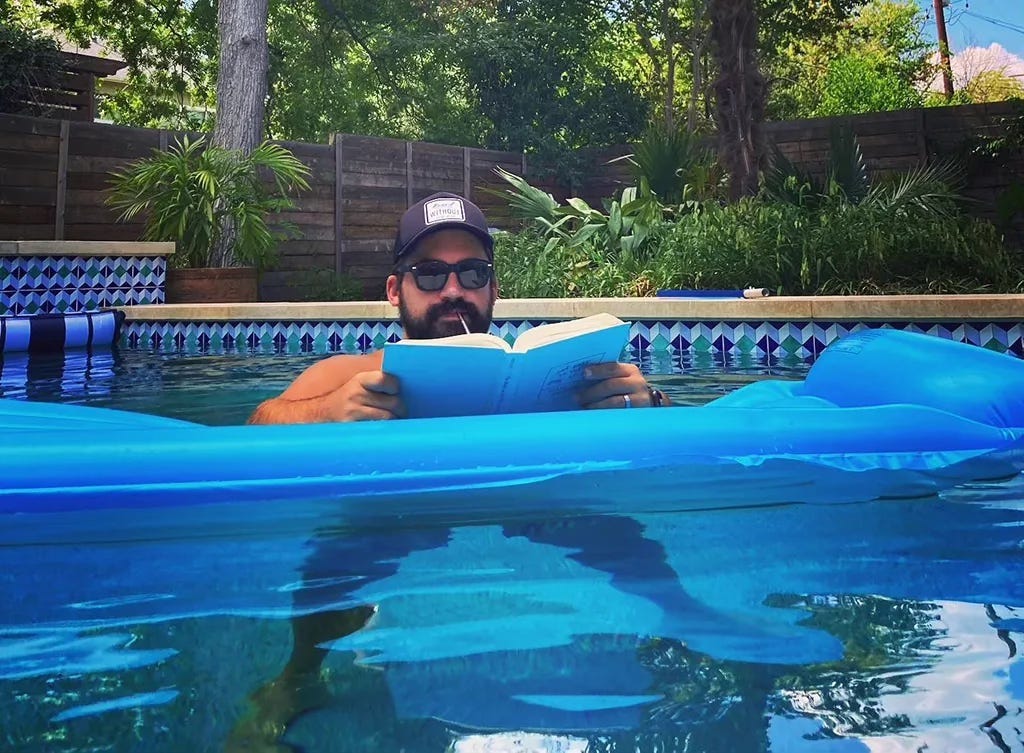
You can tell which books on my shelf got read in the pool because they’re warped from being waterlogged.
How do intense personal or professional periods affect your ability to read?
When I’m writing, I need something really escapist and different from the material I’m working on. I often find that my depression is usually correlated with my inability to find something good to read. (For example, it’s hard for me to be too depressed when I’m reading Lonesome Dove.)
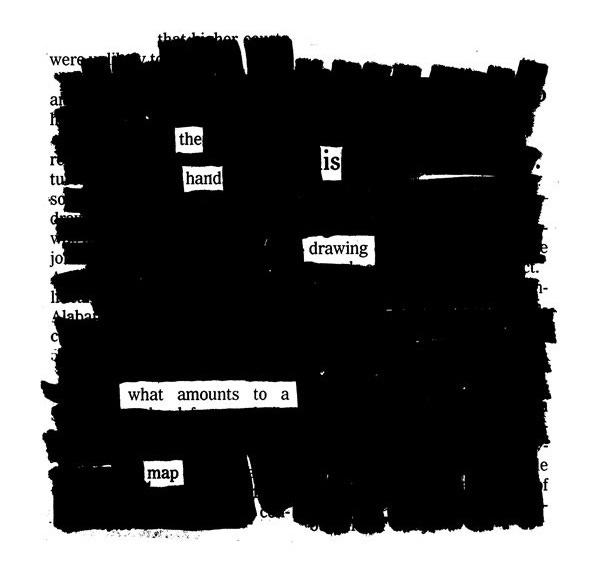
I find that as the world loses its mind, I want to spend time with people in the past who kept their heads. For most of the past winter I read a dozen pages of Montaigne’s Essays in the morning, and a Sherlock Holmes story every night. It was wonderful. Mark Slutsky has this idea of “good-handedness” in a book, the feeling you’re in good hands. (Although, I would guess that the good-handedness of a book depends on the hands that are holding it.)
What do you like to read? How has your taste changed over the years?
Hell, I don’t know. [Laughing.] I’m like Alice in Wonderland, in that I am biased towards books with pictures, and often think, “What is the use of a book without pictures?” Graphic novels and comics, sure, but what I really love are big ol’ collections of newspaper strips, like Schulz’s Peanuts, Bushmiller’s Nancy, or Jannson’s Moomin. (In another life I would’ve liked to be a cartoonist.) I love the Quentin Fiore paperbacks from the 60s and 70s, the heavily-designed stuff like Marshall McLuhan’s The Medium is the Massage. I love books where the illustrations act as punctuation and help tell the story, like Vonnegut’s Breakfast of Champions, or more recently, Sally Mann’s Hold Still or Tamara Shopsin’s Arbitrary Stupid Goal. I think Lynda Barry’s What It Is is probably my favorite book of the 21st century.
PKG: Our household is also totally and completely obsessed with the Moomins and Tove Jannson. I just recently acquired her biography — Tove Jansson: Life, Art, Words by Boel Westin and can’t wait to dig in. She is incredible.
But if a book doesn’t have pictures in it, I’d prefer its author to write great sentences and have a sense of humor. I have a hard time with humorless stuff. I’ve read all of Charles Portis’s novels 2-3 times. I love Tim Kreider’s essays.
Oh, and I love books about music and musicians, especially oral histories, like Please Kill Me and Meet Me in the Bathroom. I’ve read, like, ten books about the Beatles, but I’ll read about anybody, too: I’m not a gigantic fan of Van Halen, but I’ve read 3 books about them.
What’s a reading ritual or habit you’ve developed that’s unique to you?
I actually read myself a lot? Not my books, but I have a little sidebar on my blog that has a list of posts that were published “on this date,” and I’ll try to read those every day, just to refresh my mind about the kind of material I have. I often re-read my diaries “on this date,” as well — 2026 feels a lot like 2018 to me, so I’ve been checking in with myself, reminding myself what it is to go crazy, and trying not to go there again.
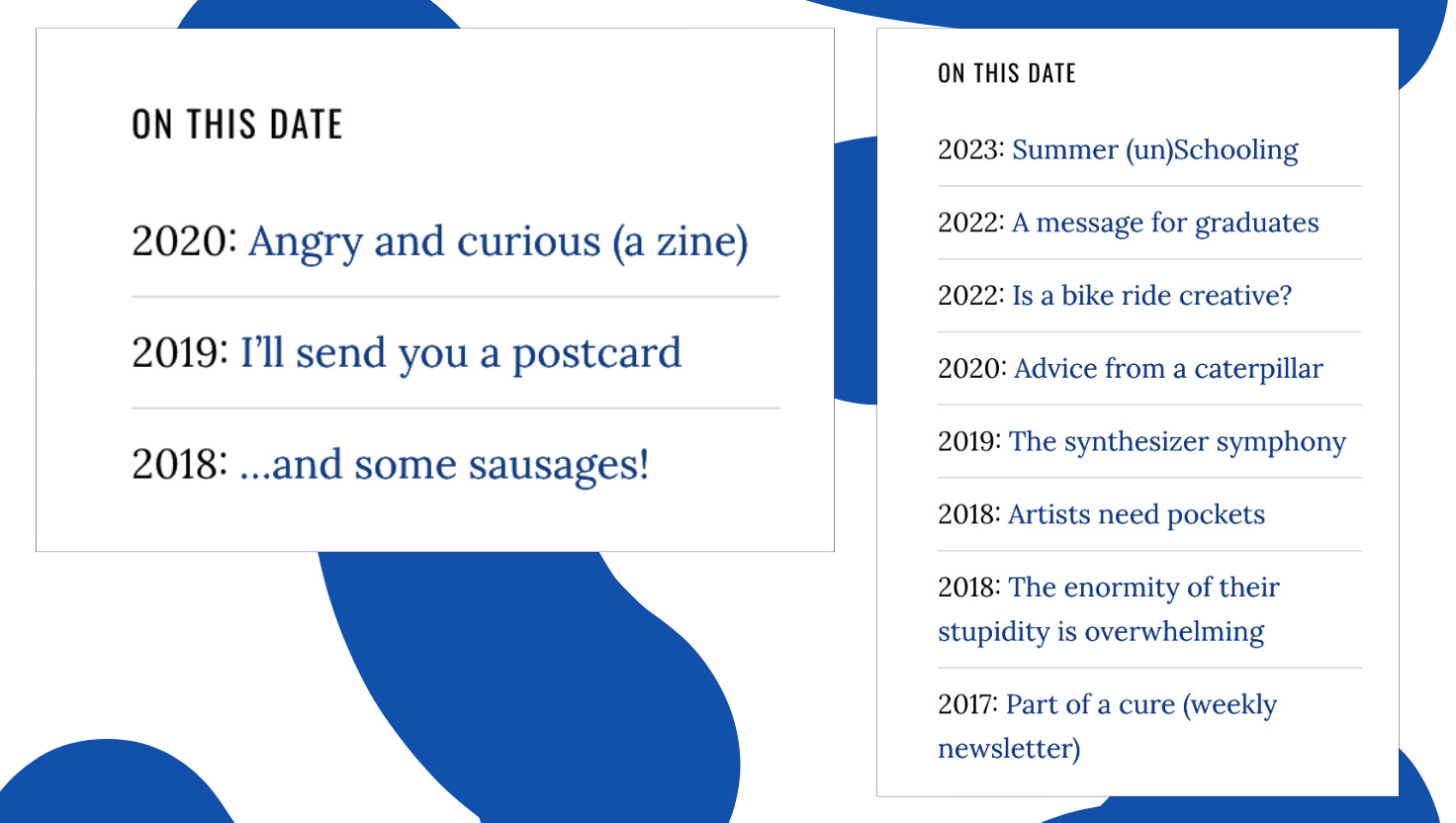
When you re-read yourself this way, you detect a lot of patterns and find that you have your own seasons. (I learned to do this by reading Thoreau’s abridged journal every day with little sticky notes on the days in each year that were closest to the current month and day. I went through the book twice doing that and learned a ton, about Thoreau, and about what it’s like to keep track of yourself.)
Do you take notes while you read? If yes, are you particular about your materials - notebooks, pens, highlighters vs. pencils, etc?
I always read paper books with a pencil — the usual marginalia: I underline, I scribble notes to myself, sometimes I get bored and doodle. I dog-ear, too, when a passage is particularly great and I know I want to go back to it. I highlight a lot on my e-reader. I try to go back through the books and copy the highlights into a big quote file, but I’m lazy, so not that often.
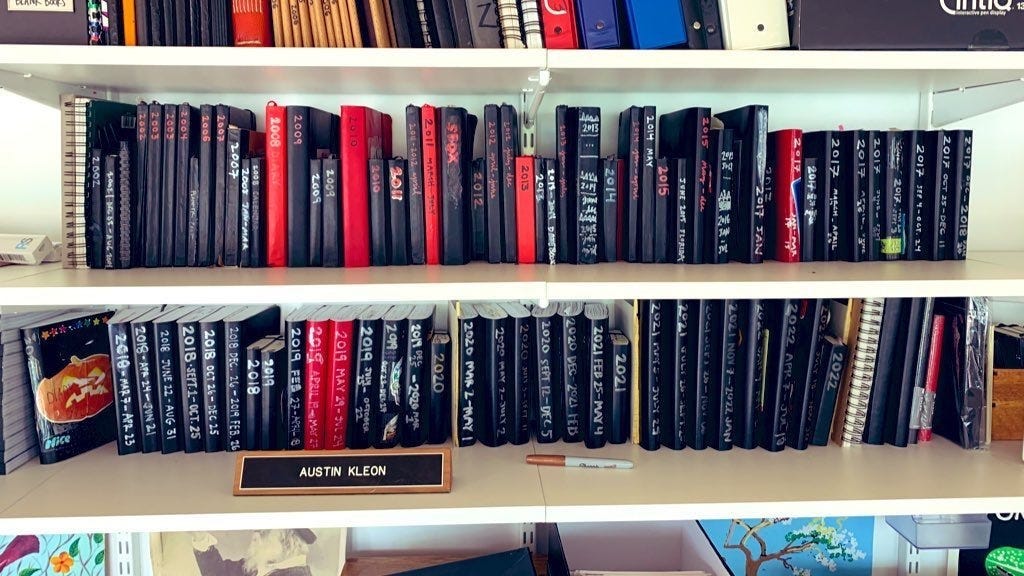
PKG: We have to take a moment and take in Austin’s notebook shelf. How beautiful is this? For the notebook fiends in our midst, be sure to take a look at Austin’s break down of his notebook ecosystem on Jillian Hess’ newsletter - Noted.
How do you keep track of what you want to read?
In my noodle. [Taps forehead.] Usually by buying the book — you can expense books on your taxes when you’re a writer, which is as good a case for being a writer as any, I think.
How do you decide what to read next? Are you a mood-reader or a planner?
I aspire to reading like a DJ builds a setlist, letting the last book lead smoothly into the next. Sometimes that’s easy and direct: I picked up Bernard Suits’ The Grasshopper because C. Thi Nguyen brings it up so much in his books like The Score. Sometimes when I’m reading I’ll note down books the author mentions that sound good on the back flap and pick one of those when I’m finished.
But usually it’s haphazard and random. I believe in my friend Alan Jacob’s dictum: “Read at whim!”
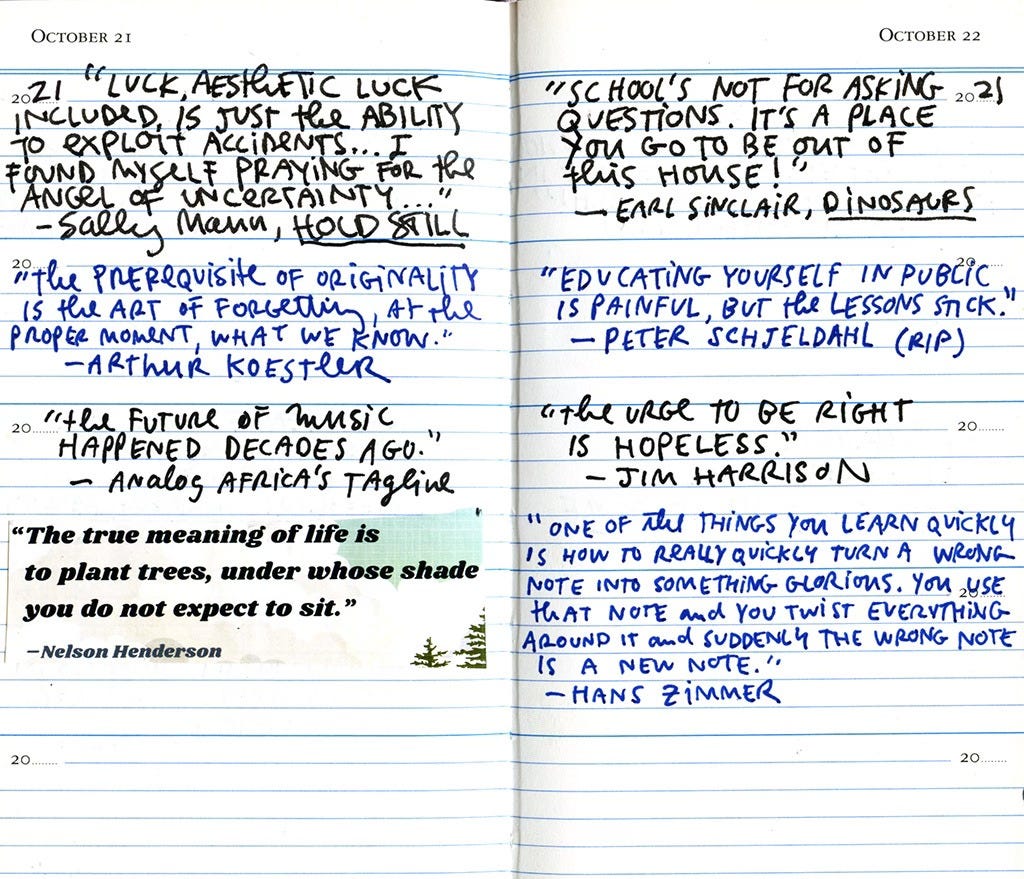
When people ask me how come I read as much as I do, I frequently just give them a list of things that I don’t do as regularly as I probably should: exercise, clean house, spend time with friends. What do you choose NOT to do in favour of reading?
If you keep your phone out of arm’s reach, you get done what you want to get done. I leave my phone in the kitchen when I go to bed and I leave it in my studio when I go out to get in the pool. Those are about the only reliable times I get reading done.
I’m not a particularly fast reader and I don’t actually think I read all that much. I just do it every day. Same with writing: I don’t think I write all that much, but I show up week after week and the days pile up.
What is one book that you find yourself recommending to people over and over and over again?
This may sound shocking, but I don’t really like recommending books to people! I also don’t like foisting books on people (except for my own) and I don’t really love it when people foist books on me. What I love is when people just talk about books they love. That’s what I do in the newsletter, and that’s what I’ve done in this interview, I hope.

Austin’s answers are, characteristically, full of warmth, specificity, and the kind of practical wisdom that makes you want to go read / write / make something something immediately. I’ll hope you do just that but before you go…
Austin describes reading himself — revisiting his old blog posts and diaries “on this date” — as a way of tracking his own patterns and seasons. Do you have any version of this practice? What would it mean to read yourself as a reader?
Austin says he doesn’t like recommending books — he’d rather just talk about books he loves. What’s the difference, for you, between a recommendation and simply sharing enthusiasm? Do you agree with his distinction?
Austin reads non-fiction in the morning to wake up and fiction at night to ease into dream-state. Do you match what you read to the time of day or your mental state — and has that ever changed how a book landed for you?
Comments
Nothing yet. Say the first thing.
Sign in to join the conversation.