
I found Weaponized Lies sitting on my bookshelf and don’t remember how it got there or how long it had been there.
The title made me expect something more intense and dramatic. Instead, the book is a practical guide to questioning the statistics, headlines, expert opinions and confident conclusions we encounter every day.
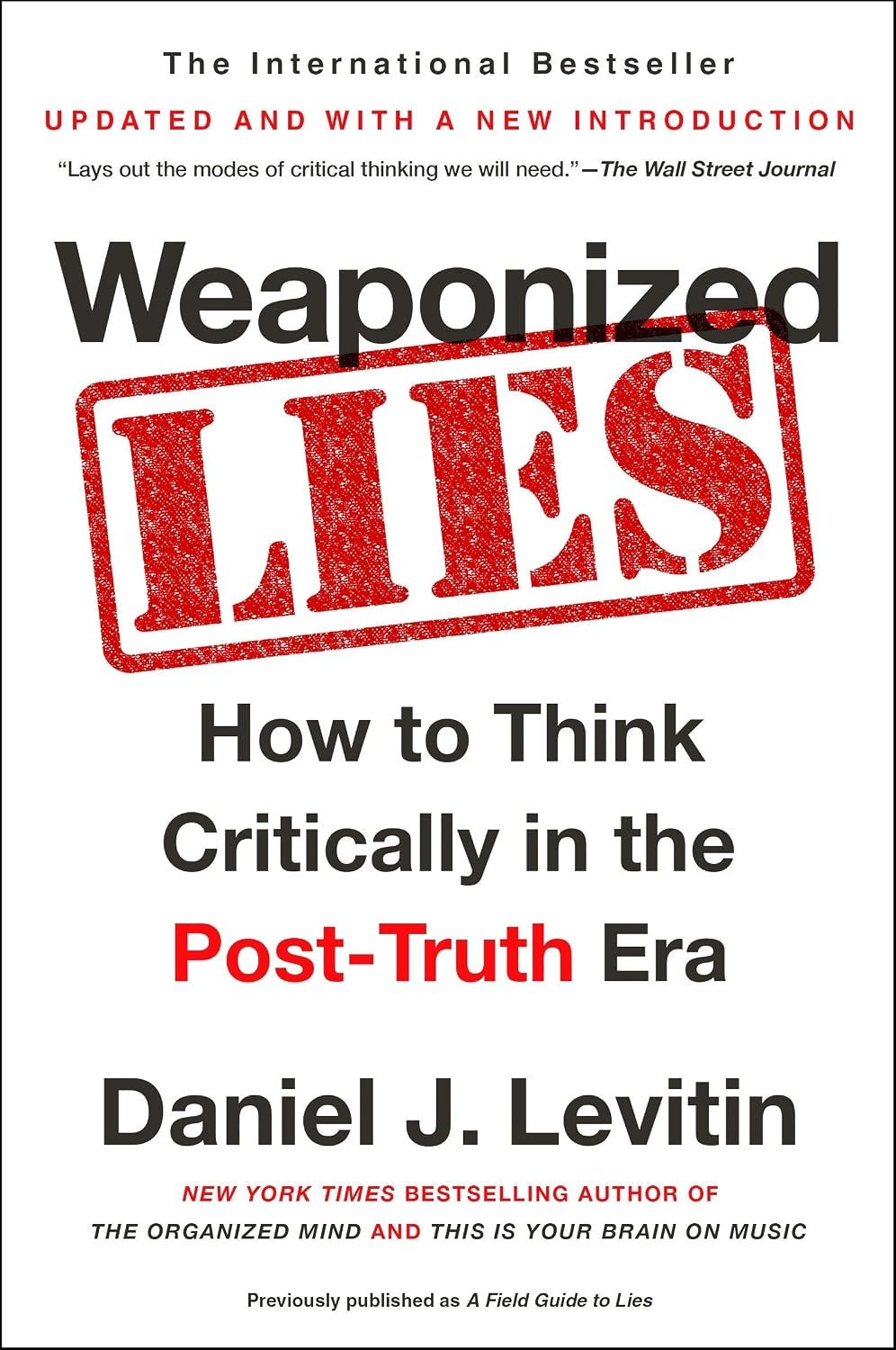
One of the bigger points in the book is that statistics are not automatically facts and can be full of our typical bias. People decide who gets counted, what gets measured, which results are shared and influence how those results are interpreted.
As Levitin puts it:
Statistics are not facts. They are interpretations.
He reminds the reader that context to the statistics matters. Your probability of finding someone who is six feet six inches tall is much higher near a basketball court than within the general population. The group being measured and where they are measured can completely change the result. So, it’s not necessarily that the statistic is wrong. We just need to question how they got there. It also makes you think of who is included and not included in research data.
I like how he talks about relying on anecdotes. As he puts it “the plural of anecdote is not data.” You can cherry-pick examples to support almost anything, but that doesn’t mean it’s what normally happens.
Another good reminder is that expertise is narrow. Someone being skilled or successful in one area does not automatically make them an authority in another. How many times have you heard people ask Buffett for life advice. lol.
One of the more interesting sections critiques Malcolm Gladwell’s arguments that some people with a disorder (in this case dyslexia) may gain an advantage because they are forced to develop skills such as delegation, communication and problem-solving due to having the disorder in our world. As Levitin points out that focusing on successful people who overcame dyslexia introduces survivorship and selection bias. Developing skills to compensate for a disorder does not necessarily mean the disorder itself was beneficial. We all like to believe we are better because we overcame something. But that does not mean we are better because we have it or something happened to us.
The book also covers how easily risk can be framed as a scare tactic and can be used to drive a narrative that may not be true. More people may have died in plane crashes in 2014 than in 1960, but far more people were also flying. Looking at deaths per mile flown produces a very different conclusion. This is the type of thing I feel is present in much of our everyday lives.
I would have appreciated more real examples of him dissecting a specific misleading headline, study or cultural belief. I particularly enjoyed when the book challenged Gladwell’s argument and would have liked more examples of him picking apart arguments from popular people. I mean, we have enough people online with opinions. I’m sure some of them are misleading.
I also would have liked more on influencers and how to avoid getting sucked into some of the conclusions they make online.
By the end, I felt a bit defeated and ready to question everything put in front of me. I was getting a bit of a “why bother believing anything” vibe. But that was just me. Overall, I enjoyed Weaponized Lies.
The author does a good job giving you the tools to question the information put in front of you, and there are plenty of real-life examples he walks through.
Critical thinking is vastly underappreciated, and it is something we should all strive to improve—especially as we increasingly look to offload our cognitive tasks to AI.
Rating: 8/10
If you read this book or something else interesting lately, let me know.
Thanks for reading my work.
Dean
Comments
Nothing yet. Say the first thing.
Sign in to join the conversation.