
I have had Our Emperors Have No Clothes sitting on my bookshelf for more than a decade. I’m pretty sure I read it eight or ten years ago, but that was before I started taking notes on the books I read (or at least keeping the notes in one place). Since I remembered almost nothing about it, I figured I would give it another go.
The book was written in the early 1990s and brings an interesting perspective from that time.
Some things have aged well and some not so well. Weiss predicted technology allowing us to download movies directly to our TVs and work remotely while travelling.
He also spends a lot of time advocating for diversity. Dude was woke before it was cool.
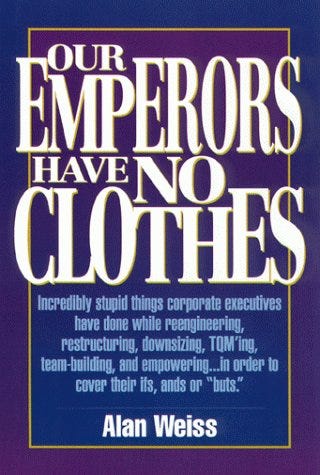
Weiss advocates for clear, rational thinking and believes management should spend less time chasing fads and more time focusing on fundamentals.
The root cause of many business failures, according to him, is: “Stupid management.”
He identifies buzzwords that were popular at the time that should have you on high alert:
Left brain/right brain
Time management
Continuous Process Improvement
Total Quality Management
Restructuring
Downsizing
Empowerment
Reengineering
Personality styles
Weiss is also a big believer in management being involved in the actual day-to-day operation of the business. It reminded me of Gemba: go to where the work is being done.
He says that employees don’t really care what management says. They pay attention to what management does and what behaviours get rewarded.
He also directly identified reasons why employees don’t change. Among the reasons:
People are rewarded for doing what has always been done.
People are punished for trying something new.
Performance isn’t linked to reward.
Organizations measure safe—but stupid—things.
Obstacles to performance aren’t discussed.
Skill problems and attitude problems are treated like the same thing.
Something I agreed with was the requirements for success is almost any profession:
Read with comprehension.
Write with expression.
Speak with persuasion.
Listen with discernment.
He also makes some points around agency that I largely agree with. We get what we tolerate.
The bigger problem with the book is that Weiss spends a ton of time telling you what’s wrong with management without providing many detailed examples of what good management actually looks like.
There is plenty of: This is stupid. Management shouldn’t do this. Companies are doing this wrong.
There isn’t nearly enough: Here is a great company. Here is what its managers do differently. Here are the systems that make it work.
He also seems overly critical of management when companies take risks that don’t work out. The point is fair to an extent, but having more responsibility in a role means that the consequences are larger. It’s part of doing business. Some projects fail. Some investments don’t work. Sometimes reasonable decisions have bad outcomes. That doesn’t automatically mean management is stupid.
He makes favourable references to unions without providing much evidence for why they improve organizations. He repeatedly references superior Japanese management without much detail. And he relies heavily on anecdotes and survey data.
I also got tired of the repetition. Diversity. Long-term thinking. Less complacency. Less downsizing. Less stupid management. Got it. Moving on.
The book was kind of meh. There are some good ideas in it, and it’s interesting how many of Weiss’s observations still feel relevant more than 30 years later.
But it spends roughly 250 pages explaining what’s wrong with management without spending nearly enough time showing what great management actually looks like.
The whole thing gives off serious consultant vibes. Which makes sense. Alan Weiss is a consultant. It feels a little like someone getting hired, walking into a company, pointing out everything they’re doing wrong, throwing out some surface-level solutions and motivational quotes, and then leaving without having to live with the consequences. The more experience I get on this path, the more Munger’s general distaste for consultants resonates with me.
I could see a younger and more naive version of myself enjoying this book more. The armchair quarterback of management. My perspective over 40, with some grey hair and a few battle scars, is less sympathetic.
Organizations are complicated. Management is complicated. And pointing out everything that’s wrong is much easier than having to do the work to fix it.
5/10
If you read this book and have a different perspective, I would love to hear about it.
Thanks for reading my work.
Dean
Comments
Nothing yet. Say the first thing.
Sign in to join the conversation.