
Team,
This is my TV debut of the Great Transshipment Scam report with Lisa Abramowicz and Annmarie Hordern on Bloomberg.
I also introduced the report in a New York Times op-ed, which you can read HERE.
And I strongly encourage you to read the 24-page report from my office HERE.
The report details the Great Transshipment Scam—involving a Shadow Transshipment Network of more than 40 countries through which China’s tariff evasion moves—and our ongoing work to stop it.
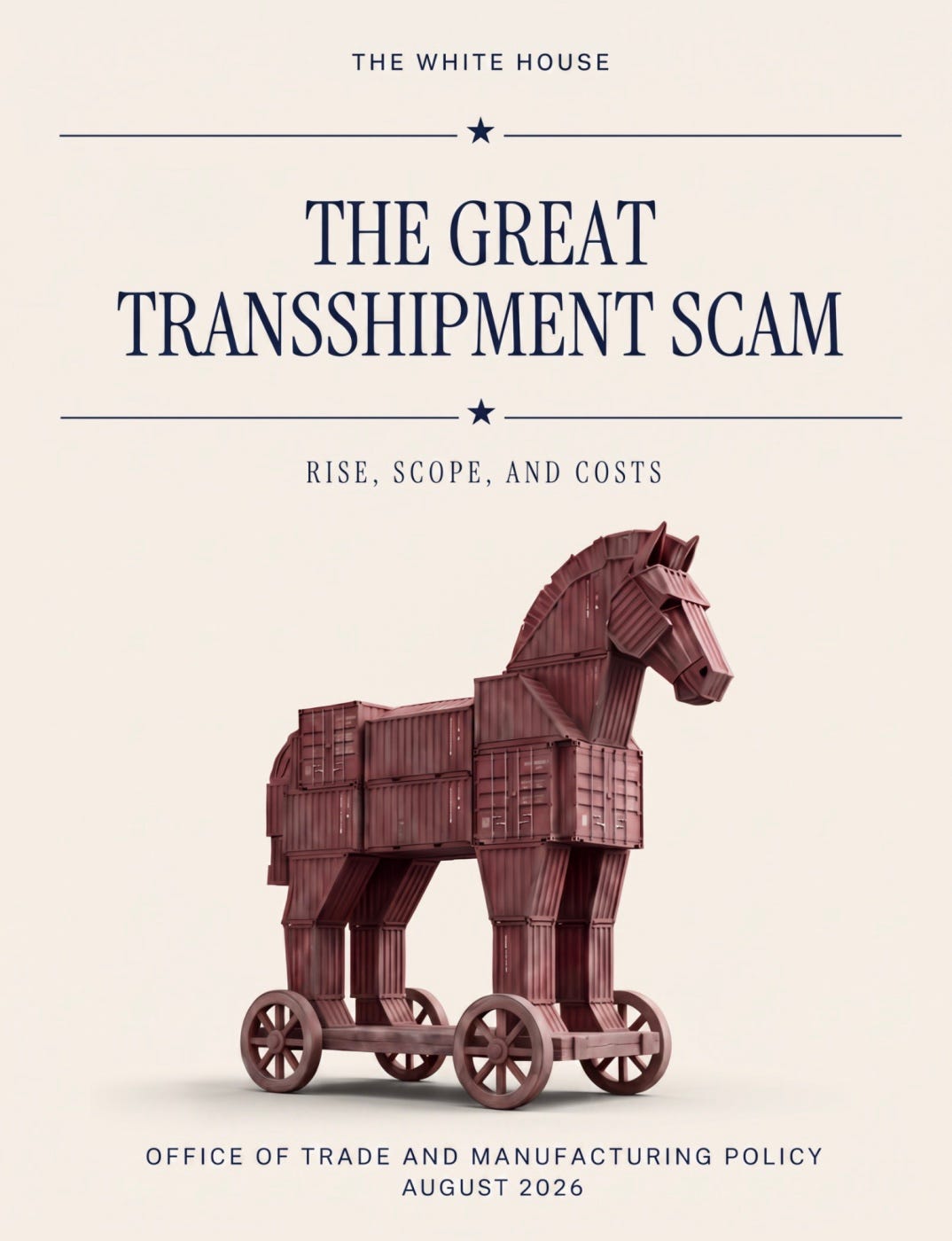
My job at the White House, going back to the first term and the first day, is to protect American workers and businesses from predatory mercantilist practices. And China leads the list when it comes to that.
Back in 2018, during the first Trump Administration, we placed Section 301 tariffs on China to protect American workers, and it has been a very successful policy.
But what happened, beginning immediately in 2018, is that China began to develop methods of transshipping, which is basically a modern form of smuggling.
The crudest form of transshipping is when China takes a crate of widgets, sends them to Vietnam or Mexico or Turkey or another third country, and then fraudulently swaps country-of-origin labels so that the products enter America at the lower tariff rate the U.S. applies to the third country.
China makes out like the globally recognized bandit it is, the transshipping third country makes out because it’s facilitating some commerce, and the U.S. gets cheated out of jobs and Treasury revenue.
I’ve taken this very seriously over the years, and have been working very closely with Customs and Border Protection (CBP). We are cracking down on this.
What’s really interesting is the new AI Detective Border that we’re developing at CBP. In the past, transshipment has been policed through paperwork and people. And they’ve been overwhelmed by the flood of tariff evasion in an era of Trump tariffs.
What AI can do with the new Detective Border—and with a fantastic company we’re working with called Exiger—is see in real time every boat and every container coming from every port in the world. And what we can do with AI at the ‘speed of scam’ is assess with a very high degree of accuracy the probability that a given shipment is a transshipment.
For shipments identified as probable transshipments, as soon as the boat arrives at a U.S. port, we slap them with a Form 28, which is a formal CBP request for information to check if the shipment follows U.S. trade laws. Then, the shipment will likely be hit with a Form 29, which is a notice of enforcement. And trade enforcement action will be taken to collect the revenues that the transshippers cheated us out of.
This is a revolution in trade enforcement.
It’s amazing how many countries—more than 40, big and small—are part of the Shadow Transshipment Network.
Mexico is one of the biggest members of the network, and they have been able to send transshipped goods into the U.S. duty-free through deceit, using the USMCA agreement.
India is very much on the radar screen.
And Southeast Asia—including Vietnam, Cambodia, Malaysia, and Indonesia—is the motherlode of the entire Shadow Transshipment Network, as you might expect.
By continuing to lie and steal, China is just being China. The world has long known that’s who they are.
The best way to crack down on the Great Transshipment Scam is going after the enablers.
It starts with our great U.S. Trade Representative Jamieson Greer and the new trade deals that we are negotiating.
We are systematically negotiating new deals one by one with countries that want to have U.S. tariffs lowered on their products. The way they may be able to have that happen is by lowering their own barriers and not cheating.
And every new trade agreement has a transshipment provision, which basically says that if the given country participates in the Great Transshipment Scam and continues to be part of the Shadow Transshipment Network, it will pay a very heavy price.
Countries are going to understand very quickly that if they cheat, we’ll catch them, and they will pay that heavy price. And once they realize that, they won’t do it.
This is a warning to the world: Don’t try to cheat America.
Our multi-pronged strategy involves President Trump’s recent Customs Enforcement executive order, which dramatically increases the teeth that CBP has to crack down on transshipment.
It involves arming CBP with the new AI Detective Border, which has off-the-chart hit rates of over 95% accuracy in transshipment detection.
And it involves new country-by-country bilateral trade deals that include very strong transshipment provisions.
We are doing an amazing number of Section 301 investigations. At the same time, we are doing an amazing number of trade deals.
And we are moving In Trump Time and getting things done.
Tariffs are a very important part of the American tradition in terms of promoting our economic and national security.
We will defend American business.
We will defend American jobs.
And we are stopping the Great Transshipment Scam.
I love reading your comments. Please share this far and wide.
Peter
TRANSCRIPT
LISA ABRAMOWICZ: Senior White House advisor Peter Navarro joins us now. Thank you so much for being with us. I would love to start with a question of what motivated you to write the op-ed that you just wrote and just got published now.
DR. NAVARRO: Thank you so much, Lisa. And I’m happy to give Bloomberg, actually, the exclusive on this. This is the report itself, The Grand Transshipment Scam, and you can download it on the whitehouse.gov site or read the op-ed in the New York Times and you can download it there. My job at the White House, going back to the first term and the first day, is to protect American workers and businesses from predatory mercantilist practices. And, as you know, China leads the list in that category. Back in 2018, Lisa, we put on the historic 301, Section 301 tariffs on China to protect American workers. And it’s been a very successful policy. But what happened, beginning immediately in 2018, is that China strategically began to develop methods of what’s called transshipping. It’s basically a modern form of smuggling. The crudest form of transshipping is when China takes a crate of widgets, sends them over to Vietnam or Mexico or Turkey or wherever, and then they swap labels, it comes into America at the lower tariff rate, China makes out like a bandit, the transshipping third country makes out because it’s facilitating some commerce there, and we get cheated out of jobs and Treasury revenue. So, I’ve taken this very seriously over the years. I’ve been working very closely with Customs and Border Protection, and we’re cracking down. And what’s really interesting is this new AI Detective Border that we’re developing at Customs and Border Protection. In the past, it’s been, basically, paperwork and people. And they’ve been overwhelmed by the flood of tariff evasion in an era of Trump tariffs. And what AI can do with this Detective Border—and one of the companies we’re working with is Exiger, it’s a fantastic company—is we can see in real time every boat and every container coming out in every port in the world. And what we can do with AI at the ‘speed of scam’ is assess with a very high degree of accuracy the probability that that’s a transshipment. And then what we can do when the boat gets here, we slap them with a Form 28, and then of likely a Form 29, and collect the revenues that they cheated us out of. And it’s a revolution.
ANNMARIE HORDERN: Peter, we know this is happening because—
DR. NAVARRO: Yeah. Go ahead.
HORDERN: —because the Chinese trade deficit is falling, but trade flows are staying stable. So, it shows that China is doubling down on transshipment. But is there appetite from this Administration to go after Beijing for this, given that there is a debate within the Oval Office about wanting to make sure that they keep the truce alive and Xi Jinping is set to visit the President?
DR. NAVARRO: You’re looking at the wrong target here. What’s so amazing about this report and my research is it’s not about going after China. It’s about going after the more than 40 countries. And I was surprised by this, frankly. I was surprised how many transshipping countries. It’s going about them, and is there appetite? You damn well there’s appetite. It starts with our great U.S. Trade Representative Jamieson Greer. What we’re doing systematically is negotiating these new deals one by one with countries that want to basically get their tariffs lowered and do that by lowering their own barriers and not cheating. And so every new trade agreement actually has a transshipment provision, which basically says if that country participates in the Grand Transshipment Game, if it continues to be part of the Shadow Transshipment Network, it will pay a very heavy price. And so, the crackdown, we understand—look, China’s just being China, okay? And shame on America, shame on the Biden regime for not cracking down on this. Okay? But the way to crack down on it is not going after China, it’s going after the enablers. And what’s so interesting about this whole thing is—I got a doctorate in economics and part of my thing was industrial organization and strategy. I mean, the complexity of the strategies that China is using to evade these tariffs is mind-numbing. I mean, literally over 40 countries are involved, big and small. Surprisingly, Mexico is one of the biggest ones. They’re able to basically get the USMCA tariffs through deceit.
ABRAMOWICZ: Hold on a second, Peter.
DR. NAVARRO: India is well on the radar screen. You wouldn’t think that. And then Southeast Asia is kind of the motherlode of the whole thing, as you might expect. Vietnam, Cambodia, Malaysia, Indonesia, and so on.
ABRAMOWICZ: Yeah.
DR. NAVARRO: Go ahead.
ABRAMOWICZ: When I was reading this report and when I was reading your op-ed, one thing that stuck out to me was that the U.S. is currently ongoing with negotiations to renegotiate USMCA with Canada and Mexico. And you pinpointed Mexico and Canada as some of the offenders. How does this affect negotiations? Does it make it less likely, frankly, that there will be some sort of new deal that is solidified in the near term?
DR. NAVARRO: No, it makes it more likely that any deal that’s done will have a transshipment provision in it, a very strong one. And again, I want to emphasize here, this is basically a warning to the world. Don’t try to cheat America. And our multi-pronged strategy basically involves, first of all, the President signed a new executive order last month that dramatically increases the teeth that Customs and Border [Protection] has in terms of cracking down on this kind of transshipment. So, that’s number one. Number two, we’re also arming them with this Detective Border. And by the way, we’re hitting like over 95-percent hit rates in terms of accuracy, in terms of identifying transshippers. And that’s off the charts. And then the third part of this approach we take is with the United States Trade Representative. Every deal that we make, and we’re making a lot of good deals for America, has a very strong transshipment provision in it.
So, we’re going to put a stop to that. And countries are going to understand that very quickly that if they cheat, we’ll catch them. And if we catch them, then they’ll pay a very heavy price. And once they realize that, they won’t do it.
HORDERN: Peter, we’re up against the clock.
DR. NAVARRO: Go ahead.
HORDERN: And I just wanted to squeeze this in. Why has the overcapacity [Section] 301 [report] not been published yet?
DR. NAVARRO: I don’t see Jamieson Greer on the set. He’ll come here any time you want and answer that.
HORDERN: Well, he’s your colleague, so maybe you can get us an update on that.
DR. NAVARRO: But I’ll tell you this. I can tell you this. We are doing an amazing amount of 301s. At the same time, we’re doing an amazing amount of trade deals. And we are moving In Trump Time, and we’re getting stuff done. And even as the news of the day is we’re having to refund tariffs over here because of the Supreme Court decision, what that decision did was basically ratify the legality of [Section] 301, [Section] 232. We’ve got a Section 122, 150-day, 10-percent tariff in place. And tariffs are a very important part of the American tradition in terms of promoting our economic and national security. So, again, everybody out there in Bloomberg land, you’ll find this really interesting as a document. And it’s really a window into the world as to how the financial system and the trading system is adapting in some sense. And it’s in some sense very bad ways to a tariff regime. But we will defend American business. We will defend American jobs. And we’re stopping The Great Transshipment Scam.
ABRAMOWICZ: Peter—
DR. NAVARRO: And I thank Bloomberg for debuting this today.
ABRAMOWICZ: Peter Navarro, thank you so much for spending the time with us, Senior White House Advisor.
DR. NAVARRO: Okay.
Comments
Nothing yet. Say the first thing.
Sign in to join the conversation.