
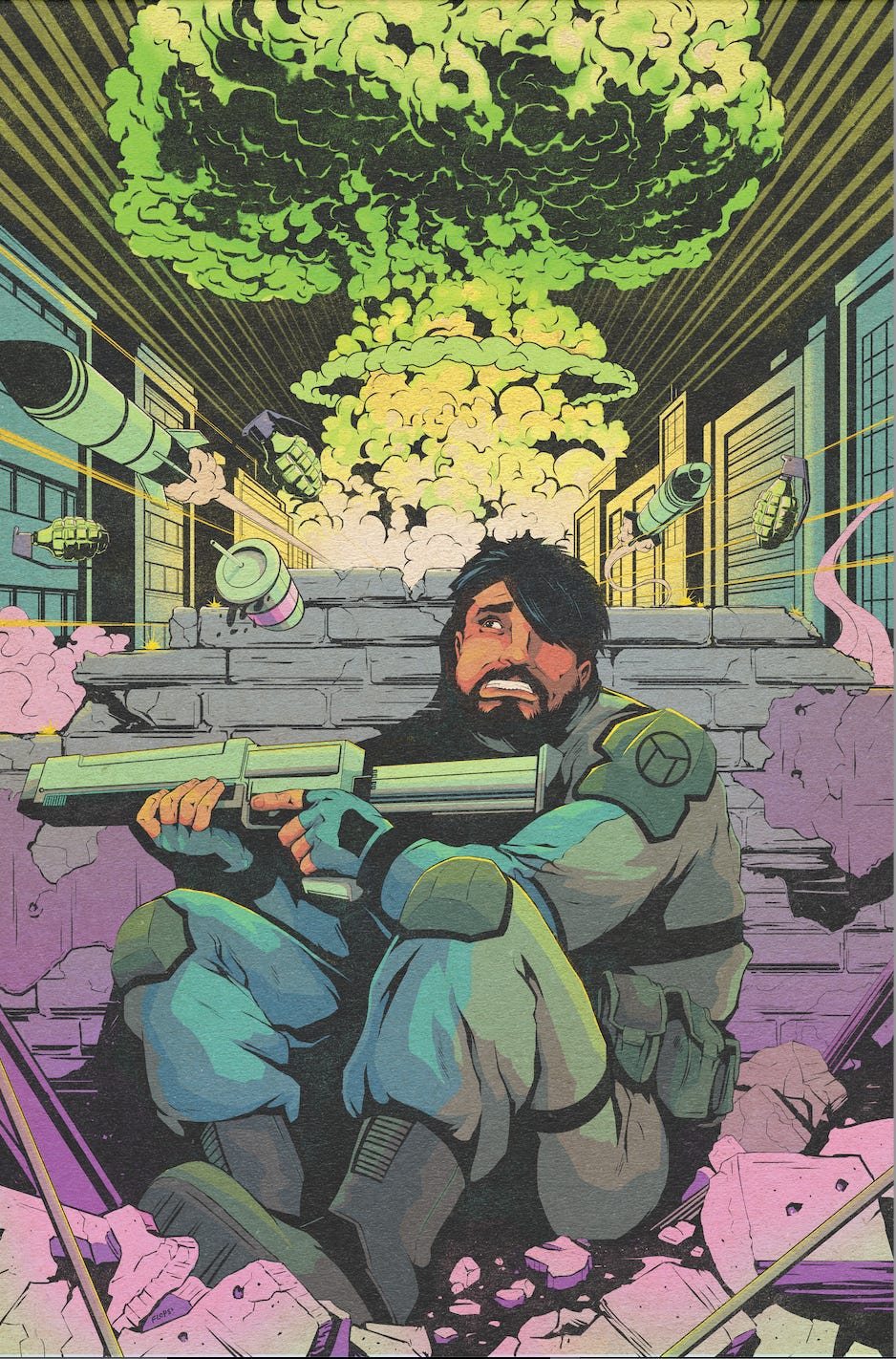
The artist and I just picked our favorite logos for the new comic book.
There were twelve options from the graphics department, and we both chose the same two. That felt good. That was the creative part. Agreement. Instinct. A little jolt of confirmation that the thing we were making looked like the thing we had been imagining.
Then, somewhere in the email thread, the editor mentioned the book might be included in the November solicitations.
Which I think means it comes out in February.
That is the kind of sentence that reminds me how many different clocks are running at the same time. Story time and Life time.
There is the clock inside a story, where everything is urgent and somebody may be chased through a temple or betrayed by their closest friend before a cup of Hot Chocolate at the local place, ATL & EMBER. Things have to keep happening or you don’t have a story. Then there is the clock of making the book, where pages become pencils, pencils become inks, inks become colors, and colors become a thing someone can hold. That has its own set of urgent things, right? Plus the industry clock where November means February. And February means, when can I start showing you artwork and teases and how excited I am about this book? Because in February it will be out in the world.
And that all got me thinking about time. Not time as a thing that passes, but something about time as a structure industries build around us.
When I got started working in television, there was a calendar. It wasn’t necessarily perfect, or kind. It didn’t care about when you slept or what your family wanted you to do, or your blood pressure some days. But it was a calendar. You knew where you were in the year, and everybody else knew too.
June and July were pitching season. The reason for getting out early became clear pretty quickly. Networks were buying in bunches. If they wanted a cop show, they might buy ten or eleven or fifteen cop-show ideas, even if they were ultimately only going to put one or two on the air. You wanted to get out there before those slots got filled.
They were buying shows to create a schedule. A feeling. A flow from one program to the next. The network wanted to know what kind of night it was creating. What kind of audience it was building. What kind of identity it had.
If you sold your cop show in June, the deal might get made in two or three weeks. There was a short-form deal and a long-form deal. The short-form deal was basically the agreement on the principal points, with the understanding that everybody would argue over the nitty-gritty later, probably if the show got picked up.
And no show in that giant bunch of shows was guaranteed to get picked up.
The summer ended. The fall started. You were outlining, writing, taking notes, thinking about actors, thinking about directors, thinking about what the show was becoming. And then the network launched its fall schedule.
This was back when networks launched their schedules in September, right after Labor Day. The TV Guide at the grocery store was thick during those first weeks. It had all the new shows, little articles about what was worth watching, who was in what, what time everything was on, and why this season was going to be different from every season before it.
And then the ratings started coming in. That was when the calendar got interesting.
The show everybody had been excited about in June might look very different by the end of September. Maybe all the network’s cop shows were succeeding beyond anyone’s expectations.
“Oh my God,” they might say. “We don’t need another cop show. What we need are lawyer shows. We didn’t buy enough lawyer shows.”
And there you were, deep into your first draft of a cop show, trying to figure out whether your network’s success was good news or bad news for you.
Because you wanted the network to succeed. If the network succeeded, your show had a better chance of succeeding. But if every show on the network succeeded, then there were fewer holes to fill.
You were rooting for the team, but also watching for the team’s weaknesses.
This was before you could immediately look up every rating number yourself. There was an early website called TV Tattle that helped, but generally, you were getting information through the grapevine.
You were a creator, but you also had to pay attention to the business. You wanted to pretend you did not care about the business, because caring too much about the business could interfere with the work. But the business was sitting in the room with you anyway.
Then came the notes. And the notes had their own time dance.
Thanksgiving was coming. Christmas was coming. The people who were giving you notes wanted you to have time to work over the holidays, so you might get notes and turn the draft around quick, hoping you’d get a break for a holiday while they read and consulted each other. But they wanted a break for the holidays, too, right? Makes sense.
And that was another construction of time. A holiday weekend. I remember a family holiday in Hawaii that had me going to a café in the morning to write and then checking in with the family after lunch to see what fun they were up to. In either case, lots of people working hard, reading, giving notes, processing, writing new drafts.
Then January arrived. Sometime in January was when the networks decided which of the ideas they had bought, and which of the scripts they had developed, they were actually going to shoot as pilots.
That cop show you sold the idea of in June, maybe you were one of 12 or 13 cop show ideas the network bought. Maybe they were going to shoot two. Maybe four.
You were now in a lottery. Long odds, but also things you couldn’t count on, or do much about. That’s what I mean by lottery. You just do your best and hope.
You were thinking about timing again.
When would your project reach the head decision-maker? What had already happened in the room? What mood were they in? Who was going to advocate for you? Was there someone in that meeting willing to stand up and say, “No, we have to do this one”?
That person mattered. A strong advocate could change the calendar of your life.
And if you got picked, you went into another cycle. Casting. Hiring a director. Finding stage space. Finding crew. Shooting. Editing. Finishing the pilot and getting it back to the same people who had bought the idea and ordered the script.
You were now competing for stages, which feels strange to think about in 2026, when you can fall out of bed and land on an empty soundstage somewhere in Los Angeles.
But back then, stages were part of the calendar too. You needed one at the right time. You needed time to shoot and time to edit. The network had to screen all its pilots before deciding what it wanted to put on the fall schedule.
And then, in May, you found out. May was when the networks held their upfront presentations in New York. This was the big roadshow for advertisers. Here are all our new shows. Here are all the stars. Here is why our network is better than everybody else’s network. Here is why you should buy commercials from us.
David Letterman emceed the CBS presentation. Jimmy Kimmel did ABC. Fallon did NBC. Later, Colbert did CBS. The faces changed, but the ritual remained.
And after that, the cycle started over.
If your show was picked up, you had to hire writers and start breaking episodes for the order. You were writing through the summer, while the network was also buying new ideas to replace your show if it did not work.
There were a very few times when I was working on a show for a network and also selling another show to that same network in June.
What was I doing? Hedging my bet? Putting money on 7-11 at the table and also putting a few chips on number 9 just in case? I don’t know. But that was the rhythm.
That was how you lived. The calendar was stressful and arbitrary at times. It was not a golden age for everybody. But it was legible. A map and a compass.
You knew what June meant. You knew what September meant. You knew why January mattered and why May mattered. You knew where you were in the cycle, even if you did not know whether the cycle was going to carry you forward or drop you through a trapdoor.
The comic book industry has its own clock, and I am learning it now.
The artist and I pick the logos. The pages move through their stages. The editor mentions November solicitations. November means February. There is a whole system operating behind that one sentence, and I am still figuring out where I am inside it.
At the same time, television has developed a very different relationship to time.
The old cycle has been disrupted. Seasons are shorter. Six episodes might be separated by two or three years. A show can disappear just as the audience is learning how to love it. The rhythm between episodes is broken. The relationship between a show and its audience gets harder to maintain. There is no flow. Or at least, there is no shared flow in the old sense.
A television network had an identity that could be built across an evening. One show led into another. You could feel the network trying to create a kind of neighborhood. You knew what it meant to watch NBC on Thursday night, or CBS on a Sunday, or ABC on Fridays.
Now some platforms are still trying to figure out what they are. Is Peacock a place for sports? Comedy? Prestige? Old shows? New shows? What does the brand promise? What does it mean to go there? That is not just a marketing problem. It is a time problem. And it happens with new things. The WB network didn’t just land on being the network of YA in its heyday. It had to try all sorts of things to find itself.
But in streaming, if a show arrives in six-episode bursts separated by years, it does not have enough continuity to create a dependable rhythm. The audience may still love it, but it has to rediscover itself every time it returns. With a show I love, I’m making internal deals when I see that the new season is coming. Do I watch all of the last season? Or if I just check out the season finale of For All Mankind, will it all come back to me enough to be ready to watch the new ones?
Adam Conover put out a video on this a few weeks ago, it popped up in my feed after I wrote this piece. It’s about what happened to sitcoms.
And besides the people watching shows with these long gaps between seasons, people making those shows are also living inside that disruption. The shows are still being made. The work is still happening. But the life that used to surround that work is disappearing. That brings me to the candle maker.
Imagine you become a professional candle maker at eighteen. You learn the trade. You get good at it. You make candles for homes, businesses, restaurants, churches, and anyone who needs light after dark. You work for twenty years.
By the time you are in your late thirties, you are doing well. You are respected. Your family is supported. Your children understand that this is a real profession. Their father makes the thing everybody needs. Then electricity arrives. At first, some people do not trust it. It looks like magic. Maybe magic is the devil. Some people say candles worked fine. Why change something that already worked?
Other people discover that electricity gives them choices. They can turn the lights on and leave the house. They do not have to worry about a candle burning down the whole place. The new thing has advantages. That does not make the candle maker foolish for being afraid. By the time you are fifty, people still buy candles. For birthdays. Restaurants. Romance. Holidays. Churches. Special dinners. You still know how to make them. You may even love making them. But candle making no longer supports the life it once supported. The work has not disappeared completely. It has become occasional. Decorative. A specialty. Something people admire but no longer need from you every day.
That is what disruption can mean when you are the person being disrupted. Not that your work disappears. That it stops being enough. That is what I worry has happened to television work. The industry is not saying, “We will never make shows again.” It is saying something more confusing. We will make fewer shows, for shorter periods, with longer gaps, under less predictable conditions, and we still expect you to treat this as a sustainable career. The product remains. The profession erodes. Writers still write. Actors still act. Directors still direct. Editors still edit. Craftspeople still do the work. But the work itself becomes harder to build a life around. It becomes a great hobby for people who already have money. Or for people who do not mind living like a candle maker in 2026.
No disrespect to candle makers.
There may be candles everywhere. They may even be beautiful candles. People may buy more of them at Christmas than they did before.
But the town no longer needs enough candles to support the life the candle maker built.
That is the question we should be asking about disruption. Not only, does the new thing work better? Also: who gets to keep living after the new thing arrives?
I am not saying the old television calendar should come back exactly as it was. I do not miss every part of it. But I do miss knowing what time it was. Now I am learning the comic book clock. November means February. Logos become solicitations. Solicitations become a book in somebody’s hands. A casual line in an email turns out to contain months of work, decisions, approvals, printing, shipping, and anticipation.
I am also trying to understand the new television clock, where six episodes three years apart makes some kind of sense. The old rhythm is gone, and nobody has quite replaced it with a new one.
Yet.
So for now, we keep working. That’s the clock I can understand. Write every day. Keep solving problems and getting better, you hope. Right?
We look at the designs. We make the next issue. We learn the schedule. We learn the language. We try to understand what November means and what February might bring.
And maybe that is what time is now: learning which clock you are living by, and figuring out whether it still has room for the life you are trying to build.
PS: Save the date! October 24. Golden Apple Comics in L.A. We’re going to have an event around the graphic novel release of Rafael Garcia: Henchman. There will be copies for sale, some fun for all and soon I’ll give you some more surprises we’ll be doing at Golden Apple that day.
THE MOST IMPORTANT CHICANO IN HOLLYWOOD THAT YOU DON’T KNOW ABOUT
Comments
Nothing yet. Say the first thing.
Sign in to join the conversation.