
I was going to write about how I have been hired to write the “novelization” of the first season of the HBO series “Game of Thrones.” About how I had not ever seen “Game of Thrones” and wasn’t aware that the HBO show was based on a novel by someone named Georgio RRR Martin, but that I had enjoyed RRR’s biopic on Netflix a couple of years ago, “RRR.”
That I had won the “novelization” job because I had a hot take on the material. And that I couldn’t share exactly what that hot take was, because of an NDA. I was going to do some version of the “If I told you, I’d have to kill you,” joke that we’ve all seen a million times on late-night talk shows about movies that, if we did know any secrets about, wouldn’t really be that earth shattering. Things like Captain America being an agent of the government, or the Batmobile having three wheels instead of four. Oops, now you must be killed for knowing Batman rides a motorized tricycle.
But I’m not going further with the fake idea of me being hired to write a novelization. Because it was going to get tedious and might not sustain even a whole paragraph.
Still, it did center my thoughts around what I was really getting at.
We’ve all lost our minds because we’ve been managed to within an inch of our lives by, I don’t know, let’s either call it The Machine, or ParaSkyWarnerBOBrosPLUSLionsgateMaybe. Boy that’s tortured. We’ll go with The Machine.
And The Machine’s favorite trick is to keep changing the password. The Machine lets us know things like: “AI is coming whether you like it or not.” “The era of streaming where we can just have our whole library up for anyone to watch anything is over.” “We just can’t market original ideas anymore and cut through the clutter. IP is KING!” And the favorite lately is, “The pitch has to be bulletproof!” Three years ago, the word was “undeniable.”
About a year ago, I had lunch with some very lovely folks who worked at a very large POD. A POD, if you don’t know, is a Producer On a Deal. A producer with a deal at a studio. They were great. They were smart. They had ideas and things that drove them forward and made them want to be a part of show business. And then, in the middle of eating the best sandwiches in Los Angeles, the pivot happened. Lots of things and phrases. “Wouldn’t it be awesome if we could just grab hold of something that excites us and follow it all the way?”
This is where I usually go quiet. Because largely, for good or bad, that’s what I’ve done. That is the whole game, at least as I’ve understood it. Find the thing that grabs you and work the thing. I don’t need to say it out loud, because it feels like the compulsory condition.
But they continued, and a lot of what I already shared up above started to come out. Bulletproof. Undeniable. IP. Attachments. Layups.
Yeah, let’s talk about attachments. Especially in the world I am in, at my level of experience, with the ideas I work on. An attachment, if you don’t know, is someone who will boost the visibility of the project to buyers. A famous director. An actor that “means something.” A piece of marketplace gravity. Something shiny to help push the thing uphill.
And conversations around attachments, for me, can be very circular. Here’s how. I know that directors and actors who are worth something in the marketplace have agents and managers that don’t want to attach themselves to an idea just based on the idea. If the idea is good and it has already been sold to a studio, or even better to a network or platform, it is much more attractive to a director and an actor.
You can probably already see the crop circle forming, right?
Because in the beginning stages of trying to develop an idea, someone will bring up, “Should we look at getting an actor or a director?” And even though I know it isn’t likely, if someone says it with enough confidence, I will eventually jump in with them. This is because they are working in this business. I assume they also know that no one will attach to an idea that hasn’t been sold yet. So, if they are talking about it, maybe they know something I don’t.
Then after a few weeks of chasing down the guy who played Superman on the CW, we get to the next part of the conversation: “We all know it’s easier to get attachments after a sale. Maybe we just go pitch this idea?” Oh. They didn’t know something I didn’t. Cool.
These things happen. A lot. I think it’s because we all want to believe that the person we are working with has some special knowledge or special sauce they are going to share with us. The secret code to “bulletproof.” The cheat sheet to “undeniable.” The hidden map to how to get around The Machine without getting your hand caught in it.
I was on a panel once with an agent who told a crowd of young screenwriters, “All you have to do is write a great script. Seriously. Just write a great script. Even though the business is at a standstill, I’m killing it out there. Because I only work with clients who write great scripts.”
Sound advice.
Also, I think he was a liar.
Or, if that feels too harsh, I think he was telling a truth so incomplete it became a lie. Because “all you have to do is write a great script” leaves out all the little ways the business then asks you to absorb more and more risk after the great script exists. It leaves out timing, relationships, packaging, the weather, the appetite of buyers, whether your idea can be explained in twelve sexy words, and whether somebody somewhere has decided this month that they only want “elevated blue-collar thrillers with a big star attached.”
The Machine loves a simple phrase because a simple phrase hides a complicated exploitation.
That is what I was thinking about at lunch with the very smart ladies from the very big production company. As they told me why they weren’t working on their passion projects and were looking instead for show ideas that were “layups.” Easy shots from under the basket. Things that felt easier to explain to a buyer, easier to pitch, easier to survive a sentence cut through the clutter in my head.
“Have you considered spec-ing this one-hour idea? We’d love to read it if you did.”
Spec-ing? Writing something for free and then giving it to a TV producer. Spec is short for speculative.
A lot of you very smart readers who are not in show business might think, “Isn’t that how it’s done? What’s the big deal?” I get it. From the outside, it probably sounds normal. Write the thing. Show people the thing. If they like the thing, then maybe you get paid for the thing.
But anyone in this business knows that what’s being asked for there is not casual. It’s not nothing. It’s not, “Hey, send me a paragraph and let me know what you think.” A one-hour script is real labor. It takes time. It takes focus. It takes energy. It takes emotional bandwidth. It takes polishing. It takes thinking about structure and tone and character and scene work and dialogue and all the other things that make a script an actual piece of writing instead of an idea someone can wave at over lunch.
So no, I haven’t considered spec-ing the one-hour idea.
I have considered finding a producer who believes in my idea and wants to help me sell it. Then we would work on a pitch together. Something that isn’t a full-blown script that takes months to write and polish before anyone has risked anything but an opinion.
No, I have not thought about working for free, then getting notes from a company that is presumably paying you a salary to give me the notes of the thing I wrote for free.
And that’s the labor part that keeps sticking in my throat. Because the language of all this is always so smooth.
Bulletproof.
Undeniable.
Layup.
Attachment.
Spec it.
The words sound tactical, professional, helpful and even strategic. But what is actually happening? Well, what’s happening is the risk keeps getting moved downstream onto the writer.
That is the trick. The Machine doesn’t say, “We don’t want to risk anything, so would you mind taking on all the risk yourself?” Hell No. It never says it like that.
Just like this famous and my favorite scene from Broadcast News (1987).
The Machine says, with a smile, “We’d love to read it if you did.” Real politely. The Machine is friendly and interested. It laughs at your jokes. And then, just like that, it’s how new bad norms are born.
The Machine isn’t going to punch you in the face and scream “GIVE IT TO ME FOR FREE!” The Machine asks you to a nice lunch. With the VERY BEST SANDWICHES IN ALL OF LOS ANGELES. No threats. Just an opportunity it WANTS TO GIVE YOU.
Do the work for free and we’ll let you know.
That, to me, is where we are headed if we’re not there already. And maybe some people are already so far there that they are wondering why I’m acting like I just discovered that if you sign into YouTubeTV on your YouTube account, you can have all of it one place, because I did just figure that out.
But what I felt at that lunch was not just the ask. It was the ripple.
I have been around long enough to know that what I got asked at a friendly lunch isn’t a one-off. It’s the pebble in the lake that will ripple out and become the next “bulletproof.” The next “undeniable.” The next phrase that everybody says with a straight face until we all begin to act like it was always normal. We always made pitch decks. We always included breaking down the full season arc in our series pitch.
That’s what The Machine does. It keeps changing the password, and then it acts like you’re the one who should feel behind for not knowing the new one.
That’s not a development process. That’s a labor issue dressed up as strategy.
And I think that’s the part I want to say plainly. Because there’s always a new phrase. There’s always a new mandate. There’s always a new “this is how it’s done now.”
And if you stay in this business long enough, you start to realize how many of those “new realities” are really just old power dynamics in fresh little outfits.
The people asking for free work are rarely the people carrying the creative risk.
The people saying “spec it” are rarely the people donating months of their lives to a draft.
The people who love to talk about undeniable are often very comfortable denying writers money, time, dignity, and clarity.
Sabes que? Maybe that’s the whole thing. Maybe the question is not whether your pitch is bulletproof. Maybe the question is why the bullets are always pointed at the writer.
And maybe the next time The Machine invents a new password, the move is not to memorize it faster. Maybe the move is to ask who benefits from making us keep changing ours.
OR you keep making your own future right now in the present. And along those lines, the last issue of the FIRST series of Rafael Garcia: Henchman came out this week. Here’s me excited to see it.
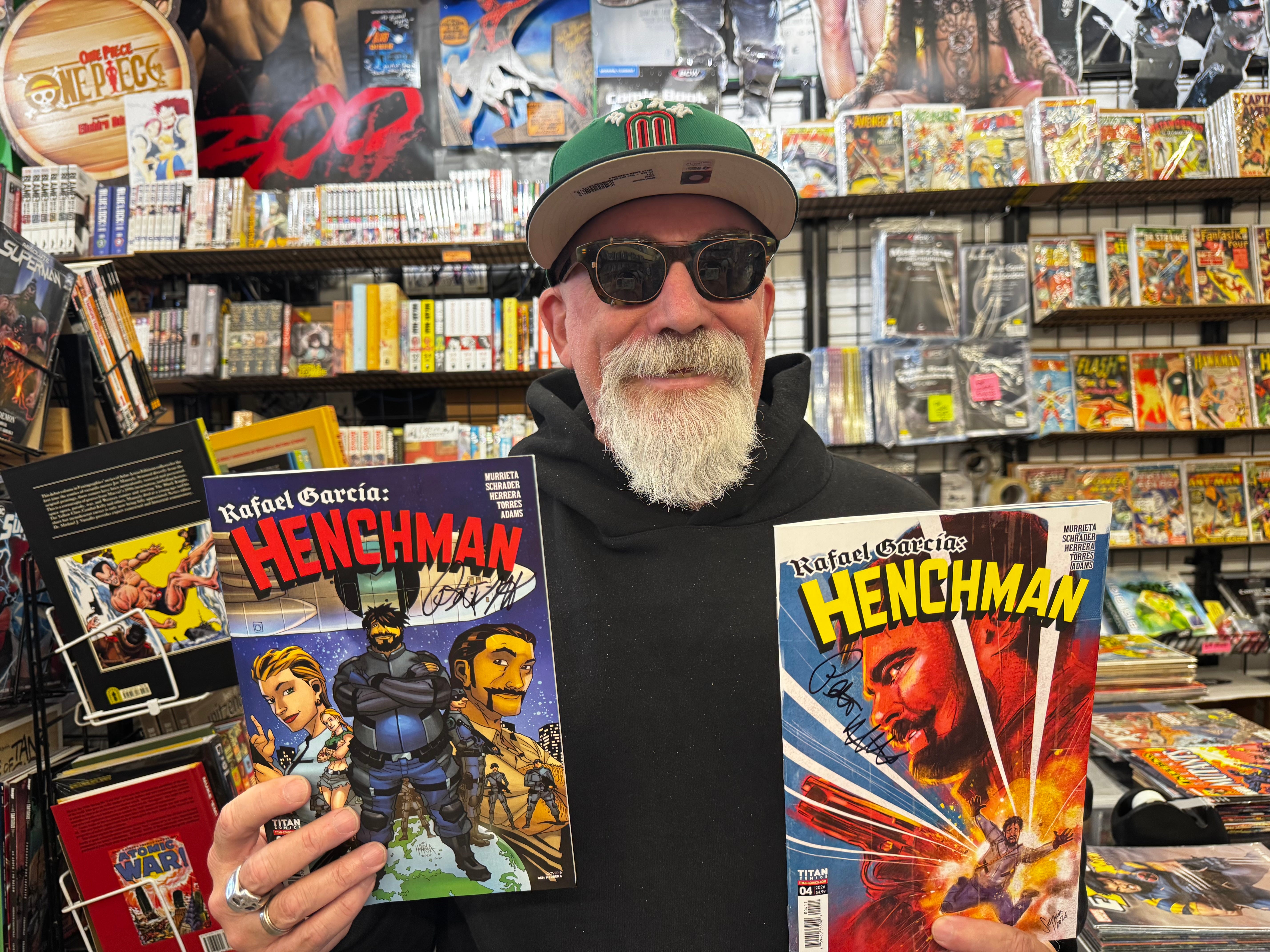
And here’s a link if you want to buy the whole trade paperback when it comes out.
And I got to see the cover to the first issue of TEQ.
Let’s keep going.
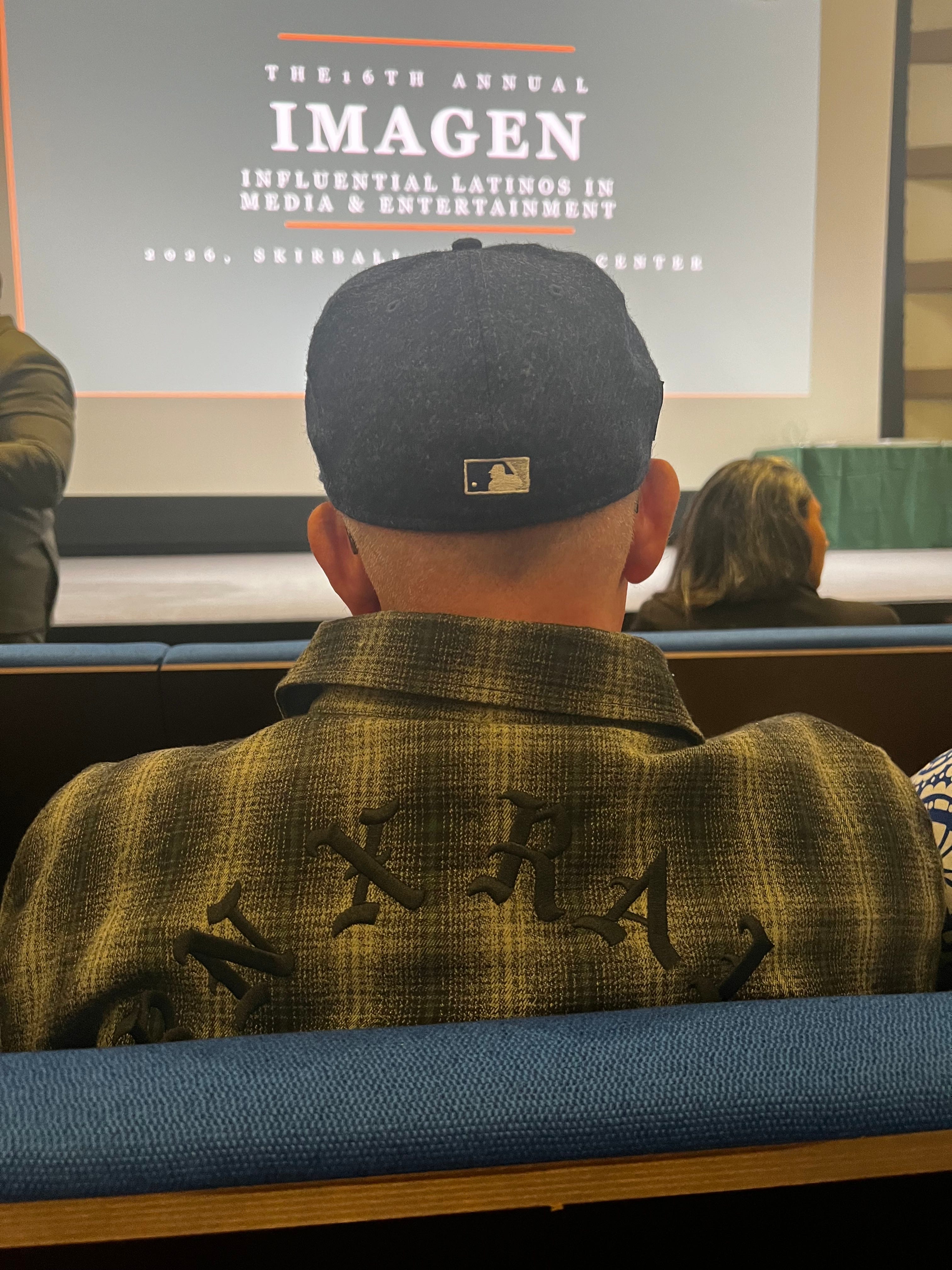
We haven’t done the thing where I end a column with a picture I like that has nothing to do with subject. Let’s do that for some Friday Fun. My friend took this when we were both being honored as Influential Latinos in the Media.
But not TOO INFLUENTIAL, right? Because I am —
THE MOST IMPORTANT CHICANO IN HOLLYWOOD THAT YOU DON’T KNOW ABOUT
Comments
Nothing yet. Say the first thing.
Sign in to join the conversation.