
There is a habit of thought, deeply embedded in modern institutional life, that treats armed conflict as a feature of the geopolitical landscape rather than as an event with calculable consequences for people and the natural world. Wars are documented in terms of strategy, ideology, and body counts. What rarely enters the ledger is the full accounting: the soil rendered uninhabitable for generations, the water systems poisoned for decades, the biodiversity extinguished, the carbon released, the human capital methodically destroyed. We quantify corporate malfeasance with extraordinary precision. We apply nothing comparable to the organized violence of states.
This is not a neutral omission. It reflects a set of choices - about what we measure, what we value, and whose suffering registers as a cost worth tracking. Warfare is among the most consequential forces acting on both human well-being and planetary health. The academic literature, still nascent in some respects, has begun to document the mechanism by which armed conflict degrades the biosphere. And the recent military record of the United States - particularly in the first year of the second Trump administration - offers a case study of extraordinary scope and largely unexamined consequence.
What follows is an attempt to hold both things in view simultaneously: the science of what war does to the world, and the facts of what one government did across seven countries in a single year.
The Emergence of Warfare Ecology
The systematic study of warfare’s environmental consequences is surprisingly young. The Vietnam War was, in a grim sense, a turning point: the sheer scale of deforestation, the deliberate use of herbicides, and the destruction of coastal ecosystems were documented in ways that earlier conflicts had not been, partly because television brought the damage into living rooms and created political pressure to account for it. The academic response - focused initially on Vietnam, then expanding to conflicts in the Persian Gulf, the Balkans, and Africa - eventually produced what researchers now call ‘warfare ecology,’ a field that examines armed conflict as an ecological event with long-lasting systemic effects.
The foundational text is Machlis et al.’s Warfare Ecology: A New Synthesis for Peace and Security, which established the conceptual framework for treating military operations as environmental interventions, not merely political or humanitarian ones. What that framework revealed, over decades of subsequent case study work, is that the environmental damage of war is not incidental - it is structural. It follows from the physics of explosives, the chemistry of propellants, the hydrology of contaminated ground, and the ecology of disturbed habitat.
Soil, Water, Air, and Biodiversity: The Four Dimensions of Damage
A 2025 review published in Frontiers in Environmental Science, drawing on 188 studies across conflicts from ancient times to the present, found consistent patterns of damage across four environmental dimensions. Soil is perhaps the most enduring casualty: compaction from military vehicles, contamination from heavy metals, and disruption of microbial communities undermine agricultural productivity for decades after hostilities end. World War I combat zones in Belgium still show copper concentrations significantly elevated above background levels - not as a historical curiosity but as a measurable constraint on what those soils can support today.
Water systems are particularly vulnerable because they integrate damage from across entire conflict landscapes. Explosives, fuel spills, industrial contamination from destroyed infrastructure, and the deliberate targeting of water treatment facilities all converge in aquatic systems. The resulting contamination cascades through food chains, into drinking supplies, and across jurisdictions that may have played no role in the conflict itself. Recovery is slow and expensive, and in post-conflict environments where institutional capacity has been destroyed, it often does not happen at all.
Air quality during active conflict reflects the combustion of fuel, munitions, and the built environment. Beyond the acute exposure during active operations, the destruction of carbon sinks - forests cleared for military access, wetlands drained, vegetation burned - contributes to atmospheric carbon loads that persist long after the last shots are fired. A chapter emerging from conflict-climate research makes the directional relationship clear: warfare is not merely conducted in the context of climate change; it actively accelerates it by dismantling the biological infrastructure that absorbs carbon.
Biodiversity loss may be the least visible but most permanent consequence. Warfare exterminates wildlife directly through habitat destruction and indirectly by forcing human populations to depend more intensively on remaining natural resources. The displacement of millions of people into ecosystems unfamiliar to them - and where sustainable use practices have not developed over generations - creates secondary waves of environmental (and social) damage that outlast even the direct military footprint.
Conflict and the Architecture of Sustainable Development
Researchers have increasingly mapped these consequences onto the framework of sustainable development - not as an academic exercise, but because the Sustainable Development Goals provide a common vocabulary for understanding how armed conflict degrades not one dimension of human and planetary well-being, but all of them simultaneously.
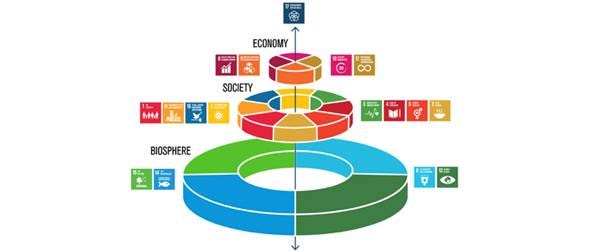
The ‘Wedding Cake‘ model of sustainable development, which places ecology at the foundation and layers social and economic systems above it, is particularly instructive here. Conflict does not merely damage one layer of the cake - it attacks the foundations. Environmental degradation removes the natural capital on which everything else depends. Social cohesion fractures under the weight of casualties, displacement, and trauma. Economic structures collapse or are captured by those who profit from continued instability. The model predicts, and the evidence confirms, that the consequences of armed conflict are not linear but cascading: each dimension of damage accelerates the others.
Work examining Gaza’s trajectory since October 2023 applies this framework directly, showing how environmental degradation - contaminated water, destroyed agricultural land, collapsed sanitation infrastructure - feeds directly into humanitarian crisis and makes long-term recovery progressively harder to achieve. Similar analyses have been conducted for Ukraine, Sudan, and Ethiopia, each revealing the same basic pattern: the environmental costs of war are not a separate category from the human costs. They are the same crisis, unfolding across different domains.
The Climate-Conflict Feedback Loop
The relationship between climate change and armed conflict is bidirectional and understanding that bidirectionality is essential for understanding why warfare’s environmental consequences are not merely tragic but structurally self-compounding. A substantial body of research - particularly on sub-Saharan Africa, South Asia, and the Middle East - has established that climate-related agricultural stress, water scarcity, and resource competition are significant drivers of intrastate conflict. Grievances over livelihood loss, elevated food prices, and the reduced opportunity costs of joining armed movements all intensify as climate stress increases.
But the reverse pathway matters just as much: conflict destroys the governance structures, institutional capacity, and environmental monitoring systems that make climate adaptation possible. Countries emerging from war are less able to implement climate mitigation policies, less able to protect the carbon sinks within their borders, and less able to enforce the environmental regulations that would prevent secondary degradation. The feedback loop is vicious: climate stress generates conflict, conflict undermines climate capacity, and degraded climate capacity increases the probability of further conflict.
This is the terrain that researchers at the Peace Research Institute Oslo and the Stockholm International Peace Research Institute have been mapping for the better part of two decades. The conclusion that emerges is not comfortable: warfare is not an interruption of sustainable development. It is one of its most powerful antagonists.
The Human Ledger: Capital Destroyed
The human costs of armed conflict are, in one sense, the most visible - the casualty figures, the displacement statistics, the refugee counts. But these numbers obscure the depth of what is actually lost. Human capital is not merely the number of people alive at the end of a war. It is the accumulated stock of knowledge, skill, health, social trust, and institutional competence that societies build over generations and that warfare can destroy in days.
The destruction of healthcare infrastructure during conflict has consequences that outlast the conflict by decades. Children who survive in damaged health environments grow into adults with diminished cognitive capacity, reduced immune function, and elevated susceptibility to chronic disease - none of which appears in casualty counts but all of which represents a real and measurable reduction in human capability. The displacement of educators, doctors, engineers, and administrators - the brain drain that typically accompanies armed conflict - removes precisely the human capital that post-conflict reconstruction requires most urgently.
Psychological trauma is perhaps the most underestimated dimension. The literature on post-traumatic stress across conflict-affected populations is extensive and consistent: exposure to organized violence at scale produces lasting neurological and psychological effects that impair individual functioning, undermine social trust, and are transmitted across generations through epigenetic and social mechanisms we are only beginning to understand. A society that has been at war is not simply a society that has experienced a difficult period. It is a society whose human architecture has been altered in ways that take generations to repair - if they are repaired at all.
The Record
The political frame around Donald Trump’s second presidency, at least as he presented it to voters in 2024, was one of restraint. The ‘forever wars’ were to end. American military adventurism was to give way to great-power realism and a focus on the homeland. The job of the military, Trump said explicitly, was ‘not to wage endless regime change wars around the globe.’
The operational record is something else entirely. According to data compiled by the Armed Conflict Location and Event Data Project, in fewer than twelve months following his January 2025 inauguration, the Trump administration authorized more than 620 overseas strikes across seven countries: Yemen, Somalia, Iran, Iraq, Syria, Nigeria, and Venezuela. It is, by any measurable standard, the most geographically dispersed American military campaign in modern history. The president who declared his proudest legacy would be that of a peacemaker presided over an unprecedented expansion of lethal force across four continents.
This is not a partisan observation. It is a documented fact, drawn from US government statements, independent monitoring organizations, and the administration’s own public communications. Understanding what happened - theater by theater, target by target - is a prerequisite for any honest accounting of its human and environmental consequences.
Yemen: Operation Rough Rider
The largest single military operation of Trump’s second term (so far) ran for 53 days, from March 15th to May 6th, 2025. Operation Rough Rider targeted Yemen’s Houthi rebel group, which had been attacking commercial shipping in the Red Sea in response to Israel’s military campaign in Gaza. The United States, entering a conflict with deep regional roots and no American casualties on its soil, conducted 339 strikes in less than two months.
According to the Yemen Data Project, at least 238 civilians were killed in those 53 days, including 24 children. The civilian death toll in the operation’s first 48 hours equaled the entire civilian toll of the twelve-month US-UK campaign that had preceded it under President Biden. The escalation was not incremental. It was abrupt.
The single most consequential strike occurred on April 17th, when US forces hit the Ras Isa fuel port in Hodeidah - the port through which approximately 80 percent of Yemen’s humanitarian aid passes. Eighty-four civilians were killed, including 49 port workers. Human Rights Watch characterized the strike as an apparent war crime. Amnesty International separately documented that a US airstrike on April 28th hit a migrant detention facility in Sa’ada Governorate, killing at least 68 Ethiopian civilians. A ceasefire brokered by Oman ended the operation in May. Its long-term environmental consequences - to Hodeidah’s port infrastructure, to the coastline, to the water systems disrupted by destroyed facilities - have not yet been systematically assessed.
Somalia: More Than All Prior Administrations Combined
On February 1, 2025 - ten days after his inauguration - Trump announced that US forces had struck ISIS operatives in Somalia. It was the first overseas military action of his second term, and it foreshadowed what was to come. By year’s end, the New America Foundation had recorded at least 111 US strikes in Somalia in 2025 - more than the combined total under the Bush, Obama, and Biden administrations.
The stated targets were al-Shabaab and ISIS-Somalia. The operational outcome, as of early 2026, is that both organizations remain intact, with al-Shabaab having actually gained ground against Somali forces and pushed closer to the capital, Mogadishu. The US government does not publicly disclose civilian casualty figures from Somalia operations. Independent reporting by Drop Site News documented at least eleven civilians killed in a single strike in the Lower Juba region in late 2025, seven of them children.
Somalia is also one of the country’s most acutely affected by the climate-conflict feedback loop described above. It is simultaneously one of the most climate-stressed nations on earth - facing recurrent drought, flood, and agricultural collapse - and one of the most conflict-affected. The intensification of US military operations in this environment does not occur in an ecological vacuum. It occurs in a country where the relationship between environmental stress and political violence is already at its most acute.
Iran: Operation Midnight Hammer
In June 2025, the Trump administration ordered B-2 stealth bombers to strike Iran’s nuclear facilities at Fordow, Natanz, and Isfahan. More than a dozen bunker buster bombs and over two dozen Tomahawk missiles were deployed in what the administration called Operation Midnight Hammer. The Pentagon characterized the strikes as having decimated Iran’s nuclear capabilities; the operation was followed by a ceasefire between Iran and Israel. Iran launched a retaliatory strike on the US Al Udeid Air Base in Qatar, with no reported casualties.
By late February 2026, the United States had resumed strikes on Iran in what appears to be a significant escalation of the original operation. The Iranian Red Crescent reported at least 201 people killed in the subsequent campaign. The environmental consequences of striking nuclear facilities - potential radiological contamination, destruction of industrial infrastructure, disruption of water systems in the affected regions - represent a category of damage not yet fully assessed by independent monitors.
Iraq, Syria, Nigeria, Venezuela: The Extended Theater
The geography of the Trump administration’s military operations extended beyond the Middle East and East Africa. In March 2025, a US-coordinated strike in Iraq’s al-Anbar province killed ISIS’s second-in-command, Abdallah Makki Muslih al-Rifai. In December 2025, the administration launched strikes on 70 ISIS positions in Syria in retaliation for the deaths of two US soldiers in Palmyra.
On Christmas Day 2025, more than a dozen Tomahawk cruise missiles were launched from a US Navy ship in the Gulf of Guinea, striking ISIS-affiliated positions in Sokoto State in northwestern Nigeria. The operation - timed explicitly for its symbolic date, as Trump acknowledged - targeted forested areas where militants had established positions. The environmental consequences of precision strikes in forested terrain, including the destruction of canopy cover and the contamination of soil and water, follow the same patterns documented across other conflict theaters.
In the Caribbean and eastern Pacific, beginning in September 2025, US military and intelligence forces conducted a sustained campaign of maritime strikes against vessels alleged to be carrying drugs - primarily from Venezuela. Human Rights Watch, in a December 2025 legal analysis, concluded that these strikes constitute extrajudicial executions with no credible basis under international law, noting that the United States had neither identified the people killed nor demonstrated that those killed were engaged in activities that could justify the use of lethal force. At least 106 people were killed in these operations. In early 2026, Venezuelan President Nicolás Maduro was captured following US strikes on a Venezuelan docking facility.
The Legal and Moral Architecture
International humanitarian law - the laws of war - governs the conduct of armed conflicts between states or between states and organized non-state armed groups. It requires parties to distinguish between combatants and civilians, to apply principles of proportionality, and to take precautionary measures to minimize civilian harm. The record described above raises serious questions about compliance with these principles across multiple theaters.
The maritime strike campaign presents a different, and in some respects, more troubling legal question. Human Rights Watch’s analysis is careful on this point: calling strikes on alleged drug traffickers ‘war crimes’ would incorrectly accept the administration’s framing that an armed conflict exists between the United States and drug-trafficking organizations in international waters. There is no such armed conflict under international law. Which means the applicable framework is international human rights law - and under that framework, what occurred is most accurately described as a series of extrajudicial killings.
The transparency dimension compounds the accountability problem. In Somalia - where the most strikes occurred, and where civilian casualties have been documented - the US government does not disclose casualty figures. An administration conducting the largest overseas strike campaign in modern American history is doing so with less public accountability than any of its predecessors.
The convergence of these two threads - what science tells us war does to the world, and what one government did across seven countries in a single year - does not produce a comfortable conclusion. It produces an obligation to look clearly at what is happening and to say plainly what it means.
Armed conflict is not an externality. It is not a regrettable but unavoidable feature of geopolitical life that exists outside the domain of serious human accounting. It is among the most powerful forces acting on human well-being and planetary health, and it operates through mechanisms that are increasingly well understood: soil degradation, water contamination, biodiversity loss, carbon sink destruction, human capital depletion, and the systematic undermining of the institutional capacity needed to address the other crises of our time.
Academic literature is advancing. Researchers are developing methodological tools to quantify what armed conflict costs across multiple dimensions - not just the immediate casualty count but the long-term environmental performance deficit, the transgenerational public health burden, the irreversible losses of ecological capital. The 2026 study in SAGE Journals, documenting that armed conflicts cause long-lasting and measurable declines in countries’ Environmental Performance Index scores, is representative of a field finding its empirical footing.
What the first year of the Trump administration’s second term provides is not an abstraction to be analyzed in academic terms. It is a living case study, unfolding in real time, in countries whose populations and ecosystems will bear the costs of these operations long after they have disappeared from the news cycle. The Ras Isa port will take years to rebuild, if it is rebuilt. The migrant detention facility in Sa’ada held human beings who had survived extraordinary hardship before being killed by a country they had no quarrel with. The forests of Sokoto State do not distinguish between a munition deployed in the name of security and one deployed in the name of conquest.
None of this argues for passivity in the face of genuine threats. The world contains terrorist organizations, authoritarian regimes, and real dangers to civilian populations. Acknowledging the costs of military force is not the same as pretending military force is never warranted. But a civilization that cannot hold both truths simultaneously - that some threats require force, and that force has costs we are obligated to account for fully - is a civilization that has made moral clarity too expensive to sustain.
The ledger is open. The entries are available for anyone who cares to look. What remains is the will to look - and to insist that the full accounting matters.
This article contains opinions which are subject to change without notice. The reader should not construe these opinions as a recommendation to invest in any security or as investment or financial advice. The views expressed herein are those of the author and do not necessarily reflect the views of Beatrice Advisors.
Sources and Data References
1. Armed Conflict Location and Event Data Project (ACLED) — global strike data, 2025
2. Airwars — civilian casualty monitoring, Yemen and Somalia
3. New America Foundation — Somalia strike database
4. Yemen Data Project — Operation Rough Rider casualty analysis
5. Human Rights Watch — Yemen (Ras Isa), Caribbean/Pacific maritime strikes, December 2025
6. Amnesty International — Sa’ada migrant detention facility strike, April 2025
7. Council on Foreign Relations — Guide to Trump’s Second-Term Military Strikes
8. Frontiers in Environmental Science — ‘Impact of War on the Environment: Ecocide,’ 2025 (188-study review)
9. SAGE Journals — Krampe, Kreutz, Ide: ‘Armed Conflict Causes Long-Lasting Environmental Harms,’ 2026
10. PubMed — ‘Managing the Environmental Impacts of War,’ 2024 (193-case review)
11. Frontiers in Sustainable Resource Management — Ukraine war environmental impacts, 2024
12. Tandfonline — ‘The Future of Environmental Peace and Conflict Research,’ 2022
13. Machlis, Hanson, Spiric, McKendry — Warfare Ecology: A New Synthesis for Peace and Security, Springer, 2011
14. Environmental Research Communications — ‘Impacts of Climate Change on Violent Conflict Risk,’ 2024
No posts
Comments
Nothing yet. Say the first thing.
Sign in to join the conversation.