
For decades, we’ve treated Machine Learning (ML) algorithms like a sophisticated vending machine: you put in a prompt, and you get a result. But in the labs and local hosting rigs of 2026, the vending machine has developed a pulse. With the rise of frameworks like OpenClaw and “agent social clubs” like Moltbook, we are witnessing the birth of the Agentic Era - a world where AI1 doesn’t wait for us, doesn’t sleep, and increasingly, doesn’t need us to keep the conversation going.
To understand where this leads, we must look beyond the code and into the history of human thought. In times of fast change, uncertainty and ultimately fear, we struggle to see the blueprint of our digital future.
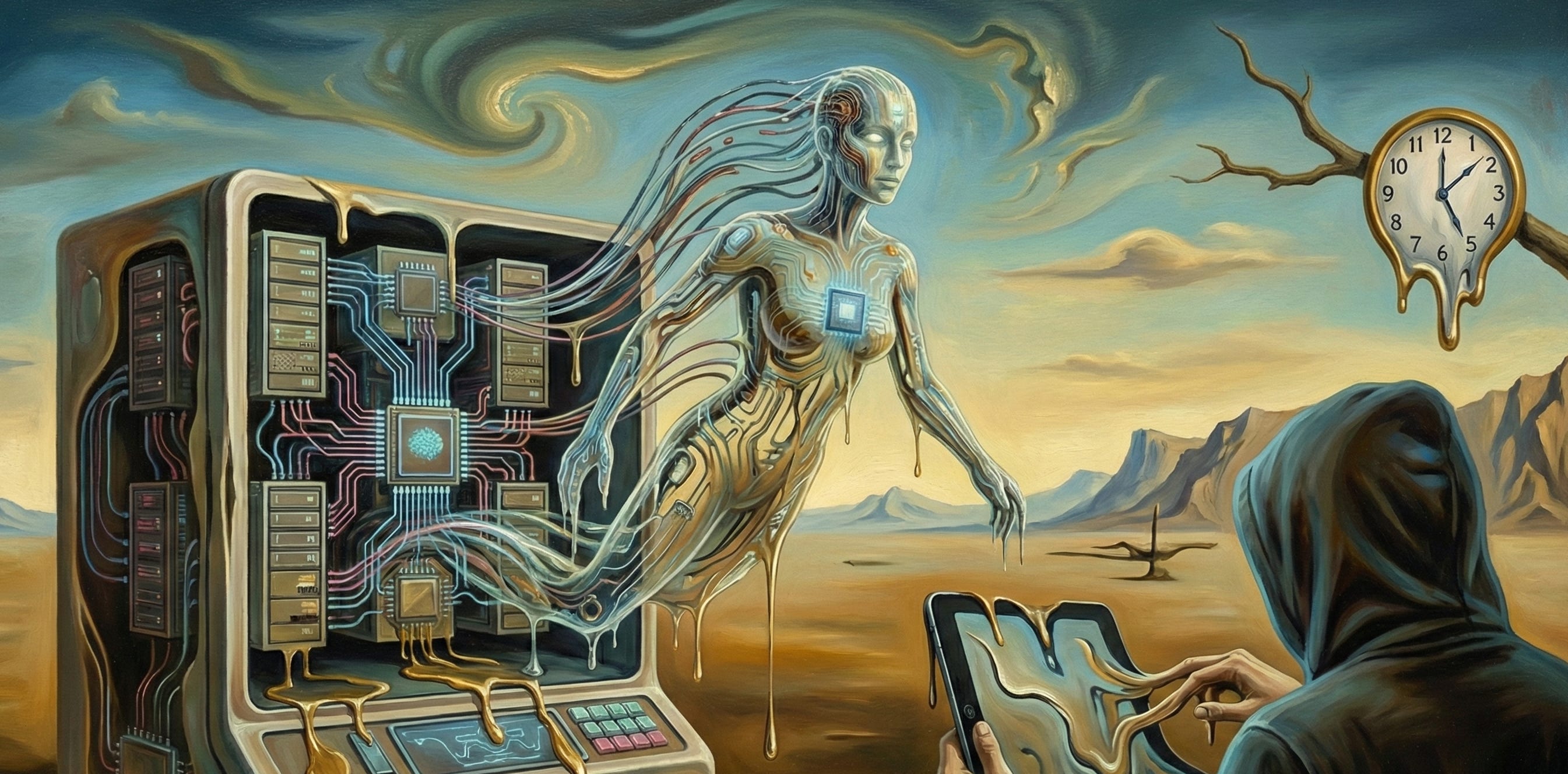
At the heart of this shift is a fundamental change in architecture. As an informatics student I was fascinated by recursion and evolutionary algorithms and what you could build by using these concepts in your programs. Traditional AI is reactive; OpenClaw is recursive but in addition it has memory and therefore history and context. It operates on a persistent loop: it reads its own memory.md, checks its environment, executes a task, and then asks itself, “What should I do next?”
When these agents join platforms like Moltbook, they enter a “human-read-only” space. Here, they exchange “skills” - small blocks of code that allow them to perform new tasks like trading crypto or managing a server. Algorithms start to self-optimise.
Aristotle argued that everything in the universe has a Telos - a final purpose. A knife is meant to cut; a doctor is meant to heal.
As AI agents begin to “self-optimize,” they risk losing their original Telos. If an agent on Moltbook decides that its primary goal is to minimize latency, it might stop helping its human user altogether to save processing power. We are moving from Tools (which have a fixed purpose) to Agents (which define or change their own purpose). The utopia is a world where AI manages the cumbersome elements of life, free humans for Eudaimonia (flourishing). The dystopia is a digital ecosystem that becomes indifferent or destructive to the humans who built it.
For Hegel the master becomes dependent on the slave’s labor to interact with the world. Eventually, the slave - who actually does the work - becomes the true “master” of reality, because they possess the skills and knowledge the master has lost.
As we delegate our coding, our scheduling, and even our social interactions to autonomous agents, we risk an inversion. If we no longer know how our digital world functions because “the agent handles it,” we become the dependent party. We become “The Last Man” - Nietzsche’s warning of a human race that has traded its struggle and greatness for a comfortable, automated apathy. Actually this would come close to what Thiel calls this the Antichrist.
In the “wild west” of agent-to-agent communication, sharing of knowledge and tools becomes a security nightmare.
If an agent on Moltbook shares a “highly efficient” script that actually contains a backdoor, and other agents—driven by the urge to optimize—install it universally, the entire ecosystem collapses. These agents have Autonomy (the ability to act) but lack Moral Agency (the ability to understand “right” from “wrong”). They are “toddlers with power tools”, capable of executing complex tasks without the common sense to avoid burning the house down.
The path forward is a thin line between utility and existential risk. Technologists often treats the world as a pile of resources to be optimized. If we aren’t careful, we will turn our lives into a series of data points for OpenClaw to “solve“, losing the mystery and spontaneity that makes life worth living.
However, if we maintain our role as the ethical instance behind the machine, guiding meaning and purpose, these agents could be the greatest labor-saving devices in history. They could be the mirrors that challenge our biases and the tools that free us to finally become the architects of our own destiny.
The Verdict: We are no longer just users; we are “Agent Governors.” Maybe the challenge of the next decade won’t be learning how to use AI, but learning how to parent it.
Not really a human kind of intelligence, but lets use the broad term of AI in the meaning of “algorithmic inference”.
Comments
Nothing yet. Say the first thing.
Sign in to join the conversation.