
That night she couldn’t sleep. Her suite at the Beau-Rivage faced the water, where the lighthouse kept her awake with its pulsing colors – she refused to have the curtains drawn. “First I had to listen to an Italian singer bawling his songs in the night,” Elisabeth complained, “and then the moon …” It was waning, high over the city, and it shone through the window directly on her face, flooding the room with “a mystic light.” Elisabeth was always alert to portents and omens. One night at Montreux, earlier in the week, she had summoned Irma to say that “the moon bore the countenance of a weeping woman” and that “a lady in white” was trespassing in the garden: “But though every path on the grounds was searched, and every bush was beaten, no woman in white could be found.” Then there were the ravens, a bird associated in Habsburg lore with calamity and disaster. Elisabeth had been picnicking, eating a peach: “At that very moment, a raven flew towards her and struck the fruit out of her hands by the force of its wings.” That she was also reading Corleone, Marion Crawford’s popular romance about the Sicilian Mafia, in which a number of victims are dispatched with stilettos, seemed pertinent only later. Irma saw her glance from her bedroom to the parlor at the Beau-Rivage, where “masses of asters, mauve and white in color, had been grouped for her appreciation.” Elisabeth shook her head.
“They’re lovely, aren’t they?” she said. “But I don’t like them. Asters are for funerals.”
“Will we be leaving?” Irma asked. She had felt “a sudden dread.”
“Yes,” said Elisabeth, “the boat leaves at 1:40. Send the others on ahead. You know I don’t like parades.”
At eleven she decided to go out. She walked to Bäcker’s, a music shop in the Rue Bonivard, where she wanted to hear the Orchestrion. This was “a new sort of musical machine,” as Irma described it, “a large music box that reproduced the sounds of an orchestra by means of percussion and pipes. We heard selections from Aïda, Carmen, Rigoletto, and Tannhäuser. Tannhäuser was Her Majesty’s favorite opera.” Elisabeth looked through the shop while Irma dealt with “the public” -- “an elegant lady,” in this case, “who introduced herself as a Belgian countess and stared obtrusively at Her Majesty. She begged to be presented, saying she was a great friend of Her Majesty’s sisters, the Queen of Naples and the Countess Trani. I answered that I could not oblige her and, wounded, she walked away.” As they were leaving, Bäcker himself, the proprietor, asked Elisabeth to sign his guest-book. Irma looked for permission.
“Just write ‘Erzébet Királyné [Queen Elisabeth],’” Elisabeth answered in Hungarian. “He won’t know what it means, and by the time someone explains it to him I’ll be miles away.”
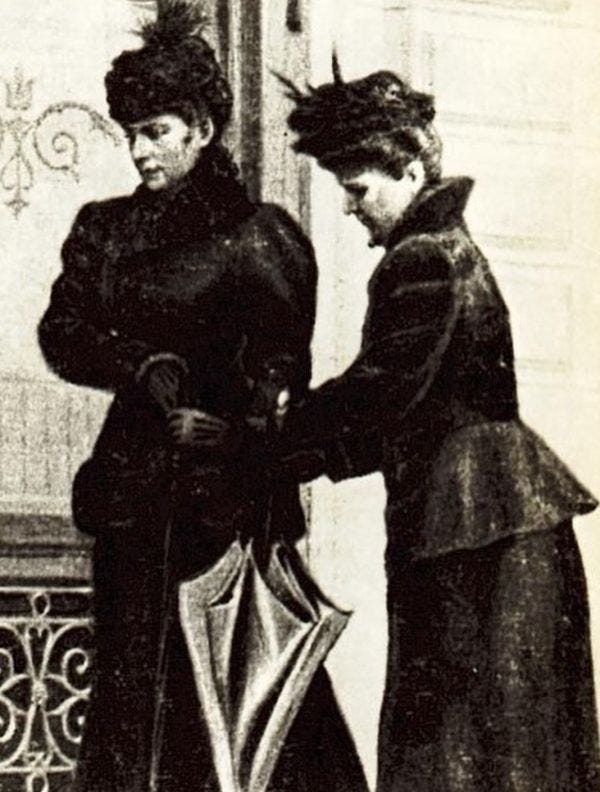
Sisi (left) with Irma Sztáray in Geneva on the day before her death (1898)
At the hotel, she retired to change her clothes. She was moving slowly, Irma thought, “without a trace of anxiety, and I was very nervous. If we missed the boat, we’d be left in Geneva alone, since the servants had already gone ahead with the trunks. I didn’t wait for her to come out. I went straight into her room and asked her if I could send the hotel porter to hold the ferry in case we were late. The captain didn’t know we were coming.”
Elisabeth shrugged. She was drinking a glass of milk.
“Majesty,” said Irma, “it’s 1:25. The boat …”
“But Irma, first you must taste this delicious milk.” She watched as Irma drained the glass. “But perhaps you don’t like it?” she said.
“No, Majesty, I’m only worried. The time … the boat …” Elisabeth looked around her, gathered her umbrella and fan, and at 1:30 precisely they left.
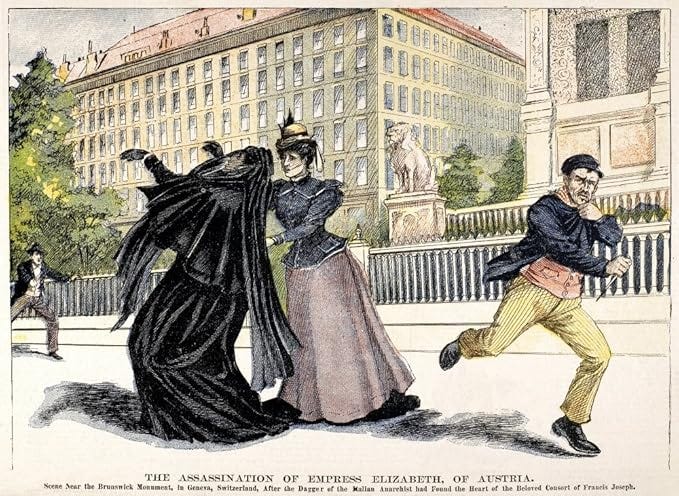
It was just a hundred yards from the hotel entrance to the landing dock, a short walk through gardens and a terraced square along the Quai du Mont Blanc, separated from the water by an iron balustrade. The Quai was dotted with statues, patches of lawn and “many-colored carpets of flowers, with trees planted in profusion.” Halfway along was the Brunswick monument, a neo-Gothic replica of the Scaligeri family tomb in Verona, built as a mausoleum for Charles II, Duke of Brunswick, and fronted by two stone lions, “looking dreamily out on the waters of Lac Léman.” Elisabeth seemed to follow their gaze, scanning the lake toward the mountains in France: “And now the bell on the boat rang, and we hastened our steps, but the Empress said: ‘We shall still be in time. See how slowly and quietly the people are walking on board.’” It was then that she noticed the chestnuts in their second bloom – “Irma, look!” -- and then that Irma saw “a strange, small figure” approaching in the distance, “zigzagging through the trees as though chased by somebody, flitting from one to the other until he finally reached the sidewalk and the railing, whereupon he rushed toward us.”
Irma stepped forward instinctively. “Now what?” she wondered: “We’re already late!” A few feet away, the intruder seemed to stumble, but gathered himself, rose, turned and lunged at Elisabeth, peering beneath her umbrella to make sure of his target. “He sprang like a tiger,” Irma said, “and struck Her Majesty full in the chest. She fell backward to the ground, like a felled tree; her head hit the pavement, and only her luxuriant hair broke the force of the blow.”
Irma screamed. The street was suddenly alive with motion. Two hotel porters had seen the attack; a cabdriver stopped and a small crowd gave chase to the assailant, who fled up the Rue des Alpes toward the central station. Elisabeth, “crimson with agitation,” sat up and began dusting her clothes. “She was fully conscious,” Irma said. “Neither she nor I were then aware that the killer held a dagger in his hand.” Irma helped her to her feet.
“Is everything all right? Is Your Majesty hurt?”
“No, no, it is nothing,” said Elisabeth.
A porter ran up from the Beau-Rivage: Would Her Majesty return to the hotel?
“But why?” she said. “Nothing has happened to me. Let us hurry to the ship.”
“But Your Majesty must have been frightened.”
“Oh, yes, I was certainly frightened.” But she wanted to move on.
“Straight as a ramrod and smiling she stood again before us,” said Irma. “Her eyes were shining, and her hair had fallen loose around her face. She was unspeakably beautiful. She put on her hat, which was lost in the fall, accepted with thanks the fan and the parasol the bystanders handed to her, and we moved along. She walked to the steamer with her usual elastic step, arranging her hair as she went.” At the gangway she stopped.
“Tell me,” she said, “what did that man want?”
“Who?” said Irma. “The porter?”
“No, the other one. That awful man.”
“I don’t know, Majesty. He is a hopeless miscreant.”
Elisabeth nodded: “Perhaps he wanted to steal my watch.”
From the Quai a cry rose up: “The villain is caught! He is taken to jail!” Elisabeth seemed not to hear.
“Is Your Majesty really not hurt?” said Irma.
“No. But tell me – am I quite pale?”
“Yes, Majesty, probably from shock. Your Majesty feels no pain?”
“I think my chest hurts a little, but I am not sure.” They had just crossed the gangplank when she turned to Irma, stricken: “Your arm now, but quickly!” Then she fell to her knees.
“I threw my arms around her,” Irma wrote, “but I couldn’t hold her up. With her head on my breast, we both sank to the floor. ‘A doctor!’ I cried. ‘A doctor! And water!’” A steward rushed up, and “a kindly nun.” Together they splashed water on Elisabeth’s face.
“She opened her eyes,” said Irma. “I thought she’d had a heart attack. We were outside the engine room, it was very hot, and a gentleman suggested we bring Her Majesty to the upper deck, where she might recover more quickly in the open air.”
Three men carried Elisabeth up the stairs and laid her on a bench, Irma still crying for assistance: “Is there no doctor on board?” The ship was ready to leave and the captain appeared, hearing that a woman had collapsed on deck “and suggesting that she be taken to shore at once. I answered that it was only a fainting fit brought on by shock,” said Irma. “He offered us a cabin, but I thought it better to remain outdoors. And so the ship pulled out into the lake.”
Elisabeth was trying to sit up, opening and closing her eyes “as if emerging from a deep sleep.” Irma pressed a candied mint between her teeth: “A ray of hope shot through me as I heard her bite down on it two or three times.”
“Thank you,” said Elisabeth. She sat up now and looked carefully at the gathered crowd. “Thank you, thank you,” she said.
“Does Your Majesty feel any better?” asked Irma.
“Oh yes, thank you.”
“Your Majesty has been unwell, but you are better now, are you not?”
“Oh yes, yes.”
But she was “broken,” Irma thought: “Her eyes were clouded and her gaze uncertain as she looked sadly around. The passengers drew back. I knelt before her and anxiously searched her face, praying Heaven for mercy.”
Elisabeth turned to the sky, her eyes fixing again on the distant Alps before settling on Irma “with a look I will never forget.” She took a deep breath, sighed and said, “What has happened to me?” Then she fell backward, unconscious, her arm falling limp to the ground.
“Rub her chest!” someone cried. Irma snapped the laces of Elisabeth’s corset: “As I tore the ribbons, I saw on her chemise a dark spot, about the size of a silver gulden. I pushed the chemise aside and discovered near her heart a tiny wound, almost imperceptible, and a single drop of dried blood.” Only then did the truth occur to her.
“Oh, my God!” Irma cried. “She has been murdered!”
In seconds the captain returned with a crowd behind him. “Sir, we must land at once!” Irma pleaded. “The woman you see here is the Empress of Austria and Queen of Hungary -- she has been stabbed! I cannot let her die without a doctor and a priest! Please, we must turn back!”
The ship had gone as far as Bellevue, about a mile east of port. Irma suggested that they take Elisabeth to Pregny, where she had lunched the day before with Baroness Rothschild. The captain shook his head: “You won’t find much of a doctor there.” He gave orders for the ship to turn about. A litter was improvised from oars and a deck chair: “They laid Her Majesty on it, covering her with a cloak, and six people lifted her, while a gentleman held her parasol over her head.” Irma stroked her face, listening to her breathing and wiping sweat from her brow: “I watched how she lay with eyes closed, turning her head restlessly from side to side. But still she lived, so some hope remained.”
Hope was gone by the time they docked -- Elisabeth died along the way. She was taken back to the Beau-Rivage, to the same room she had occupied the night before. A doctor came, and a priest: “All those present fell to their knees and prayed, but this was the end. Then another doctor came, but he could do no more than confirm the death. A slight incision was made in the artery of the right arm, but not a drop of blood appeared. The Empress lay there peaceful and happy, looking lovely and youthful, with a faint flush on her cheeks and a slight smile, her face as subtle and charming as it had been in her lifetime.”
Autopsy would reveal that Elisabeth died of a single wound from a narrow file, “not much more than a needle,” just two millimeters at its widest circumference but thrust so deeply and with such force that “it cracked the fourth rib, pierced the anterior wall of the left lung, tore the pericardium, and entered the left ventricle of the heart.” Had the weapon been left in place Elisabeth might have lived to see a doctor; as it was, she bled internally, beat by beat, not knowing what had hit her.
“And so it has happened as she always wished it to happen,” Irma reflected, “quickly, painlessly, without doctors and long, fearful days of worry.” At Geneva’s Palais de Justice, where he was taken after his capture by local gendarmes, Elisabeth’s assassin sat smiling, humming to himself, giving his name – “Lucheni” – and his occupation – “Anarchist” – and boasting that “he had made a good job of it.”
“It will be King Umberto [of Italy’s] turn next,” he cautioned. “All the other sovereigns will follow. Long live Anarchy! Long live the Revolution!” Police would learn that Lucheni had worked variously as a stonecutter, a street sweeper, a dustman and a footman. He had served in the Italian army and as a lineman on national railroads. Now he was jobless, homeless, penniless and “infected with the principles of revolutionary anarchism -- an unmistakable Italian,” said the American consul at Geneva. Newspapers reported on his “dark, restless eyes” and “sinister smile.” All were struck by the “revolting stoicism” with which he talked about his crime.
“I’m only sorry there’s no death penalty in Geneva,” said Lucheni. “I did my duty and my comrades will do theirs. The great of the world had better believe it. Long live Anarchism!” His weapon was found the next day in an alley, where he had tossed it after the attack -- just a stitching awl that he had sharpened and fixed to a block of wood, small enough to be closed in his hand and hidden from his victim: “Not a very impressive-looking weapon, but sufficiently deadly to strike at some famous person, preferably some reigning monarch, whose murder would make him notorious overnight.” For that was all Lucheni wanted – “propaganda of the deed.” In prison, he was questioned by Charles Léchet, Geneva’s examining magistrate for special crimes:
LÉCHET: Your name?
LUCHENI: Lucheni.
LÉCHET: First name?
LUCHENI: Luigi.
LÉCHET: Born when?
LUCHENI: April 23, 1873.
LÉCHET: Where?
LUCHENI: In Paris.
LÉCHET: But you are Italian.
LUCHENI: Yes.
LÉCHET: First name of father?
LUCHENI: I don’t know.
LÉCHET: Illegitimate?
LUCHENI: Yes.
LÉCHET: Why did you come to Geneva?
[No answer.]
LÉCHET: Well? You surely know why you came to Geneva?
LUCHENI: That I know exactly. I read in the papers that the Duke of Orléans was staying in Geneva.
LÉCHET: And?
LUCHENI: I came here to kill him.
LÉCHET: You mean, the pretender to the French throne?
LUCHENI: Yes. But I did not find him. I had sworn to kill some high-placed person or other, prince, king, or president of a republic—it’s all the same. They’re all made of the same stuff.
So Elisabeth entered his sights. Lucheni had learned where she was staying (it was reported as “Society News” in the Journal de Genève) and followed her when she left the hotel. He had seen her once in Budapest, while working there at some transient job. Otherwise he had no association with the Habsburg monarchy, nor any special grievance with its queen. He spoke in slogans: “Down with society!”, “Long live Anarchism!” and – a favorite – “Chi non lavora non mangia!" (He who doesn’t work doesn’t eat!). The questioning went on:
LÉCHET: How did you know where she would be?
LUCHENI: How did I know? Because since yesterday I have spied on her and the lady-in-waiting. How else? Everything went as I had planned.
LÉCHET: It wasn’t you who planned it.
LUCHENI: What?
LÉCHET: You executed a command. You acted under orders.
LUCHENI: You can believe what you want. Everything went as I planned. I alone. I ran toward her and barred her way. I bent down and looked under the parasol. I didn’t want to catch the wrong one. They were both dressed in black. She wasn’t very beautiful. Quite old already. Anybody who says otherwise doesn’t know what he is talking about. Or he’s lying.
LÉCHET: And then? What happened then?
LUCHENI: Nothing. I stabbed. That was all.
LÉCHET: And then you fled. Where did you hope to go?
LUCHENI: I had no intention of fleeing.
LÉCHET: No intention of fleeing? You ran as fast as you could just for exercise?
LUCHENI: I was going to the police. That was my intention from the start. I wanted to declare openly why I did it.
LÉCHET: Then why didn’t you simply stay where you were? That would have been more logical.
LUCHENI: I had no wish to be lynched.
LÉCHET: Have you anything to add?
LUCHENI: I confess that it was my deliberate intention to kill the Empress of Austria. I am glad of her death. I am an Anarchist.
LÉCHET: Do you practice this creed all by yourself?
LUCHENI: Nothing to practice. The great Bakunin showed us how to break our chains.
LÉCHET: What chains?
LUCHENI: The chains with which a degenerate aristocracy and a capitalist bourgeoisie have bound us.
That was all there was to it. At his trial, Lucheni’s public defender sought to portray him as the victim of circumstance – born in dire poverty, abandoned at birth, pushed into orphanages, workhouses and miserable labor until wretchedness drove him to murder: “How can society expect such a being to have the least moral perception? How can the law hold him responsible? An illegitimate child, left in one of those orphanages which are nests of crime, then consigned to poor families of mendicant habits, having learned nothing except to beg and to wander? He found such modes of subsistence as he could -- he found, we might say, infelicity in every quarter.”
But Lucheni’s case wasn’t helped by his behavior in court, where he grinned, winked and blew kisses at the crowd: “He liked above all to boast. It came out during the proceedings that he was of fairly industrious habits, and that he had constantly obtained work as a navvy or something similar. This drew from the judge a remark that he had never really known penury and the sufferings it entailed. ‘What! I have never known suffering?’ Lucheni retorted. ‘My mother deserted me when I was a baby! Was that not suffering enough to wreck my whole life?’”
The verdict, in any case, was foreordained – it wouldn’t have helped for Lucheni to repent. “The infra-human character of the assassin of Empress Elisabeth of Austria is at once demonstrated by the fact that his victim was a woman,” said The New York Times in a gruff editorial. “Even in the disordered minds of Anarchists and assassins the universal sentiment that prompts male humanity to exempt woman from the consequences of ferocious passion has commonly held sway. Consorting with Anarchists and brooding over their doctrines of violence may have unhinged Lucheni’s mind. But when he murdered the Austrian Empress he was merely a wild beast.” The jury found him guilty “without extenuating circumstances” and the court condemned him to life in prison. He was led away chanting, “Death to society!” Over time he settled down, dropped the rhetoric and adjusted to a life that, though harsh, was more secure than any he had known. In prison, Lucheni made shoes, read books and perfected his French, filling five long notebooks with his memoirs and begging posterity to consider that he had never been loved.
“I invite all judges to read this book,” Lucheni wrote, “if they want to know how a man can be changed, how criminals are made and not born. Before you add lyres to your hymns of social progress, think carefully of me, deprived from birth of that precious gift Providence bestows on every creature – the kisses, smiles, and embraces of a mother!” In 1910 he hanged himself in his cell, having claimed to see visions of Death. “For he doesn’t only visit royalty,” Lucheni said, “he doesn’t shrink from poverty and filth. We are all the same in the face of Death. And, as he always does and always will, he chooses his moment wisely.” Her friends were convinced that Elisabeth, had she somehow known as she walked to the boat, would have nodded her assent.
No posts
Comments
Nothing yet. Say the first thing.
Sign in to join the conversation.