
I am, and always have been, fascinated with the entire crisis period of 1914–1945. Those thirty years are undeniably the most important in recorded history. There is basically no country on earth today which didn’t undergo some form of national reinvention as a result of the stress, crisis, and defeat produced by the cataclysm. Even countries like Argentina, which were never involved to any degree in the fighting, have their history bisected by the era.
But I think another reason I’m so interested in it is the degree of documentation we have. When you study something like Roman history, pretty quickly you exhaust the set of primary sources and are left with guesswork and archaeology. That isn’t true here. Not only were the wars death struggles between industrial, literate empires, but they occurred during a remarkably historically self-aware period. As a result, we have a true cornucopia of source material.
Additionally, due to a combination of accident and conscious design, we have access to almost all of the “secret” material from the war. Nowhere is this more true than with the Nazis, whose records were essentially captured intact as their empire collapsed in the spring of 1945. As a result, we have everything from the minutes of their military meetings to the personal journals of people like Franz Halder and Joseph Goebbels.
This means that if you are like me and interested in learning both about modernity and history, the World Wars are like a candy shop. You can flutter between military biographies and academic tomes, all trying to understand the same broad era, and each coming at it with a different epistemology and methodology.
The pros of having access to so much information are obvious, but arguably the cons are just as important. One of the advantages of a limited set of source material is that disagreeing becomes simpler. Normally, everyone is aware of the same limited set of facts, and so the area where interpretation and opinion bleed in becomes more obvious. But in the case of the World Wars, access to a nearly unlimited amount of information has made coming up with tidy explanations for anything extremely difficult. This isn’t to say it has stopped or slowed down our attempts.
As in all circumstances where multiple interpretations are possible, I’ve noticed a sort of display case of cultural canons develop. Like a display case, this means the narratives act as invitations to learn more rather than as complete products in themselves. And when one idea gets old, we like to swap it out with another, more interesting or fresh one. Similarly, there are levels of detail and sophistication ranging from pop movies such as “Enemy at the Gates” to academic tomes like Stephen Kotkin’s biography of Stalin.
In my opinion, this cultural canon holds up relatively well to examination, and I would wager people today have a better grasp of the war than at any other point in history. Still, it is by no means “perfect,” and many of the stories we sell ourselves don’t comport all that well with the facts. Or perhaps more honestly, I don’t like the cut of the jib on all of them.
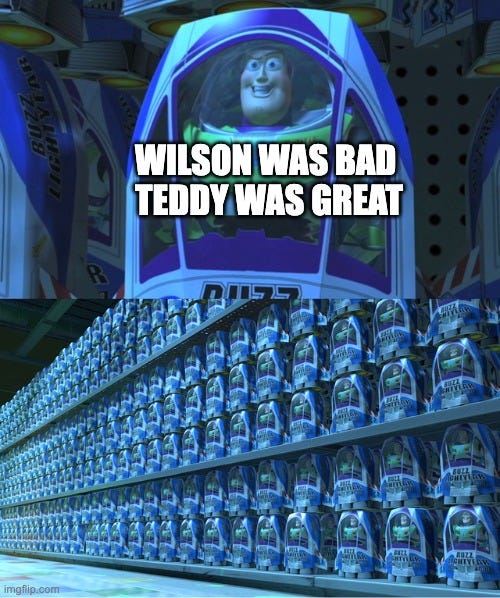
I have two issues with this particular cultural object. The first and most important is my historical gripe, which I will get into more. But another, and honestly more aggravating one, is the way it appears to always be presented. It reminds me of people who hate on Wilson, where they pretend the opinion is somehow “surprising” or “unusual” when in reality it is as close to the normie consensus as you can possibly get! Wilson was a racist and a liberal; that is the least popular combination possible. The fact that you hate him and love Teddy Roosevelt, who was slightly less racist and slightly less liberal, is not unusual!
It goes beyond that, though, because rather than focusing so much on the treaty itself, a huge amount of time is spent “disproving” the old interpretation. This is a larger cultural tic I find distasteful, and it bothers me wherever it seems like our model of a person or theory is purely negative. Marx and Freud are both great examples of this as well.
What I mean by this is that the Treaty of Versailles, as it was designed in 1919, was far harsher than the terms Germany could have reasonably expected in November 1918 when they signed an armistice, and that if these terms had been known at the time, they would have doubtless continued to fight from their forward positions in northern France.
Additionally, the terms which were designed to keep Germany perpetually “down” both created a permanent strategic nightmare in Europe because of the Entente’s inability to enforce them and were fundamentally contrary to the open promises made by the Allies, and believed by the German public, throughout the war.
To understand what I’m saying, one has to understand a little about the end of WWI. Unlike WWII, the Germans negotiated a conditional surrender with the Allies without any soldiers on their own soil. They had also, in the year prior, concluded a separate peace with the Russians and, as late as that spring, appeared on the verge of outright victory.
However, as the year came to a close, the military situation was deteriorating rapidly. All across Europe, the Central Powers were in full retreat. In the Balkans, Bulgaria was defeated in Macedonia and in September signed an armistice. This unhinged the southern flank for the Central Powers and precipitated disaster. Austria-Hungary was then fully exposed, with an Entente army rapidly pushing north through Serbia and threatening the Hungarian plain. In Venice, where they had just earlier that year nearly knocked the Italians out of the war, their troops were refusing to fight.
The Ottoman Empire faced the prospect of an overland invasion of its capital and isolation from its allies. Germany, which had routinely bailed out its partners before in the war, was facing problems of its own at the time and lacked the resources to help. So on October 30, they signed an armistice with the Entente, and the Austrians, whose army was disintegrating on every front, followed suit on November 3.
The Austrian terms had been particularly crushing. Until days before, the Entente had faced off against strongly entrenched Austrian units near Venice, and behind that a foreboding line of mountains which the Italians had spilled the flower of their youth failing to take in 1915. Now the army had surrendered, nearly 400 thousand Austrians were in POW camps, and they had agreed to transport the Allied Powers’ armies north into southern Germany. It was this more than anything else which doomed the German strategic situation permanently.
The situation was also bad, to a lesser extent, on the western front. There the Germans, who had exhausted themselves in offensives earlier in the year, were pushed behind their 1915 defensive line, often called the “Hindenburg Line” after their field marshal but formally called the “Siegfried Position.” That being said, the German army had not broken, and it was retreating in good order.
Facing the possibility of utter defeat, the German high command had two options. One, they could try to sign a peace now with the Entente; or two, they could continue the fight in hopes of reaching a stalemate in the west. The traditional historiography treats surrender as the obvious decision, but personally I disagree. The final terms of Versailles, as I will argue, were extremely harsh, and the military situation could possibly have been salvaged if domestic political will to fight still existed. The reason it really gets complicated is that Germany had, in fact, “won” in the east, and it was here that their real long-term strategic goals lay. For centuries there had been a tension between two impulses in German society, namely a more mercantile democratic one near the Rhine and a more nationalistic imperialist one in the east. Victory over Russia marked the culmination of both of their long-term goals, and the peace with the Soviet Union, which had set up a combination of vassal nation-states without annexations, had easily passed the socialist-dominated Reichstag.
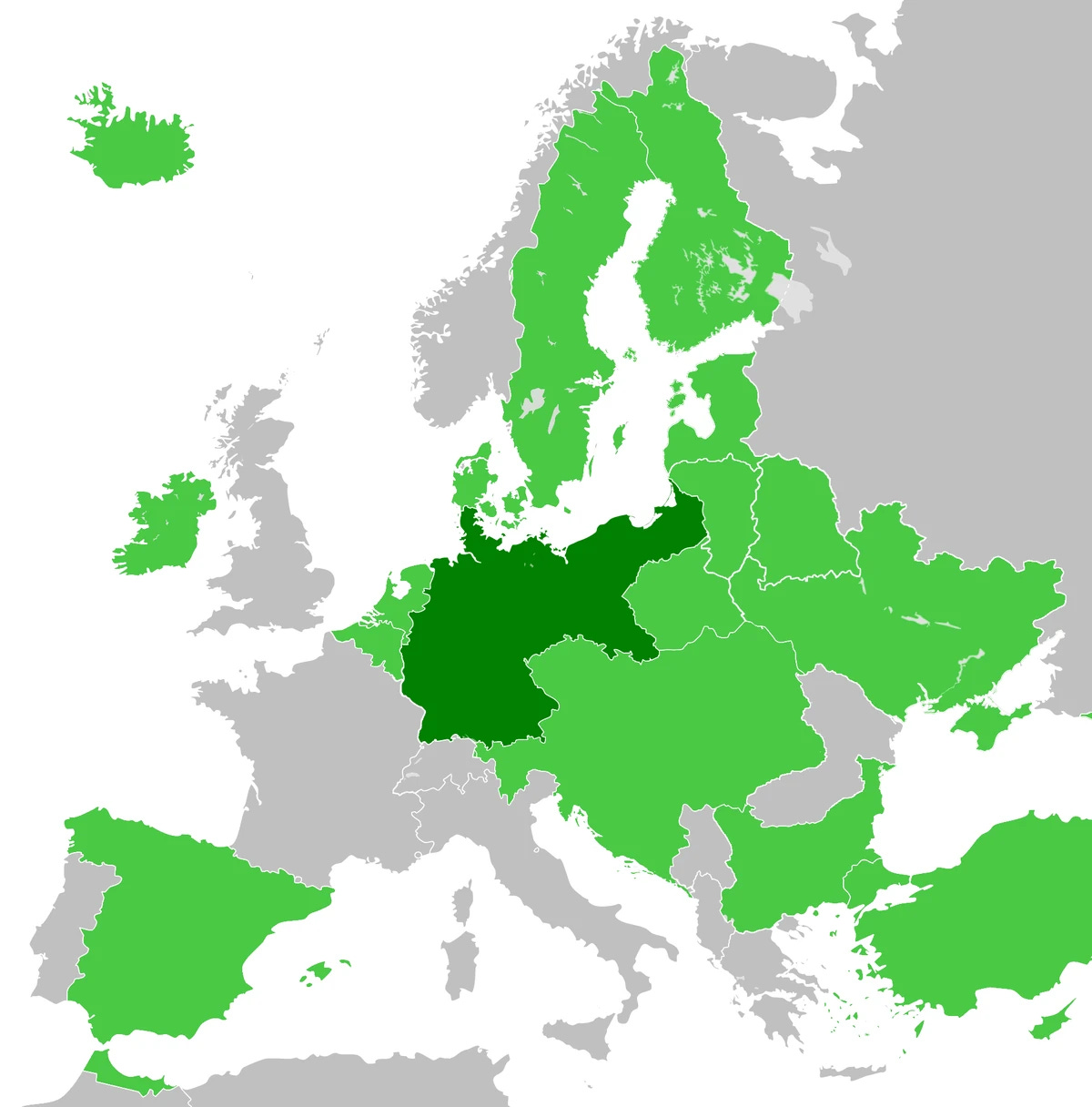
If those victories in the east could be held, even at a great cost, Germany would forever earn the status of a true world power. That isn’t something that men like Ludendorff were willing to throw away casually. But the decision to fight also represented something of a suicide pact. Doubtless, the Germans could have extracted a heavy price in blood and treasure from the advancing Allies, but whether that was enough to force them to the table simply wasn’t known. If the Germans managed to check their advance and, still, they proved unwilling to accept a German-dominated Eastern Europe, what options would have remained?
Everything I’ve described above was well understood by the actors involved, and people approached the problem with full awareness of the tradeoffs. Ultimately, the German high command decided to roll the dice, and on October 23rd, ordered the High Seas Fleet to begin preparing to strike out in a desperate bid to break the blockade. The units, aware of the nature of this mission, simply refused and instead went about overthrowing the state.
Germany was at this point on the verge of social collapse. The previous winter, known as the Turnip Winter, had led to the deaths of hundreds of thousands of civilians, many of them children. Large numbers of defectors roamed the countryside, and the “independent” socialists – who had always been skeptical of the war even in the euphoric months of 1914 – were agitating for open revolution. There was a broad feeling among the German public that the war had been a mistake, and that if they could admit that and overthrow their society, they would get a just peace of equals. It isn’t nice to draw national stereotypes, but I do feel Germans uniquely have a tendency of falling victim to utopian flights of fancy based on the literal words of someone who it should be obvious is lying.
But by November 7, the entire country was aflame. Sailors from Kiel had taken control of the coastal cities. In Munich, Kurt Eisner had declared an independent Marxist state, and in turn dumped huge amounts of embarrassing information on the old regime. Most importantly, there was a selection of Bavarian diplomatic dispatches from the July crisis which seemed to show Berlin and Vienna pushing for a war, totally contrary to the narrative which had been fed to the public of a war of national defense. In short, there was chaos, and by the second week of November there was no possibility of both continuing the war and retaining the old order.
In Berlin, the socialists under Friedrich Ebert were terrified of a Russian-style revolution, which seemed very much in the air, and so immediately went about working with the old powers to try to salvage “something” out of the maw. On November 7, the SPD called for Wilhelm to resign. On the 9th, Chancellor von Baden, an aristocrat from the Liberal faction who had been hoisted into power as a compromise, called the emperor to beg him to leave office peacefully and so avoid revolution. Although he failed to win him over, Baden decided to, without authorization, proclaim that the Kaiser had resigned and then promptly transferred the chancellorship to Ebert. At this point a republic was declared, and like that, the empire was dead. That evening, hundreds of labor union leaders occupied the Reichstag and announced elections, for the next day, of soviet-style soldier and worker councils. A compromise government of sorts was established between the moderate socialists and communists, with each taking half of the new government.
But what was actually to be done? The main effect of the revolution had been to preclude the possibility of continued fighting for long, but both how Germany should look after the war and how, in God’s good name, they were going to actually get out of it were totally open questions. On the evening of November 10, Ebert spoke with Groener, the quartermaster general of the army, and struck a secret agreement (which by its nature makes the precise details impossible to know):
In return for the loyalty of the army towards the new socialist regime, Ebert would agree to put down the communists, end the soldiers’ councils, ensure the creation of a national assembly – rather than a system of workers’ councils – and bring law and order back to the streets.
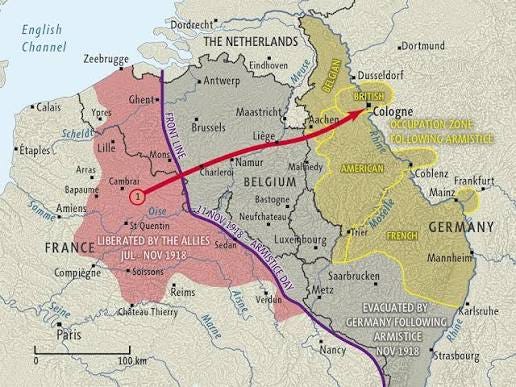
The next morning at 5 a.m., the German delegation headed by Erzberger, a Catholic centrist, agreed to the Allied demands for an armistice. This broadly amounted to an immediate evacuation of Germany west of the Rhine, with Allied bridgeheads, and an abandonment of gains in the east. Everything else was to be settled at a later peace conference, and until then the blockade would be continued.
Even for the Allied command, the decision to sign this armistice was a non-trivial one. By negotiating an end to the fighting with the new German government, they were also recognizing it as the government of a unified Germany. If they did this, they would preclude the option of either permanently breaking up the state or otherwise reducing it below the point at which it could recover to the status of a Great Power.
This was a particularly messy situation for the French, who were well aware of their military inferiority. Both the Americans and British in that late autumn were more immediately concerned with the possibility of Germany’s implosion and fall to Bolshevism, but France was already thinking decades into the future. Germany had the largest population and economy in Europe, and its military had shown itself to be at least close to a match for France, Russia, and England combined. Without American men or dollars, Paris was well aware they would have probably lost, but there was no guarantee America would return, or even if they did return, come in time to save France from a German army. Obviously history vindicated their fears.
But continuing to fight posed problems of its own. Perhaps most important was the problem of who was going to foot the cost of reconstructing northern France and Belgium. If Germany was destroyed, either intentionally or by revolutionary violence, there would be no existing Central Power with the capability to pay. Similarly, both in Paris and London, there was genuine uncertainty over the ability of their militaries to actually prevail. When you look at a map in November 1918, it can be a little misleading. In countries like Italy or France, let alone England, there was little appetite to fight a grinding war all the way to Berlin to eke out a peace when one could be had today on acceptable terms.
Finally, there was the bind created both by Wilson’s idealism and Entente propaganda. Since the outset of the war, and accelerating with America’s entry, the Entente had been pounding into the heads of their own population and Germany’s that they were not at war with the “country” but instead only with the Kaiser and the militarist caste which ran the country, meaning that if they were done away with, the world could have peace again. Well, here the Germans were, now a democracy having overthrown their Kaiser, asking for a peace on Wilson’s Fourteen Points. Continuing to fight afterwards would have appeared insane to almost everyone in the world.
I’ve written all of this to try to paint a picture for you of the situation at the time so that the rest of the article makes sense. As a society, I feel the actual shape of WWI is poorly understood even among the historically literate. When people study the World Wars, they are primarily interested in one of two things: either how WWI began or how WWII was prosecuted. We have relatively less interest in knowing the symmetrical cases for the other. In the case of WWII, this makes sense, since the immediate cause of the conflict, in my and most people’s opinion, was Adolf Hitler. Similarly, for WWI, the question of “how the war was fought and how it was concluded” was of little interest to people today or even to people in the immediate postwar years. The consensus in 1919 was that this would be the war to end all wars, and so what really mattered was trying to figure out “how” the war began so it could be avoided. By contrast, in 1946, the immediate question on everyone’s mind was how WW3 would be fought, and so the focus was on the actual conflict itself.
Now this bias has lingered, and so to the extent most people know anything about the end of WWI, it is only that the stab-in-the-back myth is a lie. And by that they usually just mean that Germany wasn’t overthrown by a Judeo-Bolshevik fifth column of deranged communists bent on destroying the brave front-line soldiers. What actually positively happened is mostly a black hole.
In late June 1919, the Entente had finally concluded their negotiations on the final peace with the Germans and produced what became known as the Versailles Treaty. It was a huge document in the 19th-century legalistic tradition, but the most important components of the treaty were as follows.
In the west, Germany was to lose Alsace and some small border regions. In the east, they would lose Poznan, the Polish Corridor, and Lower Silesia.
Germany would be demilitarized – as the first step in global demilitarization.
Germany could never unify with Austria without approval from the League of Nations.
Germany would have to pay an indemnity for all provable losses created by the conflict, with an amount of raw materials and gold due immediately; the rest would be determined later.
Much ink has been spilled elaborating on the unfairness of the treaty, but nowhere is it more obvious to me than in the reparations bill. If you study this era, you have probably run into the idea of the German “war guilt” clause, and what it really is referencing is reparations. The issue wasn’t, so much, that Germany was being held morally liable for the war, although this was offensive to many Germans, but instead that the German state itself was legally responsible to make up ALL losses as the responsible party. And when they said all losses, they meant it, or at least they did at that exact moment.
Ebert’s government, after being presented with the peace terms, was in a state of genuine shock. It was expected for them to lose land — one of Wilson’s points had explicitly referenced an independent Poland with access to the sea — but what they were being given was a Carthaginian peace designed to crush them economically and militarily. Immediately they began to prepare to begin the fighting again. However, by then they had already abandoned their positions and were facing off against units inside Germany itself. Additionally, the army which existed in November was simply gone. Soldiers were now wandering the country half relieved of duty and half AWOL, nearly all of their heavy weaponry had been handed over to the Entente, and now in the east, rather than a sea of German land, they were facing off against hostile Polish and Czech states both committed to retaining their freedom by force. Faced with no possibility of victory and a continued Entente blockade which was then killing hundreds of thousands of civilians, they had no choice but to sign.
Immediately upon signing, the French, Belgian, and other Allied governments dutifully began to assess the losses in human, animal, and material wealth and arrived at the figure of 132 billion gold marks.
There was another wrinkle. The May 1921 London Schedule set the annual payment as a fixed two billion plus a sum equal to 26 percent of German exports. To collect this, the Allies had decided to impose a duty on imported German goods, as Britain did with the Reparation (Recovery) Act. When, unsurprisingly, the main effect of this was to strangle German trade and thus limit their ability to pay anything, France and Belgium abandoned their own versions, preferring to seize coal and goods directly from the occupied Ruhr.
I could of course follow this thread all the way to 1933 and the Nazi seizure of power, but little would be gained.
Basically my argument is this. If you actually look at the terms of the treaty as they existed in 1921, they were far harsher than Germany could have reasonably expected in 1918 when they signed the armistice.
Saying specifically whether a treaty is too harsh or not can be difficult to define; was the American annexation of the Confederacy far too harsh because it totally destroyed them as a legal entity? Instead, I’m really focused here on the disconnect between what the Germans believed they were signing up for when they agreed to stop fighting and the terms actually imposed on them once they lay supine.
Because the losses of land are easy to see on a map, they often get the most attention. However, if you look into the interwar period, the loss of land was simply not the primary grievance. That is different from saying that the Germans were uninterested in ideally reclaiming the Polish Corridor or even unifying with Austria, but if the terms had been this alone, it is doubtful it would have inspired such a strong negative reaction. What was so offensive to Germany was that they were being treated not as a country which had negotiated a conclusion to the fighting in good faith but instead as a piggy bank for Entente rebuilding and a pariah nation.
It was from this that the stab-in-the-back myth gained such a mass following in Germany. Defeat had been immediately precipitated by a socialist revolution which had foolishly rushed into a peace that exposed Germany to the whims of her enemies. It would have, in retrospect, been better to have fought on. Upon this foundation of hindsight and genuine truth was layered every interwar grievance and frustration. Hyperinflation? We wouldn’t have had this without November 1918. International isolation? We wouldn’t have had this without November 1918. Your wife left you? We wouldn’t have had this without November 1918.
Now, in addition to the peace being won duplicitously, I have a couple of other grievances with Versailles and the narrative I see about it.
Comments
Nothing yet. Say the first thing.
Sign in to join the conversation.