
This originally appeared October 27, 2024.By the way, if you read out to me and get ignored, please try again. Direct messages sometimes go in my spam filter.
Greetings,
Thanks for coming back.
Today, I am returning to the topic of the California Gold Rush conflicts among Chinese miners in 1854 and 1856. As stated, this is a subject that I have not seen written about at this level elsewhere, so it’s exciting to me.
This week, I have dug into the details of the organizations that were fighting. As we will see, one of these groups, the Yong Wo Company, was composed of members of a Chinese ethnic sub-group called the Hakka. Next week, I hope to share more about who the Hakka are and were and the implications. The week or two after that I hope to get into what was going on in the homelands of China between these people and how it seems to have been a major factor in the outbreaks of gold rush violence.
There’s a lot here, and while I suspect some will find it kind of dry reading, you can’t understand what’s happening without knowing the players. Thus some understanding of this is essential to understand what these things really were and what was going on and why all these people were fighting in a country far from home during the California gold rush. And, again, I don’t think that i have ever seen a treatment of this, this detailed elsewhere.
Thanks for coming along for the ride.
Thanks for reading Mostly Asian History! This post is public so feel free to share it.
Our story so far . . .
A long, long, long time ago in a gold field far away . . .
During the California Gold Rush, an event that began in 1849 and continued into the 1850s, people from all over the globe flowed into California seeking to get rich. Large numbers of Chinese were among them, and Chinese miners became a common sight throughout the gold mining regions of the state. In 1854 and 1856, in separated incidents, large groups of Chinese miners gathered and faced off in open conflict.
In the last three weeks, I have been working to understand these incidents. While widely labelled as “tong wars” (fights between sworn brotherhoods), research shows that they were actually conflicts between organizations called “Huigan” ( 會館 ) in Chinese or commonly referred to in English as “Chinese companies.” These organizations consisted of Chinese grouped by their area of origin in China, were basically mandatory for all Chinese who arrived in San Francisco, and were dominated and controlled by the Chinese merchants of San Francisco. (For more details see last week’s publication, number three in the series.)
So at this point, we have a very basic idea of who was fighting, and this brings us way ahead of most reports on the conflicts, but we still don’t know why they were fighting. Logically, if we want to know why these groups were fighting, it would probably be a good idea to learn more about who they were.
As mentioned, all the groups involved were formed based on the home regions of China where people came from. So let’s start there. All of the groups mentioned, like the overwhelming majority of the Chinese in California at this time, came from the Guangdong region of China, commonly known as Canton in English, and the Pearl River Delta. This province ( and its famous delta, of course) is located in southeastern China. In the map below this province is green.
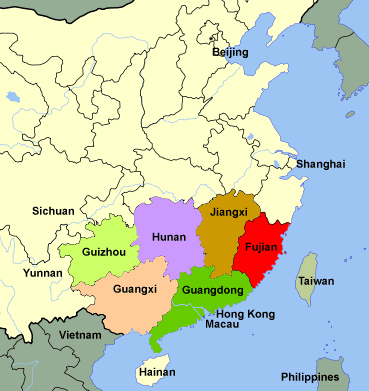
As you can see, it borders on several other provinces as well as the cities of Macao and Hong Kong, both of which were colonial enclaves ruled by foreign nations, Portugual and Britain respectively, during this time.
In previous posts in this series, I shared a couple newspaper clippings from the local English language papers about the events. One was a news report from a local correspondent. Another was a very interesting letter to the editor signed by members of three of the groups, the ones listed below as “Canton Men.”
I took that information and made a chart from it.
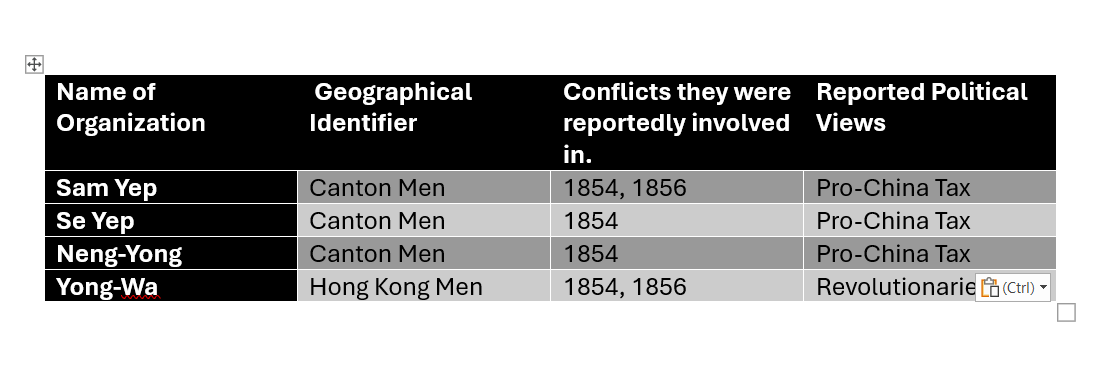
Digging deeper, I looked a bit more into these groups.
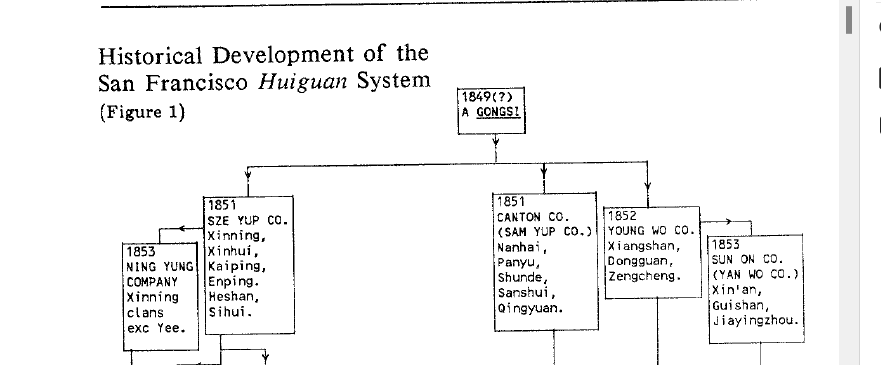
According to Lai, these were the names of all four of the Chinese Companies that existed in California at the time. In his important and detailed essay, Historical Development of the Chinese Consolidated Benevolent Association / Huiguan System , Lai includes a chart showing the interrelationships between these groups throughout their history in the USA.
I clipped only the relevent portion, the section concerning the period we are discussing. Allowing for varying spelling we can see all four of these organizations below.
One quirk about the chart below is “gongsi,” the name of the original “company.” “Gongsi,” ( 公司 ). Apparently the original company was just called “the company” by everyone who interacted with it, at least until a second one came along.
Mae Ngai in her book, “The Chinese Question, the Gold Rushes and Global Politics,” says that the Si Yi (Sze Yup) and the Sam Yup were the first founded, both in 1852, and that the Si Yi was the more numerous, but that the Sam Yup was headed by more wealthy and influential merchants from Guangzhou and thus often more important. ( p. 51) Ngai does not list Lai’s essay in her work, although she does cite a different essay by him on a different subject, and I wish she had and discussed why she agreed or disagreed with it.
Another quirk of these companies is that they were conglomerations of much smaller organizations that were often composed of people from the same villages in Guangdong (Canton). These sub-organizations were called “shantang” ( 善堂 ) and fulfilled the culturally important task of arranging for the remains of any member who passed away to be properly prepared for burial and then shipped back to their home village in Guangdong, China. 1
Therefore, there were ready made organizations quite able to facilitate splits in the Chinese companies when friction arose. As Lai reports, there was a surprising amount of violence among these groups sometime as well as when these splits happened, thus reinforcing the idea that many “tong wars” were not tong wars at all.
Digging deeper. . .
I found the following, the transliterated names of the organizations, their Chinese and Cantonese name, and the English translations of the names.
For the “Canton Men” I found the following:
The “three counties” organization still exists today and has headquarters in many of the older Chinatowns and even has its own Wikipedia page. (Oh, there is it again. That nasty “W-word.”) As for which three counties the name refers to, it’s coming up.
Siyi (Seiyap or Sze Yup in Cantonese; Chinese: 四邑; pinyin: Sìyì; Jyutping: sei3 jap1; lit. ‘Four Counties’)
Unlike the “Three Counties” organization this organization no longer exists but split into subgroups that established their own names and identities.
the Ning Yeung (Chinese:寧 陽 ) company emerged in 1853.
It appears to have been composed of people from Xining County which is now known as Taishan, Ningyang means something like “peaceful, calm, positive,” but it is not a commonly used word at all. It might be interesting to dig deeper into the meaning and origins of the name. The organization does not exist today.
These are the Cantonese groups and they were all composed of Cantonese speaking people from the Guandong province and Pearl River Delta.
As for their opponents in these conflicts:
These were the Yeong Wo (Chinese: 陽 和) company. They came from Heung-shan, Tung-kun, and Tsang-shing districts, and the organization was founded in 1852. It also included the Hip Kat company, formed by Hakka immigrants from Bow On, Chak Tai, Tung Gwoon, and Chu Mui districts, in 1852.[13]
This organization was composed of Hakka Chinese, a sub-group of Chinese that did not normally speak Cantonese but instead spoke the Hakka dialect.
As one of the group’s, the Yong Wo, are said to be “Hong Kong Men” and not “Canton Men,” there will be more on Hong Kong later in this series, probably next week. This should also include interesting information on the connection between Hakka people and Hong Kong in the 1850s. So if all goes to plan, next week’s offering will be on the Hakka Chinese and who they were, their connection with Hong Kong, and their role overseas including in North America.
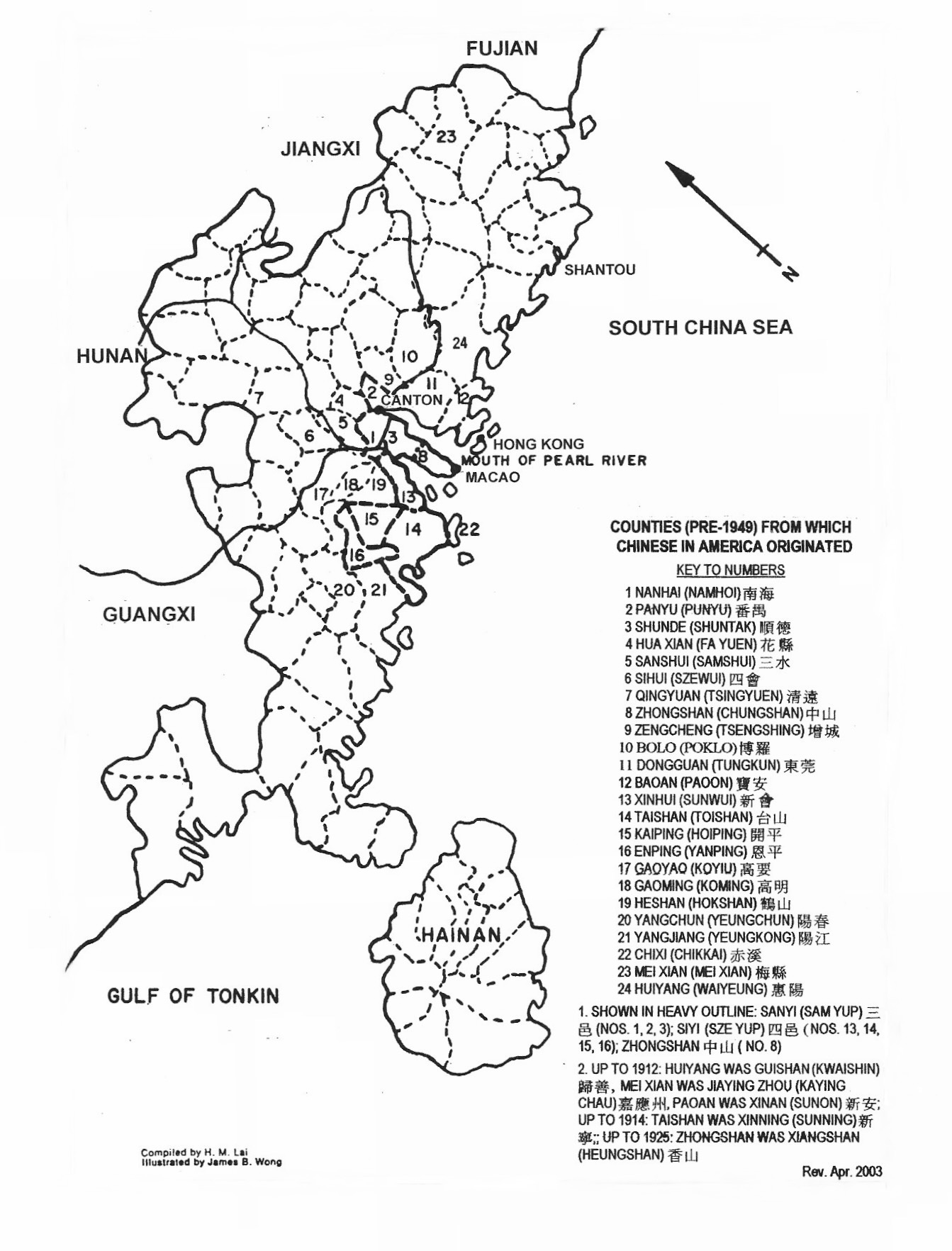
If one wishes to match up these organizations with the locations in the Pearl River Delta that their members came from, the map below is the best that I have found. Like so much of what I have been offering here, it comes from the works of Him Mark Lai. As an aside, Lai was an engineer by trade and training, but through his research and publications became one of the pioneers of Chinese American history when interest in the field began to emerge.
It’s a little difficult to read (remember graphics like this can be copied, saved, and their size can be increased) but it does have a lot of detail.
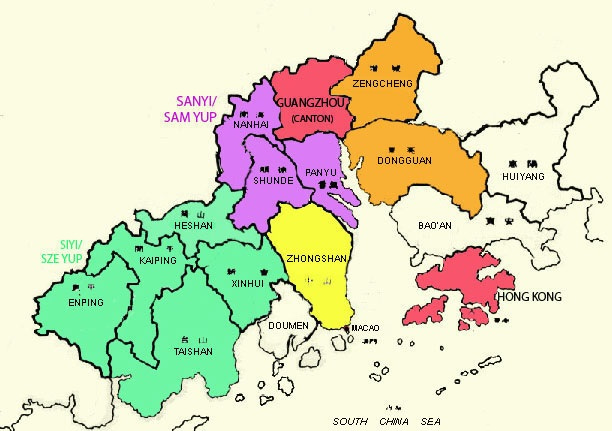
This is a second map that I found of the counties in this region of China. I am not sure of its original source, but it’s been shared widely on internet sets for people of Chinese descent who live in the USA, Australia, and elsewhere and are trying to trace their genealogical roots.
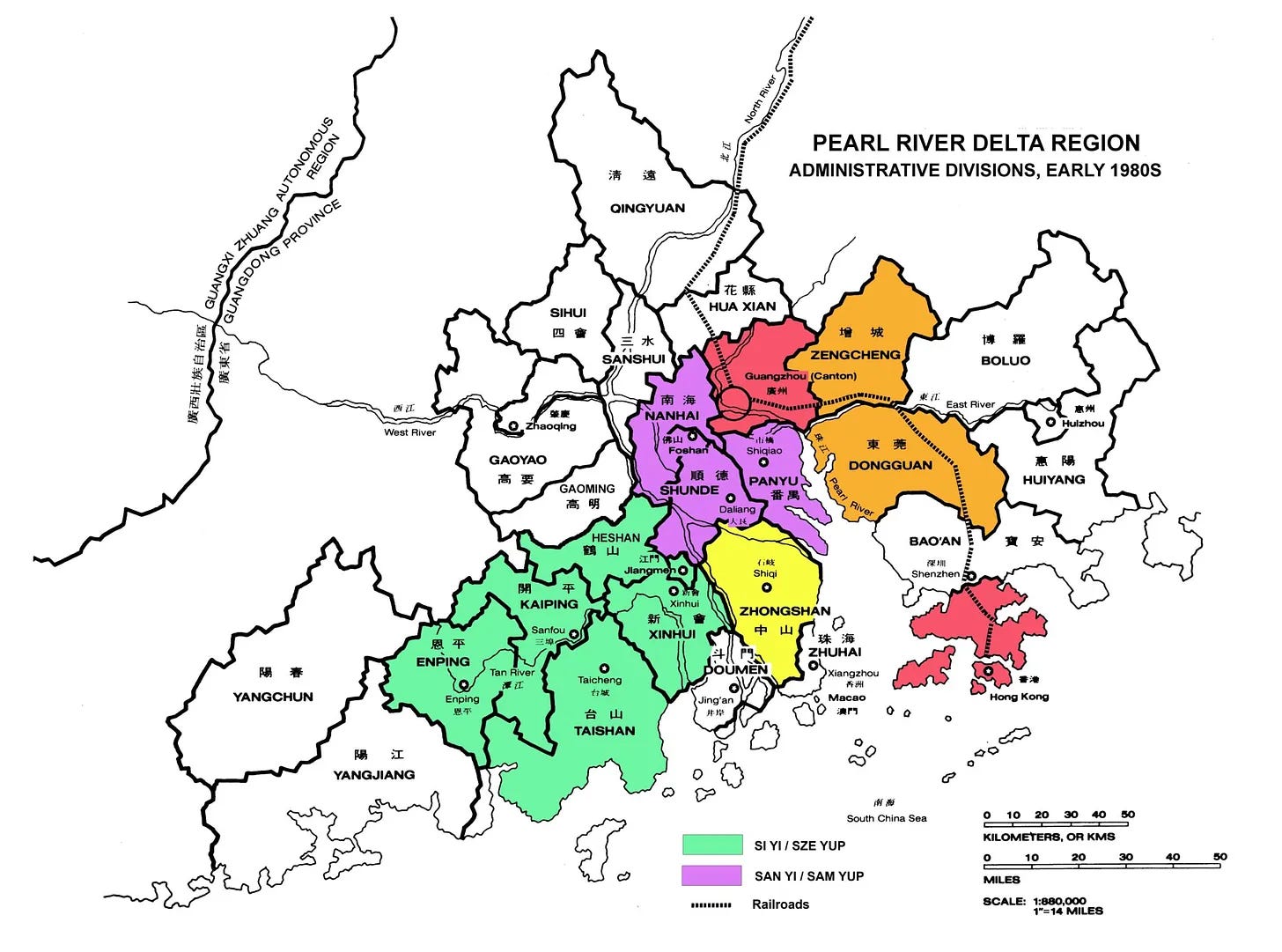
Although it’s color coded and much easier to read, I do have some quibbles and concerns with it. For instance, the borders of the counties do not match Lai’s map but they do match the boundaries of the counties shown in a map of the counties of the region in the 1980s. Additionally, if you look at the region marked with as the home region of the “Sze Yip,” a name that translates as “the four counties,” covers five counties and not four. Therefore, I suspect that someone took the map of 1980s counties and colored in the appropriately named regions without going ot the trouble of trying to track down the historically correct county boundaries.
But as you can see below the green and purple regions of the map, the areas where the “Canton Men” from the Sam Yup and Sze Yi Companies come from, is a different area from Hong Kong, where the Yong Wo and the Hakka “Hong Kong men” came from. (By the way, when thinking of Hong Kong at this time, do not think of a bustling, majory city full of Cantonese speakers. That came later. None of the Chinese port cities were terribly big or important at this time, except perhaps Guangzhou (Canton) itself.)
Therefore, the map makes it very clear that in the conflicts in Weaverville in 1854 and in Chinese Camp in 1856 both conflicts involved fights between the same groups of people and these groups consisted of people from different sections of the Pearl River Delta.
Also as mentioned, the two groups of people not only came from different home areas, but they also spoke different dialects of Chinese, ate different styles of Chinese cuisine, and had distinctly different histories and viewed themselves as distinctly different peoples.
If we want to understand these two gold rush conflicts, it would seem a good idea to look into the history and relationship of these two group people back in their homeland. Especially so, as the explanations that we have seen so far as to why large numers of these people were fighting simply don’t make much sense.
Here’s the map that I suspect was used as a base for creating the above map. Another internet find that I was not able to track down to its source prior to my (admittedly self-imposed) publication deadline.
Well, boys and girls, I don’t know about you, but I am finding this all very exciting. Although I guess chances are that if you are reading this, then you, too, at least find it marginally interesting.
A little over three weeks ago, I began with the question “Were there any American tong wars that would make a good wargame?” (Yes, that was the question that got all this started. Thanks Bob.)
I began by looking at the first two likely candidates that came to mind, the incidents in Weaverville in 1854 and in Chinese Camp in 1856 during the California gold rush, and soon discovered that they were not “tong wars” at all.
Instead, “Chinese companies” or regional assocations had been the ones fighting and not only that but the two conflicts both involved the same groups on each side.
And the groups were from different regions, spoke different dialects of Chinese, and viewed each other as different ethnic groups.
One of these were the Cantonese and the other group were the Hakka.
Next week, I plan to focus on who were and are the Hakka and delve into their unique history what makes them different from other Chinese. After that, we will get into the relationship between these two groups and how it seems to have been a major factor in why these conflicts occur.
As time went on, these Chinese Companies grew in importance and in number. They often united to address threats or issues that affected the Chinese companies or the Chinese community in America. They began to be known as The Chinese Six Companies, a name that obviously arose during a period when there were six important Chinese regional assocations, but continued to be used even during later periods when the number of member companies fluctuated a bit.
These organizaions formally consolidated under a new name, the Chinese Consolidated Benevolent Association in 1882. This event was directly related and in response to the passage of the Chinese Exclusion Act and its many repercussions among the Chinese in the USA, including an erosion of respect for the traditional Chinese-American leadership among the Chinese Americans.
As time went on, they became an umbrella organization for many Chinese American or Chinese Canadian organizations that were important in North American Chinatowns, and still exist today.
As mentioned in a previous offering in this series, I studied Hung Gar Kung Fu for a few months at their New England branch in Boston and enjoyed my time with the club immensely before leaving the city, and returning to my study of Filipino Martial Arts.
Just for interest, here’s an interesting news article I found on an event at the San Francisco chapter of the CCBA in November of 2022. The organization had chosen its first female president and appointed her to office. As you can see she was not only a Hakka Chinese but also head of the Yong Wo Company. While it was a rotation position, and not a permanent one, this was still the first time a woman had been seleted for this office. The article says that the ceremony was attended by the mayor of San Francisco.
https://sfstandard.com/2022/11/01/sf-chinatowns-first-female-president/
Although I shared this last time, here’s a list of all the chapters of the Chinese Consolidated Benevolent Associations in North America put together by the New York City chapter and shared on their website.
https://ccbanyc.org/historyfile/CCBAnorthamerica/othercities.html
Below I have offered a pair of good, well balanced videos on events involving the Chinese Consolidated Benevolent Assocation and some of its actions in American history. Although none actually address the events we are discussing, they do give a good picture of the group and some of its iimportant later history.
Dillon, Richard H. The Hatchet Men. New York: Coward-McCann Inc, 1962.
Lee, C.Y. Days of the Tong Wars. New York: Ballantine Books. 1974.
Nee, Victor, and Brett De Bary. Longtime Californ’: A documentary study of an American Chinatown. Pantheon, 2014.
Ngai, Mae. The Chinese Question, The Gold Rushes and Global Politics. New York, NY: W.W. Norton. 2021.
(I confess, I have not read this book yet. My copy arrived in the mail today about two thirds of the way through the second draft of this piece, but I am looking forward to reading it.)
Pan, Lynn. Sons of the Yellow Emperor, The Story of the Overseas Chinese. London, UK: Mandarin. 1990, 1991.
Selligman, Scott D. Tong Wars, the Untold Story of Vice, Money, and Murder in New York’s Chinatown. New York, NY: Viking. 2016.
Wegars, Priscilla & Chung, Sue Fawn. Chinese American Death Rituals, Respecting the Ancestors. Alta Mira Press. 2005
Priscilla Wegars, Sue Fawn Chung

Historical Development of the Chinese Consolidated Benevolent Association / Huiguan System by Him Mark Lai
https://himmarklai.org/
https://chinesefamilyhistory.org/
https://sfstandard.com/2022/11/01/sf-chinatowns-first-female-president/
https://ccbanyc.org/historyfile/CCBAnorthamerica/othercities.html
https://home.nps.gov/crps/CRMjournal/Winter2009/reviewbook5.html
Chinese Consolidated Benevolent Association - Wikipedia
Siyi - Wikipedia
Sanyi - Wikipedia
https://zh.wikipedia.org/wiki/%E5%96%84%E6%9C%83_(%E6%85%88%E5%96%84%E5%9C%98%E9%AB%94)
Thanks for reading Mostly Asian History! This post is public so feel free to share it.
No posts
Comments
Nothing yet. Say the first thing.
Sign in to join the conversation.