
When did the Chinese first come to America, by which I mean the area now known as the USA? Who were the earliest Chinese who came to the USA and how and why did they come here? While it’s established history that the first large influx of Chinese came to the USA with the discovery of gold in California and the California Gold Rush of 1848 or 1849, they were not the first Chinese to ever come to the USA. There were small numbers of Chinese who came to America prior to the California Gold Rush. This is established history. Some came through missionary efforts, and some were enrolled at a place called the Foreign Mission School in Cornwall, Connecticut that trained students from overseas as well as Indigenous Native American nations and peoples to bring Christianity and improve the livelihood of their peoples from 1817 to 1826. This week, we introduce the school. Next week what happened to the school, the fascinating story of why it was closed, and what came of its Chinese students.
There were two main vectors of interaction between Chinese and Americans in pre-California Gold rush dies and the late 18th and early 19th century. These were business and activities connected with the realm of Christian missionary activity.
For instance, the first known Chinese to come to the USA arrived in Baltimore in 1785. A retiring Irishman decided to leave his employ in the British East India Company after many years, purchased a ship, hired a crew, filled it with valuable Chinese cargo, and sailed to Baltimore, Maryland where he retired. While the crew were mostly natives of what is now Bangladesh, it did include three sailors from Canton (Guangzhou). I wrote about that in April. See Baltimore, 1785, the Chinese first arrive in America Peter Huston Apr 26, 2026
Similarly the first Chinese woman known to have come to the USA was known as “Afong May” (梅阿芳). She arrived in 1830, having been brought to the USA by American merchants and ship captains who believed that a show featuring a Chinese woman performing and demonstrating Chinese culture and behaviors, for instance, she reportedly demonstrated eating with chopsticks as part of her show, would raise interest and demand for their imports from China. I plan to write a column on her in the near future and am actively doing research. 1
In the archives, you may also find a few columns on Chinese who fought in the American Civil War of 1861-1865. There were a few of them, around 50, and several came to the USA after being either adopted or acquired for use as cabin boys on ships and then brought to the USA. (“Acquired” includes purchasing children being sold into slavery sometimes by their own families, decided to take away unattended orphans, or other means.)
Do a search here on the terms “civil war” https://peterhuston.substack.com/archive
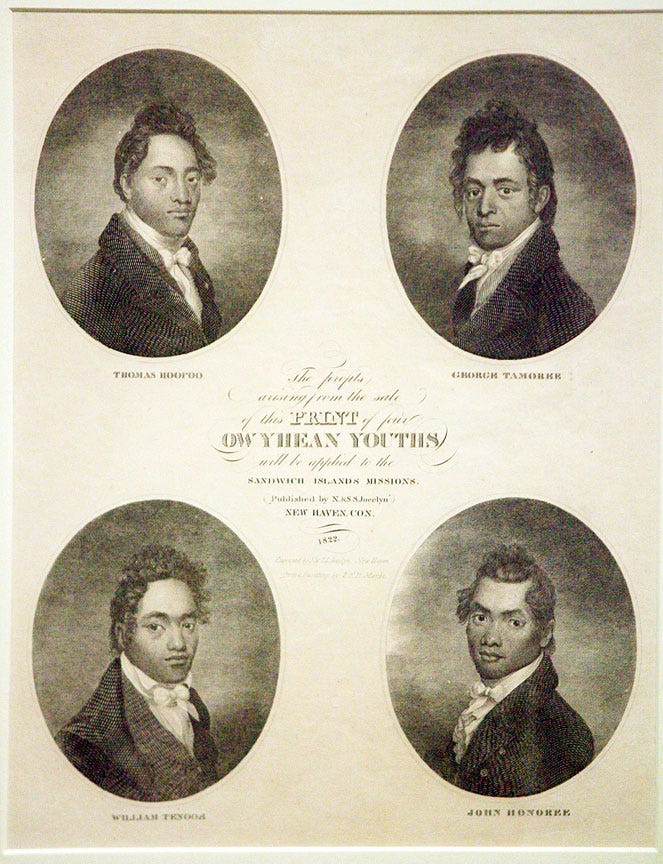
Four Hawaiian (“Ow yhean”) youth who attended the school painted by a prominent painter of the time. And, yes, there were some Chinese as well.
Now before we go too far into the subject, it needs to be stated up front that while the Foreign Mission School did have Chinese students from its beginning in 1817, thus making it an important part of early Chinese American history, there were not many of them and they were outnumbered by students from not just other nations but also by students from Indigenous Native American communities, cultures, and nations.
Thus while it could be argued that the school is an important and little known part of early Chinese American interactions, paradoxically it could also be argued that the Chinese students were not a terribly important component of the student body’s international, intercultural community at the time. Thus while they were there, I have decided to save them and their accomplishments for next week’s column. To make up for it, and ensure readers have their Weekly Asian History Fix, I have included more on later Chinese and Chinese American missionary activities during the Gold Rush as well.
The Foreign Mission School in Cornwall Connecticut was a project of the The American Board of Commissioners for Foreign Missions (ABCFM). This organization, founded in 1810, according to Wikipedia, “In the 19th century it was the largest and most important of American missionary organizations and consisted of participants from Protestant Reformed traditions such as Presbyterians, Congregationalists, and German Reformed churches.” 2
The Foreign Mission School in Cornwall Connecticut lasted from 1817 to 1826, nine years, and was intended to provide a high quality education in both religious and practical subjects to a community of male students from many overseas nations as well as Indigenous nations and peoples from within the United States territories so that they could bring salvation and improve the standard of living to their home countries and communities.
1817 to 1826,
Cornwall, Connecticut is in the northwestern portion of the state near the borders with New York and Massachusetts. The town which is located near the scenic Berkshire mountains to the north and with the Housatonic River on the West, was first incorporated in 1740 from “Indian Territory.” The school itself was located on 5.5 acres of “good tillage land.” 3
In the early 1800s, the town had a population of about 1,600.
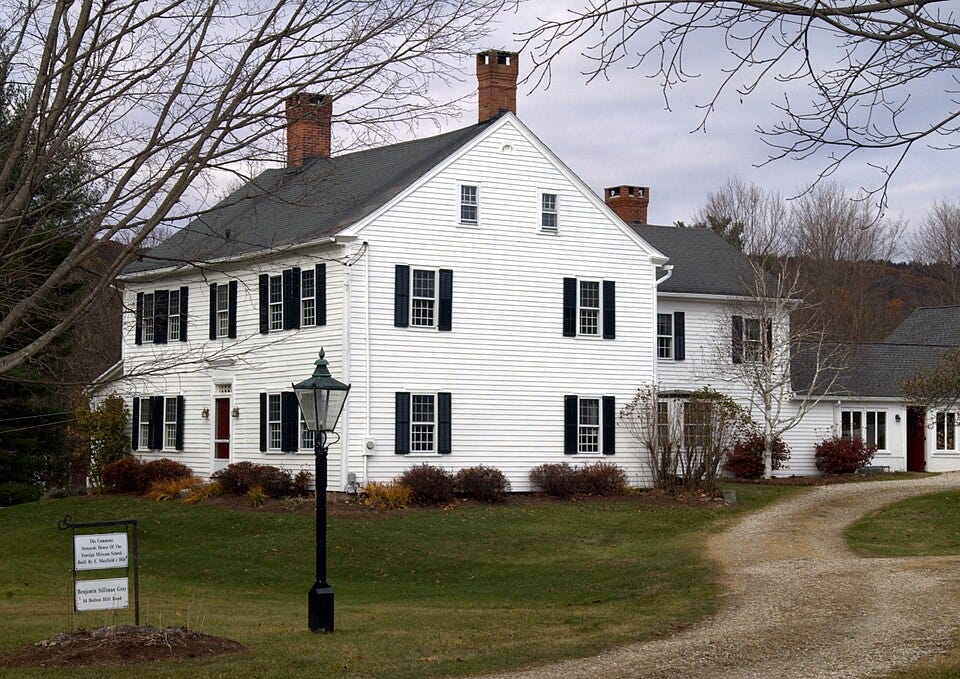
The Foreign Mission School remaining portion today Now a private residence, photo courtesy of Bphil8835 and give attribution as requested.)
The creation of the Foreign Mission School in Cornwall, Connecticut, like so many things both good and bad, stems from a combination of motive and opportunity.
Beginning with motive. This was the time of a religious movement in the United States known as “the second great awakening.” There was not only a rise in membership and importance among many now mainstream Protestant denominations, but also an increasing belief in not just the importance of personal salvation but also the belief that such salvation was possible for everyone and anyone if they truly believed and followed and accepted certain beliefs and behaviors and that these things could be taught and encouraged, especially so by people with the proper education and ability to do so. And not just that, but that these spirtual leaders and teachers could come from all races and backgrounds. And thus there was a renewed interest in this time in not just sending missionaries to go among the “heathen” (to use the historical term) and the unchurched and unsaved, but in taking people, especially highly talented people from among the “heathens” (there’s that word again) and giving them the education and skills, both religious and practical, to go among their own peoples and not just bring them salvation but also raise improve their livelihood and their standard of living. 4
This was the motive behind the school.
As for opportunity, this was the age when the USA was a new nation and was starting to feel its strength and ability and wanting to test itself in the world. It was a maritime nation involved in vast sailing and global trade endeavors, particularly in the New England region.
In the early 19th Century, the Pacific Ocean was seen as a vast frontier suitable for the expansion of American influence and markets and there was a great intermingling on the seas between the maritime workers of New England and those of the Pacific. Not only did the famed Pacific explorer, Captain Cook have at least one sailor from Connecticut on board, but by the mid-19th Century one in five of the sailors in the US whaling fleet was a Pacific Islander. (If one reads Melville’s classic 1851 work “Moby Dick,” admittedly a tough read, the first character the protagonist Ishmael meets and befriends among the crew on the whaling ship is “Queequeg,” a large, tattooed Polynesian (some argue Maori) harpoonist who likes to wear a top hat. 5
“Kanakas,” a term for foreign, non-White sailors from exotic countries, were a common sight in American ports at this time.
In fact, one of the most influential people in the founding and creation of the school was “Opukahaia,” although he was also known under other spellings of this name as well as by the name “Heneri,” a Hawaiian native who had become stranded in Connecticut, converted to Christianity, and impressed a great many people who met him. (See https://en.wikipedia.org/wiki/Henry_Opukahaia
And there was also that pesky problem, one the United States is still struggling to come to terms with even today, about what to do with the so-called Indians, not the South Asian Indians from India, some of whom by the way did become enrolled at this school, but the indigenous Native American peoples who by strange historical accident were and are also often called “Indians.”
At this time, there were widespread calls for the simple “removal,” forced removal, of many or most of the indigenous native people from large portions of United States territory. It was felt by most that members of the primarily White, “Euro-American” society could not easily share living territory with unassimilated, politically distinct, non-culturally or racially “Western” people who were trying to live in the same territory without extreme changes. Which sounds very racist today, but needs to be put in a historic context that different societies tend to approach things like land use, sharing of property, making agreements, and settling of disputes in very different ways, and there were real problems, as well as the usual, racist imaginary problems that stemmed in ethocentrism.
One alternative to simple removal and extermination of the native people lay in what we would now refer to as “assimilation” and “acculturation” but at the time was seen by most “Euro-Americans” as “civilizing” and “improving their lives.” Schools such as this were seen as an important part of such projects.
Therefore, one motivation behind the school, was to save the lives of many of the Indigenous people of the USA by bring them the benefits of “salvation” and “civilization,” and saving them from extermination. Which to modern ears sounds like a terrible thing to do, but we are writing about people who lived approximately 200 years ago and they saw things differently. And while I am not saying they were doing a good thing, in their eyes they were, and in the eyes of many of the people who were targeted with “salvation and becoming civilized,” the very students of the school who came from these peoples, these actions were seen as desirable.
According to Jedidiah Morse, a prominent American scholar, geographer, and, yes, preacher of New England of the time ( see https://en.wikipedia.org/wiki/Jedidiah_Morse ) in his r1822 report to the Secretary of War, the Foreign Mission School was one of several projects that would improve the nations and peoples of the students at the school and thus the school benefitted not just the United States but also the lives of the students:
“Besides the establishments in the Indian nations, we have a school at Cornwall, Connecticut, instituted ibr the purpose of educating youths of Heathen nations, with a view of their being useful in their respective countries. This school commenced in May, 1817. The number of pupils is at present about thirty; fifteen of whom are Indian youths, of principal families, belonging to five or six different Indian tribes; several of these last receive an allowance from the government; and I beg to commend them all to the favor of the President, as very promising youths, in a course of education, which will qualify them for extending influence, and for important usefulness, in their respective nations. They, as well as the pupils in the schools in the nations, are exercised in various labors, and inured to industry; and the school comprises most of the branches of academical education, and is under excellent instruction and government.” 6
If I am discussing early Chinese-American relations, it can’t hurt to readdress the common question of whether or not the Chinese could have visited the Americas in the days before Columbus,
Outside of established history, there are also recurring claims that Chinese visited the Americas long before Columbus did. However, there are either lacking in evidence or easily disproven and considered pseudo history by virtually all scholars of Chinese history. For more on these you can see my previous columns:
(See https://peterhuston.substack.com/p/did-the-chinese-discover-america?utm_source=publication-search and https://peterhuston.substack.com/p/smallpox-in-china-history-of-a-disease ) and for a take on a different claim of pre-Colombian Chinese visitation to the Americas see https://en.wikipedia.org/wiki/Fusang#The_Americas )
Just an update. I took a day off last week, relaxed, and by the time I was done, had ideas for at least four good columns on Chinese American history and a few more on political issues. And another I hope to write on some of the issues and misunderstandings surrounding the Vietnam War (American War in Vietnam) and its aftermath. So I guess I am back on track and the issue is how to do the actual writing while also living a balanced life the way I wish.
So onwards and upwards and time for today’s column but first in the “Pete, are you a real writer and scholar?” section:
I recently had a piece published in the Journal of Emergency Medical Services. AI, Drones, and Robotics Take Center Stage at FDNY Field Medicine Symposium July 6, 2026 By Peter Huston
On the weekend of September 11 - 13, 2026 in Schenectady NY, I will be running a pair of miniature wargames at an event called “CouncilCon 2026.”
One will be a table top miniature game with detailed model buildings and miniature figures that recreates the feel and types of events feature in 1980s Hong Kong movies. It’s intended to be a few hours or so of silly fun with dice rolling and such as models of kung fu masters engage in mock battle on the tabletop with models of bandits and hopping Chinese vampires (Jiangshi) and so on.
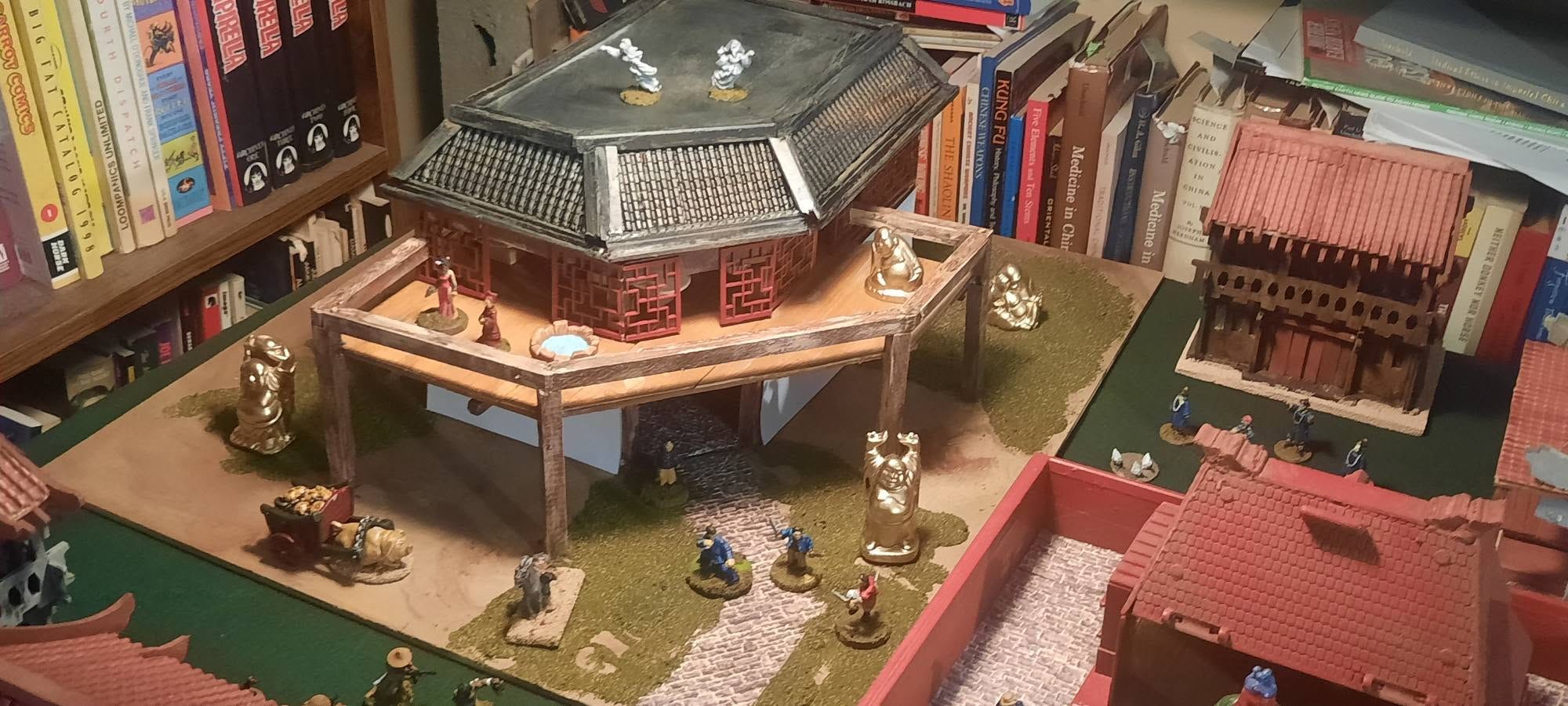
This is what happens if you let the wrong people watch Crouching Tiger Hidden Dragon too many times. They start building models of the buildings and painting model figures. Yes, I built that model from scratch.
In October I will be presenting at the New York Conference on Asian Studies (NYCAS) on the afternoon of Saturday October 24, 2026 held this year at Vassar College in Poughkeepsie. The title of my presentation is “Problems and Questionable Beliefs about China, Hong Kong, and the Great California Gold Rush -1849-1860, and the Need for Further Academic Exploration.
Thanks for reading Mostly Asian History! This post is public so feel free to share it.
FOOTNOTES
When I originally started this column over two years ago, one of my plans was to never, ever cite Wikipedia for all the reasons people say to never cite wikipedia. However, in many cases, including this one, Wikipedia can be a very good source although it does vary from page to page and day to day. Therefore, see https://en.wikipedia.org/wiki/American_Board_of_Commissioners_for_Foreign_Missions which was cited on August 2, 2026.
Pages 4 - 6. NHL nomination for Steward’s House, Foreign Mission School” (PDF). National Park Service. Archived from the original (PDF) on March 16, 2016.
No posts
Comments
Nothing yet. Say the first thing.
Sign in to join the conversation.