
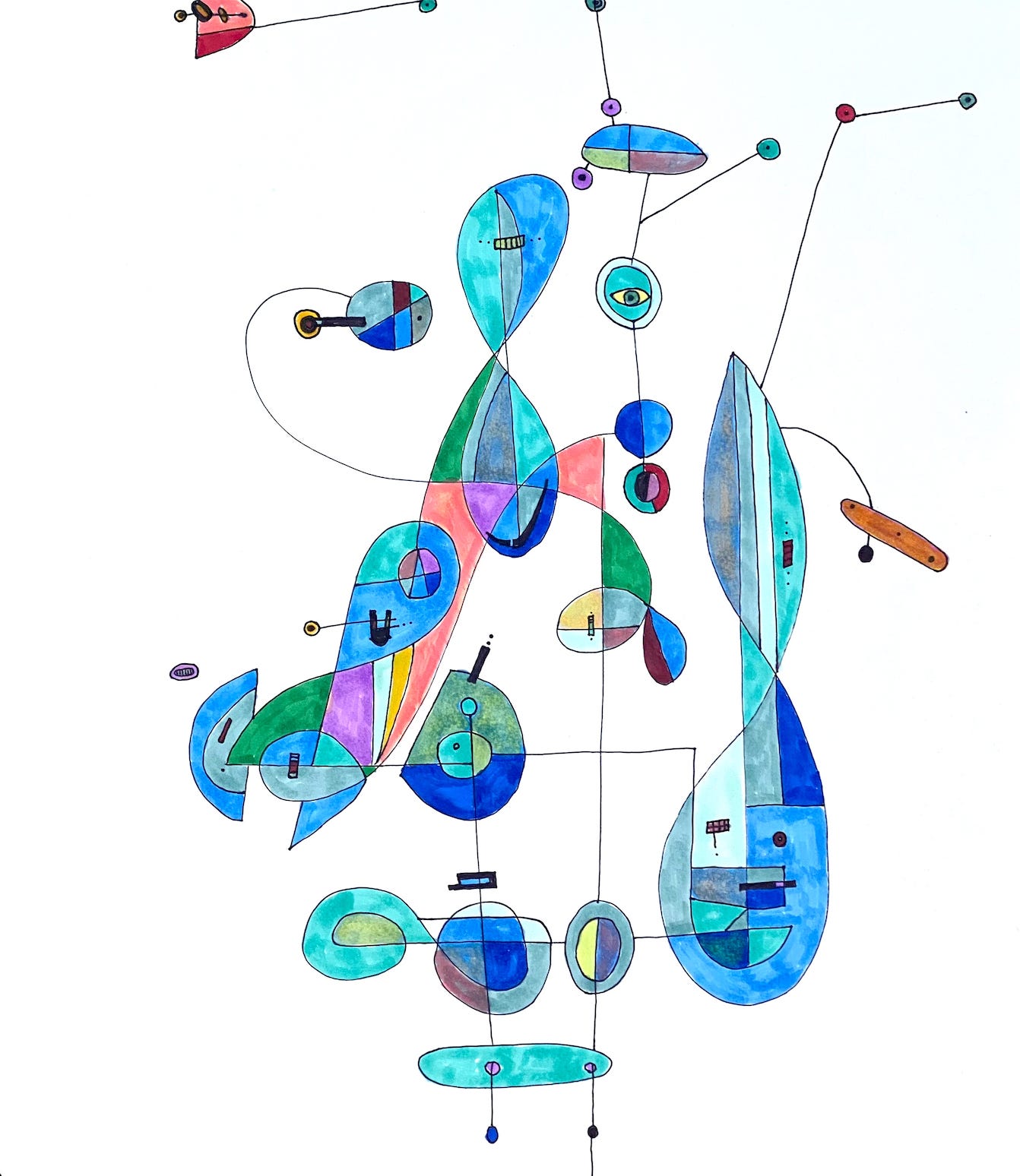
Drawing by the author (Ink and watercolor marker on paper. 17” x 14”)
It was 2020. COVID was just starting to be worried about. A heavy rain was coming down on a rooftop deck outside my window, and I was drinking my PG Tips and preparing to leave the apartment when I got an email from a friend, a guy I knew from the music business. It felt urgent, something I didn’t expect, since it’d been a while since I’d heard from him and because our day-to-day dealings over the years were pretty business-like.
His email got straight to the point.
He asked me how I could have faith in God when we live in a world as frightening and uncertain as ours is. A world where evil shows its face every day. He knew, as everyone at Sony did, that I only ate kosher food and kept Shabbat. He must have thought I’d have a better response than a rabbi would. I figured he didn’t want a perfunctory answer, as if there was one.
I started out by citing a short but crucial Hebrew phrase that’s said when the Torah is removed from the ark during festivals and Sabbath services. In transliterated form, the phrase is written as Ain od milvado. It literally means “There is none but Him.” Its most familiar interpretation is that there’s only one God, as opposed to two gods or twenty gods.
But it also has a deeper meaning: there is no conceivable, or inconceivable, object, entity, or truth other than God.
Look, even if this isn’t your thing, stay with me for a little while longer. I promise, it won’t hurt.
When I think of how to explain the vastness of this concept, I find myself going back to a physician, philosopher, and arguably the greatest and most influential Jewish thinker of the Middle Ages — Moses Maimonides, better known as the Rambam. He lived from 1138 to 1204 CE.
Unlike today, this was an age when belief in God was a given. The Rambam wasn’t trying to prove God’s existence — he was expanding what it meant to think about God. He famously explained God’s omniscience this way: “God is the knower, the known, and the knowledge itself.”
What the Rambam is describing is a oneness so comprehensive, so entirely unique, that it precludes the independent existence of anything else. In a poetic sense, it also suggests that God alone is truly alone.
Whatever your conception of God may be, believer or skeptic, it will inevitably fall short. To call God “inconceivable” is itself a conception. The moment I make that claim, I have already reduced what cannot be reduced.
Here’s a simpler way to think about this.
At the moment I was writing the email to my music-business friend, God was, in some sense, responsible for my fingers tapping my sentences onto the keyboard, for every raindrop striking the rooftops beyond my window, and for every feather on every pigeon taking shelter beneath the eaves.
Since only God exists, there can be no separate force of evil in the world. The devil, if there such a thing, could not operate independently of God. The dilemma is unavoidable and troubling. It speaks directly to the question my friend posed in his email: if there is truly nothing but God, where does evil come from? How does one account for the Holocaust, or the death of a single child?
An adequate answer lies well beyond the scope of this essay, but Jewish thought offers one enduring possibility. It proposes that what we experience as evil is not a separate or competing power to God, but a necessary pre-condition for free will.
If human beings are commanded to choose goodness, there must also be the possibility of choosing otherwise. God continuously sustains even that which appears to stand in opposition to His will, because without that apparent opposition there could be no moral freedom. I use the word “apparent” because nothing—not even what we call evil—exists outside God’s sustaining presence.
This may help explain why evil exists, but it does little to ease the pain of those who suffer from it. I remain wary of anyone who presents this, or any explanation of evil, too quickly or with too little sensitivity.
The human tragedy is that we have, through our choices, enlarged that tiny portion of evil far beyond its intended scope and purpose. Therein lies the inherent challenge of mankind’s free will. The idea is crystallized in the famous biblical dictum “I set before you life and death; choose life.” It’s humanity’s wrong choices (although they are choices “allowed” by God) that are responsible for the preponderance of evil in the world.
God should have no restrictions. Why not banish all evil? Perhaps it’s as I’ve said, to allow for free will. Did this make my friend go: “Ah, yes, thank you Peter. Now I understand!” Hardly. And yet, it’s a perspective that’s been held by generation after generation of people, many of whom were, and are today, incredible geniuses.
For me, the question of faith in God comes down to more practical matters: How do we cope with the not-knowing that surrounds us at every moment? How do we reconcile ourselves to the fact that we will never understand many of the things we take as a given — air, for example, or light, or water, or the ability to communicate our thoughts, or to give birth to a child who can give birth to a child of her own? How do we get used to the supernatural phenomenon of our own consciousness? Or do we just ignore the idea that our existence and the existence of the entire universe is a miracle?
My friend died not long ago. That email, I would later realize, was one of the last exchanges we had, and, in hindsight, one of the most honest. He was a brilliant man who argued for a rationalist approach to life, death, the existence of consciousness, and the creation of the world.
I never argued the case for the existence of God with him. That would have been pointless. But I did once ask him if he believed there were things that lay so far outside the ken of the human mind that they could never be conceived of, much less understood.
It was his opinion that with enough time and effort, theoretically, at least, everything is knowable. My belief is that the human mind is limited, and that the number of things we are capable of truly understanding is utterly overshadowed by the things we will never comprehend.
At some point, I asked him why, if he didn’t believe in God, he was seemingly so upset that his daughter had married out of her Jewish faith.
I knew I’d hit a nerve.
He finally said, “I don’t know why. I find it difficult to explain.”
I left it at that.
I consider it my spiritual and creative practice to make a kind of peace with the unknowable. With it I’ve found a sort of elevating humility, a state in which I begin to perceive myself as a tiny part of the world rather than the center of it. I’ve tried to put myself in a place where everything doesn’t revolve around what I need, what I want, what I feel, and what I believe.
That doesn’t always work. And whether it does or not, it doesn’t make me special or insignificant. It just is.
I only know that the more willingly I approach the unfathomable, the nearer I come to my own ever-evolving connection to God.
Faith is difficult. It isn’t about belief. It’s about adjusting to being human.
The essays I care about most are written to begin conversations. If you'd like to be part of them, I hope you'll consider becoming a paid subscriber. You'll receive access to my full archive of more than 600 essays, exclusive posts, creativity seminars, virtual concerts, and our subscriber community. Most of all, thank you for your readership.
(This essay grew out of a shorter piece that first appeared in my book Suspended By No String.)
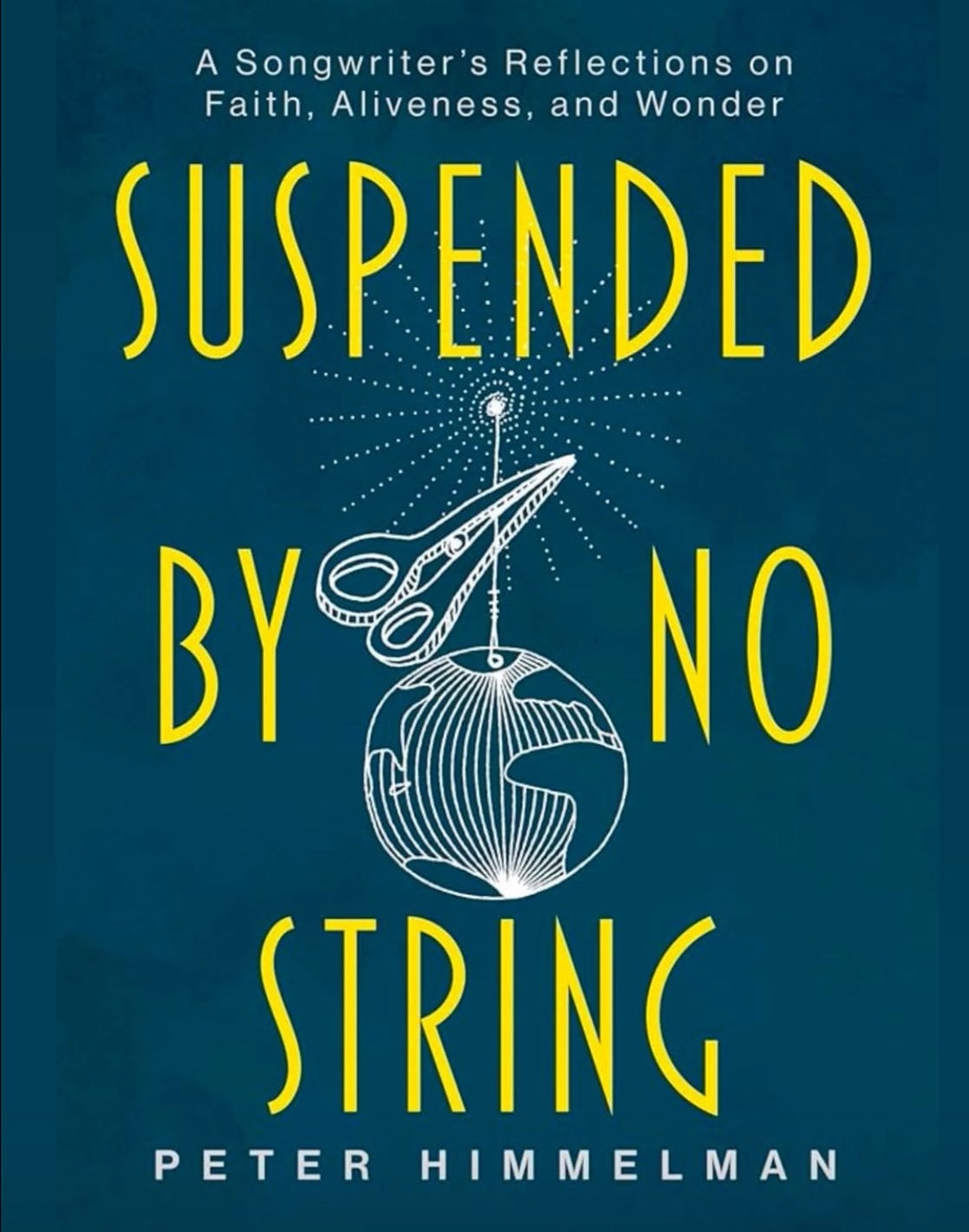
“Peter Himmelman has a great gift for helping us open our minds, discover new ideas, and express ourselves.” —Jonathan Eig, Pulitzer Prize winning author (King, Ali, Capone, Luckiest Man)
Note for paid subscribers! Stay tuned for information on receiving a link to watch our Minneapolis show on August 20—live and online. The venue has great sound and video capabilities.
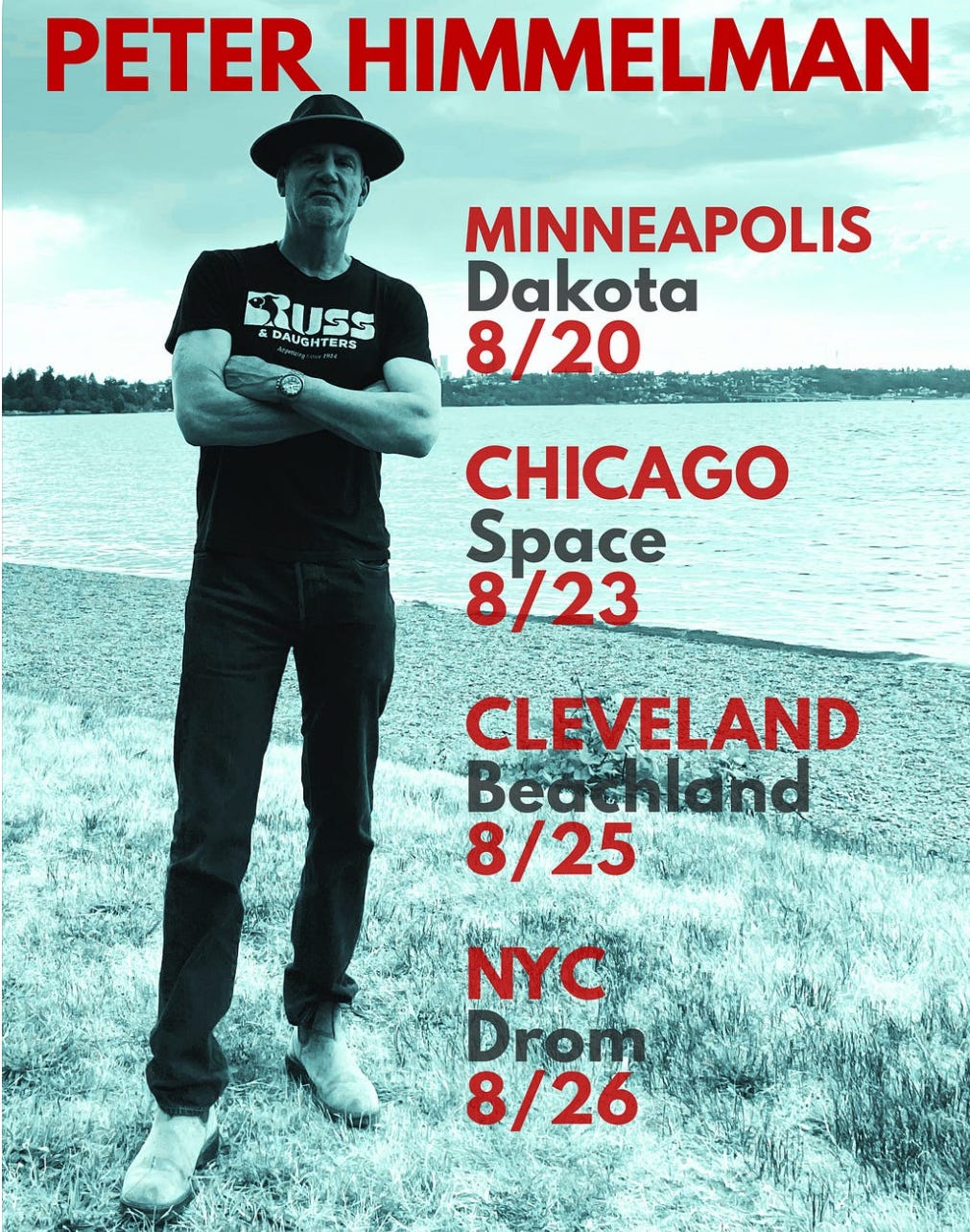
Minneapolis, MN
Evanston, IL
Cleveland
NYC, NY
No posts
Comments
Nothing yet. Say the first thing.
Sign in to join the conversation.