
Dear friends,
This is not my usual kind of Substack letter. I’m doing no research for it. I’m documenting nothing. I’m on vacation with my wife at our A-frame cottage on Blodgett Hill in Cabot, Vermont. I’m typing semi-reclined on a futon looking out at a beautiful blue sky above the towering green of the trees. I’m writing as I might in an actual letter to friends. I am not giving it a number, as it is not part of the collection of letters I recycle on Facebook.
I like to think of Cabot as “where I’m from,” but truth be told I only resided here year-around for two years—my last two years of high school. I’m a 1962 graduate of Cabot High School. But my parents and younger bothers stayed here for years after that, and one brother still lives with his family in Plainfield, near Cabot, so this is where I have for 64 years been going “home” to family. I also have ancestors (no longer living) who lived in this area before the ancestral branch that produced me moved to Minnesota, which is where I mostly grew up before we moved to Cabot.
If you have heard of Cabot, it’s probably because of Cabot cheese and other Cabot dairy products. Those now are sold nationally, even internationally, and are made not just in Cabot but also at branch creameries elsewhere. Cabot Creamery products were just local when I lived in Cabot. I worked for a few months in high school at the creamery, as an afterschool job.
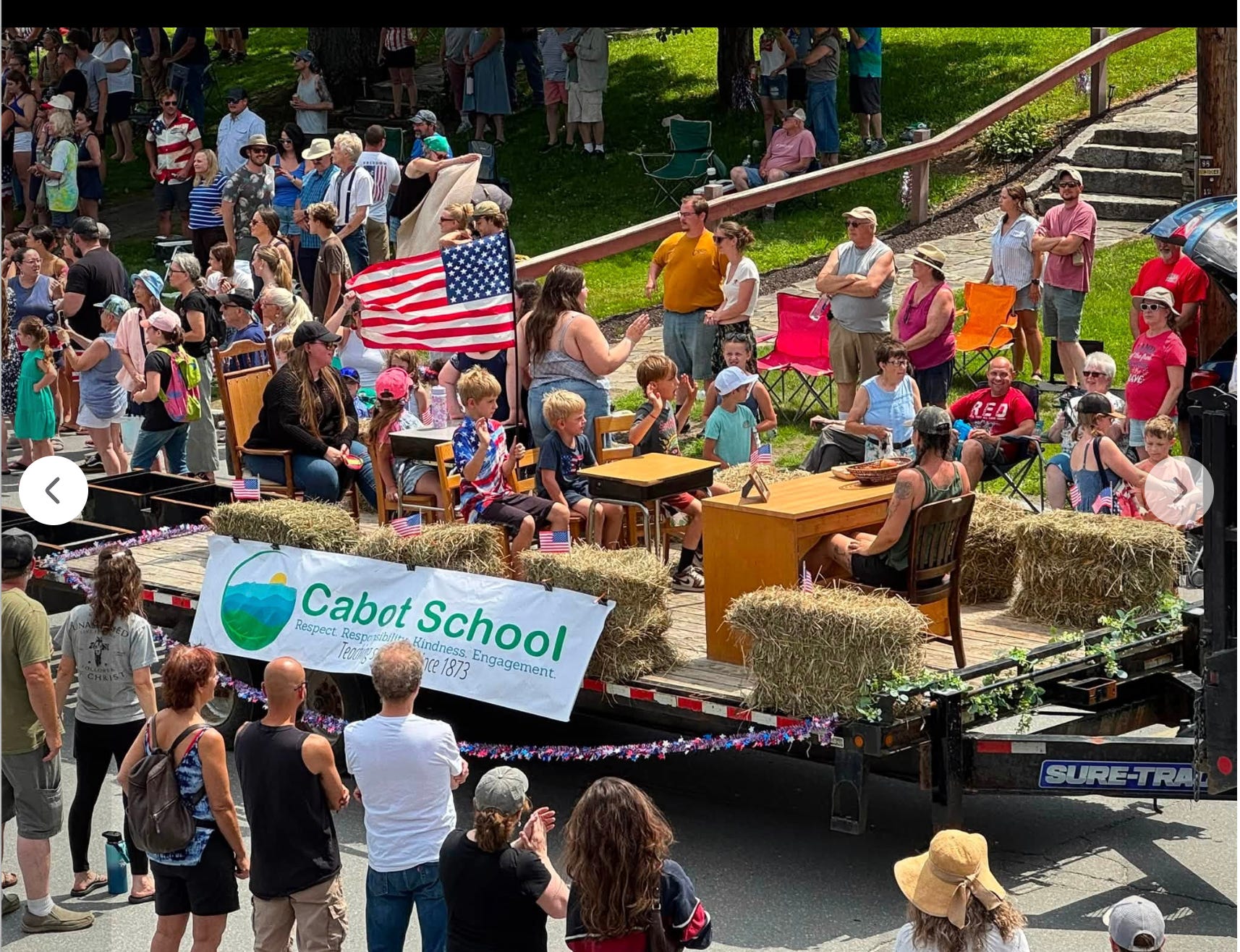
Regular readers of my writings know well my distaste for conventional schooling, but I must confess that I liked Cabot School. When I was a student there, there were just 52 students in the high school, just 12 in my graduating class. The school is still going strong, with about the same number of students as it had then. Cabot has stubbornly resisted pressures to consolidate with schools in other towns, which attempts had been present even before I became a student there. I’m glad of that.
When a school is small and everyone knows everyone, it has a kind of family feel. At least that’s how I felt about Cabot School. Courses were adapted to some degree to the needs of the students, and I recall teachers and the school principal being rather humble and open to students’ ideas and opinions. We had most of the usual extra-curricular activities, and the great thing about them was that anybody who wanted to be part of them could be—in fact was encouraged to be. To have boys’ and girls’ basketball teams (which competed with other small schools throughout the state) we needed all the boys and girls who wanted to play, regardless of ability. Similarly with the boys’ baseball team. We also had a school chorus, student newspaper, student yearbook, one or two school plays a year, and a debate team that did well even against big schools, including those in Burlington and Montpelier. I was part of all of them. Our teams did well, but we didn’t feel much pressure about winning. We were in it for fun. We did well despite our small size because, in a setting where they know they can be on the team, kids rise to the occasion and become pretty good.
The A-frame cottage, from which I am writing this letter, was built by my uncle Wyman Smith shortly after I left Cabot to go to New York City for college and graduate school. I helped a little on a visit home one summer. Wyman is the uncle who encouraged my family of origin to move to Cabot from Duluth, Minnesota, where we had previously lived. Wyman was a lawyer by profession, but his love was maple sugaring. He had purchased what people call a “sugarbush,” here on Blodgett Hill, and spent as much time as he could working it. Helping him with the sugaring—at a time when we hung buckets rather than plastic tubing—was another of my learning experiences the two years I lived in Cabot. Wyman also was the volunteer who coached our school debate team and drove us around to meets throughout the state.
When Wyman died his children inherited the cottage and land (about 70 acres of woods), but after a few years I learned they had put it up for sale. I bought it to keep it in the family, I think in 1998, and have spent time here ever since when possible. My mother—who lived up here her last days—is buried on the property. She’s buried the way she wanted to be buried—in a pine coffin made by my brothers Fred and Barney, in a hole my brothers and I (her four sons) dug together in the woods. She wanted no marker, but her brother Wyman put a small one there later, anyway. I’m glad of that, as it has allowed me to find the spot and think about her from time to time as I walk the woods.
But now I want to turn my attention to yesterday, the Fourth of July, 2026, the 250th anniversary of the founding of this country. Cabot regularly has perhaps the greatest small-town Fourth of July parade in Vermont. People come from surrounding towns to participate in it and see it. Not surprisingly, at such events my own eyes are drawn to the children.
After the parade, as people picnicked and examined the wares at various booths on the town common, children frolicked as children do whenever there is a bunch of them together and nobody stops them. I watched a kid, maybe about 7, somehow get himself up into a tree that had no lower branches. He climbed barefoot, and used his feet the way a monkey would. I watched kids chasing one another around, doing wheelies on bikes, climbing on the Civil War monument, and on and on—doing what kids are designed to do—and nobody was telling them not to. Maybe Independence Day, at least in Cabot, is Independence Day for kids.
We need in this country a new Declaration of Independence, a declaration that children, to grow, must have more time than we currently allow them, and more time every year as they grow older, in which they are not guarded and told what to do by adults, but are free to manifest their biological drive to make their own decisions, play in their own ways, take charge of themselves, and play with other kids unimpeded by adult-imposed constraints. For more on that, I refer you to Lenore Skenazy’s Free Range Kids blog post, The Declaration of Childhood Independence!
With respect and best wishes,
Peter
Thanks for reading Play Makes Us Human! This post is public so feel free to share it.
Comments
Nothing yet. Say the first thing.
Sign in to join the conversation.