
Dear friends,
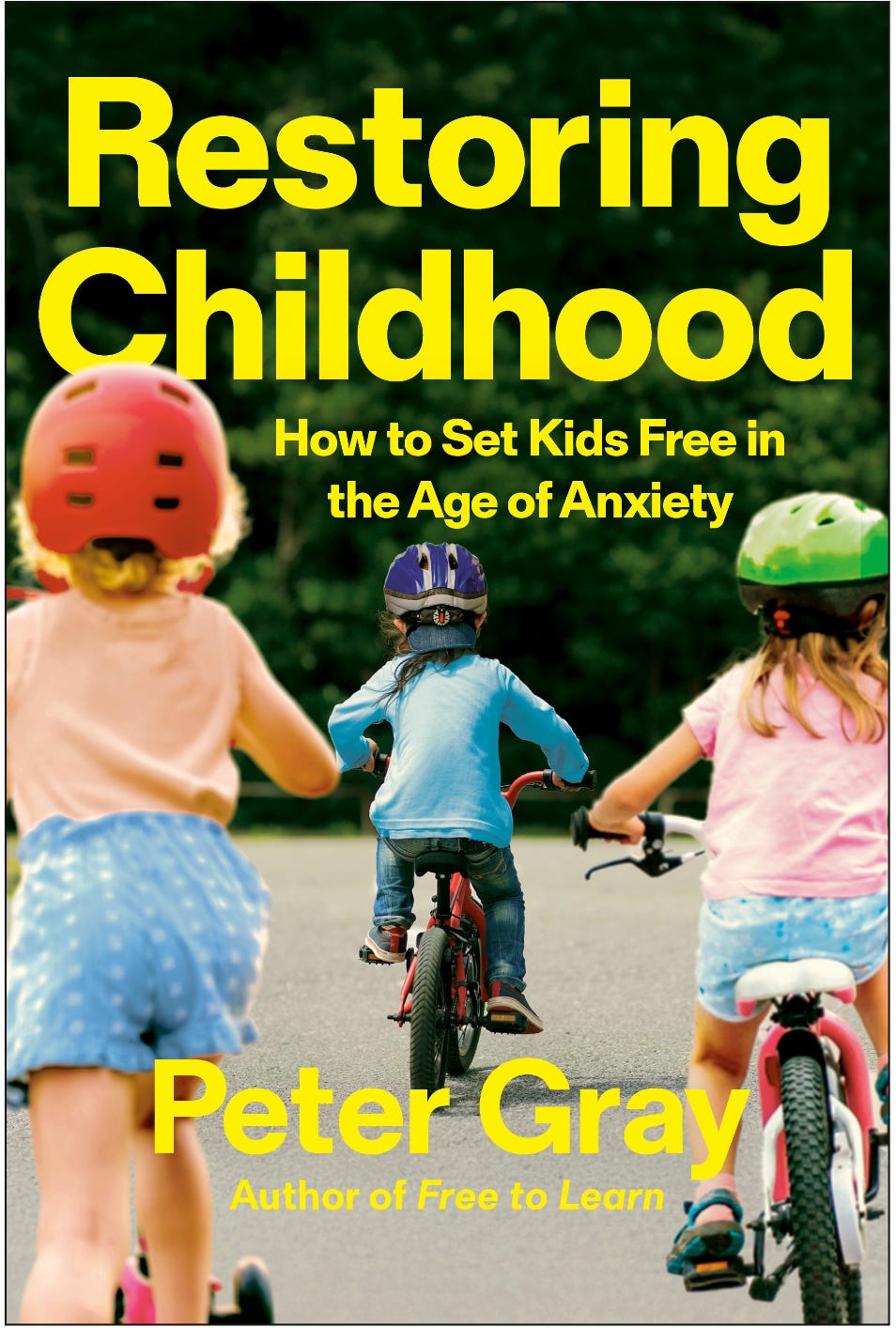
Perhaps you’ve noticed that my letters recently have a been spaced a bit farther apart than usual. I’ve been somewhat overwhelmed with tasks, but in a good way. Prepublication announcements about my new book—Restoring Childhood: How to Set Kids Free in the Age of Anxiety—have led to a flurry of media activity on top of everything else I was doing. Perhaps you saw the Atlantic article, or the recent New York Times article. Almost every day lately I’ve been involved in some sort of interview or media event. Earlier today I was interviewed for an upcoming NPR Ted Radio Hour discussion and composed and recorded a “Book Bite” for the Next Big Idea Club. Tonight, at 9 pm Eastern, I’ll be on McGraw Milhaven’s America at Night talk radio show. (Don’t worry; my wife is very good at keeping my head from swelling.)
Admittedly, I’ve been quite justly accused at times of being overly optimistic, but I think my new book has the potential to change the way we, as a society, think about children and what they need (and don’t need) from us. There seems to be lots of media interest in the research-supported insights I present in Restoring Childhood. If you have been a regular reader of these letters, you will not be surprised by the insights, but you will find them more fully developed, supported, and in some ways more nuanced in the book.
• The fundamental task of childhood is to grow ever more independent of parental (or other adult) care and protection. Current societal practices are hindering, even preventing, children from pursuing that task. This has led to psychological suffering.
• Children need time and space to play, explore, daydream, find themselves. We are keeping children way too busy with adult-directed activities.
• Children need less forced instruction, less oversight, more trust. All those extra hours of schooling along narrow, curriculum-determined lines, are burning kids out, not educating them. Academic instruction to little kids, in preschool and kindergarten, has proven to be especially harmful.
• Children gain courage, agency, social skills, emotional control, and much more through their independent play with other children, away from adult intervention and control. For a satisfying life, these skills are way more important than what is taught in school.
• We need to stop forcing anxiety-inducing competitions onto children, in school and elsewhere. We should encourage cooperation, not competition. Making friends is much more important than winning.
• We must stop thinking of childhood as a period of résumé building for some future charted by adults and start thinking of it as a period of finding oneself and figuring out how that self fits best into today’s world.
• The parental practices that have come to be labeled “intensive parenting” are harmful to children and parents alike.
• Teenagers need more acceptance into the culture as the apprentice adults they truly, biologically are. We need to stop treating them like infants.
• We need to welcome kids into public spaces rather than discourage them.
• To adapt well in today’s world, children need freedom to play and explore in digital space, just as they need freedom to play and explore in other spaces. The digital world is increasingly an integral part of all aspects of the “real world” in which our children are growing. There is no going back.
The publicists at Penguin Random House have informed me that they will provide a link to the book’s Introduction, so you can get an early start in reading the book, if you preorder the book before its publication date (Sept. 15). Preorders are valuable, because they help convince marketers that the book will sell well, so they stock up and put the book front and center in their sales procedures. The earlier you preorder the better. Here are links to some places where you can preorder.
Amazon Barnes & Noble Books A Million Bookshop.org Hudson Booksellers Powell’s Target Walmart
And here is the link to claim your small gift, the book’s Introduction.
For those of you who are paid subscribers, either our September or October online meeting (or both) for paid subscribers will be devoted to a discussion of Restoring Childhood.
With respect and best wishes,
Peter
Thanks for reading Play Makes Us Human! This post is public so feel free to share it.
Comments
Nothing yet. Say the first thing.
Sign in to join the conversation.