
This is the newsletter for the New Kind of Monster project - an ambitious and twisted project whose goal is to invent an entirely new kind of monster. In our special orbital nuclear weapons issue, we’re going to examine recent reports of a Russian effort to deploy a nuclear anti-satellite system in space.
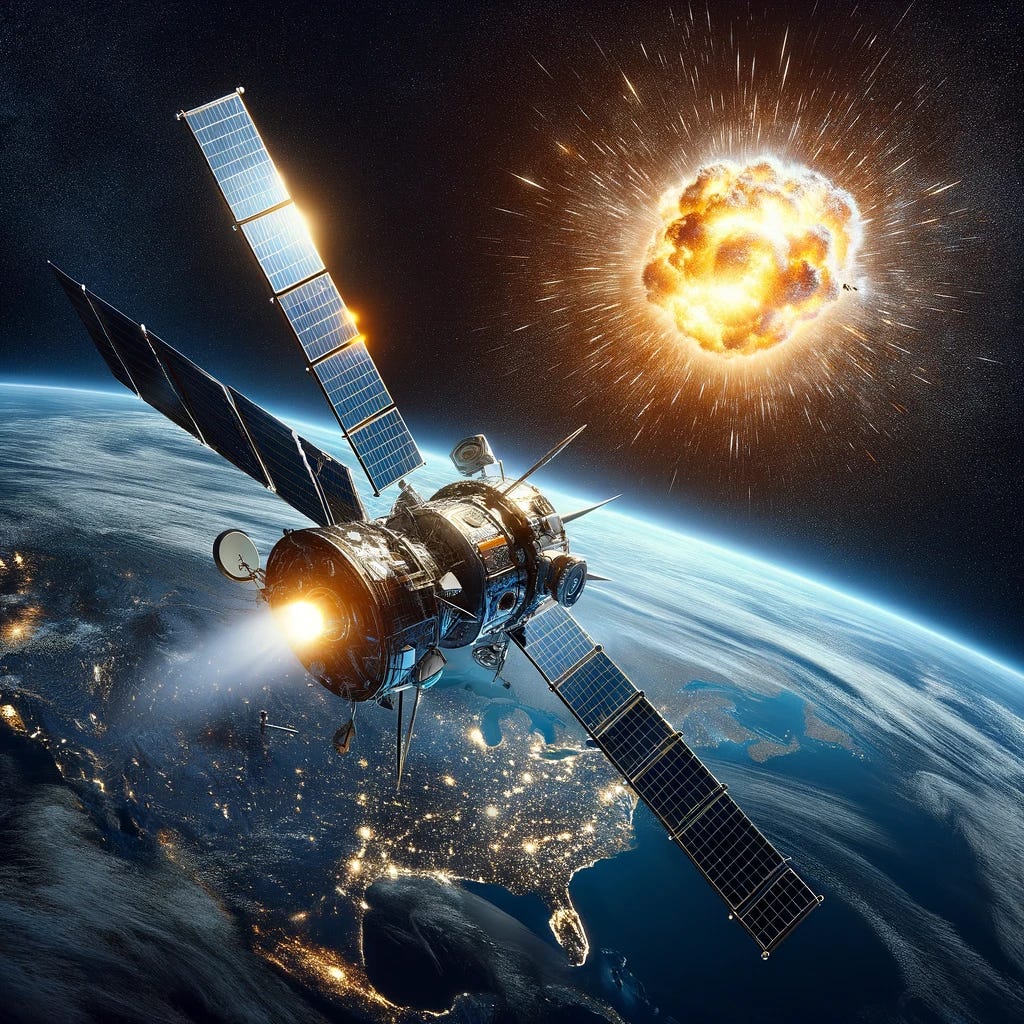
Hopefully it’s obvious that nuclear bombs in space are really bad. A bad guy - sorry, a bad actor (gotta use the cool geopolitical terms here!) - can wait for months or even years, while their space-borne superbomb flings itself around the Earth every ninety minutes. When it’s finally time to implement their devious plan, they simply command the orbital weapon to fire its retro-rockets. It will de-orbit within minutes, arriving at its target far faster, and with far less warning than even an intercontinental ballistic missile.
But dropping bombs from space is, frankly, the least interesting thing you can do with an orbital device capable of spewing gamma-rays into the Earth’s magnetic field.
I always keep a copy of UNITED STATES HIGH ALTITDUE TEST EXPERIENCES1 on my bedside table. Here’s what my favorite bedtime reader says about the electromagnetic effects of high-altitude radiation on electrical and electronic systems:
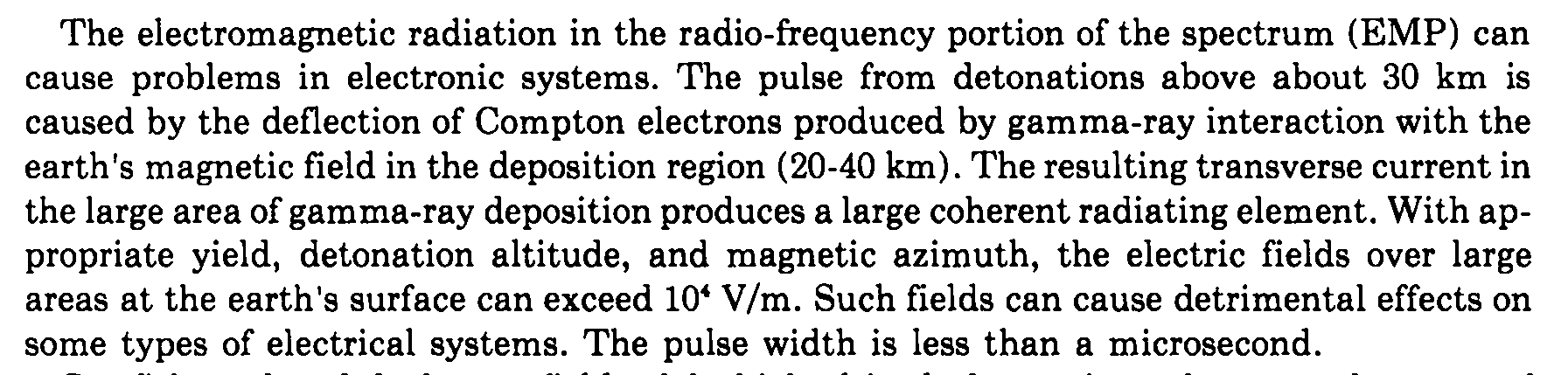
What does “detrimental effects on some types of electrical systems” mean? The Washington Post explains that someone could detonate a nuclear weapon in space to interfere with satellites through the emission of radiation.
Imagine being outside on your patio or balcony one mild spring evening. Suddenly, a second sun flickers to life for a few milliseconds, just above the horizon. Over the course of a minute or two, it fades to a diffuse florescent cloud that crawls across the sky above you.
“Hey honey,” you shout to your partner through the screen door. “Did you see that?”
“What’s that?” your partner replies.
“There was some kind of weird lightning or something up in the sky.”
“Whatever. Look, we got problems. The Doordash guy just messaged me. His GPS isn’t working. He can’t figure out how to get here.”
The Doordash guy never gets there. No Doordash guys ever get there again. Our constellations of GPS satellites, and telecommunication satellites, and weather satellites, and spy satellites, are gone. Fried. Toasted. Instantly transformed into inert, orbital junk. Don’t worry - new ones be launched in a few centuries when the radiation finally clears out of Earth’s magnetic field.
Russia’s current bid to be the first nation with a space-nuke isn’t the first time someone - a bad actor - has attempted to disrupt civilization with a satellite-killing space radiation. It’s already been tried.
Three years ago, a megalomanical supervillain nearly destroyed the world’s fleet of satellites by attempting to launch seven Angara heavy-lift rockets tipped with highly-radioactive cesium-thorium devices into orbit. Had he succeeded, life as we know it today would be much different.
This genius-madman’s plot was thwarted at the last moment by an agent working for the Directorate - a shadowy multi-national intelligence agency whose legality depends on an unconventional interpretation of the constitutions of the participating nations.
While the plot failed, the crazed criminal scientist managed to narrowly escape before his headquarters disintegrated in an inferno of ferociously combusting rocket fuel. He wrote a memoir about his experience. Here is an excerpt from his yet-to-be-published book:
I have always preferred to reside in the same facility as my headquarters and command center. I can’t afford the time expenditures or the security risks inherent in a commute. But establishing a suitable facility is not always easy to accomplish. For instance, when I posed as the reclusive Lord Barnevon, I placed my command post in the labyrinthine chambers beneath his castle. The facility was accessible only through a concealed panel in the servants’ quarters, where Ehrlich lived, posing as my butler. Even for the two of us, moving the racks of computers and surveillance equipment down the castle’s ancient winding staircase was a difficult chore. And the construction methods used to build fortifications in the late 800s completely failed to anticipate the eventual need to route three-phase power cables through the subterranean passages.
In the staging area on the island of Karnemakwa, I took up residence in an abandoned aircraft hangar, coordinating the logistics and strategy of my mercenary army from a lovely set of mid-century modern tables arranged in a small cluster in the center of the cavernous building. I loved to hear my voice resonate through the chamber when I shouted, “Next time, you had better bring me RESULTS.” The echoes of my mercenary commanders scampering away to do my bidding made a nice dénouement to my frequent crescendos of rage.
That old aircraft hangar was one of my favorite headquarters. I prefer large, dimly-lit spaces for my audience chambers and meeting areas. Such a setting lends an importance to the directives and commands I issue, and allows my screams for results to echo a bit, amplifying the fear they create in my often-incompetent underlings. And, during off-hours, Ehrlich likes to practice his yoga and krav-maga in the lonely, empty spaces.
My very favorite command center, however, was the one I abandoned ten days ago. I had established the nerve center of my operations on the bottom deck of one of the legs of the larger of my two stolen oil rigs. Inspired by the tenets of Feng Shui, I had arranged my set of replica Liao Dynasty writing tables in a flower pattern on my antique Ningxia rug. The contrast between the elegant ancient style of the furniture and the soulless machinery and plumbing of the rig produced a nice effect. I was so fond of that command center that I even bothered to tolerate Ehrlich’s endless complaints that the encroaching machinery interfered with his krav-maga practice. Why couldn’t he practice his krav-maga on the helicopter pad?
I was in my command center in the oil-rig when Yuri, Ehrlich, and a squad of my security personnel brought me the handcuffed Mr. Wendleburr. He was onboard as a representative of one of my narco-warlord financiers. Rather, as all of us standing on my Ningxia rug learned, the handcuffed man was posing as Mr. Wendleburr. The real Mr. Wendleburr had been found a short time earlier, bound and gagged in a machinery space on deck five. We instantly sounded the intrusion klaxon and the imposter was captured in a matter of minutes. Yuri found him behind the communication rack, attempting to sabotage the satellite uplink equipment. Greenwald, my computer expert, discovered the tracking device he had connected to the empty network drop in the commissary.
“Mister Wendleburr,” I said calmly as he stood in front of me, a few feet from the edge of my Ningxia rug. “I suppose that’s what I shall call you until we find a more … accurate … name for reference to you.”
“Very well,” he said calmly. Was that a fake British accent he was using, or was that his real voice? “I’m very impressed with your little operation here,” he added with a smirk.
Being professionally roughed up by Ehrlich and Yuri seemed to have had no effect on him other than slightly mussing his hair. His sarcastic smirk and tousled blond locks amplified his boyish charm.
“Oh, you should be impressed,” I said. I strolled to the front of my replica Liao Dynasty writing table and sat on the edge. “In a few moments you will get to watch me tell the United Nations Security Council that I’ve initiated the launch sequence for the seven Angara rockets stored in the remaining legs of my oil rigs.”
“I’ve seen them. Very impressive rockets. What’s in them?”
“I suppose I can tell you now, since there’s nothing you can do to stop me.” Ehrlich began to say something, but got no farther than “Um-“ before I shushed him with a wave of my index finger. “They each carry a special kind of nuclear device.”
“You’re threatening the world with nuclear weapons?” Fake Wendleburr feigned disappointment, “I thought you had something much more interesting planned.”
“Oh, oh I do. Much more interesting.” I had to shush Ehrlich once again before continuing. “Nuclear extortion isn’t practical. Plutonium is too hard to obtain. Uranium enrichment takes soooo long, and all those noisy centrifuges spinning endlessly give me a headache. But obtaining the cesium-thorium physics packages at the tip of each of my rockets only required well-laundered money, a few forged identities, some bribes, and a cadre of corrupt Russian physicists. Anyway, the extremely dirty nuclear material in those rockets will irradiate low Earth orbit very nicely. And that radiation will cause satellites to fail. All of them.”
“Well, I suppose everyone will have to get together and launch some new ones.”
“Those will fail too. Earth’s orbit will be polluted with enough radiation to kill even hardened military satellites for the next four hundred years, Mr. Wendleburr.” I paused for effect. I liked the way my voice echoed off the metal walls of the rig’s hollow leg. “But there is a way of making electronics that can survive in such an environment. Do you know how that can be done?”
“Lots of aluminum foil?”
“No. Only microcircuits made from rhodium borosilica can survive the levels of radiation I’m going to place around our planet.”
“Rhodium borosilica?”
“I’m sure it was mentioned in the mission briefing your employers, whoever they are, gave you. It’s extremely rare, and can only be found in fewer than one percent of the meteorites that have fallen to Earth. Also, and this is the really interesting part, I have acquired all of it. Literally. All. Of. It. Is. Mine. I own one hundred percent of what is about to become the most valuable substance in the solar system.”
“Well, I’m sure you’ll use it responsibly.”
“You can trust me to use it very effectively. Now good bye, mister Wendleburr.” I turned to Ehrlich. “Bind him under the rocket in leg four. And make sure he’s in view of the launch-chamber camera. I want to watch him incinerate when we launch.” Ehrlich, Yuri, and the security squad led the now silent Wendleburr out of my command center.
If you’re in the mood to be told a story, instead of reading one, I highly recommend Scary JUJU’s narration of My patient spent eight million years under a bench at the Glenmont metro:
In the Back From the Dead section of this newsletter, we descend into the dark corners of my laptop’s hard disk to find the fragments of abandoned works that once showed promise - like an elementary-aged student who was sentenced to time in the school’s Gifted program.
In this issue, we’ll look at another excerpt of the memoir of a defeated supervillain.
Last time this project was actively in-work: 4:27 pm, August 27, 2022
Scene: Our protagonist, an international criminal mastermind, is lying low in the rural Virginia town of Harlan’s Creek. He has devised a plan to make his comeback - a plan which is now in peril. His thuggish henchman Ehrlich has somehow tracked to Harlan’s creek. Ehrlich, once a loyal minion, is now a fierce foe. And he wants revenge.
When darkness befalls you, you must fight the darkness with an equivalent amount of light. If you experience a modest inconvenience - running out of petrol, say - then you must address this problem with a plan that will cheer you up to the extent you are demoralized. Rob the petrol station!
Larger problems must be attacked with solutions that bring even greater benefits. Have you found yourself being the victim of a kidnapping? Become an accessory to your own abduction and form a more profitable plan with the kidnapper.
When your personal valley of darkness is so deep you cannot even see the sky, you must think big. Moonshot big. Hoover-dam-perched-atop-the-pyramids-at-Giza big.
At that moment in the Harlan’s Creek town square, my personal valley of darkness was immeasurably deep. Oil-well-at-the-bottom-of-the-Marianas-trench deep. I cowered behind the narrow obelisk of the Civil War monument in the center of Harlan’s Creek’s green. Not ten meters away, my violent adversary sat on the grass, gathering strength and focus from his yogic meditation and exercises. I was fortunate to have wandered onto the green while he was meditating, his eyes closed. I am an expert on Ehrlich’s exercise habits, and I know that his meditative yoga poses only last for thirty seconds or so. I dove behind the Civil War monument and waited to learn if he saw me.
I had strutted onto the green only thirty seconds earlier. Yet, that version of myself from thirty seconds ago might as well have been the person I had been as a child. I had been full of the confidence, high on the buzz of mathematical modeling. That morning in my trailer - I mean, my command center – I had downed a heavy dose of game theory, chased it with a healthy swig of probability modeling, and then allowed a tab of social science to slowly dissolve on my tongue. My confident swagger as I strode onto the green was really the lurching stagger of a fool drunk on the idea of certainty.
There is no mathematical model for Ehrlich. His temper flares unpredictably, and when it does, he draws on an artistic level of creativity in the design of his violent acts. During our years of working together, he often returned from the most benign errands with bruised knuckles and a sleeve torn off his shirt, bragging of the damage he inflicted on whoever, or whatever, had slighted him.
When his task was one that required the use of force, threatening a recalcitrant partner or fighting our way out of an uncomfortable situation, he delighted in finding ways to use the most unlikely objects as weapons. I’ve kept a mental list of the objects he has used to send our adversaries to the hospital. This list incudes a yoga ball, a cocktail shaker, a paperback copy of Catcher in the Rye, and a tuba.
I leaned against the narrow obelisk and stood as straight and slim as I could manage. A dozen pounding heartbeats. Erich failed to materialize on my side of the monument. A dozen more heartbeats. Still no blur of bone-smashing fists and oxygen-depriving chokeholds. A dozen more heartbeats. I was safe.
Well, maybe not safe, but “safe,” with air-quotes around it. The most optimistic view of my situation was that Ehrlich wouldn’t kill me within the next forty-five seconds. But what would happen when he finished his yoga session? Would he stroll about the green, eventually seeing me? Would he remain on the grass for the afternoon? What about Yuri, whose pants I had come to steal? He is incompetent, yes. But if he is wandering about town, he would no-doubt raise the alarm if he saw me.
I was wearing my suit, and therefore stood out like a blooming orchid in Harlan’s Creek’s field of weeds. I might get away unnoticed if I walked as unobtrusively as possible off the green and slunk away to the safety of Stan’s shop. But plans that might work are not really part of my repertoire.
This was a terrible situation. How could I turn this around? How could I turn this dark situation to an equally large success? I needed to think big. I needed a plan that would not just safely transport me off the town square, but that would also represent a major step towards my greater goals. Sandra! I would use this as a chance to make fall her in love with me.
I opened my Autoradiopuhelin and placed a call.
I’m certain that I would have been captured or killed a long time ago if I used a standard commercial mobile phone. A modern mobile device is essentially a Victorian-era madhouse of lunatic, rogue software processes harvesting every piece of information available and broadcasting that information around the Earth. Owning a modern mobile phone is like having me in your pocket. A devious and malign intelligence bent on exploiting and betraying you.
Yet, as a professional orchestrator of complex global conspiracies, I do often need to place phone calls while away from my command centers. That is why I carry a 1968 Finnish Autoradiopuhelin with me at all times.
The Autoradiophuelin system was the first nationwide commercial mobile phone network deployed anywhere in the world. Think of it as the zero-th generation mobile communication network. The service was offered commercially in Finland in 1968, at the height of the cold war.
NATO leadership immediately recognized the system’s tremendous potential as a communication network for civil defense authorities. By 1969, every NATO country was required, by treaty, to incorporate the Autoradiophuelin protocols into their national phone networks. Only 18 months later, the commercial Autoradiophuelin company went bankrupt and was soon forgotten by the public. But the protocols are still written into the NATO treaty – look them up!2 Every NATO member country is required, by law, to field mobile communication networks that support the Autoradiophuelin protocols.
Because of this obscure rule, written into an appendix of a supporting document of an addendum to the NATO treaty, deep in the electronics of every cell tower in the Northern Hemisphere is a small and lonely 150 MHz receiver, listening futiley for the specially modulated Autoradiophuelin carrier signal. Each tower has a sad little microchip waiting and waiting to make contact and converse with a phone that hasn’t existed for half a century. These electronics are never activated. Unless I’m in town.
The phone operates at 150 MHz, which means the signal is omnidirectional. It can only be tracked if special electronic warfare gear is pre-positioned to triangulate it. This afternoon, I took the risk that such equipment had not been deployed in Harlan’s Creek.
I pulled the device from my jacket pocket. A shoe-sized enameled steel box that looks more like an ammunition case than a communication device. I unlatched the cover and opened the case. A rotary dial, a military-grade power switch, and a chunky green toggle button labeled lähettää3 smiled at me from the tiny metal sarcophagus. I extended the half-meter antenna, clicked the Autoradiophuelin into transmit mode, and began spinning the rotary dial. I didn’t know Sandra’s number, but I knew Stan’s.
“Stan, it’s Stephen”
“Stephen, Jesus. The caller ID says ‘NATO Civil Defense Authority’. I thought the Soviet Union got back together and decided to invade.”
“Yes, that’s just a glitch I have yet to work out with the phone company. Look, can you give me Sandra’s number, I need to ask her for a favor.”
“Sure thing.”
Three minutes later, I again toggled the lähettää button to transmit mode and spun the dial to ring Sandra.
“Uh … hello?”
“Sandra-“
“Oh, Stephen, it’s you. The caller ID said it was the cold war calling me. What’s up?”
“Sandra. I’m going to ask you to do me a favor.”
“It doesn’t have to do with civil defense, does it?”
“Not exactly. I need you to rush to the town square. My life is in grave danger and I need you to rescue me.”
Silence. More Silence.
“Sandra, are you there?”
“Yes. Just. Like. Can you give me some idea what this entails? Not that I want you to die or anything. But, you know. Is there any kind of heads-up you can give me?”
“There is a man performing yoga on the town green. If he sees me, he’s going to kill me. I’m hiding behind the Civil War memorial. I need you to distract him so I can escape from the green.”
“And if I do this, what’s in it for me?”
Silence. This time from my end.
“Stephen, are you there?”
“Yes, I’m here. If I survive until tomorrow evening, I will cook you a fantastic meal.”
“Fine. I’ll be there in a few. Hang tight.”
Look up NATO standard “STANAG 1074 - Standard Characteristics of Mobile Phones for Civil Defense”
No posts
Comments
Nothing yet. Say the first thing.
Sign in to join the conversation.