
My mother’s law diploma hangs on the wall of my office.
Mine is in a cabinet.
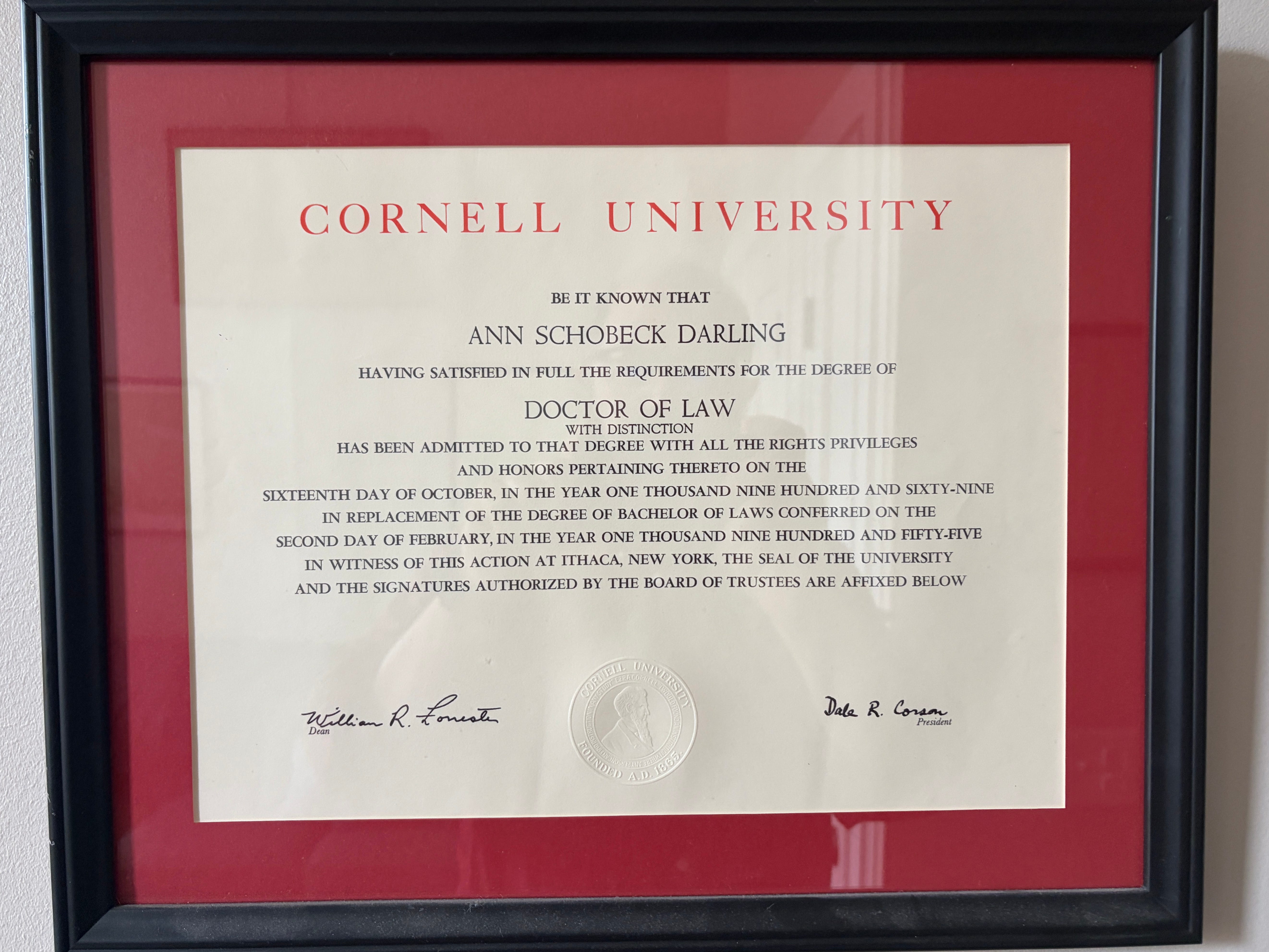
Her diploma, from Cornell Law School, has the red Cornell logo and matching matting. The paper has the faint yellowing old documents acquire with time, and the lettering has that particular weighty solemnity universities favor for things meant to last longer than the people who earn them. It’s the first thing you see when you walk into the room.
Mine, from the University of Pennsylvania, is smaller, monochromatic, and in impenetrable Latin, with a translation thoughtfully tucked into a pocket in the back. It has spent years in a cabinet behind files and old papers.
A few weeks ago, the possibility arose that I would rejoin the Pennsylvania bar, after almost thirty years away. I left in 1998 to join a startup in California. At the time, I believed that I would never, ever even consider practicing law again. Now, I’m thinking about the diplomas and the experiences that connect me to my mysterious, unknowable, emotionally distant mother, and reconsidering the whole thing. I think I’ve figured something out.
My mother graduated in 1955: seventy years ago. There were two women in her class and ninety-eight men.
A woman attending an elite law school like Cornell in that era was walking into a place where she was not welcome. When she spoke about law school, which she did only occasionally, my mother did not describe discrimination. She described open hostility. Professors who treated women as anomalies. Classmates who viewed them as intruders. She was hit on, insulted, belittled, criticized. She was also beautiful, which didn’t help.
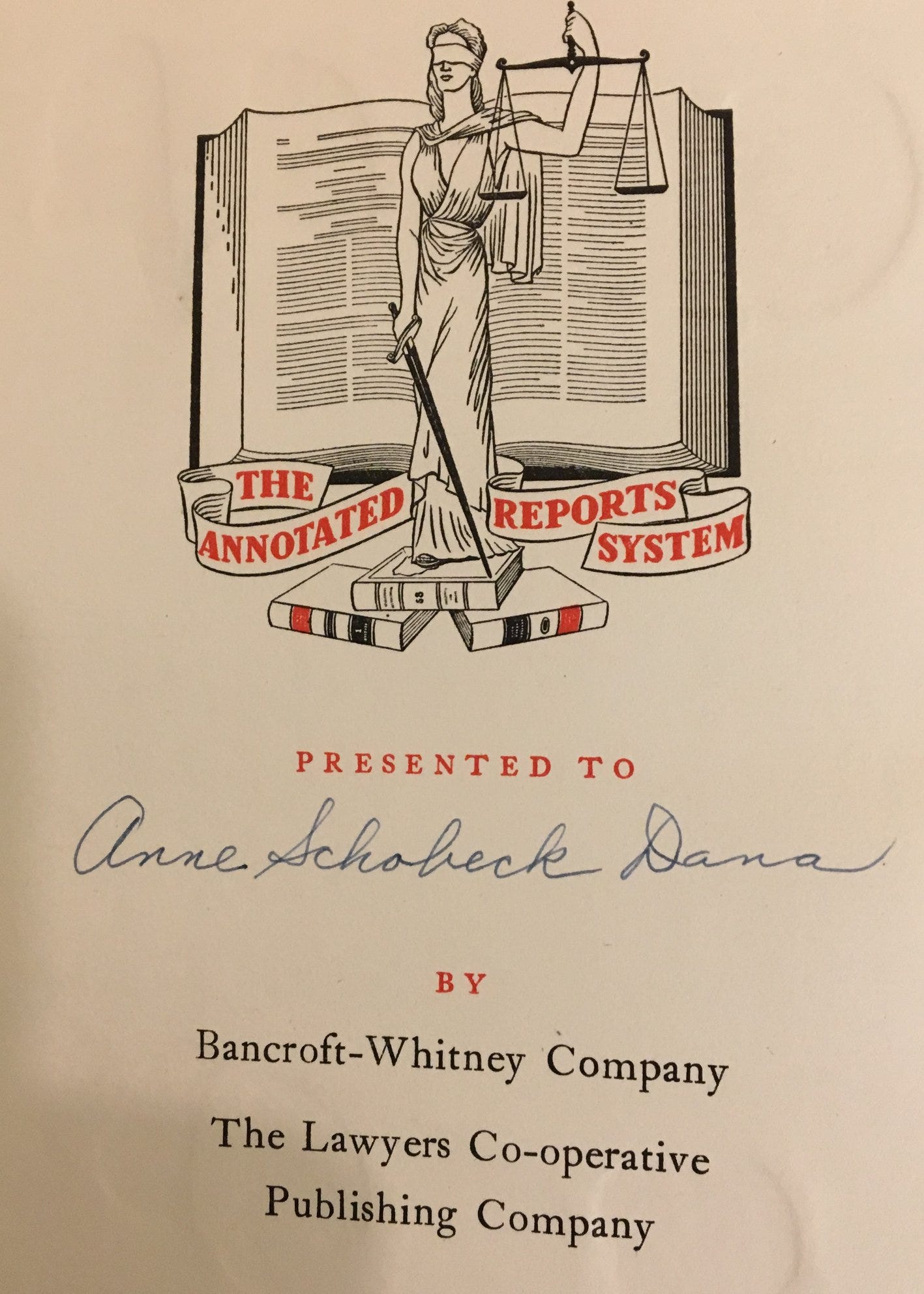
Despite all this, she graduated with distinction and won the Tax Prize for outstanding scholarship in the topic. There’s a certain degree of defiance in that achievement. Lady that she was, she’d never admit it, even to herself. But she also must have spent three years fighting an ugly daily battle against smart people who wanted her to make her quit. Every damn day.
Tax law rewards a certain kind of mind. It demands patience, analytical discipline, and the ability to work inside an abstract, very theoretical system until every piece fits exactly into place. It is not a field that yields easily to charm or improvisation. It requires seriousness, and my mother possessed that quality in abundance. She was an extremely serious, organized, disciplined person. She was always, always in control. I’m beginning to realize that maybe she had to be.
For instance, in what James Taylor described in a song as extreme old age, she had a process for warming up the slice of a particular raisin bread from a particular bakery she ate every morning for breakfast. Her nurse, Fawn, would come in, and they would have coffee. She would put a slice of bread on top of her mug of hot coffee, which would warm it slightly to the way she liked it.
She managed a litany of ailments, limitations and sheer pain with the same exacting sense of routine she’d lived by all her life. If she were practicing law today, she’d be a tax partner at White & Case or somewhere similarly prestigious. She’d be paid several million dollars a year. She’d hold meetings, charge thousands of dollars an hour, testify in front of Congressional committees. She’d have a tasteful, low-key office that was organized, clean, efficient, calm – just like her.
But she never had a chance. Not in 1955. No way in hell. After fighting her way through law school, after winning big, and publicly, she ran straight into the granite wall of her gender. The exact same thing happened three years later to Ruth Bader Ginsberg, who was at Cornell, too, and also had a hard time finding her first job in law. Ruth Bader Ginsberg could not find a job. That’s how hard it was.
The social structure of the time offered women a very limited set of options. Becoming a tax lawyer wasn’t one of them. My mother did what many women of that era did. She became a mother instead, because that was the role the world had prepared for.
She was not a good mother.
That sentence used to feel dangerous to write. It doesn’t anymore. Age has clarified a great many things for me. My mother was a parent with whom I had a puzzling and often painful relationship. As just one example, during the last years of her life, I worked hard to call her several times a week, because I suspected she was lonely and sad. After she died, I learned that my calls had meant a great deal to her in the twilight of her life. But she never said so, and she almost never called me. I had to call her. This hurt me, and for me was the continuing of a pattern of slightly chilly distance I’d spent most of my life contending with.
For a long time, the law belonged to her. Or perhaps it is more accurate to say that it belonged to the charged territory between us. I went to law school partly because I wanted something harder than advertising, which I had already discovered came too easily and, for that reason, struck me as faintly unserious. I loved the intellectual work of law school more than I expected to. I loved the rigor of it. I loved how concepts, particularly transactional ones, supported each other like fieldstone in a wall.
But the profession I encountered afterward was a completely different story. Like many graduates of elite law schools, I stepped directly onto a conveyor belt. Large firms. Associate track. The expectation that one would spend years learning the profession under the watchful eyes of partners before eventually being worthy of advancement. My job was to keep my mouth shut, not screw anything up, and work like a sled dog for a decade in an office. At twenty-five, that system feels inevitable. You assume that if you cannot thrive inside it, the problem must lie with you. I did.
The culture of large law firms is procedural and hierarchical. It rewards patience with institutional structures and a tolerance for slow advancement. A lawyer builds his career layer by layer, like sedimentary rock. I found the constant monitoring of billable hours oppressive. I hated the idea of sitting quietly for years while the institution decided whether I belonged. I remember sitting in my little office next to the elevator shaft in Center City, Philadelphia, hearing the elevator whoosh up and down, and thinking to myself, I am going to eventually die in this little box.

One day I left. At the time, I told myself a simple, devastating story: I had failed at law.
It took me many years to realize that the story was incomplete. What I had rejected was not the law but a particular institutional version of it. It’s like the difference between God and church. The legal profession is much wider than the law firm pipeline presented to students. But when you are young and inside that pipeline, it can feel like the only route available.
After leaving law, I found my way into Silicon Valley and into startups. In that environment, some of the qualities that made me a poor fit for law firms turned out to be ideal for launching a technology company. I could think strategically. I could write. I could see patterns in complicated situations and explain them to other people. I moved fast, often on instinct, and I was usually right.
Writing became central to my life during that period. It offered something the law had not: autonomy. No one tracked my time in six-minute increments. No one stood over my shoulder waiting to discover what I had overlooked. Writing allowed me to operate inside a different professional identity — one defined by creativity and perception rather than by procedural accountability.
But that shift had a cost. The part of me that thrives on rigor and responsibility went dormant. The idea of practicing law was radioactive. I couldn’t bear to even think of it.
And then, for reasons that began as purely practical, the possibility of rejoining the Pennsylvania bar surfaced. A colleague suggested it. There were business reasons. Strategic reasons. Administrative reasons. I would be an attorney again.
My reaction surprised me. I was excited.
Not nostalgic, not resentful, not burdened by memories of law firms. Excited. The feeling was not entirely comfortable but it was alluring. The best description for it was simple: exciting, but slightly daunting.
As I thought about it, the idea kept changing shape. At one moment it looked like reclamation: taking back a credential I had walked away from in 1998. At another moment it looked like possibility: reopening a set of professional options that had abruptly disappeared from view. Sometimes it even felt like vindication, a correction to the story I had told myself about failing in the profession.
Then another layer appeared. There’s a sentence about what happened in Norman McLean’s novel A River Runs Through It that’s eerily accurate: Now nearly all those I loved and did not understand in my youth are dead, but I still reach out to them. My mother is dead. I am reaching out to her. And in the very tips of my outstretched fingers, I can feel something. To mix literary metaphors, it’s like when the children in The Lion, The Witch and The Wardrobe enter Narnia through the magic wardrobe. In the darkness, I reach out, feel coats hanging, and then keep moving forward, begin to feel fir trees, and find myself in a snowy forest.

My mother died a couple of years ago. True to her disciplined, distant self, she died alone, tended to by caregivers, no family. Neat, clean, final. One day she was, then she started failing, and a week later, she was not. Her passing brought a measure of grief, but it also brought something I had not expected: liberation. When certain parents die, something subtle disappears along with them. The internal audience fades. The quiet question — what would she think? — loosens its grip. I was freer to think for myself, which seems a little strange at 63, but okay.
And it occurred to me that some part of my earlier departure from the law might have been shaped by a complicated loyalty to her. Children often sense the unrealized ambitions of their parents long before they can understand what’s happening. I loved and did not understand. A parent with great ability whose career is stillborn can create an emotional atmosphere that is energized, and enticing, and painful with no obvious reason. Success in the same field may feel less like achievement and more like tension, or betrayal, even (or especially) if it’s never discussed.
With my mother gone, the emotional contract that may have existed between us is now void. Contracts can do that. When certain circumstances change, they can effectively disappear. In my case, death did the job. The law no longer belongs to her ambitions or her disappointments. It belongs to me. I’m still here.
And when I look at her diploma now, I feel sadness above all. I’m old enough to be very familiar with sorrow, with loss, and this is that. She’d find it childish and amusing to hear this, but Mom, I’m sorry for what happened to you. I think I understand now.
I feel sadness for the career she might have had. Sadness for the determination that had nowhere adequate to go. Sadness for the complicated life she lived. Sadness for being someone the world won’t allow you to be. The thing I believe she was born for, besides being my father’s wife, was impossible. It was in her DNA, but she wasn’t allowed to live it. What a terrible fate. You can be determined, successful as a wife and mother and leader of a family, but that ache, like the sense of a phantom limb, never quite departs.
With the benefit of hindsight, additional pieces fall into place.
During her final years, when I visited her, I felt like I could occasionally see that sorrow in her. It was never, of course, discussed. At the time I assumed it was purely a reaction to being elderly and mortal and infirm. I now wonder if it also reflected regret at an unlived life, a career she never got to have. And the strengthening realization that she never would.
Despite my divorce, she remained connected to my ex-wife. She spoke highly of her, had talks with her on the phone, and in some sense admired and respected her. This was hard for me, but my ex-wife was, and is, a trial lawyer, and I believe now my mother saw in her what she’d wanted for herself, and was drawn to it.
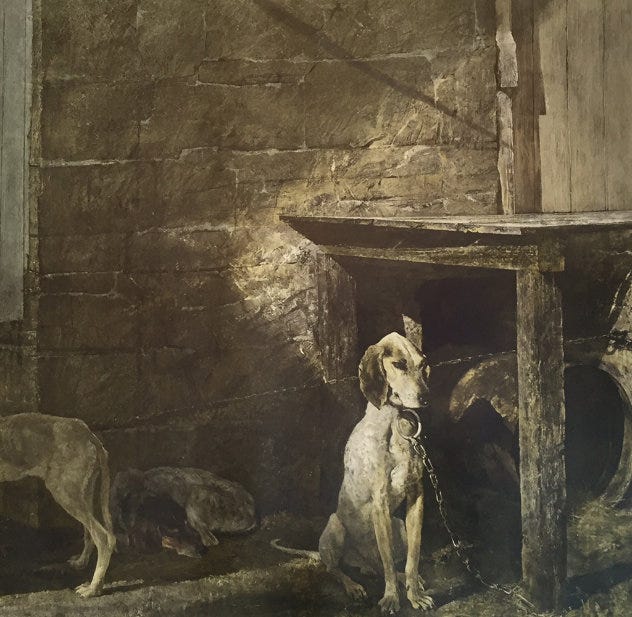
There’s a lovely Andrew Wyeth painting entitled Raccoon. My parents loved Wyeth’s art – the house was full of prints. As a child, I just thought Raccoon was a painting of a dog. I learned the whole story when I got older. It’s a painting of coon hounds chained up in a basement, deliberately underfed to keep them hungry and make them aggressive when released to hunt. It’s a portrait of a kind of cruelty.
In the painting, the hounds are beautiful, regal animals, but they’re also sad. That was my mother, except I now realize she was never unchained, and eventually resigned herself to living in the basement. Perhaps symbolically, the room she lived her last years in, and eventually died in, was the actual basement. She would have been brilliant, respected, and paid a great deal of money had the chains been removed. She never got the chance.
For all the difficulty in our relationship, we shared one important experience. We both entered the same demanding intellectual world. I am the only other law school graduate in the family.
For me, then, law represents a kind of lineage — not a sentimental one, but a factual one. Two people in the same family crossed into the same profession under very different circumstances. My mother did it at a time when the profession did not want her. I did it at a time when the profession was structured in ways I couldn’t bear. We both had to stay away, but the thread is still there. I know exactly what it’s like to sit in a law library with a pile of open casebooks. I’ve studied Tax. We share that. The closest relationship of this life for me is interwoven with ambition.
Reactivating my license will not recreate the career she never had. It will not repair the past or transform our relationship. That story is over. It will, however, acknowledge that the capability we shared belongs to me as much as it belonged to her.
For years I kept my diploma in a cabinet, as if that part of my life were closed. In reality, it was only dormant. The training never disappeared. The way of thinking never disappeared. The only thing missing was permission.
Permission, it turns out, is something you eventually have to grant yourself.
My mother’s diploma still hangs on the wall of my office.
Mine is still in the cabinet.
But I don’t think it will stay there much longer.
No posts
Comments
Nothing yet. Say the first thing.
Sign in to join the conversation.