
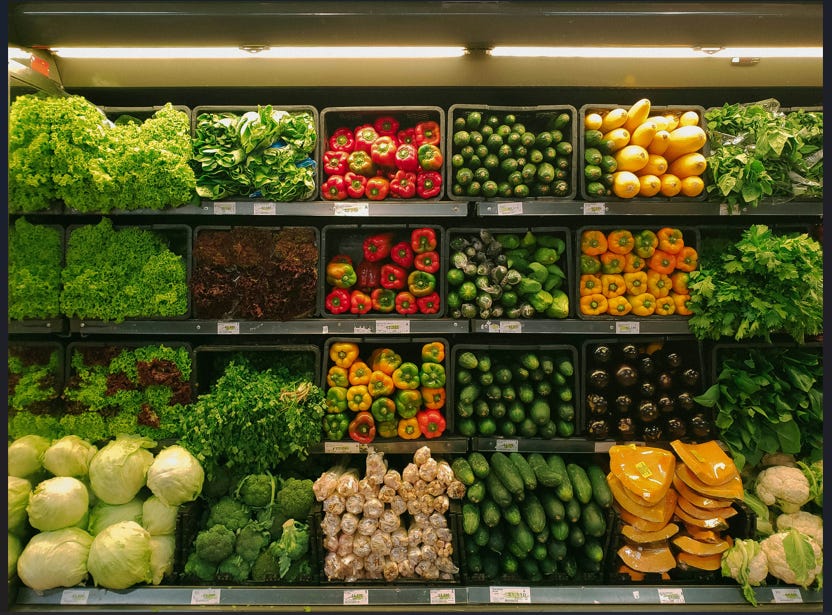
On Monday, the Opinion section of The New York Times led with “There’s a Grocery Price Emergency in America,” a guest essay by Lael Brainard and Rohit Chopra.
Um, no. There is no emergency. According to the Bureau of Labor Statistics, the prices of “food at home” — loosely, groceries — rose 3.2 percent from January 2025 through this May. People tend to focus on things that went up, like ground beef, which rose 18.4 percent, and less on the things that went down, like eggs, which went down 35.4 percent.
Even a 3.2 percent price increase is more than you’d like to see. On the other hand, over that same period, average hourly earnings rose more than that: 4.7 percent.
In other words, groceries got more affordable for someone earning the national average, not less. Where’s the emergency?
I have great respect for Brainard, who served as a vice chair of the Federal Reserve and then as director of President Biden’s National Economic Council, as well as her co-author, Chopra, a former director of the Consumer Financial Protection Bureau. I also greatly respect the Opinion section of The Times, where I used to work.
I also don’t want to minimize the pain that people are feeling trying to make ends meet.
And please don’t take this as sticking up for President Trump, which I am emphatically not doing.
But facts are facts: Average hourly earnings have risen faster than grocery prices since Trump took office.
Why did Brainard and Chopra come up with such a different conclusion? I’ve emailed them some questions, and I will update this piece if I hear back. But I can think of a few explanations.
One is that although “grocery price emergency” is in their headline, the essay and accompanying website cover a broader range of necessities, including rent, healthcare, daycare, utilities, gasoline and car payments. And several important items have gone up more than groceries.
Gasoline shot up 40 percent over the period, according to B.L.S. data. That’s because of the war with Iran, which Trump owns.
On the other hand, rent, which is the biggest single expense for renting households, rose 4.5 percent, a smidgen less than average hourly earnings.
By far the biggest factor in Brainard and Chopra’s “kitchen table” calculation is not groceries, but healthcare. They calculate that the cost of an Affordable Care Act Silver Plan went up $1,260 this year. The increase was driven by the expiration of enhanced federal tax credits, another shock that Trump and his fellow Republicans fully own.
This is a major blow to people on Obamacare. However, it doesn’t affect the majority of Americans who are covered through employers, Medicare or Medicaid. In fact, the Bureau of Labor Statistics calculates that for all urban consumers, the cost of “medical care” — not exactly the same as what Brainard and Chopra are measuring, but in the same ballpark — rose 3.8 percent from January 2025 through May 2026.
The right way to analyze the burden of inflation is to take into account everything people buy, weighting each item by its typical share of consumers’ spending. That includes, for example, “telephone hardware, calculators, and other consumer information items,” which got 13.7 percent cheaper from January 2025 through May 2026.
That’s how the Bureau of Labor Statistics does things. According to the B.L.S., the Consumer Price Index for all items rose 4.7 percent from January 2025 through May 2026. Which coincidentally is exactly the increase in average hourly earnings.*
Please don’t write to tell me that Trump has corrupted the B.L.S. The agency is still doing excellent and politically impartial work.
Are a lot of people hurting? Yes. Has Trump made matters worse? Yes. Is there a cost-of-living emergency in the United States? No.
*Several readers wrote to say that I should have used median pay rather than average pay in my calculations. (The median is the point where half earn more and half earn less, while the average is total pay divided by the number of people.) Changes in the two can be quite different in principle, but they haven’t been lately. According to the B.L.S., median usual weekly earnings rose 3.4 percent from the first quarter of 2025 through the first quarter of 2026, which is the most recent period available for that series. For comparison, average hourly earnings rose 3.6 percent from the first quarter of 2025 through the first quarter of 2026. (The 4.7 percent figure I use is through May, not just through March, the end of the first quarter.)
Thanks for reading Economics for Everyone! This post is public so feel free to share it.
No posts
Comments
Nothing yet. Say the first thing.
Sign in to join the conversation.