
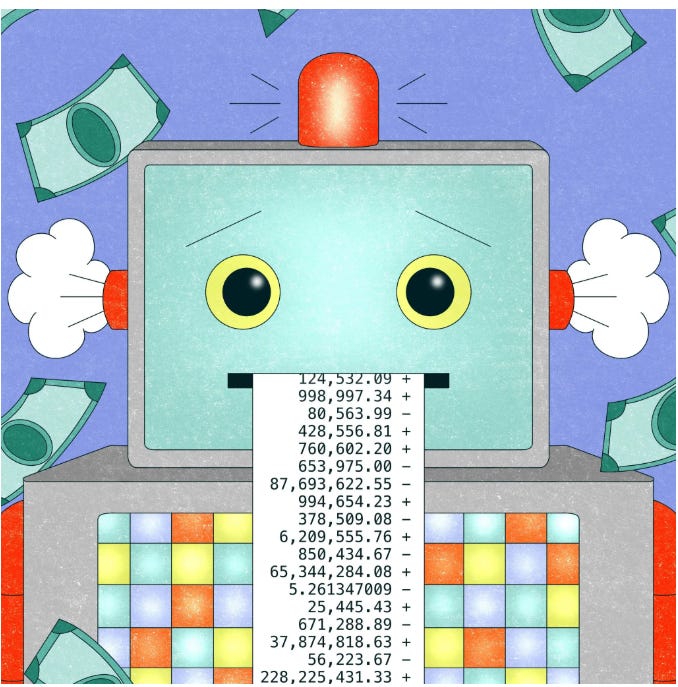
Source: Melanie Lambrick, The New York Times
So, Elon Musk is the world’s first trillionaire. On Friday, investors went crazy for the initial public offering of SpaceX partly because the company’s brags about potential riches in artificial intelligence. Anthropic and OpenAI, two other A.I. giants, are also planning IPO’s this year — fantastic news for share-owning employees and outside investors.
What about taxpayers? What’s in it for them? As I wrote in a piece this morning for the DealBook section of The New York Times, “proposals to tax A.I. for the benefit of the public are multiplying like the fingers on an A.I.-generated hand.”
The hunt for A.I. taxation is making for strange bedfellows. President Trump and Senator Bernie Sanders, the democratic socialist from Vermont, both think the federal government should take big ownership stakes in A.I. companies. Trump has been vague about how that would come about. Sanders has said the government should get the shares for free by taxing the companies, and demanding that the tax be paid in the form of shares.
The government and the A.I. companies would make another strange pair of bedfellows if united through equity ownership. One can imagine that the government would be less likely to rein in the A.I. companies if doing so would suppress the value of its shares.
Another idea is to tax the assets of the A.I. companies: their server farms, their software, their power plants, and so on. Bill Gates, the co-founder of Microsoft, long ago called for a robot tax. That would raise money while presumably slowing down the penetration of artificial intelligence, which some people think would be a very good thing.
But mainstream tax theory says that it’s more efficient to let businesses use plenty of artificial intelligence to maximize their production and profits, and then recoup some of those gains on the back end through taxation. The tax revenue could then be used in part for retraining or otherwise aiding workers displaced by A.I.
As long as (some) human workers remain in the loop, adding A.I. will make them more productive and thus presumably better paid, the theory goes.
If artificial intelligence lives up to its promise, it will raise living standards across the board. Consumption of goods and services will rise. The government could tax that consumption (through something like a sales tax) and cover all its bills.
I end my piece in The Times with economists’ speculation about a sci-fi future in which A.I. kind of goes off and does its own thing, such that raising human living standards is no longer its sole purpose. In that world, consumption taxes would miss a lot of A.I.’s value creation. Then again, in that world, A.I. might be so advanced that it would shrug off the efforts of puny human beings to impose taxes on it.
Scary thought.
No posts
Comments
Nothing yet. Say the first thing.
Sign in to join the conversation.