
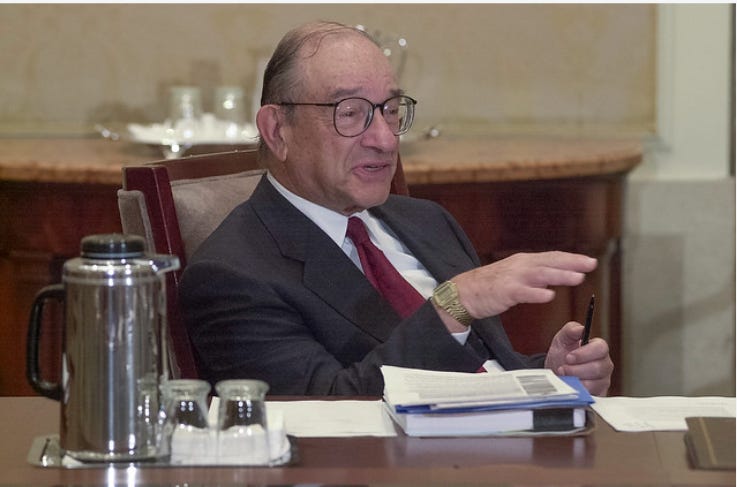
Source: Federal Reserve
Alan Greenspan, who chaired the Federal Reserve from 1987 to 2006, has died at age 100. Others have written about his legacy. I want to make just one point, which is that the new chair of the Fed, Kevin Warsh, seems to have a little Greenspan in him.
Greenspan was deliberately obfuscatory. He seemed to believe that too much transparency would hem in the Fed, making it harder to respond to changing circumstances.
“What I’ve learned at the Fed is a new language called ‘Fed speak.’ We learn to mumble with great incoherence,” he once said.
“If I seem unduly clear to you, you must have misunderstood what I said,” he added.
The next three chairs of the Fed were a lot clearer and more direct than the inscrutable Greenspan. They laid out their rationale in speeches.
“Transparency in monetary policy enhances public understanding and confidence, promotes informed discussion of policy options, increases the accountability of monetary policymakers for reaching their mandated objectives, and ultimately makes policy more effective by tightening the linkage between monetary policy, financial conditions, and the real economy,” Ben Bernanke said in a 2013 speech.
“Clear communication is itself a vital tool for increasing the efficacy and reliability of monetary policy,” Janet Yellen said in a speech in 2012, when she was the vice chair.
Following their lead, Jerome Powell said in 2018, the year he took the helm: “In a democratic system, any degree of independence brings with it the obligation to provide appropriate transparency. In turn, transparency provides an essential basis for accountability and democratic legitimacy by enabling effective legislative oversight and keeping the public informed.”
Warsh begs to differ. He seems to enjoy playing cat-and-mouse games with reporters. (I had that experience myself when I interviewed him once.)
In his first press conference following a meeting of the rate-setting Federal Open Market Committee, Warsh “received questions with knowing smiles,” The New York Times reported. “He elicited laughs. He gave long answers that amounted to neither a yes nor a no. And he filled his answers with the kind of jargon that seemed more suited for a corporate boardroom than a Fed news conference.”
“Jocular jujitsu” is how The Times described Warsh’s style.
The first FOMC policy statement of the Warsh era was significantly shorter than those under his predecssors. Warsh also declined to contribute to the so-called dot plot, which is where members of the FOMC place dots to indicate anonymously what they expect to be the appropriate level of the federal funds rate at the ends of coming years. (See page 4 here.)
Warsh is setting up five task forces to study how the Fed operates, one of which will be on how it communicates. It’s a good bet that the task force will conclude the central bank has been oversharing.
Here is how he stated his position at the press conference last week:
Financial markets perform best when they react to incoming data. I think the financial markets work less efficiently when they ask a question: how will the Federal Reserve react to that incoming information? The more that markets are paying attention to what's happening in the real economy ... the more financial markets can price what they believe is the most likely and what are the tail risks. Financial market prices are probably the most important source of information to guide central bankers. But when all the financial markets are doing is reflecting back what we've said, then we're taking the most important source of information and we're being blind to it.
In other words, Warsh is saying the Fed should be taking signals from the financial markets, but it can’t learn from them when all they’re doing is reflecting back what the Fed itself has said.
I would have loved to ask Alan Greenspan what he thought of Warsh’s statement. I suspect he would have agreed. Greenspan, like Warsh, was a strong believer in the wisdom of free markets. (True, Greenspan admitted in 2008 that a “flaw” in his reasoning led him to underestimate the risks of underregulation of credit markets, but that’s a story for another day.)
Experts who did comment on Warsh’s presser were divided. Mohamed El-Erian, the former chief of bond investor PIMCO, called Warsh’s press conference “a true masterclass in central bank communication.”
On the downside, pulling back on “forward guidance” takes away one of the tools the Fed has used to steer rates.
It’s also possible that members of the public will feel that the Fed is shunting them aside — the concern that Powell raised in his 2018 speech.
One likely outcome is that bond and stock prices will jump around more. Because traders won’t have as clear an idea of the Fed’s intended path, each new bit of data will matter more and hit harder. “If the Fed provides less forward guidance under Chair Warsh, markets may become more sensitive to incoming data and policy surprises,” the asset manager Lord Abbett wrote. “That could lead to larger moves in shorter-maturity yields as investors reassess the timing and probability of future rate hikes.”
It’s somehow fitting that Warsh gave his first post-FOMC press conference less than a week before the passing of Greenspan, who seems in many ways to be a role model.
No posts
Comments
Nothing yet. Say the first thing.
Sign in to join the conversation.