
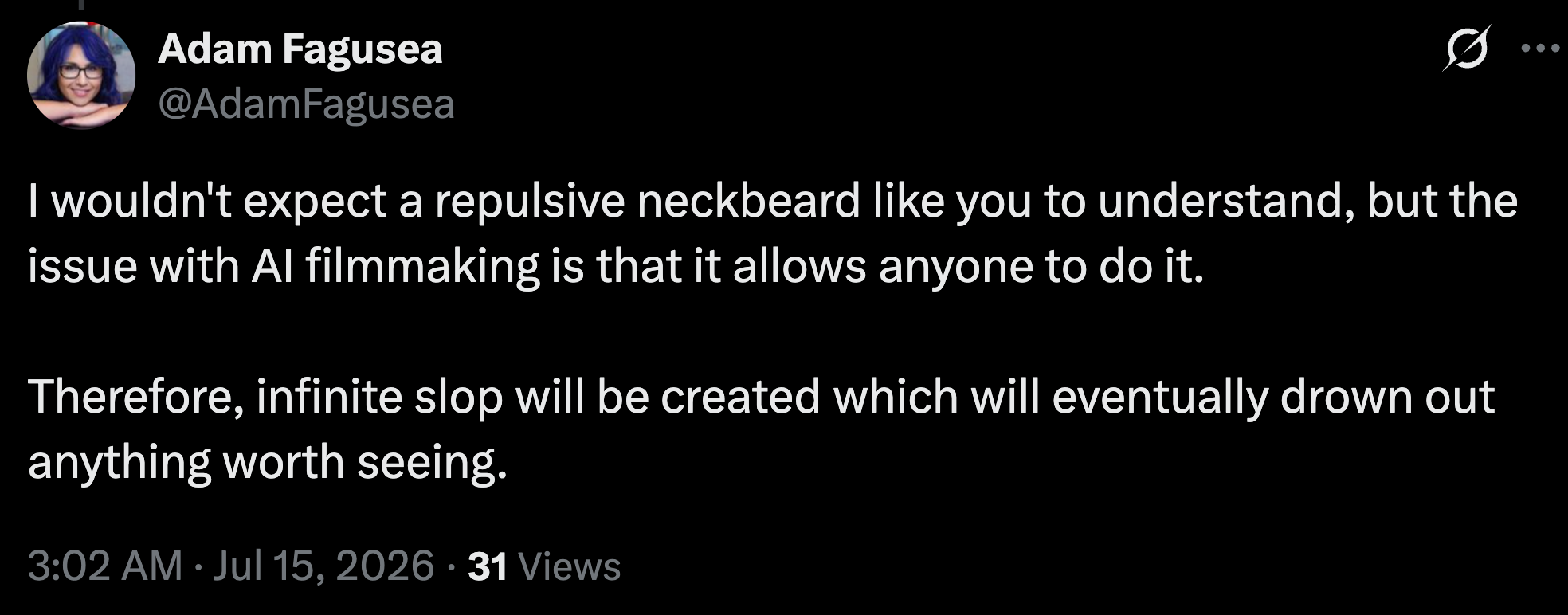
Every so often, someone says the quiet part loud. I was sent a post that sums up what I think is at the center of the deranged hatred of AI: “The issue with AI filmmaking is that it allows anyone to do it.”
People have endlessly insisted that this is not what the backlash is about. They say it is about theft, authenticity, labor, or quality. And yet, sooner or later, the argument almost always gestures toward the same fear: too many people will be able to make things, the market will be flooded, and the distinction of being an artist will mean less.
This post simply skips the scenic route. More people gaining the ability to make films would produce an “infinite ocean of slop,” burying anything worth watching.
But if the problem is that “anyone can do it,” then the position is simply elitism, which is often found lurking beneath the surface of these arguments. However they begin, they almost always end in the same place: too many people will be able to create, too many people will compete for attention, and being an artist will no longer “mean something.”
I reject that premise completely. Expanding people’s ability to communicate visually should be celebrated, not feared. If your first instinct is to treat broader access to artistic expression as a cultural catastrophe, then you are no longer defending art but the exclusivity of those who already make it.
There is a faint echo here of Syndrome, the villain from The Incredibles: “When everyone’s super, no one will be.”
Anti-AI artists increasingly seem to believe the same thing about art. If everyone can make art, then being an artist no longer matters. The ability loses some of its social distinction once it is no longer reserved for people with the right training, equipment, money, collaborators, or institutional access.
This is a false idea of artistic value. Being able to express oneself really should not be valued primarily because other people can’t.
AI does not make everyone equally talented. It does not give everyone taste, judgment, imagination, or anything worth saying.
More people being able to communicate visually does not erase the difference between good and bad work. It does not make great filmmakers ordinary or inexperienced filmmakers great. It does weaken some of the barriers that kept people from realizing their ideas, though. That should be a good thing.
And amateur art has always been tolerated when it remains obviously amateur. It’s gotta be safely beneath professional competition; “irrelevant.” The smol bean artisté’s anxiety begins when people without credentials, connections, years of training, or expensive tools can make something that looks like it could be taken seriously.
Make no mistake: most who incorporate AI into their pipeline will make absolutely dogshit art, just as most who pick up a camera, guitar, paintbrush, or word processor will as well. The real threat is that some will use AI to make good art.
The elitist response is to treat that expanded access as degradation. If the process becomes easier, the work must be bad. If more people can participate, the medium must be dying. If the distinction between artist and audience becomes less rigid, then art itself is supposedly under attack.
Elitism does not come out of nowhere. It is ultimately incentivized by the market.
There is already far more creative work than anyone could ever consume. More books than anyone could read, more music than anyone could hear, and more video than anyone could watch. The supply of art is effectively limitless, but the way we reward the work (read: as property which must “win” in the market) is not.
That is to say: attention is currency in the marketplace of ideas.
Everyone trying to make money from creative work is competing for some portion of the same finite pool of attention, there is more than anyone could ever consume, and AI exacerbates this. It makes certain kinds of production faster, cheaper, and accessible to more people. More people can create images, music, videos, and eventually films; more work can be produced by each person; and all of it enters an already-overcrowded market.
I talked about this at greater length in my documentary Plato Is a Bitch: A.I. and Bomberguy, where I described two broad reactions creators have to market saturation: the sad reaction and the mad reaction.
The sad reaction is a retreat. A creator sees diminishing returns, concludes that there is no longer room for them, and scales back or quits. They may still love making art, but the amount of work required to reach an audience—or simply to earn enough money to continue—becomes impossible to justify.
The mad reaction is an angry attempt to thin the market.
Instead of criticizing the method we reward creative labor for not being able to adequately support everyone creating within it, the creator starts identifying people who should not be there. Plagiarists! Content farms! Asset flippers! AI users!. These fake artists producing fake art and taking attention, jobs, and money that should have gone to the real ones!
“The issue with AI filmmaking is that it allows anyone to do it” is the mad reaction stated with uncharacteristic honesty.
The market is becoming more saturated, and the proposed answer is to reduce the number of people allowed to participate (see: degrowth). A problem created by falsely scarce rewards is reframed as one of excessive access. “There is not enough attention or money for everyone” becomes “not everyone should be able to try to make art.”
This is economic anxiety taking the form of artistic gatekeeping. The people entering the market cannot merely be competitors; they must be illegitimate competitors. Their work cannot merely be unwanted; it must not count as art. Otherwise, the argument would have to remain what it actually is: more people are now competing for the same limited rewards.
And that concern is real. Artists, like everyone, need to be able to live. Creative work is already precarious. But the danger comes from the system of rewards, not from too many people gaining the ability to create.
A saturated market is not a problem for art, but for people who are selling art. More people making films does not cause good films to disappear. Yes, it makes attention harder to acquire. If we agree that artistic expression and enjoyment are valuable parts of human life, though, should we make attempts at its creation dependent on markets?
Capitalism once saved the human race from scarcity by scaling up the means of production. Now, when the ability to live in a post-scarcity world exists, capitalism needs to produce scarcity to justify itself.
Thus, the honest objection is therefore not “AI will destroy art.” It is “AI may make it harder for me to earn money making art.” This is not a problem of art or of tools; it is a problem of our current mode of production.
The strangest thing about this debate is that people talk about artistic expression as though it were a luxury product. The horror is not that more people will lose the ability to create, but that more people will gain it!
Imagine applying that logic anywhere else. “The problem with literacy is that it allows anyone to write.” We instinctively understand how absurd that statement is because we recognize communication as something worth expanding. We generally celebrate when more people gain the ability to write, or for that matter, photograph, publish, compose, or speak.
For some reason, AI is treated differently. The expansion of creative capacity becomes something to fear rather than celebrate, which should make us ask exactly what people believe gives art its value.
Capitalism teaches us to confuse scarcity with value. If only a few people can do something, we assume it must be important. If access expands, we’re supposed to assume the thing itself has been degraded. But a great filmmaker is not made great because most people cannot make films. A great painter is not made great by the difficulty of obtaining paint. A great writer is not made great because people are illiterate.
Excellence does not depend on exclusion.
More people should be able to realize the ideas in their heads. More people should be able to experiment, fail, improve, and occasionally make something extraordinary.
Most of what they create will be bad, too! I don’t want to pretend the fact that anyone can make art means it will all be good! Most songs have always been bad. Most paintings have always been bad. Most YouTube videos and novels have always been bad. The existence of bad art has never been evidence that too many people were allowed to try. If anything, it is evidence that people were free enough to fail.
That is the question beneath all of this: should more people have the opportunity to communicate, create, and attempt work they previously could not?
My answer is yes.
The post at the center of this article treats “anyone can do it” as the indictment. I think it is the promise.
That does not mean AI is automatically liberatory or that the companies building these tools should be trusted (THEY SHOULD NOT BE TRUSTED). But none of those problems are solved by preserving the barriers that kept ordinary people from making things.
The elitist response says artistic value depends on distinction. The market response says artistic survival depends on scarcity. Together, they turn expanded access into a threat and call that defense of art. It isn’t.
Art does not need fewer people making it. Artists need a society where their ability to live is not dependent on defeating everyone else in a limited pool of attention and money.
Those are different problems, and confusing them only protects the system that created the insecurity in the first place.
No posts
Comments
Nothing yet. Say the first thing.
Sign in to join the conversation.