
Now that the Hungarian government is desperately trying to frame the electoral activities of the country’s largest opposition party as Ukrainian interference, it is worth examining the interference efforts that the Hungarian government itself has undertaken in recent years to bring political forces it favours to power in a given country (and we will soon see why).
Interference or active involvement can generally be grouped into three categories: (1) direct political endorsement (e.g. speeches, video messages and visits); (2) media and financial support (e.g. media acquisitions by Hungarian business circles to support local allies); and (3) strategic/diplomatic assistance (e.g. loans, asylum or the immediate legitimisation of disputed election results).
A few memorable examples from Europe alone:
North Macedonia: Hungarian business allies acquired local media outlets to support the VMRO-DPMNE party, and the Hungarian government subsequently granted political asylum to its convicted leader, Nikola Gruevski, to protect him from imprisonment.
Slovenia: Investors linked to the Hungarian ruling party financed media outlets aligned with the Slovenian Democratic Party (SDS), while PM Orbán personally campaigned for his ally Janez Janša at party conventions.
France: A Hungarian bank with ties to Orbán’s associates provided a crucial €10.6 million loan to Marine Le Pen’s National Rally during her presidential campaign when French banks refused financing.
Bosnia and Herzegovina (Republika Srpska): The Hungarian government has provided significant financial aid and diplomatic backing to Milorad Dodik, supporting his leadership in the Serb-majority entity against Western sanctions.
United States: PM Orbán has openly endorsed Donald Trump in multiple elections, hosting CPAC Hungary to align with US Republicans and using his platform to campaign for the MAGA movement.
Czech Republic: Days before the parliamentary election, Orbán visited Prime Minister Andrej Babiš to appear at campaign events, endorsing their shared anti-migration stance to boost Babiš’s reelection chances.
Brazil: Orbán recorded a video endorsement for Jair Bolsonaro during the 2022 election and later allowed the former president to hide in the Hungarian embassy in Brasília for two nights to avoid potential arrest.
Georgia: Orbán flew to Tbilisi immediately after the disputed 2024 elections to become the first EU leader to legitimize the ruling Georgian Dream party’s victory despite international concerns of fraud.
Slovakia: The Hungarian government actively facilitated the unification of ethnic Hungarian parties and openly supported Robert Fico’s Smer party in recent elections to secure a sovereignist ally.
Romania: Beyond consistent financial backing for the ethnic Hungarian party (RMDSZ), Orbán recently provided rhetorical legitimacy to nationalist candidate George Simion, whose campaign used Orbán’s words in election materials.
Poland: Before the war in Ukraine cooled relations, Fidesz organized mass “Peace Marches” and bused supporters to Poland to demonstrate international solidarity with the Law and Justice (PiS) government during election seasons.
Spain: Orbán recorded video messages endorsing the far-right Vox party and its leader Santiago Abascal, framing their election participation as a crucial battle for national sovereignty.
Netherlands: Orbán publicly celebrated Geert Wilders’ election victory as a “wind of change,” instantly aligning Hungarian diplomatic weight with the Dutch far-right leader’s platform.
Montenegro: Hungary expanded its influence through the state-backed acquisition of the leading mobile operator and by shifting diplomatic support from the long-time leader Milo Đukanović to pro-Serb political forces as power dynamics changed.
Serbia: PM Orbán maintains a symbiotic relationship with President Aleksandar Vučić, utilizing massive economic grants via the Prosperitati Foundation and directing the ethnic Hungarian party (VMSZ) to act as a loyal coalition partner to ensuring Vučić’s continued rule.
This amounts to interference in the elections of ten countries within just a few years (and this is not an exhaustive list).
All of these interventions have one striking similarity: they each aimed to bring to power a government that is anti-EU and pro-Russian, or at the very least represents a political orientation that is more aligned with Russian interests than that of its opponent.
After all, the fragmentation of the EU already serves Russian interests. Therefore, it is a fact that the Hungarian prime minister did not intervene in these countries’ elections in the interest of Hungary, but rather in the interest of Russia.
In doing so, he violated not only the sovereignty of the countries concerned, but also that of Hungary.
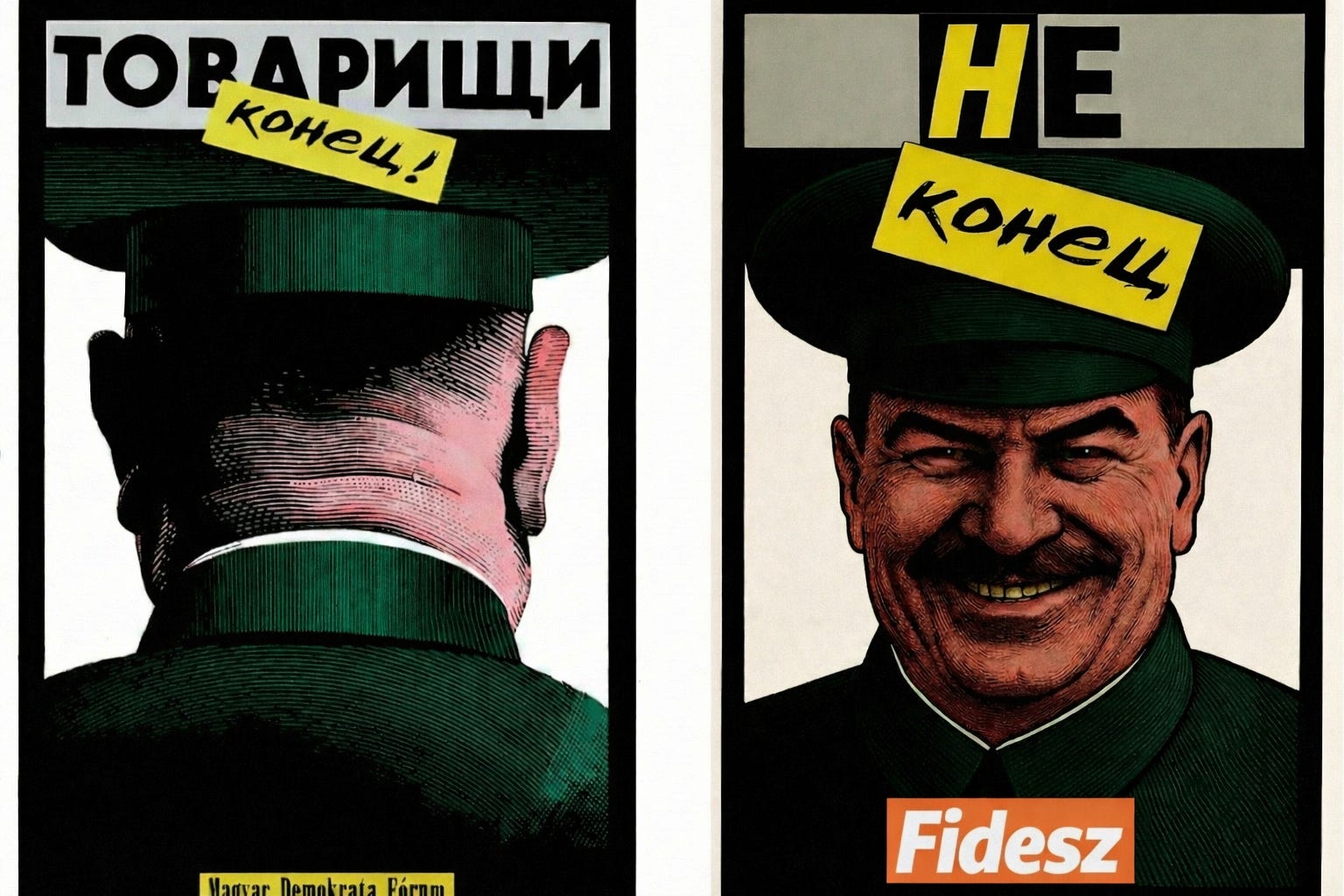
Against this backdrop, it is clear that the government is well aware of how fundamentally lacking in credibility it is to accuse someone of something in which it is itself a black-belt champion. It is therefore likely that this is merely the preparatory phase for something bigger and more sinister. In any case, the current, highly intensified government communication for the time being follows exactly the scenario outlined back in August 2025 in my post titled “Russians, come back! Russian false-flag operations to influence the Hungarian elections?”. That post includes the following few sentences:
“the foreign minister’s statements may be particularly well suited to laying the groundwork for a Russian false-flag operation, in which agents of Russian intelligence carry out provocations against Hungary under Ukrainian colors. And since government communication—both Russian and Hungarian—will by then have sufficiently conditioned the public, on the one hand to make anti-Hungarian Ukrainian provocations seem plausible, and on the other hand to blur the line between the opposition and Ukraine, the hatred sparked against Ukrainians because of these ‘provocations’ will be redirected at the opposition.
At least, such calculations lie behind operations of this kind. And before anyone thinks that this could not happen in the 21st century, let us recall once again that the Russian intelligence services have carried out numerous false-flag operations over the past decade and a half with the aim of influencing the domestic political situations of foreign countries.”
We have now reached the phase indicated by the sentence highlighted in bold and italics. To be continued. (?)
In any case, the most effective way to counter operations of this kind is to talk about them as much as possible.
Comments
Nothing yet. Say the first thing.
Sign in to join the conversation.