
The explosive device found near the section of the Turkish Stream gas pipeline heading toward Hungary is the dramatic climax of the false-flag interference in the elections—or at least it could have been, had the predictions not rendered it completely laughable by then. However, a crime remains a crime even if it fails to achieve its actual objective.
And in this case, we are not talking about just any crime. Alongside the proper accounting of assets acquired through corruption, it is absolutely essential to get to the bottom of the false-flag operations involving election interference.
Below, I would like to draw attention to a detail regarding the dramatic structure of this series of events that links the attempted sabotage of the gas pipeline to the “Hungarian Maidan” false-flag operation, which I discussed in a recent post. The connection between the two cases—their common source and organization—is an extremely important fact. It shows how the provocation announced in connection with the “Hungarian Maidan” scenario would have involved real violence, just as explosives were actually planted. (Of course, under a “Ukrainian” false-flag.) Establishing the connection between the two cases also highlights that the Russian connection is evident in the attempted sabotage of the gas pipeline, just as it is in the “Hungarian Maidan.” And if this is the case, on top of preparations for a terrorist act, suspicion of treason also arises with regard to the Hungarian perpetrators.
It is important to note that even the preparation of a terrorist act or an act of treason is a criminal act that can result in legal consequences. Furthermore, it is evident that the perpetrators of these crimes are still at large.
The explosive device was found on April 5, 2026, near Oromhegyes in Vojvodina. The fact that this was a false flag operation is supported by the fact that the amount of explosives would have caused no more than a few days’ disruption to Hungary’s gas supply—in other words, it would not have been sufficient to cause a prolonged shortage in Hungary’s gas supply. The sole purpose of a truly hostile—that is, not merely a false-flag—act of sabotage, however, would have been precisely the latter: to cause a prolonged gas shortage.
What is truly interesting, however, is that a few days prior to this, on April 2, news emerged that “Ukrainians” had also held training sessions in Vojvodina—specifically in Novi Sad—for Hungarian Tisza (Hungarian opposition party) supporters, with the aim of sparking a “Hungarian Maidan” following the elections (as discussed in the previous post). The coincidence of the two locations with the false flags—both in Vojvodina, Serbia—speaks for itself.
It is absolutely clear that the April 2 report about the “training” in Novi Sad was, in fact, a media setup for the discovery of the explosives on April 5.
Frankly speaking, there is no other explanation for the otherwise utterly astonishing information in the report, namely that Ukrainian saboteurs were conducting “training”—for Hungarian opposition figures—in Russia- and Orbán-friendly Serbia. If there is an unfortunate choice for a so-called third-country location for such training—that is, a location outside the countries of the Ukrainian “trainers” and the Hungarian “trainees”—then it is precisely Serbia. After all, the presence of Ukrainian “trainers” is far more conspicuous here, and there is a much greater risk that the Orbán-friendly Serbian authorities will spot a Hungarian opposition plot. We can say with certainty: of all the neighboring countries, Serbia was the least suitable location for this purpose.
The dissemination of news about the training exercise held in Vojvodina can be explained by one thing: the aim was to make the story of the explosive device found a few days later—also in Vojvodina—seem more realistic, and to link it to the “Hungarian Maidan” event.
In other words, this would have been an effective and efficient way to link the opposition demonstrations expected in the event of a narrow Fidesz victory to an attempted terrorist act and its perpetrators.
Let us recall that, following the discovery of the explosives, Hungarian government propaganda—led by the foreign minister himself—immediately blamed the Ukrainians, even though no concrete evidence pointing to this has emerged since then. And Russian state propaganda picked up on the Hungarian government’s narrative without delay. In addition to this, there is another interesting detail that suggests Moscow may have had more to do with this operation than we previously knew.
The news about the “training” in Novi Sad was first reported by Hungarian journalist Tamás Magyar B. on April 2, citing a completely anonymous source:
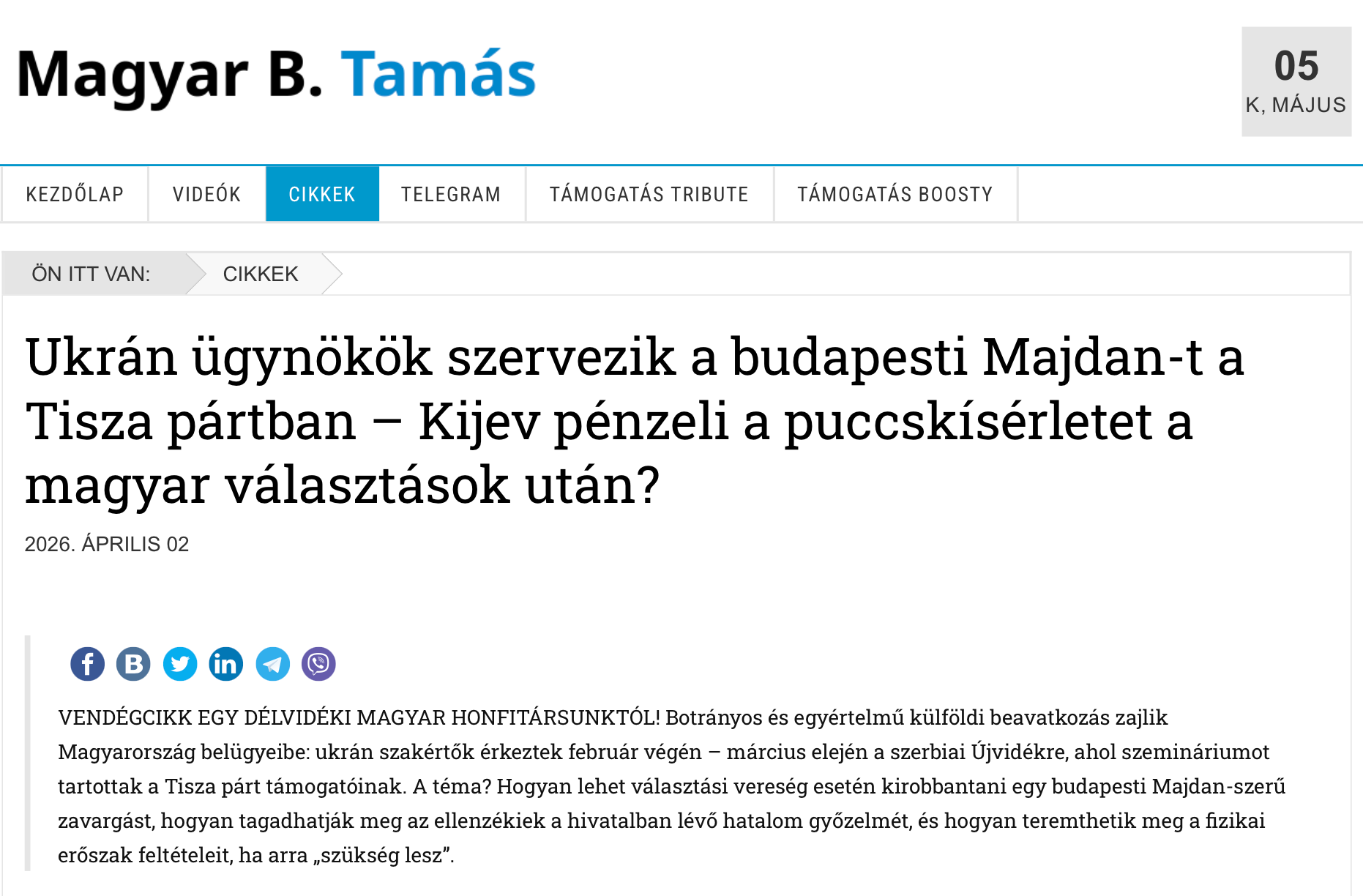
The following is the English translation of the original version of the news as published on Magyar’s personal website:
»Ukrainian agents are organizing a Budapest Maidan within the Tisza Party—is Kyiv funding the coup attempt after the Hungarian elections?
GUEST COLUMN BY A HUNGARIAN COMPATRIOT FROM THE SOUTHERN REGION! A scandalous and blatant foreign intervention is taking place in Hungary’s internal affairs: Ukrainian experts arrived in Novi Sad, Serbia, in late February–early March, where they held a seminar for supporters of the Tisza Party. The topic? How to spark Maidan-style riots in Budapest in the event of an election defeat, how the opposition can deny the victory of the incumbent government, and how to create the conditions for physical violence if it becomes “necessary.”«
It is important to note that Tamás Magyar B. is considered a key Hungarian figure in the Russian disinformation ecosystem. In his statements (e.g., on his personal website and Telegram channel), he systematically and thoroughly disseminates Russian propaganda related to the war.
The most striking example to date of B. Magyar’s deliberate involvement in Russian information warfare occurred when Maria Zakharova, the spokesperson for the Russian Ministry of Foreign Affairs, launched a Russian disinformation campaign explicitly citing his information. I wrote about this in more detail in a previous post. To fully understand the significance of these pre-election false-flag operations and their Russian background, it is necessary to briefly revisit this case.
Marija Zaharova wrote the following in her Telegram post:
“The Russian Federation has received information from Hungarian intelligence regarding a possible false flag attack by Ukraine on Poland and Romania.”
Yes, but the fact is that no such Hungarian media reports existed. Zaharova backed up her sensational claim solely by linking, in the aforementioned Telegram post, to an article on the Hungarian online portal Pesti Srácok—specifically, an article by Tamás Magyar B. In this article, Magyar B. refers to a Telegram post without providing a link or mentioning any names (as follows: “at the same time, strange news is circulating on Telegram, half of which is no joke”), and based on this, he reports on the plan for the ominous “Ukrainian operation.” In other words, the Russian Foreign Ministry spokesperson accused Ukraine of a false-flag operation by citing a little-known Hungarian journalist who used an anonymous and unsourced Telegram post as his source. In a further twist, Tamás B. Magyar referenced Zakharova’s statement on his Telegram channel, in which the spokesperson mentions his article. Zakharova’s Telegram post was then picked up by the pro-government Hungarian press, such as Magyar Hírlap, Origo, and Ripost, as well as the Russian state news agency TASS. Finally, the Russian intelligence agency, the SVR, also weighed in with a statement.
The process followed the typical script of Russian disinformation operations, which we are familiar with from Soviet times and KGB practices. Such operations begin by “planting” the false information to be disseminated. The “planting” usually involves a recruited or friendly journalist, or a media platform where there is no need to worry about verification of the “planted” information intended for dissemination. Typically, a lesser-known, non-established journalist or media outlet is used for this purpose, as more prominent journalists and media outlets are less likely to risk publishing unverified information. The task of mentioning the published information is entrusted to a lower-ranking but relatively well-known politician, government official, analyst, or researcher, whose statement is then picked up by the more serious press.
The Russian Foreign Ministry spokesperson’s claim that Ukrainian sabotage operations are being planned in NATO member states was undermined by the very source he cited to back up his assertion: an anonymous Telegram post quoted by a Hungarian journalist. It is clear that there is only one scenario in which a foreign ministry spokesperson—and subsequently Russian intelligence—would base such a serious allegation on an anonymous source cited by an obscure Hungarian journalist: if it is part of a disinformation operation.
Based on the above case, Magyar B. can therefore rightly be considered a deliberate and high-level tool of the Russian disinformation ecosystem.
Let us be very clear: The person who started spreading false information on 2 April about the training of Hungarian opposition by Ukrainians in Vojvodina for a “Hungarian Maidan” was the same person that Moscow had previously used to launch a particularly high-profile Russian disinformation campaign.
This was followed a few days later by the “exposure” of the sabotage operation against the gas pipeline in Vojvodina, after which Russian and Hungarian propaganda ramped up the threat of a “Hungarian Maidan.” The coherent narrative arc of these three events is entirely clear.
The “Hungarian Maidan” and the false-flag sabotage operation against the gas pipeline build on one another.
It is important to clarify the above points from two perspectives.
First, based on the above, there is a suspicion that certain domestic political forces sought to influence the election results and the subsequent political developments through organized false-flag operations that explicitly threatened the use of violent means in both cases.
Furthermore—and this is the second point—based on the above, it is also plausible that these political forces colluded with the Russian disinformation network, that is, ultimately with the intelligence service of a foreign country. The tools used (the person identified as “Magyar B.,” who has already been proven to have been involved in the Russian operation), as well as the way Russian and Hungarian communications built upon one another in the cases of the “Hungarian Maidan” and the “sabotage” against the gas pipeline, make it implausible, based on our current information, that this was merely a random coincidence. (The likelihood of this is further reduced by the fact that Russian intelligence had previously intervened in the election on the side of the ruling party through a statement, from which the Hungarian government refused to distance itself.)
If the “collusion” were indeed proven, the case could simultaneously involve some of the most serious provisions of Hungarian criminal law—the overlapping elements of crimes against the state, against public order, and against the electoral process—and could result in a combination of charges punishable by extremely severe prison sentences for the perpetrators.
Examples of such crimes include treason, breach of trust, acts of terrorism, spreading false alarms, abuse of office, aiding and abetting a crime, and misleading authorities. Moreover, most of the listed acts constitute a true formal concurrence: the same conduct (e.g., a meeting with a Russian—or Serbian—officer to discuss the placement of explosives) simultaneously constitutes treason, espionage, and the preparation for or incitement of a terrorist act. The classification as a criminal organization and the involvement of public officials can significantly increase the penalties. It must be emphasized again that even the preparation of a terrorist act or treason is punishable—that is, it is not necessary for the explosive to actually detonate for liability to apply.
Given the above, it is clear that a consistent reckoning with the anti-democratic abuses of recent times in Hungary is inconceivable without investigating the series of false-flag events launched to influence the elections and holding the perpetrators accountable. This is absolutely essential, if only to prevent a recurrence of such crimes.
Comments
Nothing yet. Say the first thing.
Sign in to join the conversation.