
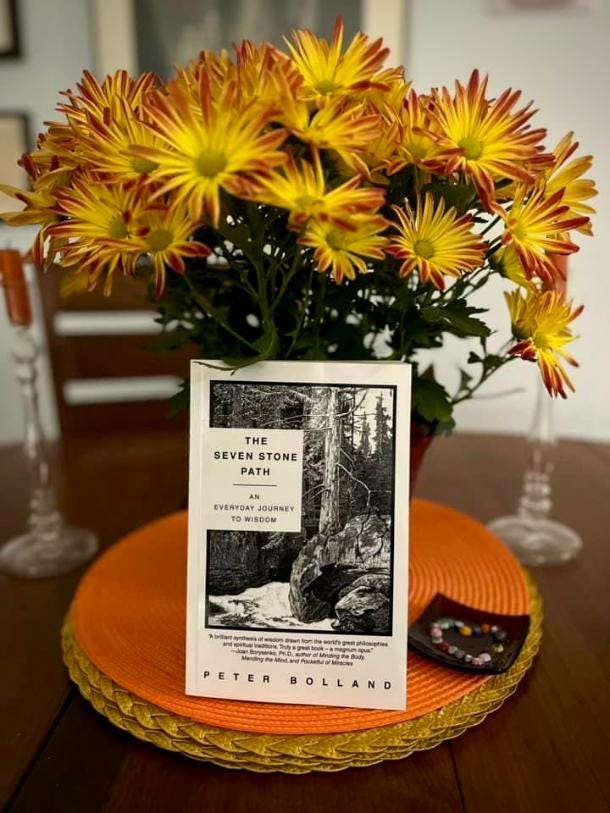
Well, we got through the terrible twos. And here we are, celebrating the third birthday of my book The Seven Stone Path: An Everyday Journey to Wisdom, published in August 2023.
I know I already wrote about this last August, on our second birthday, so I’ll spare you the complete overview and blow-by-blow summary I did last time. (Read it HERE if you’re interested).
This time, let’s just read a few passages together for old times’ sake, or for you new readers, to offer a little taste of what’s in store should you choose to pick up the book and check it out. It’s available wherever you buy books, online, or at your favorite indie bookstore. Just ask for it.
What’s it about? The Seven Stone Path is my summary of my favorite insights from the world’s wisdom traditions, with an emphasis on real-world application of those guiding principles. We do not study wisdom in order to become more knowledgeable and clever—we study wisdom in order to embody and realize it in the midst of our ordinary lives.
In the first chapter, Wisdom as Acceptance, there’s quite a bit of Buddhism and Stoicism because both of those traditions place the practice of acceptance at the heart of their traditions. Throughout all my years of teaching, however, I’ve again and again encountered resistance to the idea of acceptance, and it always sounded a little like this: “Doesn’t practicing acceptance mean saying yes to cruelty, abuse, and injustice?” Not exactly, but good question. Here’s what I wrote:
Acceptance does not mean indifference, apathy, avoidance, denial, or inaction. Instead, cultivating the consciousness of acceptance means moving willingly into a field of pure possibility, unhindered by rigid conceptual frameworks, arbitrary personal preferences, or lifeless limitations. If anything, the consciousness of acceptance is an ideal starting point for deeply engaged, effective, and compassionate action. Despite its content-free nature and apparent fluidity, the consciousness of acceptance is simply the best foundation for the construction of wisdom and compassion, as well as the realization of a joyful and fully actualized life.
As we continue to reflect on the nature of acceptance, the portrait that emerges is of a condition of consciousness where all resistance to reality has be relinquished and replaced by a clear-eyed awareness that no matter what my intentions are for what comes next, I must begin in the here and now. Resentment, frustration, anger, and denial only inhibit my ability to respond powerfully by moving forward and participating in the cocreation of my intentions. As Carl Jung wrote, “We cannot change anything until we accept it. Condemnation does not liberate, it oppresses.” In fact, when I do not practice acceptance, I am practicing a kind of oppression. “I am the oppressor of the person I condemn, not his friend and fellow-sufferer.”
In chapter two we unpack the idea of surrender. In this excerpt we explore its deeper meanings:
In the dubious narrative we tell ourselves—that nothing good comes without a fight—we imagine there to be an enemy. The enemy goes by many names: poverty, ignorance, disease, powerful others, disempowerment. But what if the narrative is flawed? What if beneath our simple-minded characterization of life as a war there lies a deeper, less convenient truth that evolution, growth, and emergence, whether of an individual organism, a culture, or an entire universe, is necessarily messy, painful, and littered with dissolving forms? Loss is a part of there being a world at all. That fact does not make the world our enemy. Perhaps the enemy is our own misconception, born in the ego’s illusion of separateness. We have met the enemy, and it is us.
If all is one, then the struggle disappears. In the world’s wisdom traditions, especially in the teachings of the mystics, we find a challenging alternative to the standard dualistic portrait of life as a battle between good and evil. As Jesus counseled his students to “turn the other cheek” and “resist not evil,” he was asserting the ancient insight that we are already at one with the Good; we don’t have to create it from scratch with our ingenuity, cleverness, and sweat. Instead, what is required is a deep-tissue surrender and cooperation. “For my yoke is easy,” said Jesus, “and my burden is light.” Straining to control everything is, in stark contrast, a painfully difficult yoke to bear.
~The Seven Stone Path: An Everyday Journey to Wisdom, p. 43-44
Two brief excerpts cannot do justice to an entire 334 page book, but I hope I’ve whetted your appetite, or if you’ve already read it, taken you back to a pair of memorable moments. There are five more chapters after the first two on acceptance and surrender—engagement, allowance, enjoyment, love, and integration—but I’ll leave this here and let you explore those on your own.
Thanks to everyone who bought the book these last three years, and especially those who bring their heavily underlined, highlighted, and dog-eared copies to my events for me to sign, and also to those multiple-book buyers who loved The Seven Stone Path so much you’ve made it your personal mission to share it with everyone you know. I did not see that coming.
Also, all of your five-star reviews on Amazon really, really help—they truly do—the more reviews an author receives on Amazon, the more Amazon’s algorithms share the book across their recommended books banners, exposing it to a wider and wider slice of Amazon’s enormous global reach. And the stories parents share with me about teaching the principles in the book to their children. And the book clubs, in private homes and at prestigious universities, who build months-long discussion groups around the book. And the legions of you who’ve downloaded the free Seven Stone Path Workbook from my website, whether you own the book or not.
There is a hunger for wisdom in all of us. I’m so honored that my little book played a small part in facilitating a process by which so many people have experienced wisdom welling up through the cracks in their own lives.
I can never thank you enough, and am deeply moved that the work I did had value for you.
Gratefully,
Peter Bolland
No posts
Comments
Nothing yet. Say the first thing.
Sign in to join the conversation.