
I recently finished my MBA.
Alongside the lectures, assignments and group projects came something every business school understands matters: networking.
Events. Drinks. Introductions. Rooms full of people you don’t know yet, but perhaps should.
The logic is hard to argue with. Careers aren’t built on capability alone. Opportunities travel through relationships. Ideas travel through relationships. Much of what we learn about industries, organisations and possible futures comes from people outside our immediate circle.
I’ve also enjoyed meeting many of those people.
There is just one complication.
I’m an introvert.
Meeting someone new is interesting.
Walking into a room containing a hundred people I don’t know is something else entirely.
There is a strange tension here for the introverted professional.
We know relationships matter. We know a strong professional network creates opportunities, perspective and resilience that we cannot manufacture alone.
Yet one of the conventional routes to building that network is an environment many of us find unusually demanding.
A few years ago, I wrote about how introverts could handle that room.
The advice was practical. Arrive early. Give yourself a curfew. Find somewhere quiet when the room becomes too much. Aim for one or two worthwhile conversations rather than trying to meet everyone.
I still stand by most of it.
But after finishing my MBA, and attending more networking events along the way, I’ve realised I was solving the wrong problem.
I was treating the networking event as the thing an introvert needed to get better at.
The room is not the network.
The room introduces you to people you might not otherwise meet.
The network is what happens afterwards.
That sounds obvious once stated. Yet much of what we call networking still concentrates on what happens in the room:
work it → make contacts → perfect your introduction → connect on LinkedIn.
For an introvert, the usual alternative is just to play a smaller more reserved version of the same game.
I think there is a better way to think about this.

Introversion isn’t a professional disability.
It isn’t a secret superpower either.
We don’t need an elaborate neuroscience story to explain why some people find prolonged social interaction more effortful than others. Research gives us enough evidence to establish the more modest point.
Leikas and Ilmarinen (2017) found that behaving more extravertedly was associated with an immediate improvement in mood, but also greater fatigue several hours later.
For some of us, a crowded reception after a full day of work simply costs more.
Temperament changes the cost of an action. It doesn’t decide whether the action is worth taking.
That distinction is important.
You don’t choose your starting temperament. You do have considerable say over how much authority you give it.
If an event matters, go.
Just don’t assume you need to experience it in the same way as the most socially energetic person in the room.
There may also be another reason some of us dislike networking.
Research by Casciaro, Gino and Kouchaki (2014) found that instrumental professional networking could leave people feeling morally uncomfortable, even “dirty”.
Sometimes the objection isn’t just that we don’t want to talk to people.
It’s that we don’t particularly like treating people as opportunities.
That’s a useful instinct to preserve.
There is another reason to rethink networking now.
AI is making it remarkably easy to appear interested in people.
You can research someone’s career before meeting them, identify common interests, draft a personalised connection request and produce a polished follow-up before you’ve made it back to the hotel.
Some of this is genuinely useful. I use AI extensively myself.
But it changes the signal.
A personalised message once provided at least some evidence that another person had invested time in you.
Increasingly, it proves that someone, or something, assembled a personalised message.
Contact is becoming abundant. Credible attention is not.
Credible attention leaves evidence. You remember what someone said. You send something later because it is genuinely relevant. You make an introduction because two people should know each other. You do what you said you would do.
This changes the objective.
You don’t need to maximise contact.
You need enough contact to discover where your attention is worth investing.
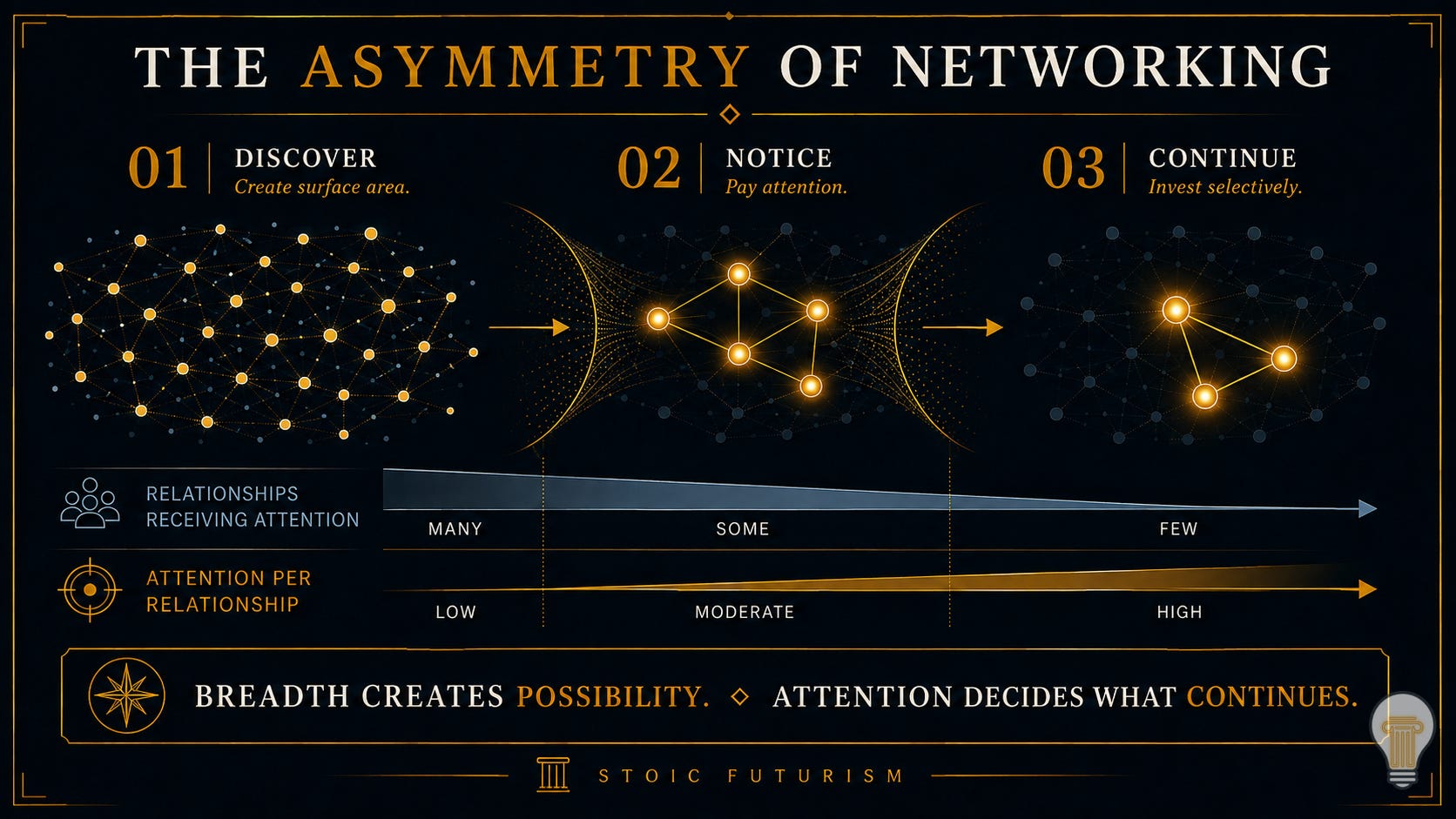
The strategy is asymmetric.
Create enough surface area to encounter new people, then invest disproportionately in the few relationships worth continuing.
There is a trap here for introverts.
“I prefer deeper conversations” can become a respectable explanation for meeting nobody new.
Breadth matters.
Mark Granovetter’s classic work on the “strength of weak ties” showed why acquaintances can connect us to information and opportunities outside our immediate social circles (Granovetter, 1973). Almost fifty years later, experiments involving more than 20 million LinkedIn users provided causal evidence that weaker ties can increase job mobility, although the relationship varies by industry and isn’t simply a case of “weaker is better” (Rajkumar et al., 2022).
A useful network needs some breadth because you cannot know beforehand which conversation will matter.
So talk to people.
Just don’t expect every conversation to become meaningful.
This is where I’d revise the One-Two Rule from my original article.
I used to suggest aiming to speak with just one or two people.
I’d now say:
Aim to find one or two conversations worth continuing.
You may need several lighter interactions to find them.
That’s fine. An acquaintance doesn’t need to become a close professional relationship to have value.
The point is to create enough surface area for serendipity, without confusing the number of people you meet with the strength of your network.
Eventually, you meet someone interesting.
At that point, stop working the room.
Stop scanning for someone more important. Pay attention to the person in front of you.
This is where the old advice to “ask, don’t perform” still works.
Huang et al. (2017) found that people who asked more questions, particularly follow-up questions, tended to be better liked by their conversation partners. The important mechanism appears to be responsiveness. A follow-up question demonstrates that you actually listened.
You don’t need a collection of clever networking questions.
Listen to the previous answer.
The next question is usually sitting inside it.
This also changes how I think about small talk.
I’ve never particularly enjoyed it. Discussing the weather while wondering whether either person actually wants to discuss the weather can feel spectacularly inefficient.
But small talk has a job.
It’s Required Friction.
Two strangers need some way to work out whether the other person is friendly, interested, inclined to listen or desperate to escape. The apparently superficial conversation provides some of that calibration.
You don’t need to become brilliant at small talk.
You need to notice when there is something worth talking about.
And don’t turn curiosity into an interrogation. A good conversation needs some reciprocity. Offer enough of yourself for the other person to discover whether they are interested in you too.
Then the event ends.
This is where most of the value is either created or lost.
You don’t need to follow up with everyone you met.
Follow up where there is something worth continuing.
Send the article you discussed. Make the introduction you offered. Ask how the project turned out. If you come across something genuinely relevant a month later, send it.
Then leave them alone until there is another reason not to.
You don't need to stay constantly in touch. Occasional, relevant contact is enough.
This asymmetry can work particularly well for introverts.
You don’t have to maintain fifty conversations with equal intensity. Most people you meet can remain acquaintances. A smaller number will warrant more attention. Some of those relationships will deepen over time.
Depth doesn’t replace breadth.
It grows out of it selectively.
Of course, none of this makes three hours in a crowded room any less like three hours in a crowded room.
The practical advice from my original article still matters.
Arrive early where you can. It is easier to acclimatise as a room fills than to walk into an established wall of conversation.
Have an anchor. Someone you know gives you somewhere to return between conversations without obliging you to spend the entire evening together.
Take five quiet minutes if you need them. Give yourself a rough curfew. Leave when you’re no longer meaningfully present.
These aren’t strategies for avoiding the room.
They’re ways of staying useful while you’re in it.
There is a Stoic principle underneath this that matters more than any networking tactic.
Your temperament is part of the conditions you’re working with. It isn’t an instruction.
Protecting your attention is sensible. Protecting yourself from every uncomfortable interaction is something else.
The aim isn’t to minimise discomfort. It’s to spend your limited attention where it has value.
That includes keeping some in reserve for what comes afterwards.
If you exhaust yourself collecting contacts you never speak to again, you’ve optimised the least important part of the system.
I used to judge networking events partly by whether I had successfully survived them.
That was a low bar.
I now think three questions are more useful:
Did I meet anyone outside my existing circle?
Was there a conversation worth continuing?
Did I continue it?
That’s enough.
Introversion doesn’t exempt us from building relationships. It gives us a reason to be more deliberate about how we do it.
The room creates possibility.
The network is what you choose to continue.
Comments
Nothing yet. Say the first thing.
Sign in to join the conversation.