
On November 18, 1883, residents of dozens of American cities lived through two noons in a single day — their traditional solar noon, when the sun was actually at its highest, and the railroad’s standardized noon some minutes before or after, when the new clocks said it was. After that day, only the new noon remained. The sun moved across the sky as it always had, but the clocks no longer followed it.
How that came to pass is the subject of this essay. First, a note on the frame I am bringing to it.
In a recent conversation with Dr. Paul Héroux, I made a sweeping comment dismissing technology, and he pushed back:
“I have to disagree with you, Peter, on one thing. You say technology is bad for us. I think technology is great as long as you don’t shoot yourself in the foot with it. I mean, technology is basically knowledge, you know, that’s applied. They’re applying science. So there’s wonderful things that we can do as long as we keep our eyes open and our minds not closed.”
He was right, of course. I will be writing a lot more about specific technologies — substations, wireless technologies, LEDs, AI, data centers — and the harms that follow them into bodies and ecosystems. But I am not coming at this from a general anti-technology perspective.
Technology itself is neutral, it is how we deploy it that matters. I work with an implicit framework about how I think about the use of technology that I would like to make explicit, so when readers encounter my criticism of a specific technology, they have the larger worldview that produced it as context. This essay lays that out, and does so by going into the history of a seemingly innocuous invention — the clock.

Time itself is not a technology. Time is a property of the universe — something we exist inside the way we exist within space, registered through change, sequence, and duration. Humans have always lived inside this relationship, but we haven’t always had a way to measure it. When you measure something, you reduce it to what can be measured, and the act of measurement changes how we understand what is being measured. The clock did not invent time. It turned time into something concrete enough to be counted, divided, traded, and eventually imposed. Once time became a measurable unit, everything built on top of it — schedules, time zones, clocking in/clocking out, hourly billing — became possible. The clock is the hinge between time as experience and time as infrastructure.
For most of human history, time was read from the sky. A farmer in Mesopotamia, a merchant in classical Athens, a baker in medieval France — all of them organized their days around the same set of markers: sunrise, midday when the shadows shortened, the afternoon decline, sunset, the position of the moon and stars at night.
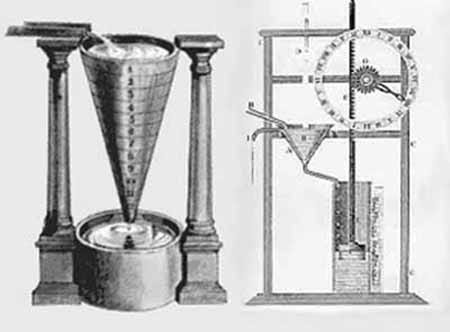
The Egyptians around 1500 BCE were building obelisks whose shadows divided daylight into rough segments — the earliest known sundials. The Greeks and Romans refined the sundial into a public instrument that could be consulted in any forum or marketplace. The clepsydra — a water clock that measured time by the steady drip of water from one vessel to another, with marks on the receiving vessel calibrated to known intervals — filled the gap on cloudy days and through the night. Roman magistrates used clepsydras to limit speeches in court. Buddhist monasteries in China and Islamic muezzin in the medieval caliphates kept time by the same principle of regulated water flow, alongside the position of the sun. The hourglass arrived later, sometime in medieval Europe, and added a critical feature the clepsydra lacked: portability. Ships used hourglasses to measure the watch schedules at night. Churches used them to time sermons.
What this meant for daily life is hard for a modern reader to feel from inside the current arrangement. The hours themselves were not equal lengths the way ours are. In Roman reckoning, the day was divided into twelve hours from sunrise to sunset, which meant a summer hour was longer than a winter hour. Appointments were made at the eleventh hour, or after the midday meal, or when the shadow of the church reached the well. Markets opened at the dawn bell and shut their stalls at sunset. Workers in agriculture worked from light to dark with breaks calibrated to heat rather than time. The body’s experience of time was the reference. Devices were built to approximate that experience for civic and religious purposes, complementing the natural cycles rather than overriding them by defining their own.
This arrangement persisted for thousands of years across every literate civilization on earth. Variations were enormous, but the basic pattern was constant. Time was read from the sky. The devices approximated it.
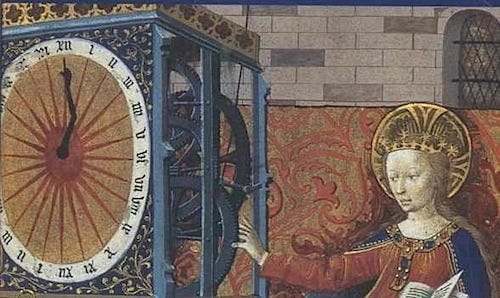
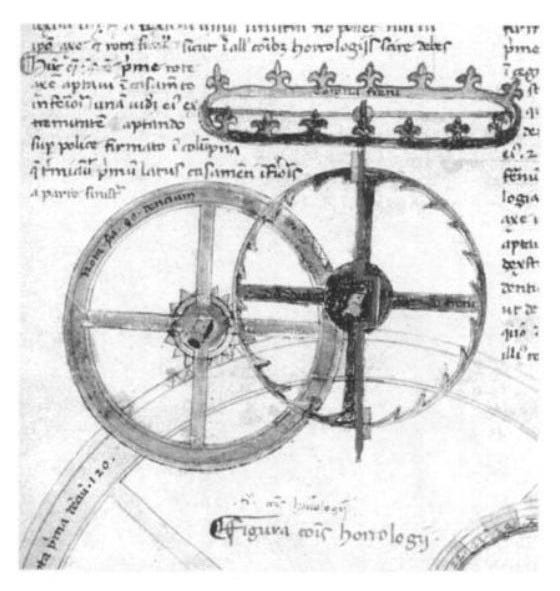
The mechanical clock changed the reference. By the late thirteenth or early fourteenth century, in European monasteries that needed to ring bells for the eight daily prayer hours regardless of weather, weight-driven escapement clocks appeared. A falling weight wants to release all of its energy at once. The escapement interrupts that release — a small lever, driven by an oscillating arm, alternately catches and frees a toothed gear, letting it advance one tooth at a time. Each release produces a tick. Each tick is an interval. For the first time in Europe, time was measured in units the sun did not set.
The early monastic clocks were not accurate by modern standards. They drifted by minutes per day. But they ran continuously, required no flipping or refilling, were insensitive to temperature in the way water clocks were not, and produced something the older devices could only approximate: a unit of time that was the same duration whether it was day or night, summer or winter, sunny or overcast.
Within a century the clocks had migrated from the monastery to the town square. Around 1360, Henri de Vick was commissioned to build a mechanical clock for the royal palace in Paris that established the basic design — a weight-driven verge escapement with a foliot balance — that would dominate European clockmaking for the next three hundred years.
Italian cities built elaborate clock towers in the fourteenth century. The town clock became a feature of European civic life, and the the bells that had called monks to prayer now called the townspeople to market, to court, and to curfew. The accuracy improved slowly. The mainspring — a coiled metal strip that stored energy when wound and released it gradually as it unwound — appeared in the early fifteenth century and allowed clocks to be made small and portable for the first time. A clock no longer needed a tower. It could be carried in a pocket. The pendulum in the seventeenth century brought accuracy to within seconds per day.
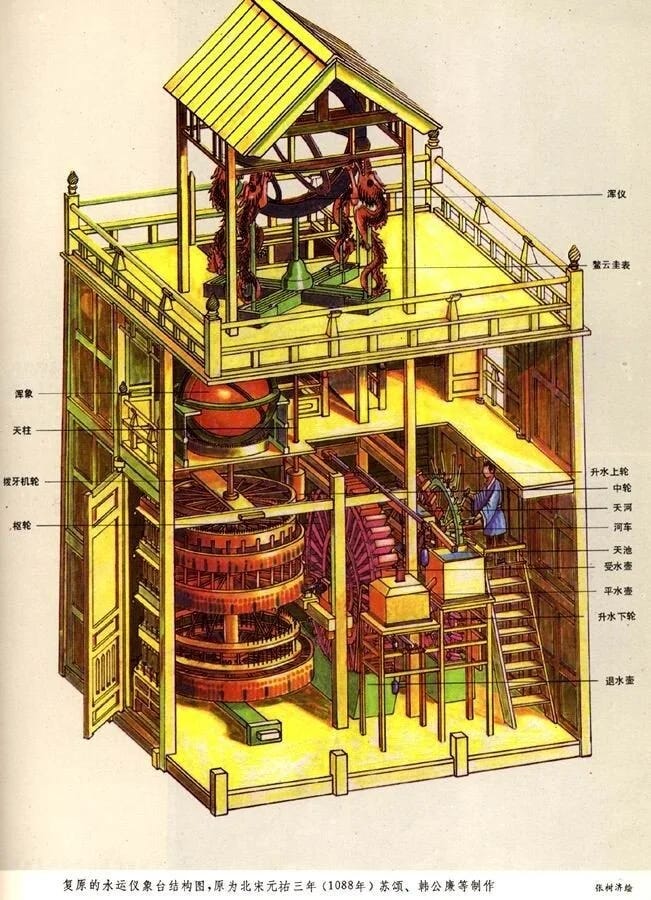
China developed a parallel tradition that ran on its own track for over two thousand years. Water clocks were in continuous documented use from the Shang Dynasty onward, and incense clocks emerged around the sixth century CE — calibrated sticks that burned at known rates. By the eleventh century the polymath Su Song had built a water-powered astronomical clock tower whose escapement did in water what European clocks would not do in metal for another two hundred years. When Jesuit missionaries arrived in sixteenth-century China carrying European mechanical clocks as gifts, the Chinese received them as ornamental playthings. The empire’s timekeeping had taken a different path. The mechanical clock was not, in the Chinese view, a serious instrument.
Either way, the result was the same as in the West: the underlying daily experience of time, for most people in most places, remained anchored to the sun. Each town set its own clock to local solar noon — the moment when the sun reached its highest point in the sky over that town, when shadows fell shortest. A man in Boston at noon was experiencing the actual highest point of the sun in Boston. A man in Buffalo at noon was experiencing the actual highest point of the sun in Buffalo, which arrived roughly eighteen minutes later by the rotation of the earth. Both clocks read noon. Both readings were correct. Time was still local.
In practice, this rarely mattered. A man traveling by horse from Boston to Buffalo would take more than a week to make the trip. He would adjust to local time at each stop along the way without ever noticing the eighteen-minute offset; his body would absorb the change as gradually as the change accumulated. Local time was a curiosity, not a hindrance.
This arrangement persisted through five hundred years of mechanical refinement. Each town kept its own time. The system absorbed the growing pressure of a society scheduling itself by the clock rather than the sun, bending but never quite breaking.
The railroads broke it. They had to. This is what railroads did everywhere they went. Trains moved people and freight fast enough that the difference between Boston noon and Buffalo noon became a scheduling problem rather than a curiosity. By the 1880s, hundreds of local times were in active use across the United States, and railroad companies maintained dozens of different time standards. A traveler changing trains in a major junction like Chicago could find several different official times on the railroad clocks in the same station. In the summer of 1853, a series of fatal head-on collisions on American railroads were traced to discrepancies in conductors’ watches. The worst of them, at Valley Falls, Rhode Island, killed fourteen people in a single morning. The accident produced calls for reform, but the railroad industry was fragmented, regional rivalries were intense, and no single company had the authority to impose a continental solution on the rest. It took thirty years of accumulating scheduling failures, additional collisions, and pressure from telegraph operators (who had been struggling with the same coordination problem) before the industry finally consolidated enough to act collectively.
When the industry did act, the General Time Convention of American and Canadian railroad managers — a private trade body with no government standing — imposed four standard time zones on the continent. At noon Eastern Standard Time, station clocks across the country were reset to the new system — and so was every other clock that took its reference from the railroads; courthouse clocks, church clocks, and the clocks on every public building. The country had been operating on solar time for the entire prior history of its civilization. Within a single afternoon, that history ended.
The U.S. government did not legislate any of this. It did not need to. The railroads in 1883 were the closest thing the country had to a continental infrastructure agency. They had been built with massive federal and state land grants — roughly 175 million acres of public land, an area the size of Texas, along with tens of millions of dollars in subsidies. In return, the railroads organized the continent. They laid the lines that decided which towns grew and which died. They set the freight rates that determined the economic fate of entire regions. They were a private monopoly clothed in public authority, and when their executives met to impose continental time, they were exercising power the government had effectively ceded to them. Congress ratified the railroads’ scheme thirty-five years later in the Standard Time Act of 1918.
A century of scheduling for an entire continent was set by a trade convention of rail executives, and the country adjusted. Some towns resisted. Detroit changed its official time repeatedly between 1885 and 1916, bouncing between Central and Eastern as civic pride collided with commercial necessity. Cincinnati refused railway time entirely for seven years, keeping its city clocks on local solar time until 1890. The state of Indiana fought about time zones for over half a century, with different counties on different sides of the Eastern/Central boundary, and did not fully resolve the question until 2006. They all eventually lost. The railroads ran the schedule, the schedule ran commerce, and commerce ran on the clock.
We had three thousand years of solar and water timekeeping, in which time was read from the sky and devices were built to approximate it. Five hundred years of mechanical clock refinement, in which a parallel reference began to develop but did not displace the sun. Then a single afternoon in 1883, a private industry consortium overrode local solar time across an entire continent and the populations affected absorbed the change. Who, in 1883, would have called this a transfer of authority? Almost no one. It looked like a logistics fix. It looked like progress. The acceleration was no longer gradual at the end. It was discontinuous.

Time zones, by their nature, force most people to live somewhere offset from their actual solar time. Each time zone spans roughly fifteen degrees of longitude. Solar noon arrives at the meridian that defines the zone — for the U.S. Eastern Zone, that is the seventy-fifth meridian, which runs roughly through Philadelphia. Everyone east of that line experiences solar noon before clock noon. Everyone west of it experiences solar noon after. By the time you reach the western edge of the Eastern Zone — Ontonagon, Michigan, almost at the far western tip of the Upper Peninsula — solar noon in winter standard time arrives around one in the afternoon. With daylight saving time added in summer, two in the afternoon. The clock has overridden the sun by roughly an hour in winter and by two hours in summer.
This is apart from any individual’s choice about when to sleep or work. This is a structural offset built into the geography.
The biological apparatus that responds to light and dark is older than mammals. Every cell in the human body keeps time. The master clock sits in the suprachiasmatic nucleus, a pair of small structures in the hypothalamus — the almond-sized region at the base of the brain that regulates body temperature, hunger, thirst, sleep, hormone release, and the autonomic functions that keep the body in range. These structures receive direct input from specialized photoreceptors in the retina — not the rods and cones that handle vision, but a separate population of cells discovered only in 2002. These cells respond preferentially to blue light, the spectral signature of sunlight as the sun climbs high enough in the morning sky to deliver direct, unscattered shortwave illumination. When those receptors fire, they tell the brain it is time to be active. When they go quiet at dusk, they tell the brain it is time to rest.
The downstream consequences of this signaling are enormous. Cortisol — the adrenal stress hormone that mobilizes glucose, regulates immune function, and shifts the body from sleep mode to active mode — follows the morning light signal. Melatonin — the pineal hormone that signals night to every tissue in the body, lowering temperature, slowing metabolism, and triggering cellular repair — follows the dark signal. Body temperature, glucose tolerance, growth hormone, the entire hormonal architecture of the day, is keyed to the timing of light at the eyes. When that timing is wrong, the system runs out of phase. Shift workers, the population on which the largest body of evidence has accumulated, show elevated rates of metabolic syndrome, cardiovascular disease, certain cancers, and depression compared to day workers performing the same jobs. It is not hard to understand why. We evolved to receive the light of the sun as the guide for our circadian clock, and when the signaling is disrupted by artificial light, the downstream systems absorb the cost.
Social jetlag is the term researchers use for the milder version of this misalignment that affects most of the population — the gap between the time when we would naturally want to sleep and wake, and the time the scheduling of our day-to-day responsibilities demands. Adolescents living on the western edge of time zones where it stays darker much later in the morning show measurable academic and mental health decrements. Indiana’s decades-long fight over time zone boundaries, finally resolved in 2006, was driven in significant part by parents who recognized — without the technical vocabulary — that their children were being asked to function before their bodies were ready.
The clock did not cause this by itself. Artificial light is the other half of the story, and I will save that for a separate piece. What the clock made possible was the imposition of centralized schedules set by an institution and applied to a whole population regardless of where the sun actually is. Time zones are the largest and most undeniable instance: solar time overridden, written into law, absorbed without consent, built into the geography itself.
None of this rests on contested science. The literature on circadian biology fills the journals, it won the 2017 Nobel Prize in Physiology, and underlies the standard of care in sleep medicine. The clock and the lightbulb are two halves of the same intervention, and the body absorbs the cost of both. What’s missing is the connection between that literature and the daily life of populations who absorb the cost without ever being told they’re paying it.
Fourteen people died at Valley Falls in 1853 because the railroads did not share a standardized time. The deaths were visible, dramatic, traceable, countable. They led to a radical restructuring of society within a generation. The country adopted standardized time. The collisions caused by mismatched clocks stopped.
What the country got in return was a century and a half of measurable circadian misalignment built into the schedule of the population living offset from the central meridian of their time zone. Because the cost was distributed across millions of people over many decades, instead of in a tragic accident that made the newspaper headlines, the effects were not dramatic enough to register. And even when the effect was noticed, its cause was not obvious.
This is the pattern. A real, acute, visible harm gets fixed by an intervention, and the intervention carries a chronic cost that is diffuse, delayed, and distributed across a population too large for any single case to carry the weight of the wreck that prompted the fix. The body count is real, but the bodies do not appear on the news. They accumulate too slowly to be noticed and across populations too dispersed to be counted. By the time the epidemiology catches up, the infrastructure is locked in place, and the entity that would have had to answer for the chronic cost may no longer exist.
Neil Postman, cultural critic and self-proclaimed Luddite, wrote in Technopoly that every technology is a Faustian bargain. It gives something. It takes something away. This trade-off framework is the basic position of my thinking about technology. The most revealing illustration is a technology people don’t even think of as a technology: writing.
Postman opens Technopoly with a parable from Plato’s Phaedrus. The Egyptian god Theuth, inventor of writing, presents his creation to King Thamus and claims it will improve both the wisdom and the memory of Egyptians.

King Thamus disagrees, telling Theuth that he has been misled by his affection of letters to ascribe to them a power that is the opposite of what they really possess.
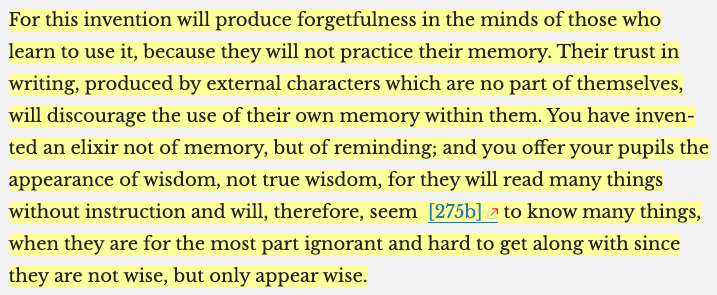
Filled with the conceit of wisdom rather than real wisdom, he explains, they will be a burden to society.
It is striking how much this sounds like current concerns about AI. The defenders of writing in the fifth century BCE made the same arguments the defenders of large language models make now — knowledge will be expanded, memory will be augmented, the slow work of internal discipline will be automated and made universally available. The critics in both eras have made the same response. Externalizing what was internal does not just extend the faculty. It atrophies the faculty being extended. Thamus turned out to be at least partly right. Writing did weaken the kind of attention required to hold long passages in the head. It ended the oral tradition, the accumulation information has stood in for understanding, and few would argue that wisdom has grown alongside it. The trade-off was real, and most of us would still accept it, but the cost was not zero, and Thamus saw it before any of the technology’s downstream defenders did.
Postman addressed the clock directly. The passage is the philosophical formulation of what this essay has been describing, and it is worth quoting in full:
“But such prejudices are not always apparent at the start of a technology’s journey, which is why no one can safely conspire to be a winner in technological change. Who would have imagined, for example, whose interests and what world-view would be ultimately advanced by the invention of the mechanical clock? The clock had its origin in the Benedictine monasteries of the twelfth and thirteenth centuries. The impetus behind the invention was to provide a more or less precise regularity to the routines of the monasteries, which required, among other things, seven periods of devotion during the course of the day. The bells of the monastery were to be rung to signal the canonical hours; the mechanical clock was the technology that could provide precision to these rituals of devotion. And indeed it did. But what the monks did not foresee was that the clock is a means not merely of keeping track of the hours but also of synchronizing and controlling the actions of men. And thus, by the middle of the fourteenth century, the clock had moved outside the walls of the monastery, and brought a new and precise regularity to the life of the workman and the merchant. “The mechanical clock,” as Lewis Mumford wrote, “made possible the idea of regular production, regular working hours and a standardized product.” In short, without the clock, capitalism would have been quite impossible. The paradox, the surprise, and the wonder are that the clock was invented by men who wanted to devote themselves more rigorously to God; it ended as the technology of greatest use to men who wished to devote themselves to the accumulation of money. In the eternal struggle between God and Mammon, the clock quite unpredictably favored the latter.”
Postman is drawing on Lewis Mumford, the historian of technology whose Technics and Civilization (1934) is the foundational text for thinking about the clock as the key machine of the industrial age. Mumford’s analysis goes further than the passage above. He observed that the clock was the first machine whose product was not a physical good but a measurement. It taught the human mind to think of time as something that could be saved, spent, wasted, accounted for — language that would have been incomprehensible in a culture guided by the natural light from the sun. And the clock disciplined the body in a way no prior technology had. Sleep, eating, work, prayer all became scheduled rather than responsive to bodily states. Mumford argued that the clock taught humans to think of themselves as machines: bodies running on schedules, processes that could be timed and measured, performance that could be evaluated against quantitative standards. Most readers of this essay live inside this conditioning so completely that the alternative is hard to imagine.
Postman’s framing in the opening sentence of that passage — that prejudices are not apparent at the start of a technology’s journey — is the deeper bind that the trade-off framework actually contains.
Every technology is a Faustian bargain, and we don’t actually know what the bargain is at the moment we make it.
The benefit is acute and visible. The harm is chronic and invisible, often for decades, or even centuries. The railroads in 1883 were not stupid or evil. They could see the dead at Valley Falls. The status quo was untenable. They could not risk another collision from misaligned schedules. By the time the science caught up the trains were no longer even close to a primary form of transportation. The bargain had been signed, the country had reorganized around it, and the entity that would have had to answer for the chronic cost no longer existed.
No technology can be evaluated by what it gives alone. The trade-off is the unit of analysis. If you cannot name what was taken, you cannot put a price on what was given. And what was taken is almost always invisible at the moment of the trade.
Technology Is a Double-Edged Sword will be an occasional series, interspersed between the investigative pieces. These structural essays will lay out the framework I’m operating within. The clock is one case, but the pattern is everywhere.
Part two: the taxonomy of how technologies impose chronic harm — reform, novelty, and “scope-creep” — and the institutional machinery that lets the deployment cycle run forward in every case, until the cost is too embedded to reverse.
No posts
Comments
Nothing yet. Say the first thing.
Sign in to join the conversation.