
What does it mean to be human today?
I hear this question surfacing in conversations about AI, in reflections on our role in the sixth mass extinction, and in contemplations about our potential beyond destruction.
The modern answer has reduced us to being a supposedly enlightened homo oeconomicus, a thinking machine. A functional and interest-maximizing individual. It shapes how we move through life, how we organize work, and what we count as contribution to society.
We have been rehearsing our own replacement by machines by first agreeing to become like them, accepting that what matters is what can be calculated, measured, and processed.
With the notion of “kinship” (e.g. Robin Wall Kimmerer) we are reminded of a cultural repertoire we have largely lost in modern societies. It invites us to reconnect to indigenous traditions, to our bodies, to being integral part of nature again, in right relationship to the more-than-human world.
However, there is a risk of romanticizing this reconnection, as well as applying a monocultural framing to it. I often hear that we can access this way of being by moving away from the drive to action by “just being, without performing.”
Can we be without form? What does “just being” human then mean? Is there a pure essence beneath we just need to access? A pre-modern “right” way of being human? It often comes with an appeal to inner work, as a precondition of being a “good human”.
In this respect, I share the challenge by Dave Snowden and Nora Bateson, among others, regarding “inner development” as drawing a false binary between inner and outer worlds. A well-intended attempt, but nevertheless implying a homogenization of what it means to be human. After all, we co-evolve, we are mutually constituted in relationship.
If anything, the (quite ancient) conversations on “human nature” point at radical diversity, as expressed by the great variety in human cultures, affecting worldviews, practices, rituals, postures and gestures of being alive. In sum, a rich cultural repertoire of what it means to be human, as nature’s means of building resilience and abundance.
“The primary threat to nature and people today comes from centralising and monopolising power and control. Not until diversity is made the logic of production will there be a chance for sustainability, justice and peace. Cultivating and conserving diversity is no luxury in our times: it is a survival imperative.”Vandana Shiva
And yet, as the words of Vandana Shiva remind us, diversity is threatened at all levels: biodiversity, the diversity of practices, beliefs, and ways of being. This modern homogenization is also largely prevalent in movements that aim to make the world a more conscious, sustainable, or regenerative place.
There seems to be a structural incapacity of connecting, of weaving between different narratives, subcultures, lifestyles, and roles played in regenerating places and the planet. The polarization of our times is mirrored by the annihilation of the diverse spectrum of being that makes life rich, meaningful, and abundant.
It shows up as:
- homogenizing narratives around sustainability, the circular economy, regeneration etc. arguing, convincing, influencing for “the right way” thereby adopting an expert up to colonial posture This leads to the incapacity of embodying diverse collective and more-than-human ways of being – what I call
- the evocation of a larger “we”: “we” are sitting in “the same boat”, “we need to” while this “we” is not based on consent, may involve speaking on behalf of others, and lacks the representation of the diversity within the “we” under the veil of well-intended, but superficial convergence. At the same time, individualistic logics remain in place through virtue signalling an inexistent and often unfelt “we”.
- the invisibilization of edge perspectives in speaking about “the future” in singular, excluding the diversity of voices and bodies of more-than-human beings, disabled, LGBTIQ, Global South people etc. (cf. decolonial approaches, queer ecology etc.)
- this goes hand-in-hand with the massive waste of diverse “talent” that escapes the monopolizing idea of worthiness we see today from job recruitments on a broken labour market, in youth unemployment, to the exclusion of whole categories from contributing to society.
- hidden power dynamics even in horizontal approaches to power, incl. sociocracy, holacracy and others, unreflective of the diversity of power dynamics and very understandings and manifestations of power. Reduction to “The Circle” as unique archetypal form of organizing.
- the projection of community in transactional networks, groups, and social media platforms without deeper forms of belonging, shared meaning-making, and solidarity.
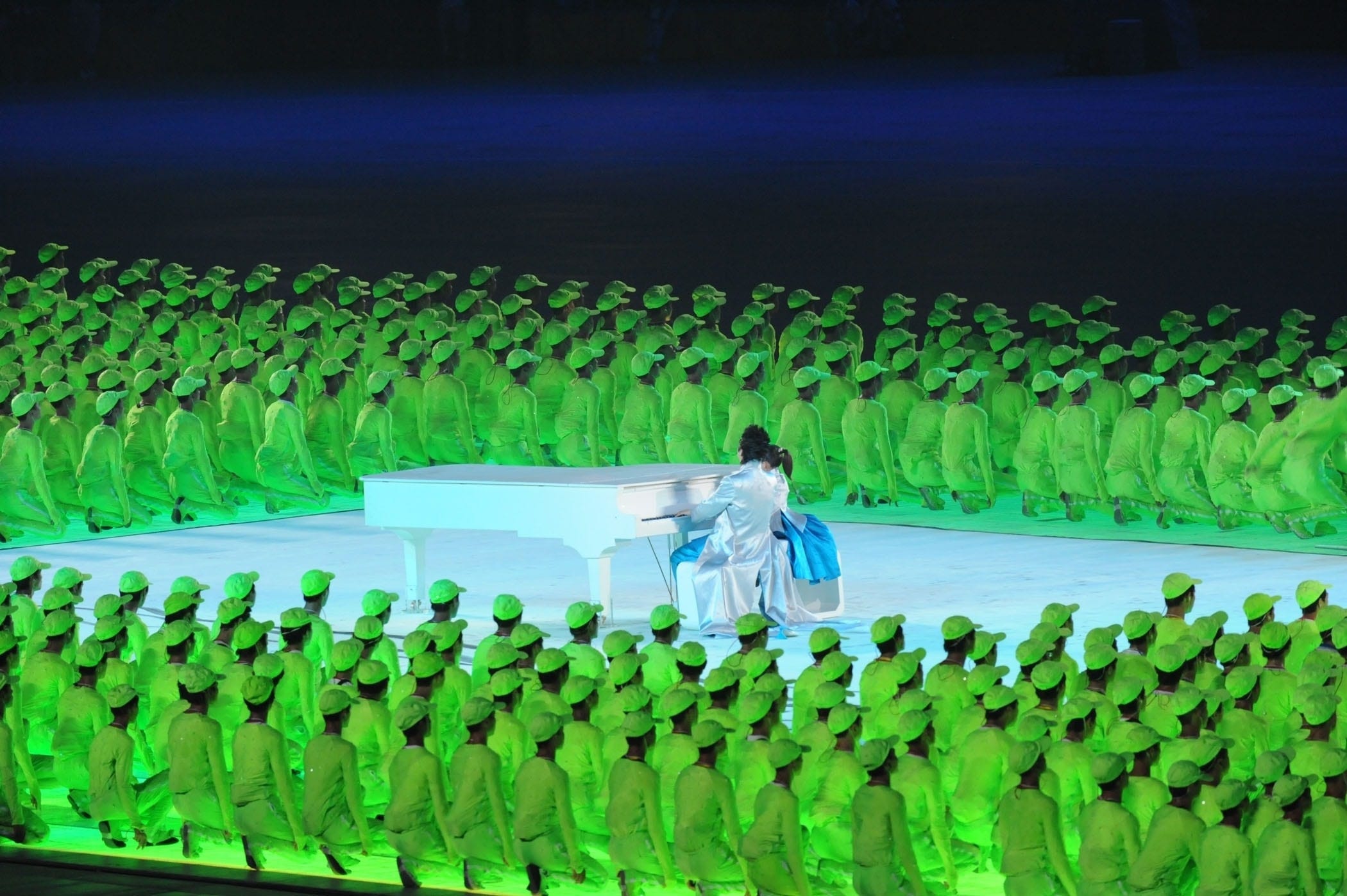
It leads to “modern constellations” that you will recognize in how our societies are organizing and moving through life and work.
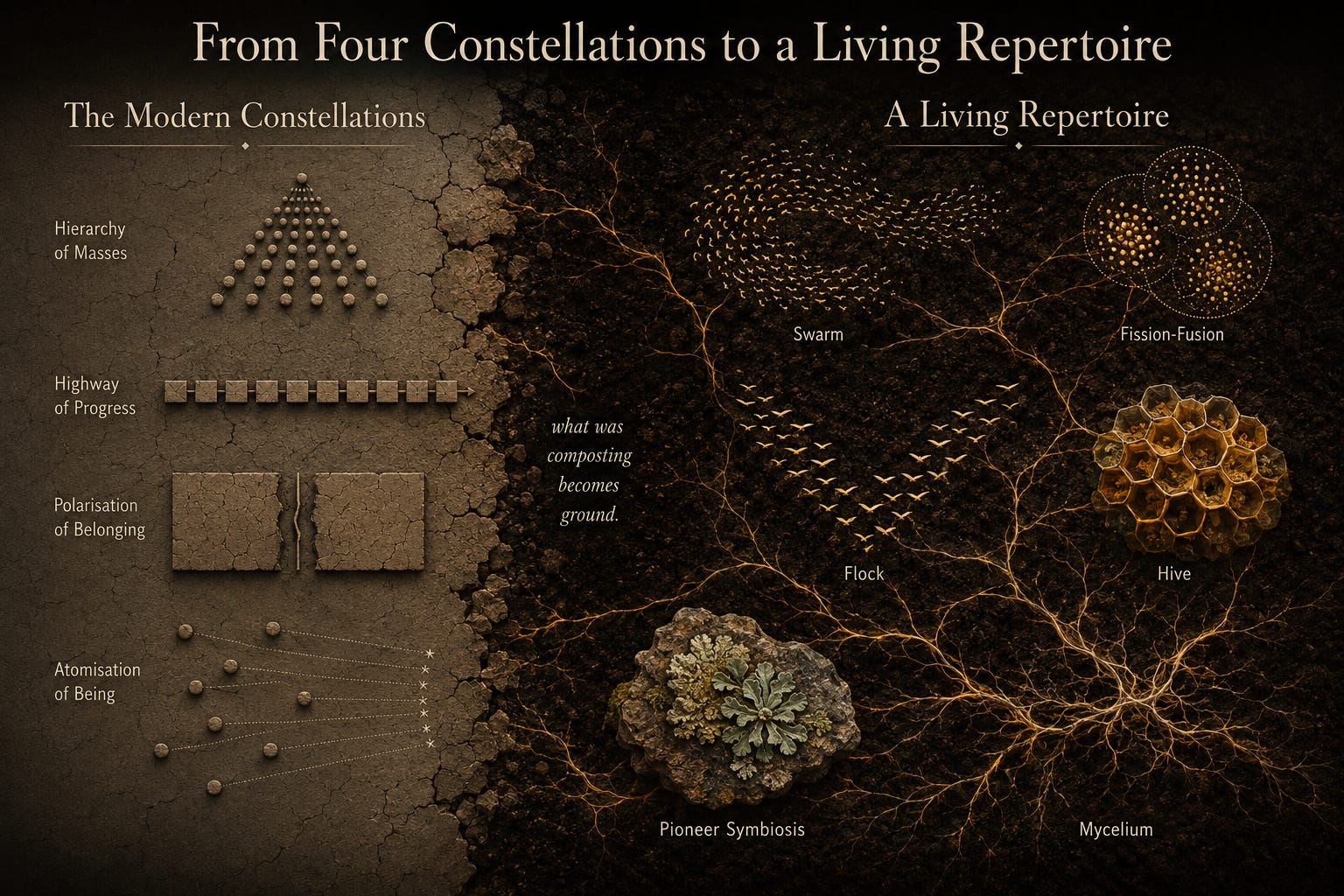
I call these the four modern choreographic constellations.
The Hierarchy of Masses. Schools, political parties, corporations, mass media, administrative states: organising large numbers of people through a single dominant logic, centred at the top, homogenised at the base. The movement is top-down, the rhythm is command-and-comply, the cultural soil is authoritative narrative monoculture.
The Highway of Progress. Factory production lines, corporate processes, marketing funnels, innovation cycles, algorithmic feeds: movement as efficiency, direction as singular, speed as the only legitimate metric. The choreography is linear. Everything that cannot be placed on the conveyor belt does not exist.
The Polarisation of Belonging. Citizen and foreigner. Friend and foe. Able and disabled. Normal and different. The reduction of the radical diversity of identity and belonging to binary opposition: a choreography that generates permanent conflict precisely because it cannot hold the complexity of what it simplifies. Every excluded middle becomes a wound.
The Atomisation of Being. The maintenance of isolation through the projection of a higher, unattainable power: heaven, utopia, AI, political messianism, religious dogma. Meaning exists somewhere other than here: in the future, in the transcendent, in the next upgrade. This choreography keeps individuals separated and reaching, never arriving, never feeling enough to act in genuine relation.
These four are part of a larger system. The Hierarchy creates the masses that the Highway processes into output, which the Polarisation keeps from organising across difference, while Atomisation ensures that no one feels located enough in a particular place and people to resist. Combined, they produce a culture that is, as I keep putting it: disembodied, dislocated, and dissociative.
While it is easy to dismiss these modern movements, they have emerged for a reason, raising the question: what legitimate need or urgency may they have been an answer to, at least originally? The Hierarchy answered the need of organizing industrial societies. The Highway ensured that the permanent growth need of these societies can be met. The Polarisation points at the role of discernment and judgment (of what’s right and wrong). The Atomisation follows something beyond the immediate, something larger than ourselves to orient toward.
Emerging from a European context of industrialization in which poverty, famine, (civil) wars, poor education etc. were still largely present, they offered a response our modern systems are still largely based upon: nation-states, education systems, health systems, political systems, mass media narratives, organizational structures, etc.
Having originated from a context of scarcity, it is perhaps unsurprising that these modern constellations are catastrophically impoverished in the diversity of choreographic responses available to them.
Which brings us to what nature has actually been rehearsing.
Long before humans invented organisations, living systems developed a rich and differentiated repertoire of collective movement forms. Rather than picturing them as metaphors, they are actual patterns of self-organisation, each adapted to specific ecological conditions, specific succession phases, specific relational challenges.
We carry these patterns. They can even at times already move through us. The challenge today is to develop the literacy to recognise them (again), name them, and consciously work with them.
I have been mapping ten Choreographic Constellation Archetypes as a living framework for reading and redesigning how human collectives (can) move. Each carries its own genius, its own shadow, its own cultural soil requirements, and its own place in the succession sequence of a living ecosystem.
As part of the Ecosystem Choreographies framework’s Synergy Move, they are tightly linked to the Soil Move, the cultural soil they help nurture and transform, and to the Style Move, the individual archetypes that make the collective constellation possible, or not. The following archetypal constellations provide an overview.
If you’d like to receive the full guide with full constellation portraits as with The Swarm archetype, consider joining as paid subscriber.
Starlings, sardines, herring, baitfish, murmurations
The Pattern The swarm is perhaps the most breathtaking demonstration that coherence does not require command. Thousands of starlings shift, fold, compress and expand across the sky with no conductor. Only local rules of proximity, alignment, and avoidance. Each individual tracks its three to seven nearest neighbours. The global pattern is breathtaking, predator-confusing, beauty-generating and emerges from such simple organizing principles.
The swarm is an emergent order operating at a scale no single node can perceive or control in its entirety. With few individual archetypal roles present, it makes an ideal starting point for pioneering efforts, such as launching a new product, creating a pioneering community project or testing innovative approaches.
Human Cultural Analogues
Flash mobs and spontaneous street protests
Viral social media movements (#MeToo in its first surge, Arab Spring cascades)
Open-source development sprints and hackathons
Wikipedia’s early collective editing behaviour
Festival-time economies where thousands coordinate without central planning
Market microstructure (high-frequency, short-horizon trading behaviours)
The early, pre-institutional phase of any social movement
Labour Division / Role Archetypes
The swarm distributes leadership across all nodes simultaneously. There are no permanent roles, just temporary local influence. The Catalyst is momentarily whoever is on the leading edge of the direction-shift. The Body is the mass that amplifies and transmits. The Sentinel is whoever happens to be at the periphery, first to sense a predator or opportunity. No one holds these roles across time.
Catalyst / Edge-Mover: initiates micro-direction changes; influence lasts seconds
Body / Amplifier: follows the nearest signal; creates the mass coherence
Peripheral Sensor: triggers the collapse or expansion by sensing the edge first
Cultural Soil Conditions
The swarm needs:
- high porosity (information flows instantly and without gatekeeping),
- low structural density (no hierarchy to slow the signal),
- strong moisture (people trust each other’s embodied sensing enough to follow rapidly), and
- adequate microbial life in the form of shared tacit norms.
- It does not require narrative diversity. In fact, narrative monoculture can intensify swarm behaviour, for better and worse.
It thrives in low-trust-in-institutions, high-trust-in-peers environments.
Ecological Succession Phase Early pioneer. The swarm is the pattern of immediate response: to threat, to opportunity, to spectacle. It appears at the disruption-and-reassembly phase of succession: after a clearance event, before new structures have crystallised. It is the shape that occupied space before a forest can begin.
What It Is Best At
Rapid, non-hierarchical collective response to threat or opportunity
Predator confusion: creating enough complexity that the dominant system cannot target any single node
Generating collective emergence without coordination costs
Mobilising at scale before institutions can catch up
Shadows and Thresholds The swarm’s gift is also its fragility. Without the five-dimension soil conditions, it tips into stampede, panic, or mob. It cannot hold complexity over time, carry institutional memory, or coordinate toward multi-year goals. Every swarm moment eventually needs a different choreographic form to metabolise what it has generated. The failure mode is: swarm forever, never nest. Movement without roots.

birds: from thrushes to raptors to penguins
The choreography of protected becoming, of incubating with care and nourishment. Built with extraordinary precision and relational labour for a specific developmental window, then left. The nest holds the not-yet.
In human culture: residency programmes, founding-team intimacy, sanctuary spaces, initiatory circles, and — yes — the Cœureographers programme in its holding of practitioners before they are ready to fully emerge into the wider field. The gift is the capacity to hold what is not yet ready to meet the world. The shadow is the protector who cannot release, the nest that does not know it has become a cage.
honeybees
Distributed intelligence producing complex, coordinated, surplus-generating production without a commander. The queen does not rule but enables continuity over generations. The workers follow chemical gradients and waggle-dances rather than orders. The result is architecture, climate regulation, collective decision-making by quorum (through popular excitement about the waggle-dance), and the production of honey as the surplus that makes winter survivable.
In human culture: worker cooperatives, monastic orders, guild systems, the best of what institutions can be when their microbial culture is healthy. The gift is sustained production and accumulated surplus over time. The shadow is calcification: when order becomes rigid, when the waggle-dance stops finding anything new and the colony follows its own trails to exhaustion.
wolves, African wild dogs, orcas
Cooperative pursuit across complex terrain, through total relational attunement. The pack’s extraordinary hunt success (African wild dogs succeed in roughly 80% of attempts) comes not from individual dominance but from the collective capacity to read each other in motion.
In human culture: surgical teams, jazz ensembles, start-up founding cohorts, special forces units, high-trust facilitation partnerships, theatre ensembles with long collaborative histories. The gift is collective intelligence in dynamic conditions where the whole genuinely exceeds the sum. The shadow is insularity: the relational depth that creates the gift also closes the group to what is outside it.
wildebeest, horses, bison, caribou
Collective safety in open terrain through distributed sensing. Every individual contributes vigilance; the alarm of one becomes the response of all. The migration follows routes that encode ancestral knowledge across generations.
In human culture: religious congregations, pilgrimage traditions, political mass movements past their swarm phase, and consumer trend cycles and the herding behaviours of financial markets. The gift is the embodied transmission of memory and the safety of collective presence. The shadow is conformity pressure that eliminates the edge species, and the stampede that follows when collective panic overrides individual judgment.
chimpanzees, dolphins, elephants
The most cognitively complex of the collective movement forms. A community that regularly divides into smaller working sub-groups and reconvenes. It can split and reunion following social, ecological, and relational logic that all members track simultaneously. This requires high distributed intelligence compared with other archetype constellations, because managing who is with whom, what alliances are active, and what knowledge each sub-group is developing demands extraordinary cognitive and social capacity.
In human culture: project-based organisations, university ecosystems, bioregional networks, jazz scenes, regenerative territorial experiments. The gift is holding diversity of perspective within a container of relational trust. The shadow is fragmentation when the reunion rituals (the grooming, the shared meal, the gathering) are defunded in the name of efficiency.
geese, cranes: migratory formation flyers
Organised formation flight in which each position has a distinct aerodynamic function, and the lead rotates to share the energetic cost of cutting through resistance. The V-formation creates uplift for every bird behind the leader. The whole flock arrives after migrating thousands of kilometres on significantly less energy than any bird flying alone would need.
In human culture: leadership-rotation cooperatives, relay teams, editorial collectives, long-distance caravans, facilitator networks with rotating lead roles. The gift is sustaining collective movement toward a shared destination without burning out any single node, making visible the gift of shared uplift. The shadow is rigidity: when one leader remains in position, burning out, and putting the whole constellation at risk.
ants, termites
A million nodes producing architecture, agriculture, climate regulation, and coordinated defence without any individual understanding of the whole, through chemical gradients and distributed computation. Termite mounds have been continuously occupied for over two thousand years. This is complex infrastructure.
In human culture: large bureaucratic institutions, global logistics networks, national administrations, the long memory of religious institutions. The gift is sustained production at scale across generational timescales. The shadow is the brittleness of a system that cannot absorb novelty: when the pheromone trail leads nowhere, a million ants follow it to exhaustion, and the caste structure cannot metabolise what it cannot categorise.
fungal networks: the Wood Wide Web
A single organism expressed as a network. Simultaneously decomposing dead matter and transferring nutrients, carbon, water, and chemical signals between living organisms across hundreds of hectares. The mycelium is not a collective of individuals. It is a distributed intelligence that connects what would otherwise remain isolated, and dissolves what needs to be composted.
In human culture: informal knowledge networks, diaspora webs, dark social (the WhatsApp threads and email chains that carry most of the actual relational value invisible to any institutional map), peer learning ecosystems, and the connective tissue of regenerative practice networks. Its gift is making soil, making connection, making decomposition possible. Its shadow is extraction: when the connectors stop returning value to what they connect; and permanent invisibility, mistaken for discretion.
lichen, dandelions, nitrogen-fixing bacteria with legumes
The choreography of making the impossible habitable via improbable partnerships. Lichen colonises bare rock: not one organism but two or three (funghi, bacteria and algae), each providing what the other cannot. Together they produce the acids that break stone into proto-soil as the foundation on which every subsequent succession depends. The dandelion arrives on disturbed ground, drives its taproot through the compacted layer, brings up minerals from below the plough line, and flowers first for the earliest pollinators. Like an alchemist for degraded soil.
In human culture: social entrepreneurs working in contexts written off by institutions, early bioregional practitioners in conventional landscapes, whistleblowers who create the conditions for accountability processes that arrive after them, first-generation practitioners bringing regenerative agriculture into farming regions where it has no precedent. The gift is making soil where there was none. The shadow is the martyr who mistakes tolerance of harsh conditions for a permanent virtue. It’s the pioneer who does not know when the soil is ready for something to follow.
These ten are a living repertoire of moving together with the intelligence and space-shaping power of nature. This article has covered patterns that co-exist, intersect, and succeed each other in any healthy ecosystem. A mature ecosystem like forest can hold many of them simultaneously.
The work of choreographic constellations is not to choose one pattern and implement it. It is to develop the literacy to read which patterns are already moving in a given cultural field: what is composting, what is emerging, what is overextended, what is missing. It’s learning to embody a greater cultural repertoire of being and acting in the world.
This is the diffractive move building collective resilience: not replacing the Hierarchy of Masses with a single alternative, but introducing enough choreographic diversity that different parts of the human community can reorganise around the patterns that actually fit their soil, their succession phase, their specific gifts.
Something is composting. And beneath it, the mycelium is already moving.
The succession is underway. The question is whether we have enough choreographic literacy to dance with it, rather than against it.
The full profiles with how each archetype divides labour among role archetypes, what cultural soil conditions it requires, what ecological succession phase it belongs to, and what it costs when it stays past its time are available for paid subscribers. Jean-Philippe Steeger is an Ecosystem Choreographer working at the intersection of cultural soil analysis, regenerative leadership and communication practice, and systems change.
Comments
Nothing yet. Say the first thing.
Sign in to join the conversation.