
I’m writing this post because, after reading through Simon Laird’s recent post I Like (some of) The Gays, I found many points of disagreement. Not only that, but I found so many angles of disagreement that it wouldn’t really be proper to try and fit them all in just a comment. This is also a fairly rare case where I have such a lengthy disagreement with someone who I probably agree with in like every single other instance, more or less. I find it much more useful to present a counter-point in that type of situation compared to just arguing against leftist talking points for the five millionth time.
I say all of this to justify why I am writing a post that is just responding to things that someone else said in a post of their own. This type of post feels like low-effort slop content and/or baiting for attention, so I want to be clear about my reasons for doing it and explain why it’s not just a comment on the post I’m responding to. Whenever I put something in quotes below, it’s a quotation from Simon’s post.
Homosexuality is a disorder, like autism. If you were standing in the ether, choosing whether to be born with autism or without autism, it would be better to choose to be born without it. But there are many wonderful folks who live with one (or both) of these disorders.
Simon will partially invalidate this premise further down when he explains that “The popular idea that people have an internal switch that is set to either “homosexual” or “heterosexual” is false. There is a spectrum, and most people who have had a homosexual experience fall somewhere in the middle of the spectrum, not at the extreme.” While this is a better view than the extreme binary viewpoint held by most liberals (and even many non-liberals), it is just a slightly expanded version of the same basic concept: That you are born with some kind of innate “gay score” that determines your “gay percentage,” so to speak.
The flaw in this premise is the notion that such a “value” is fixed and unchanging. It is trivial to observe that people can and do change their own sexual proclivities over time as a result of conscious and willful behavior; often, by choosing to fall down rabbitholes of increasingly extreme and degenerate pornography. It is widely known and accepted that this can change people’s sexual responses to such an extent that stimuli which they previously found extremely arousing no longer interests them at all, or vice versa. On the right, it is widely known and accepted at this point that many “transgender women” decide to troon out due to a version of this phenomenon called “autogynephilia.”
Why would we expect homosexuality to be somehow magically excluded from these basic principles of human sexual behavior? No one can make the case for that because it is impossible to actually study the topic from a dispassionate and objective perspective without politics getting in the way, and by all indications, that is always going to be the case. Until that changes, we should assume that homosexuality is not, in fact, magically immune to these basic observations. People cannot “choose” to be gay from one moment to the next, but they can absolutely “choose” it in the same way that a person who develops a rape fetish from watching violent pornography has chosen that preference.
The typical counter-point that most people have in mind will be something which Laird also touches on, the observation that some degree of homosexual activity will continue to occur even when society is extremely intolerant of it. This means nothing in terms of the observations made above, as it is again, very trivial to observe that some degree of sexual degeneracy more broadly will always occur in any society, no matter how much the overall culture tries to repress it. This does not mean that the behavior isn’t a choice or isn’t done willfully. It also does not mean that we should stop opposing sexual degeneracy more broadly. This would be akin to arguing that we should stop opposing murder because it is impossible to reduce the murder rate to zero.
Lastly, while this should be obvious, I can anticipate that some people might need it laid out explicitly for them: I am not arguing that homosexuality is purely a result of pornography (though it is likely exacerbated by it). I am putting forward the theory that every time someone chooses to engage in homosexual behavior, they are making themselves “more gay,” and vice versa. While I do think it is plausible that some people have a genetic predisposition to homosexual behavior, I see no reason to believe that they, or anyone else, are immune from the self-reinforcing effect that I have described above. I reference pornography addiction because it is a widely known behavior which makes the existence of this effect clear, obvious, and undeniable.
Note that this theory provides a plausible explanation of this chart:
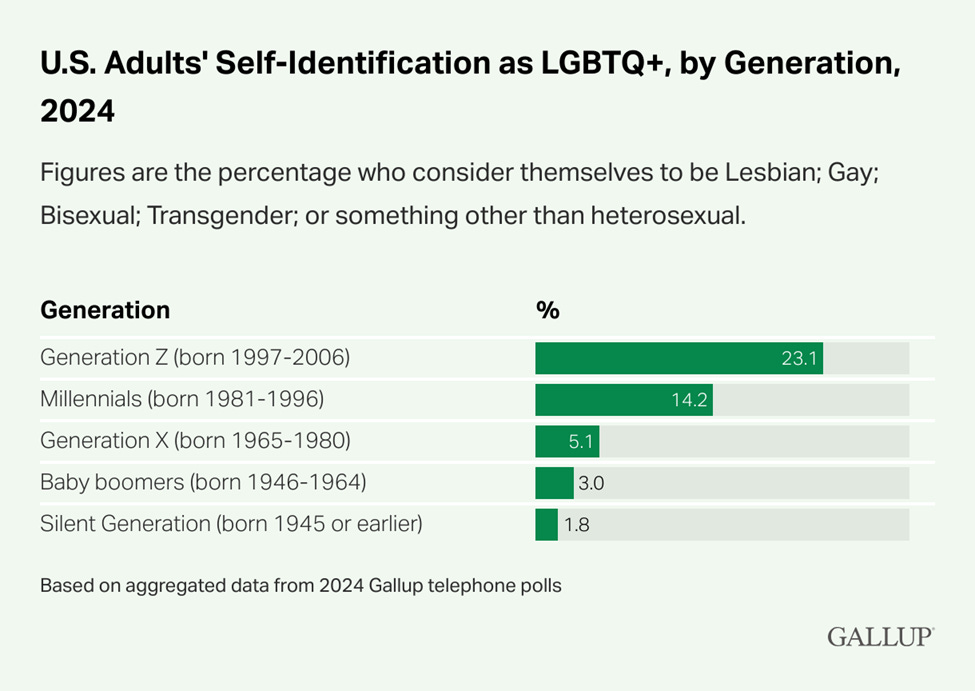
Among the Silent Generation, very, very few people encountered homosexuality or had any real opportunity to indulge in it during their formative teenage + young adult years, resulting in the figure you see above. But with each subsequent generation, as acceptance of homosexuality increased, obviously more and more people could experiment with it during those formative years and thus wire their brains in that direction. Simon includes this chart in his article but doesn’t really address it directly, although his statements imply that people who have a “gay score” of 3 to 4 on a 6-point scale can choose whether to be gay or not. Are all those extra gay men after the Boomer generation just choosing to be gay for social or political reasons, despite being perfectly capable of liking women?
If that were true, it would be all the more reason to publicly shame homosexuals, because it would be the case that if we don’t do that, apparently large numbers of people will choose to be gay just for brownie points. While that would be convenient for my viewpoint, I actually don’t think it’s very plausible. I think it’s more likely that in newer generations, there are more people who turn out gay because they watched too much porn, or were groomed by an older man, or had their first pleasurable sexual experiences with other men in their youth, or whatever the case may be, because all of these sorts of sexual behaviors have become more common and more accepted with each passing generation.
This lines up with the data much, much better than the usual binary “hard-wired from birth” perspective. Again, while it’s probably true that some people are more susceptible to being gay than others, the thing is that we don’t have any real data on exactly who those people are, how many of them there are, how much more susceptible they are, etc., and that data is probably impossible to get at, at least under the current paradigm. With that being the case, it’s better to err on the side of trying to maximize sexually normal behavior and minimize sexual deviancy, as the data that we do have obviously suggests that these behaviors are highly responsive to overall social conditions.
We would not want a very large percentage of the population to be homosexual or autistic, but I don’t think we should want homosexuality or autism to be fully cured. In life you should struggle as hard as you can to overcome adversity, yet it is the challenges you face that make you who you are. Fully curing a disorder of desire like homosexuality or autism would deprive the world of a certain kind of person.
I really do not think this point was thought through very well. While it is technically true that “fully curing homosexuality would deprive the world of a certain kind of person,” this is also true in the exact same sense for pedophiles, adulterers, men who enjoy rape… the list goes on. All of these are “disorders of desire” as Simon describes homosexuality to be. It is unclear what great value the world would be missing out on were these behaviors to be “cured.” The same goes for gay buttsex. I actually think the world would continue on perfectly fine without any men having anal sex with each other. Nothing of value would be lost. I don’t think that’s really that hot of a take.
I also think this is a romanticized view of autism which is guilty of participating in the condition’s absurd expansion of scope that has occurred over the past decade or two. Believe it or not, fully functional people who don’t have autism can also like and build model trains. But this post isn’t about autism and I’m not that interested in discussing autism so let’s move on.
At the National Conservatism conference in DC a few months ago I met a student from New St. Andrews College. New St. Andrews College is a Christian college recently founded by the influential Christian Nationalist pastor Douglas Wilson. The student told me that the panel he was most looking forward to that evening was the Overturn Obergefell panel with the editor of First Things magazine and a few Christian and Jewish pundits. I asked him if he thought it was important to oppose gay marriage and he replied “Yes, because it is impossible.” I wondered why, if it was impossible, he cared whether people attempted it
The parallel to transgenderism here is almost perfect. Just as leftists were briefly allowed to redefine “gender,” they have been allowed to redefine “marriage.” What is one of their foremost defenses of the practice? “Well, why do you care if people try it? How is it hurting you?” The leftist redefinition of marriage has removed procreation and natural family formation as fundamental components of the practice. Children have become merely an afterthought, to be purchased via surrogacy or adoption after the fact, if the “couple” feel like it and have enough money laying around. This is the clear implication behind the viewpoint that a “gay marriage” is equivalent to a real one.
I really don’t think I need to lay out all the obvious negative consequences of this and the reasons why it shouldn’t be allowed.
Furthermore, even if you want to be a right-winger that supports “gay marriage,” you should still oppose Obergefell. This is because Obergefell is a terrible decision from a legal standpoint. Obergefell sets the precedent that the Supreme Court can simply invent new “rights” out of thin air based on nothing, just because the justices feel like the social attitudes in the country have shifted in this way or that.
If we had six Ketanji Brown Jacksons on the Court, it is absolutely plausible that this could be used to do something similar with transgenderism, creating some kind of “right” to gender identity that is imagined via SCOTUS fiat into the Constitution, in exactly the same way as “gay marriage” has been. If you are a conservative that supports “gay marriage,” your position should still be that leftists must address the issue in the proper way, by passing legislation, whether at the federal or state level or both. Leftists should not be allowed to wield the Supreme Court as a weapon to completely bypass legislatures and get their way without anyone having to actually vote for it.
I think immigration (we need to oppose it) is a million times more important than gay marriage.
As I wrote in Aporia, the so-called “Social Conservatives” have their priorities badly out of order. Gay marriage, abortion, and physician-assisted suicide are simply not very important issues. Immigration, economic centralization and racial plunder politics (DEI) are vastly greater threats to our civilization. “Social conservatives” tend to call gay marriage, abortion and assisted suicide “the moral issues” which reflects an extremely impoverished vision of morality. Even if we focus just on issues of marriage and family life, the “social conservatives” have their priorities out of order.
I am not particularly invested in arguing about which issue is “more important” than another as, by nature, this is far too subjective to ever really go anywhere. That and there is no reason that we cannot walk and chew gum at the same time. But if we must talk about it, I think there is a fairly simple litmus test here. Would I rather live in a country with many immigrants, in which everyone (both immigrant and native) shares my religious and cultural views regarding sexuality, or a country with no immigrants and rampant sexual degeneracy?
I actually choose the former and I don’t find it a particularly difficult choice. I would much rather associate with morally upright brown people than morally degenerate whites. I would be curious to hear someone’s defense of the inverse.
Heterosexual promiscuity, divorce, bastardry, and advanced parental age are all more important issues than gay marriage.
Perhaps, but attitudes towards all of these things move in tandem, and the battle must typically be won at each step before advancing to the next. We have to tear down transgenderism before we go after “gay marriage”; we will have to tear down “gay marriage” before we go after normalization of divorce; and so forth and so on. At the societal level, there is no meaningful bloc of people who believe that heterosexual promiscuity is a terrible problem but “gay marriage” is perfectly fine. As with every other political issue, they all simply map onto left-right alignment in a very predictable way.
Gays should be incorporated into the old norms of virtue. Gays should save themselves for their spouses, marry young and stay together for life.
This buys into the same exact leftist lie that started all of this: “Everyone is the same.” Women are the same as men. All races are the same; evolution stops above the neck. Gay people are the same as straight people. No they’re not. There are all sorts of deviations between gay and straight in terms of things like sexual behavior (and I don’t just mean the anal sex, I mean levels of promiscuity, willingness to engage in additional levels of deviancy, etc.), drug use, mental illnesses, etc. These are so clear-cut that if you just ask Google, it will straight up tell you that they are the case.
When you say that gay people should just play-act at being straight people, you are repeating the same narrative that was used to push Obergefell through in the first place, and which was then co-opted to advance transgenderism (“they’re just like you, they were just born in the wrong body!”). I believe this is actually highly inconsistent with the narrative that some people are “incurably gay” and simply can’t help but have lots of anal sex. If that is true, and we are to be sympathetic towards their condition, why expect them to play-act at being straight? What is the point?
I would much prefer that they be left free to indulge in their desires without attaching a false pretense of “marriage” to it. It is the same as with transgenderism: If a man wants to put on a dress and pretend to be a woman, I do not necessarily think that we need to use force to stop him from doing that. But he must not expect me to actually call him a woman, or else it has now become my problem. Likewise, if two men want to live together and have gay sex and actually leave the rest of us out of it, that would be more tolerable than a situation where I am expected to call them “married.”
Modern technology might help people to discover where they are on the Kinsey scale and whether they are best suited to pursue a heterosexual relationship, or whether they are so predisposed to homosexuality that it would be better for them to have a homosexual relationship. A brain scanner could be used on 16 year olds to determine which of them are actually naturally disposed to be gay and which of them are trenders. The brain scanner device would be very helpful for young people struggling with their sexual orientation because it would give them fact-based feedback on whether they were really gay or if their feelings were likely to be a phase.
Why not a brain scanner that simply cures one of their lust for gay sex? So long as we’re speaking in science fiction, that seems far more useful to me.
No posts
Comments
Nothing yet. Say the first thing.
Sign in to join the conversation.