
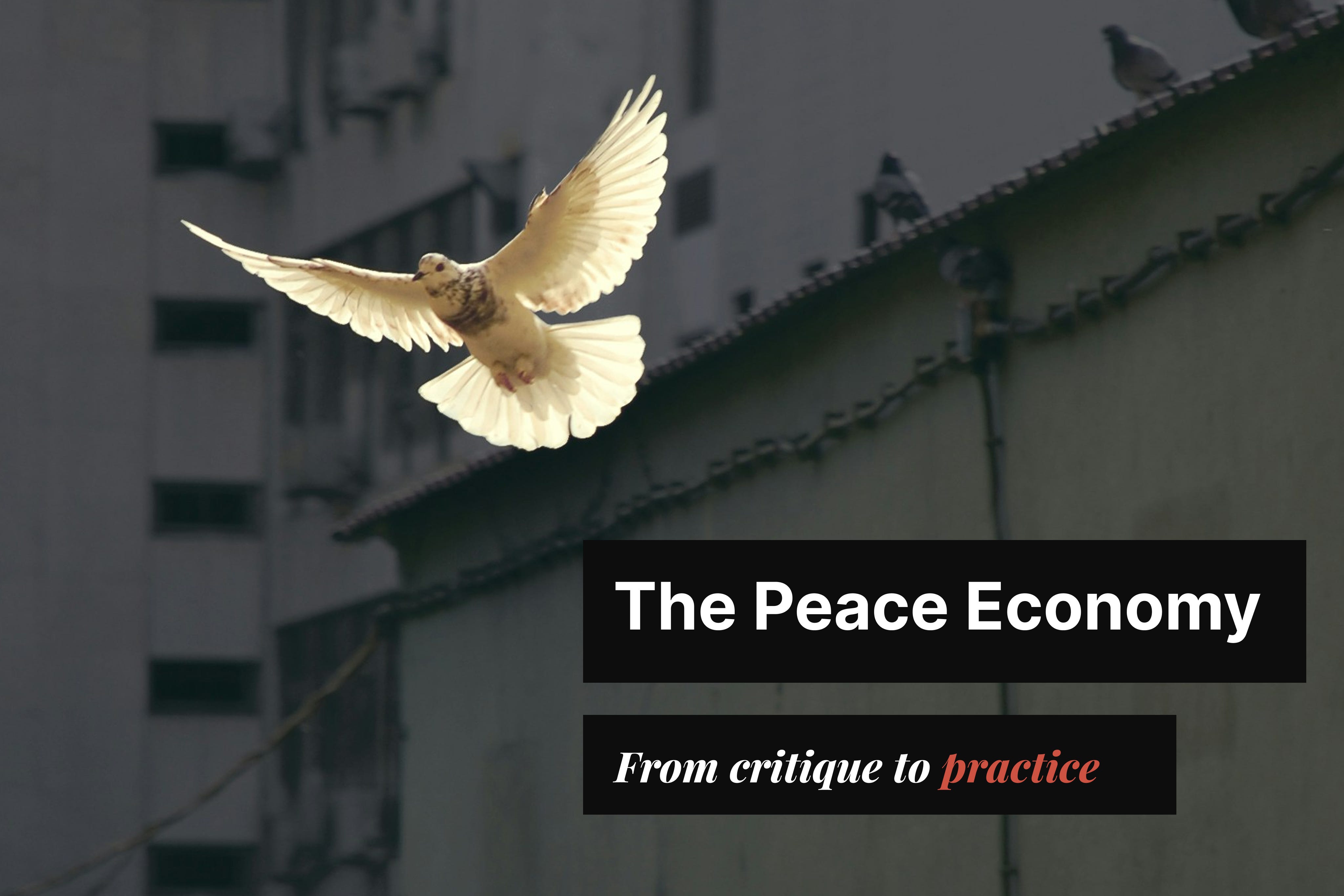
This is the fifth in a series of theological essays on what most people call ‘the marketplace’ and ‘the economy’. If you haven’t read the first (A Scandalous Tale of Two Economies), second (The Lie of the Debt Economy), third essay (The Lies of the Competition Economy), or fourth essay (The Grace Economy) please do so before reading this one.
Four essays, one argument: the economy we call ‘normal’ runs on debt and competition and it’s suffocating us. This is the last essay, and I offer some hopeful and practical things we can do to stop the suffocation and start breathing freely and deeply.
Since this essay series has explored the damage wrought by a global economy that runs on debt and competition I am conscious that the scale of the problems I have brought into view here are so overwhelming that you might resign yourself to the notion that things are so out of our control that we can do nothing to change anything about them.
Alternatively, you might be led to conclude that change is only possible through violent action. I include within this category ideology and propaganda because I think both do violence. Jacques Ellul’s Propaganda: The Formation of Men’s Attitudes is a must read on this and other points.
I think inaction and violent action are two sides of the one flawed coin. Inaction results in slow death. Violent action is an immediate response that, as far as I can tell, will generate more violence than it will stop it. But if neither are the best moves we have at our disposal, than what other option(s) do we have? Peace, for starters. Or better yet, shalom.
The problem with using peace and shalom language in a North American context, however, is that it is prone to being individualized, sentimentalized, and sanitized. The result is people like you and I use the words, but the words don’t take enough root in our lives to help us resist the status quo—which is exactly the kind of thing called out in James 2: 15-17: “If a brother or sister is naked and lacks daily food and one of you says to them, ‘Go in peace; keep warm and eat your fill,’ and yet you do not supply their bodily needs, what is the good of that? So faith by itself, if it has no works, is dead.” We can’t just say peace. We have to actually practice it. In fact, here is what shalom really looks like in the Bible. Randy Woodley writes,
Shalom is communal, holistic, and tangible. There is no private or partial shalom. The whole community must have shalom or no one has shalom. As long as there are hungry people in a community that is well fed, there can be no shalom. Where there are homeless and jobless people amidst the employed and wealthy, shalom cannot exist. Shalom is not for the many, while a few suffer; nor is it for the few while many suffer. It must be available for everyone. In this way, shalom is everyone’s concern. Shalom very much defines the common good.[1]
God’s shalom is not limited to people, especially a particular group of people (i.e. middle-class white North Americans). God’s shalom—what I call God’s peace economy—is overtaking all of creation, bringing about life and what is good, true, and beautiful for everyone and everything. The question is: do we see where this shalom overtaking is happening in our communities, and do we participate in it? Or are we completely missing it, or even worse, working against it? For folks in churches, here are three practical questions you can keep asking yourselves to determine whether you’re seeing and participating in God’s peace economy, or missing or working against it:
• Are we competing or collaborating with people in and beyond our local church community?
• Are we looking for and pursuing opportunities to practice generosity?
• Are we giving gifts to our community?
And very, very practically, Ellul says the following about what peaceful (i.e. Christian) dealings with money ought to look like. He writes, “We must always side with humanity against the power of money… Money pushes us to put its interests (which we assimilate as our own interests) before those of the person with whom we are doing business. Scripture tell us how we must choose: we must decide in favour of the person and against money.”[2] Mammon or God? Jesus asks us. You can’t follow both at the same time (Matthew 6:24). Pick carefully. Pick peacefully. Pick shalom. Pick God, who “Though he was rich, yet for your sakes he became poor, so that by his poverty you might become rich,” (2 Corinthians 8:8-9). And as scary as this may sound to you, what would it sound like to hear this as a promise instead—an opportunity to be freed from the destructive power of Mammon, debt, and competition? Because that is what God is offering us here: liberation from kinds of power that destroy us, other people, and creation.
But what can this look like on an average day in your life and my life? Maybe it’s a line item in your budget that is added or is changed so that other people benefit. Maybe it’s forgiving the debt someone owes you and not holding it over their head. Maybe it’s lending somebody money at no interest (cf. Deuteronomy 23:19). Maybe it’s giving someone something with no expectation they repay you. Maybe it’s collaborating with people you have categorized as competition. Maybe it’s becoming friends with people in your community whom you’d never imagine becoming friends with and caring for each other in generous and creative ways.
These are just a few of the many things we can do to cultivate shalom and change the current economic game where we are. And for those who don’t have hope that this will actually change anything, just check out the parable of the mustard seed: Jesus tells us that the Kingdom of Heaven is like a tiny, nearly invisible seed that grows into a massive, bright, invasive shrub (Matthew 13:31-32).
The essential and exciting truth is this, then. Shalom is not a disembodied, unrealistic idea. It is a decision available to you and me right now.
Since this series started with David Graeber’s book Debt: The First 5000 Years, it feels right to end with what the book suggests after pages and pages of such revealing analysis. In a word, jubilee. Or, the cancellation of every debt every seven years, and a resting of the land. Graeber writes,
It seems to me that we are long overdue for some kind of Biblical-style Jubilee: one that would affect both international debt and consumer debt. It would be salutary not just because it would relieve so much genuine human suffering, but also because it would be our way of reminding ourselves that money is not ineffable, that paying one’s debts is not the essence of morality, that all these things are human arrangements and that if democracy is to mean anything, it is the ability to all agree to arrange things in a different way… A debt is just a perversion of a promise. It is a promise corrupted by both math and violence. If freedom (real freedom) is the ability to make friends, then it is also, necessarily, the ability to make real promises. What sorts of promises might genuinely free men and women make to one another? At this point we can’t even say. It’s more a question of how we can get to a place that will allow us to find out.[3]
Just imagine what the world, what our relationships, would look like if this vision was put into practice? Jubilee would function like a circuit-breaker in that it would prevent debt and competition surges that threaten to blow up our ecological and relational networks. Jubilee would also function like a north star, in that it would help us navigate towards freedom by design rather than alienation via accumulation (i.e. greed). Of course, some people might receive this vision as preposterous and impossible. Others as naive and dangerous. But the question is: who is most likely to receive it as such? My best guess is people who have chosen Mammon as their master.
And maybe that includes you. Honestly, it includes me more often than I’d like to admit. But naming who serves Mammon and who doesn’t isn’t the goal of this series.
Extending an invitation is the goal.
So here is the invitation: walk away from the debt and competition, and step into the shalom of Jesus. It’s worth the risk.
This was the fifth and final essay in this series. Catch up on the whole thing: A Scandalous Tale of Two Economies, The Lie of the Debt Economy, The Lies of the Competition Economy, and The Grace Economy.
[1] Randy Woodley, Shalom and the Community of Creation: An Indigenous Vision (Grand Rapids: Eerdmans, 2012), 24.
[2] Jacques Ellul, Money and Power (Eugene: Wipf & Stock, 2009), 99.
[3] David Graeber, Debt: The First 5000 Years (Brooklyn: Melville House, 2014), 390-391.
Comments
Nothing yet. Say the first thing.
Sign in to join the conversation.