
I’ve never done this before, but right now I’m dying to play a live-action role-playing game.
The game is Sign, played for over two hours in total silence and based on actual events. These events are: as of 1977, Nicaragua had no official sign language and deaf individuals, living in isolation from each other, were left to improvise their own gestures. The Nicaraguan government invited fifty deaf children to start a school in Managua—the plan was to teach them spoken Spanish through lip reading. This plan largely failed. But on the schoolyard, children played and socialized. As they grew older, they met at ice cream parlors, markets, dances. Spontaneously, under the noses of their teachers, these children invented their own language, what is now known as Nicaraguan Sign Language.
“In Sign,” writes philosopher C. Thi Nguyen, “Your group plays as these schoolchildren. At the beginning of the game you are assigned a goal: an inner secret that you are yearing to epxress. (In my first game, it was “I miss my cat more than I miss my parents.”) But you have no means to express it. Over the course of a few hours, you will all have to invent a sign language together, in order to communicate.”
Doesn’t this sound riveting? It’s from Nguyen’s “The Score,” a book that I think a lot of educators are going to want to read as they grapple with the proper use of grades, standardized tests, and other educational metrics.

Nguyen is a philosopher of games and clearly loves them. His book seems born out of what he experiences as a painful tension. The heart of any great game—basketball, chess, Twister, poker, Mario Kart, Sign, the fictional Cones of Dunshire— is a simple scoring mechanism. The score makes it easy for anyone to start playing, as the clear goals determine success and failure in the game. Once you’re sucked in, these simple goals guide your actions and you (hopefully) have a good time. Scores, as in these games, are good.
But!
Nguyen names case after case of scores that distort incentives, spark fixations, or institutionalize unhealthy values. Think US News and World Report’s law school rankings. Think of people chasing social media likes. Think of how some people pursue wealth seemingly for the hell of it. Think of the love administrators often have for meaningless numbers, just because those numbers are what they have. Institutional metrics are everywhere. Nguyen loves scores, but he thinks these metrics are smothering us.
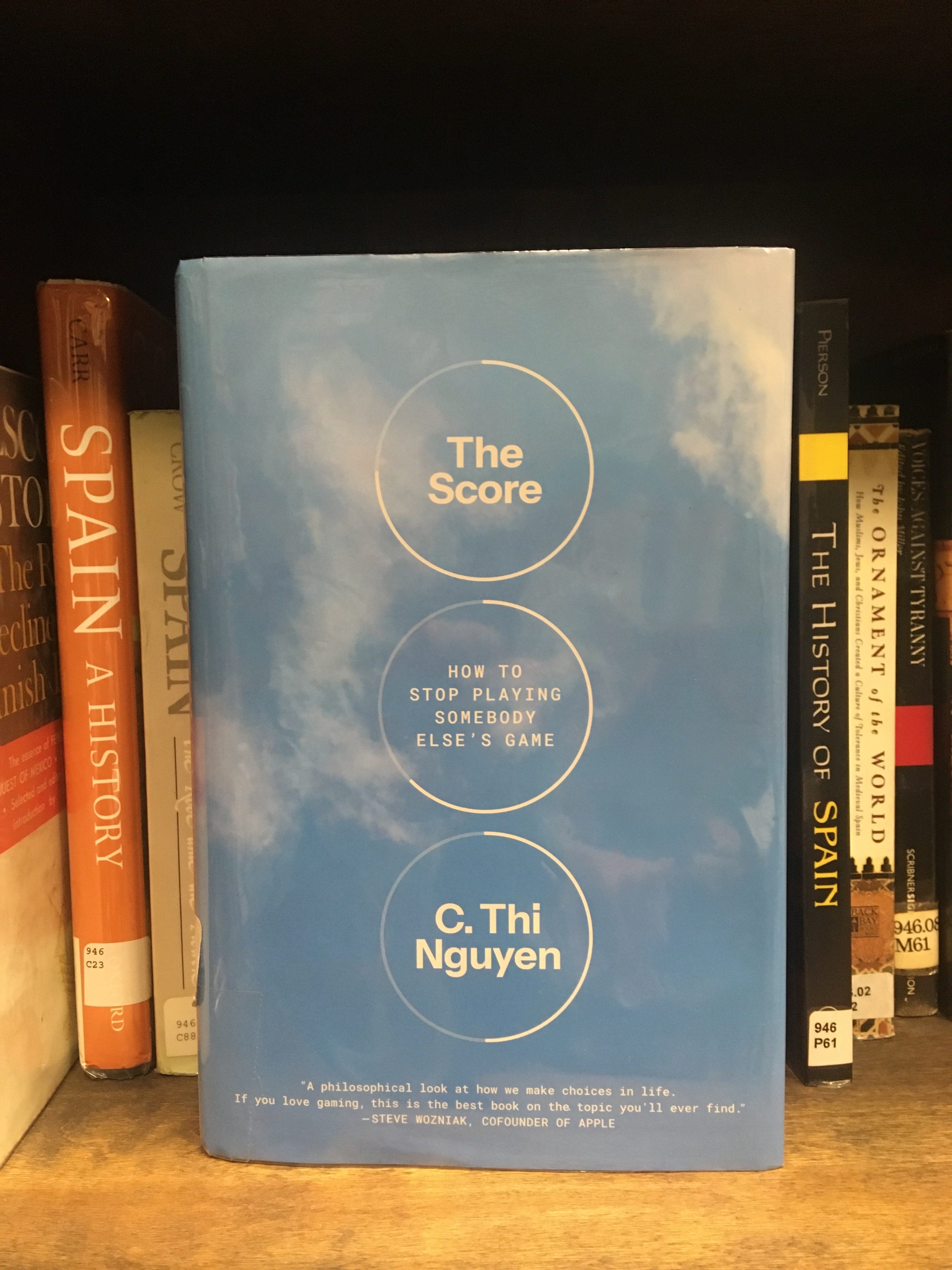
“The Score” develops these ideas in parallel. On the one hand, it’s an insightful account of how games work. For Nguyen, the simplicity of a score makes it easy to temporarily adopt the game’s goals. Then, for as long as you play, you’re a slightly different person—a cutthroat killer, a member of a team, a master strategist, a Nicaraguan deaf kid. Every game is a role-playing game. You’re taking a different sort of mind on a test drive.
At the same time, Nguyen argues that institutional scores—metrics—are the technology of modern bureaucracy. This isn’t all bad. Nguyen writes about his son’s recovery from a terrible asthma attack at a hospital; this sort of recovery is only possible thanks to the coordination at scale that happens in hospitals, fueled by mechanical rules and institutional metrics.
But there are tradeoffs. We pay attention, as in games, to what is measured. Since what’s measured represents what’s possible to quantify and what institutions care about, there’s a real risk that we permanently replace our own goals with the ones represented by metrics.
This is why games and play are essential to Nguyen in our world—they teach us how to pick up and drop scores reflectively. They help us avoid having our values captured by institutions. It’s summarized neatly by a student of Nguyen’s who changes the background of her phone to a question, visible every time she opens it: “Is this the game you really want to be playing?”
It’s a big, lively book that’s stuffed with stories about pizzerias, wine-tastings and the history of cookbooks. (Nguyen used to be a food critic.) Here are a few quick education-y reflections I had while reading Nguyen’s fascinating book.
A handy criticism of schooling is that kids just limp through their academics, treating their studies as a game. But maybe this is the healthiest possible version of institutionalized learning.
In Nguyen’s telling, a game always has a goal and a purpose. The goal is defined by the score. But the purpose is something greater. The goal of basketball is to score points. But my purpose in playing basketball is (let’s say) to experience beautifully coordinated action. The purpose is the point, but without simple scoring nobody would play. (And pickup games would be impossible.)
For kids, school has a simple scoring system—get good grades. But the purpose of schooling is more individual, personal, and subjective than what’s represented in metrics like grades. Maybe the healthiest attitude is to think of grades as something like the score of a game. The “score” gets the motivational ball rolling and sets the direction of learning, but it’s ultimately not what matters.
Quantitative research is good. It’s important. But it perfectly fits the “value capture” dynamic that C. Thi Nguyen describes in this book, where we gradually define our values in light of what’s measurable.
This should be correctly seen as a criticism of “data-driven” or “evidence-based” schooling. The issue is the available data and metrics don’t represent everything of value because:
Quantified data by definition strips away contextual details
Some data can only be collected by the government, so data availability reflects the interests of powerful actors
Our quirkiest values or most personal goals are by definition hard to get consensus on, so aren’t measured, making public metrics a record of what we all sort of agree on, even if it’s not the most important thing for any of us
The problem isn’t really with quantitative research, but in believing that this research represents the totality of what we should care about. It’s not. And yet! Sometimes policymakers seem to be the only people in the world unaware that kids and parents care about much more than academics. These people aren’t stupid; they’ve had their values captured by public metrics. They’ve gotten lost in the game.
Nguyen argues that play is essential and I agree.
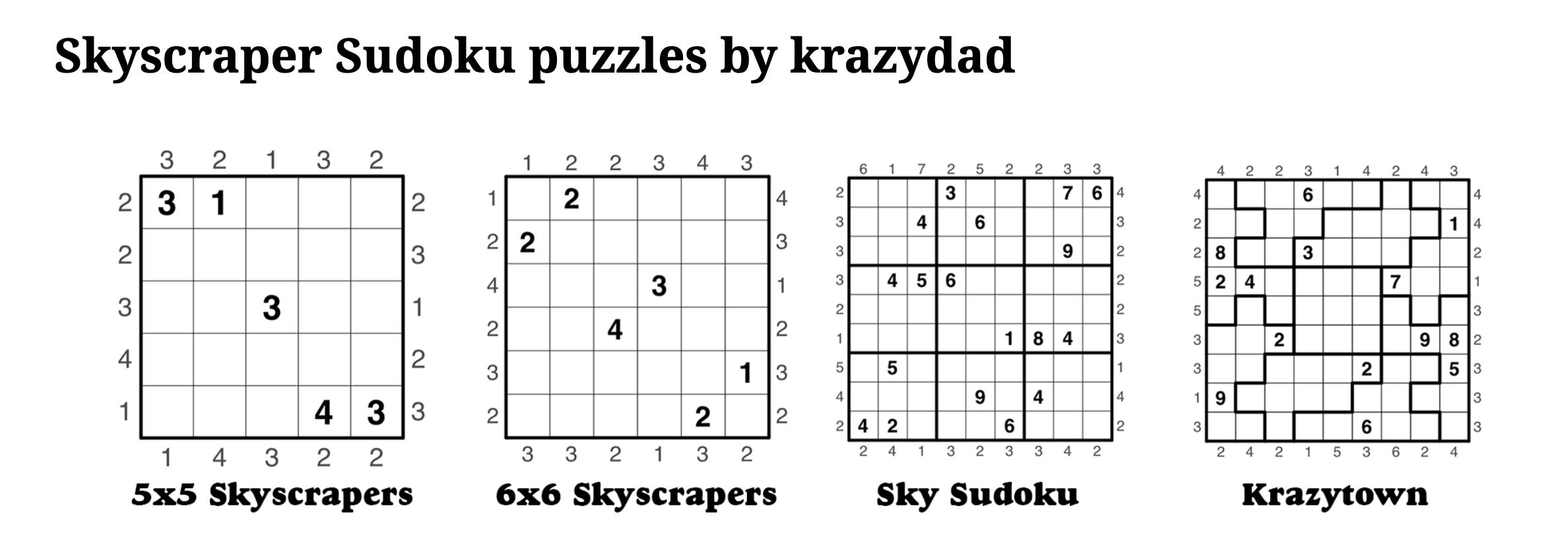
Does everybody know about Krazy Dad? It’s arguably my favorite website on the internet. (Sorry, Substack.) It’s a guy—I guess he’s a father, I suppose he’s krazy—who creates packet after packet of logic puzzles. My personal favorite puzzle lately is Skyscraper Sudoku, which I won’t even attempt to explain. But I love ‘em, and I’ve found myself making time for Loony Pa in my classes.
Sometimes, after my students work on a puzzle, or something off the beaten path of the curriculum, I’ll ask a question: “Was this math?”
Here’s my answer to that question, the one I share with kids: Math is about thinking about what has to be true, or what can’t be. If you do that sort of thinking, that’s math. If you don’t do that thinking, it’s not. That makes math, potentially, very big. But things can be math or not, depending on how you think about them.
School is the perfect site for all the things Nguyen is worried about. It’s Value Capture City. That’s one of the tradeoffs we all collectively accepted when we made education compulsory—it’s a good deal, no regrets. But…there are tradeoffs, right? We shaved down subjects as messy and vibrant as mathematics into something coherent and tidy for school learning. We assigned scores to success with this curriculum. Naturally, people end up thinking that’s all that matters. But it’s not.
Games are resistance.1 They remind us that institutional values are just one possible set of things to care about, that we can easily adopt others. In small but tangible ways, I think ungraded puzzles and games make room for discussions about taste and value. Play is where we, for a moment or two, try being different people. And isn’t that something school should be about—trying to learn exactly who you are?
“Gamifying,” on the other hand, according to Nguyen, is business as usual and potentially awful, as it packages institutional metrics in even more addictive forms.
No posts
Comments
Nothing yet. Say the first thing.
Sign in to join the conversation.