
When Christians think about persecution, they naturally think of the Book of Acts.
They think of apostles dragged before councils, threatened by rulers, beaten for preaching, imprisoned for refusing to remain silent, and sometimes killed for their testimony. They think of Stephen looking toward heaven as stones struck his body. They think of Paul and Silas singing in prison. They think of Peter declaring, “We ought to obey God rather than men.”
And when reports arrive of Christians being murdered in Nigeria, the comparison appears obvious.
Christians were persecuted then. Christians are persecuted now. The same faith produces the same hatred.
There is truth in that comparison. The Christians who suffered under Rome and the Christians being killed in Nigeria belong to the same Lord. Both are hated because they bear the name of Christ.
But the comparison becomes more complicated when we ask a simple question:
What did the persecutor want?
In the opening chapters of Acts, the authorities repeatedly arrest and threaten the apostles.
But their first command is not, “Die.” It is, “Stop speaking.”
Peter and John are ordered “not to speak at all nor teach in the name of Jesus.” Later, the apostles are arrested again, beaten, and commanded not to speak in His name.
The authorities are attempting to control the Church’s public confession. The apostles may continue living, but they must stop proclaiming Christ. They may remain members of society, but they must surrender the message that has placed them in conflict with those who rule.
Peter’s response reveals the nature of the dispute:
“Whether it be right in the sight of God to hearken unto you more than unto God, judge ye.”
The question is one of obedience. Who has the right to command the apostles? Who has authority over their speech and conscience? When the rulers command silence and Christ commands preaching, whose word is final?
The same conflict appears in Thessalonica, where Paul and Silas are accused of turning the world upside down and acting contrary to Caesar’s decrees by saying “that there is another king, one Jesus.”
The charge is political. The apostles are not accused merely of teaching unusual religious ideas. They are accused of announcing another King.
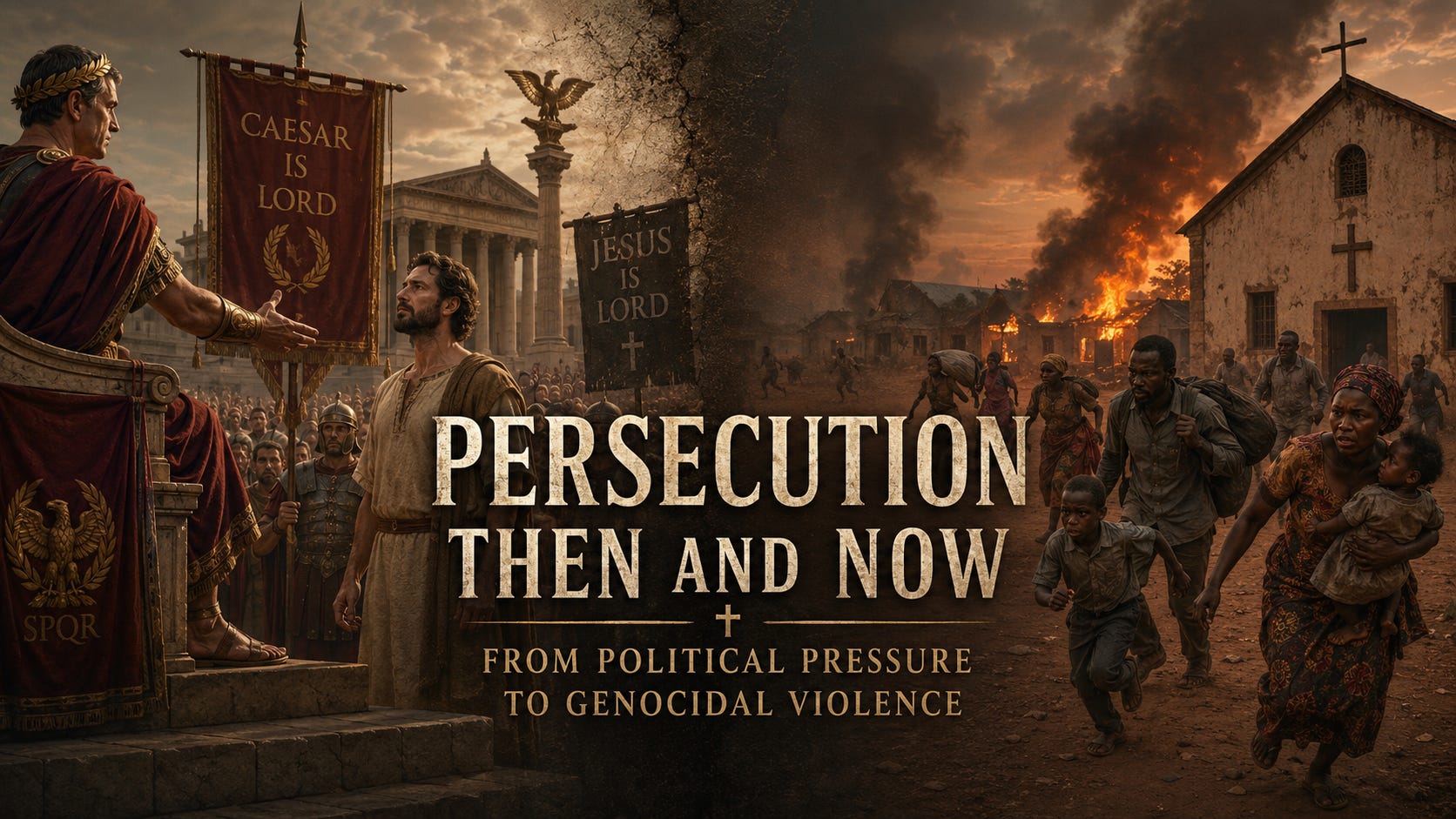
Rome was not generally troubled by the existence of many gods. The empire contained a multitude of religions, temples, sacrifices, and local deities. Rome could tolerate one more object of private devotion. What Rome could not comfortably tolerate was a Lord above Caesar. Jesus could perhaps be accepted as another god. He could not be permitted to rule as King.
This becomes even clearer when we examine the choices offered to early Christians.
The authorities frequently gave Christians an opportunity to avoid death. The persecuted believer might be told to offer incense, swear by Caesar, curse Christ, or otherwise demonstrate loyalty to the Roman order.
Why offer such a choice? If the goal were simply to kill Christians, recantation would be irrelevant. The choice existed because the authorities wanted submission. A Christian who denied Christ’s supreme authority and publicly acknowledged Caesar’s claims was no longer resisting the political and religious order. He might continue to live because Rome had obtained what it wanted.
The demand was not that every Christian cease to exist. The demand was that Christianity cease to challenge the supremacy of Caesar.
The martyrdom of Polycarp displays this logic plainly.
Polycarp was an elderly bishop who had served Christ for decades. When he was brought before the Roman authorities, he was not immediately executed without discussion. He was urged to save himself. The magistrate pressured him to swear by Caesar, reproach Christ, and go free.
Polycarp was being offered a place within the Roman world—but only at the price of placing Caesar above Christ.
He refused.
“For eighty and six years have I served Him,” Polycarp answered, “and He has done me no wrong. How then can I blaspheme my King who saved me?”
The final word is important. King. Polycarp did not merely refuse to insult a beloved religious teacher. He refused to betray his King. The magistrate could threaten his body, but he could not command his highest allegiance. Caesar possessed political power, but Caesar was not Lord.
Polycarp was killed because he would not give Rome the confession it demanded. And because he was given the opportunity to recant, his refusal became a public testimony.
This helps explain why persecution in the early Church so often contributed to the spread of the gospel.
The authorities wanted Christians to speak words of surrender. Christians instead spoke words of testimony. The trial itself became a platform. The demand to deny Christ produced an opportunity to confess Him.
This pattern runs throughout Acts. The apostles are arrested and preach to the council. Paul is imprisoned and testifies to governors and kings. Christians are scattered by persecution and preach wherever they go. The authorities repeatedly attempt to silence the gospel, yet their attempts create new audiences for it.
The persecutor says, “Stop speaking in the name of Jesus.” The Christian answers, “We cannot but speak the things which we have seen and heard.”
The persecutor says, “Acknowledge Caesar and live.” The martyr answers, “Christ is my King.”
Rome attempted to subordinate Christianity. The martyr’s testimony magnified it.
At first, it seems natural to place the persecution of Nigerian Christians into this same pattern. Christians are threatened. Christians are attacked. Christians are killed. Surely this is simply the Book of Acts continuing in another place and century.
But then we look more closely.
Christian villages are attacked in the night. Homes are burned. Churches are destroyed. Families are shot while they sleep. Women are murdered. Children are slaughtered. Survivors flee, and the land they leave behind is emptied of its Christian population.
No magistrate summons the infant. No one asks the child to offer incense. No theological recantation is demanded from a sleeping family before armed men enter the home.
When a two-month-old baby is murdered alongside Christian relatives, the logic of Polycarp’s trial no longer explains what is happening. Polycarp was offered life if he would deny Christ as King. The baby could not deny Christ. The family was not being asked to alter its confession. Its members were being killed because they belonged to a Christian community that the attackers intended to terrorize, displace, or destroy.
Rome was prepared to tolerate Christianity under certain conditions—provided it was not confessed as the supreme Lord who stood above Caesar. The violence in Nigeria often reflects a more radical intolerance. Christianity is not merely being told to accept a subordinate place. Christian populations are being driven from their homes, their villages emptied, their churches burned, their children killed. The objective is not to convince Christians that another authority is higher than Christ. The objective is to reduce or eliminate the Christian presence.
Both Polycarp and the murdered Nigerian Christian suffer because of Christ. But Polycarp’s persecutor wanted him to recant. The genocidal persecutor does not need a recantation. He needs an empty village.
This does not make the persecution of the early Church less evil. Rome tortured and killed faithful believers. It demanded idolatry and punished Christians for giving Christ the allegiance He deserved. Polycarp’s choice was not merciful. He was offered life only if he committed treason against his true King.
Nor does the distinction mean Nigerian Christians have no opportunity to testify. Their faithfulness, endurance, forgiveness, and courage proclaim Christ powerfully.
But the differing objectives produce different practical results.
Political persecution may unintentionally provide the Church with a platform. The Christian is ordered to recant, refuses publicly, and turns the courtroom into a pulpit. The persecutor seeks surrender but instead places Christian courage and conviction before the world.
Genocidal persecution does not operate through that same exchange. It does not need to place a Christian on trial. It can simply enter the village at night. Its immediate earthly effect is not to create a public debate over the lordship of Christ. It is to kill Christian families, scatter survivors, destroy churches, and leave formerly Christian land without Christians.
One creates a martyr before an audience. The other creates a mass grave where a church once stood.
Because the persecutions are different, they require different conclusions from the Church.
From Acts and Polycarp, we learn that no government may command what belongs to Christ. The Christian must never deny that Jesus is Lord. He must preach when commanded to remain silent and obey God when human authorities demand disobedience. The proper response to political persecution is courageous confession.
But when the persecution is genocidal, confession is not the only duty involved.
A child cannot defeat a gunman through a better testimony. A family sleeping in its home cannot answer bullets with a theological argument. A village marked for destruction needs more than admiration for its willingness to suffer.
It needs protection. It needs justice. It needs the guilty restrained and punished. It needs the displaced returned to their land. It needs the worldwide Church to recognize that defending Christians from slaughter is not a rejection of martyrdom. It is a defense of innocent life.
The question presented by Rome was: Will Christians deny that Jesus is Lord?
The question presented by Nigeria is: Will Christians be allowed to remain?
Rome was willing to tolerate Christianity without Christ’s lordship. The genocidal persecutor is unwilling to tolerate Christianity at all. Rome attempted to make Christians bow. In Nigeria, the attempt is to make Christians disappear.
No posts
Comments
Nothing yet. Say the first thing.
Sign in to join the conversation.