
I’m starting to dread going online, although I try to stay open minded about it. Every morning I make my coffee and sit out on my deck, ready to tackle the day. I lift the lid on my Mac and hope the assault won’t be too brutal.
Whether I go to my email or any social media platform, there it is. Free this, limited time offer, only two left, only one hour left to get the deal of the year. Pop-ups everywhere. Miracle products for aging, weight loss, hair loss, eyesight, all with dramatic promises and countdown timers ticking away in the corner of the screen.
And heaven forbid if I searched for something the day before, or actually bought something online. The ads never stop. Apparently the internet hasn’t realized I already purchased it.
Sometimes I click because I genuinely want to explore something. But there is barely time to understand what the product or service is before the pressure begins. Big discounts. Free for the first week. Special bonuses if I sign up immediately. Endless questions pretending they care about my goals and dreams, when really they just want my contact information.
Who are these people? Half the time I’m not even sure anymore. AI-generated videos, fake testimonials, and smiling faces that don’t seem entirely real. It all feels strangely hollow.
The internet used to feel useful and interesting. Now it often feels exhausting.
It’s the aggressiveness that wears me down. So many businesses competing for our attention, our money, and our emotions all at once.
Everything now seems monetized. People selling lifestyles, sponsored recommendations disguised as honest opinions, fake reviews, and endless promises that life will somehow improve if we just buy one more thing.
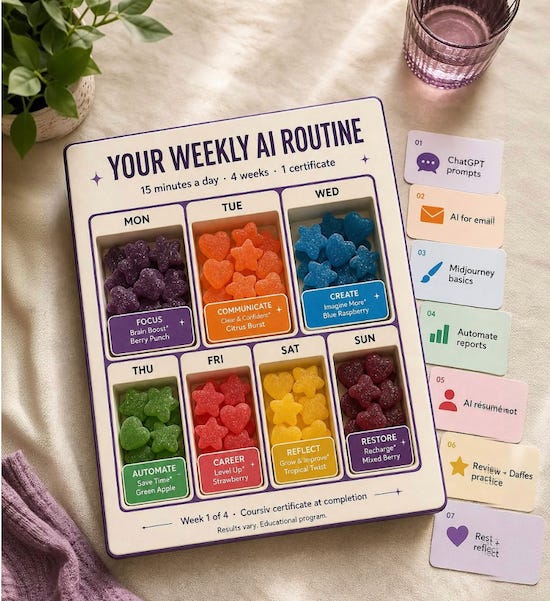
Apparently I should look younger, feel younger, work smarter, earn more money, build an online business, reinvent myself, improve my memory, sleep better, and somehow do it all in only fifteen minutes a day.
And then there are the courses. So many courses. Most begin as “free,” followed by subscriptions that quietly renew themselves month after month. Others promise complete transformations in twenty-eight days if you just follow their system.
Every day I seem to spend more energy deciding what not to click than actually enjoying being online.
All this urgency has taught me something important. If someone is pushing me to act immediately, then there is probably nothing urgent about it for me.
It’s the countdown clocks, the warnings that this is my last chance, the promises that life can improve instantly if I only click before time runs out. That pressure is everywhere now.
And it works. People do click.
Sometimes I stop and ask myself if any of it is even real.
The emotional manipulation is often what catches my attention first. The dramatic stories designed to pull at emotions and lower our guard. The struggling single mother who discovered an AI tool that changed her life in thirty days. The online business owner suddenly earning thousands of dollars while barely working. The app that supposedly transforms every small business overnight starting at only twenty dollars a month.
Really?
I find myself wanting proof, not emotional storytelling. Statistics. Real information. Something grounded in reality instead of hype and urgency.
Real businesses rarely pressure aggressively. Their products, services, and reputations usually speak for themselves.
Maybe it’s my age. Maybe it’s because I’m reasonably tech-savvy. Or maybe I’ve simply spent enough time online to recognize when something feels off.
Poor grammar makes me hesitate. Unrealistic discounts do too. So do exaggerated promises that sound too polished or too perfect. And the fake celebrity endorsements are becoming harder and harder to ignore. Some of the AI-generated videos now look surprisingly convincing, which honestly makes the whole situation worse.
Even legitimate websites sometimes feel questionable. No real contact information. No substance. Just sales pages leading to more sales pages.
Scams never used to look this professional.
And I don’t think this only affects older people. Everyone is vulnerable when things are presented in a polished, emotional, convincing way. The internet has become very skilled at creating urgency and emotional pressure before people have time to think clearly.
All of this has slowed me down online, and honestly, that’s probably a good thing.
I no longer feel the need to react immediately. I take my time. I read more carefully. I close windows without guilt. Aggressiveness now feels like a warning sign rather than an invitation.
I also question why so many businesses immediately want personal information. Why do they need my email address just to provide a quote or tell me the price? Most of the time, they don’t.
The internet encourages impulse, but experience has taught me patience.
If something is real and worthwhile today, it will probably still exist tomorrow. I don’t need to buy immediately or join instantly. I can step away from the screen, think about it, and come back later.
Sometimes I do exactly that. I go for a walk. I call a friend. I give myself time to think clearly without a countdown clock flashing in the corner of the screen.
Because this isn’t only about losing money online. It’s also about losing trust in ourselves, our judgment, and our ability to make thoughtful decisions without pressure.
I think we have to become more protective of what deserves our attention online. Not fearful. Not cynical. Just more selective about what we allow into our time, our minds, and our lives.
If this article resonated with you, feel free to share it with friends or family. So many intelligent, thoughtful people are being overwhelmed by the pressure, urgency, and emotional manipulation that now fills so much of the online world. Sometimes simply slowing down and talking openly about it can help all of us make better decisions online.
Video taken a few days ago at the Turtle Beach Restaurant on Long Beach, Koh Lanta
I see it everywhere now, the slow transition from a bustling tourist destination back to a laid-back island with a gentler rhythm. While I love this time of year, many tourists and local businesses definitely do not.
The change begins gradually. The winds shift as the sun moves position in the sky. On the ground, this means the winds start blowing from the east, affecting the western side of Koh Lanta where all the beaches, resorts, and tourist activity are concentrated. The eastern side of the island is mostly mangrove forest and far less developed.
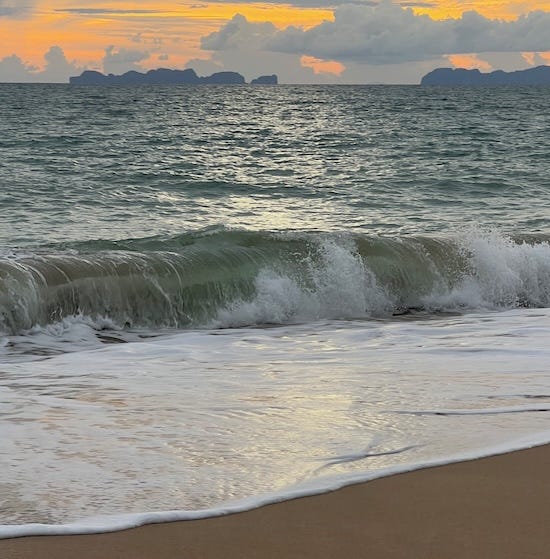
The incoming winds bring rougher seas and huge amounts of garbage drifting in from both the Pacific and Indian Oceans. Some days the water is simply too rough to swim. Dive shops, one of the island’s major tourist draws, begin shutting down because visibility becomes poor and conditions challenging, even for experienced divers. Boat trips to the surrounding islands stop operating regularly as the sea becomes too rough for a pleasant day exploring.
And then there is the rain.
It doesn’t rain all the time, but during low season there is usually rain most days, often for a few hours in the late afternoon, evening, or overnight. Sometimes it’s only a heavy shower. Other days it’s torrential, with localized flooding that can make getting around by motorbike difficult and stressful.
For tourists, this time of year can feel disappointing. They arrive wanting sunshine, beach days, boat tours, and dramatic tropical experiences. Sometimes they get dramatic experiences, just not the kind they imagined. Getting caught on a motorbike during a tropical downpour deep in the jungle is not particularly romantic. Neither is sitting inside a beach bungalow while the rain pounds the roof so hard you can barely hear yourself think.
During stronger storms, the electricity occasionally goes out for a while. Resort staff may not be able to get to work, and services become limited. It’s understandable why many visitors leave feeling frustrated.
Businesses begin adapting quickly. Resorts close sections of their properties and cover beachfront areas with tarps. Restaurants and bars reduce their hours or close completely until the fall. Staff head home or take time off. For many businesses, low season becomes renovation season, with repairs, upgrades, and sometimes complete location changes happening quietly behind the scenes.
But for those of us who live here, this season feels glorious.
With fewer tourists, the roads become calmer and quieter. During high season, traffic can feel chaotic, especially with inexperienced tourists trying to navigate motorbikes in busy areas. Now it’s easier to get around, easier to think, and easier to settle back into the slower pace that island life naturally wants to have.
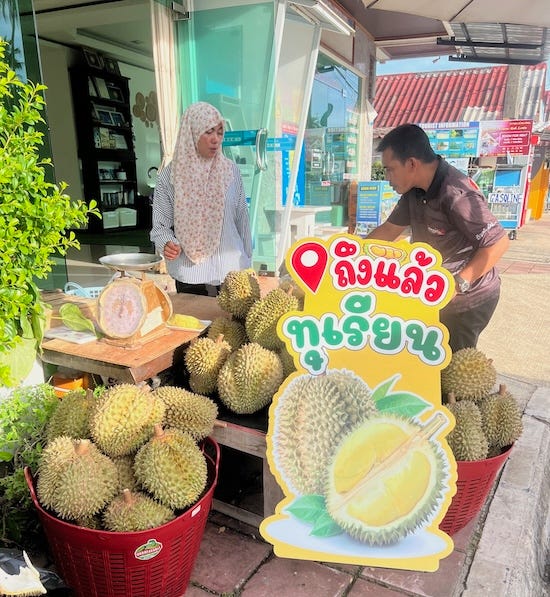
The phrase “rainy season” is slowly disappearing because it doesn’t actually rain constantly. In many ways, it feels more like a season of renewal.
The island becomes intensely green again. Plants grow wildly fast, flowers thrive, and everything feels fuller and more alive. Friends who spent months working nonstop during tourist season suddenly have time again. Places that were overcrowded only weeks earlier become enjoyable and peaceful.
Low season gives the island back to the people who actually live here.
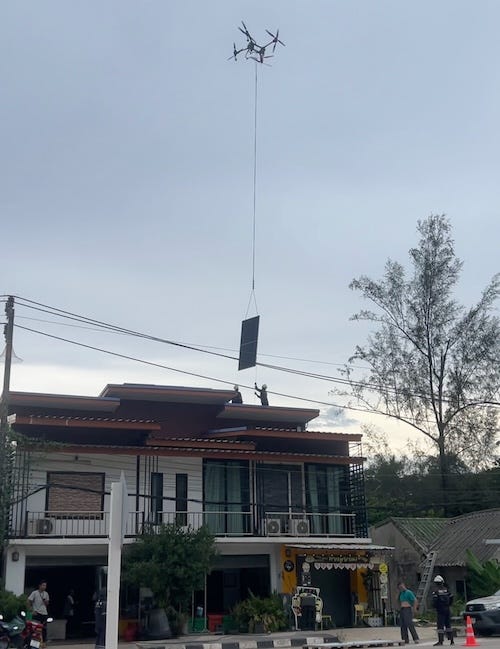
Today a group of friends is taking me to lunch. All three of them work through the busy tourist season, so seeing them together at the same time is a treat.
We’re heading to a quirky place in the deep south of Koh Lanta, somewhere they would never have time to visit during high season because getting there and back takes too long when you’re working every day.
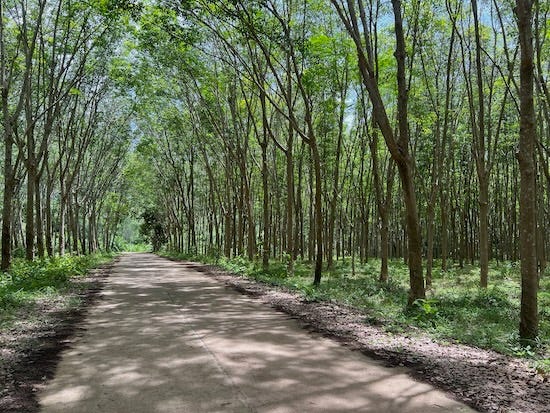
The restaurant is tucked a few miles off the main road, winding through a rubber plantation along narrow roads that feel like they lead nowhere. Suddenly there’s a small modern resort built around a man-made lake with a massive fountain in the middle. The whole place feels slightly surreal, as though it was created by AI and quietly dropped into the jungle. But somehow it works.
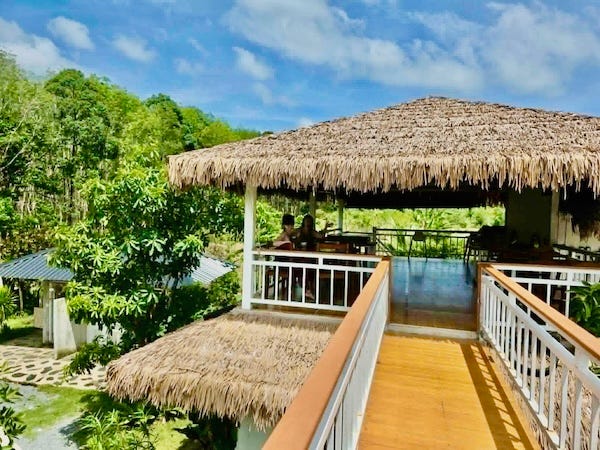
This is the kind of outing low season makes possible. Nobody is rushing. Nobody is checking reservations or fighting traffic or trying to squeeze something into an already overloaded schedule.
Later today, when I go for my walk, I’ll probably head toward the beach. The overcast sky will keep the temperature comfortable, and the roads will be quiet enough that I won’t constantly be trying to avoid collisions with tourists driving motorbikes the wrong way down the road.
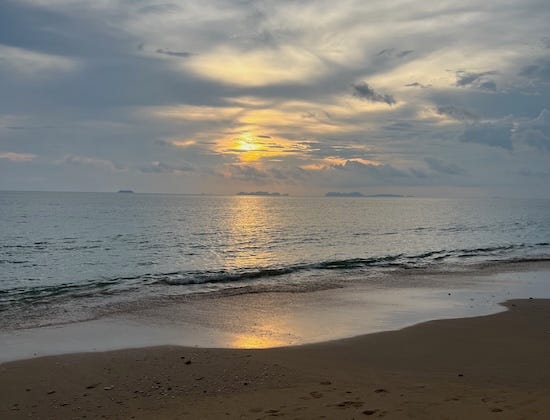
I’ll likely walk home along the beach, listening to the crashing waves and watching the rough surf roll in. There may only be a few other people there, mostly locals enjoying the cooler weather and the quieter shoreline.
Low season isn’t really “low” for me.
I live here. I have a comfortable home, a large garden, fibre-optic internet, a car, and a strong circle of friends. In many ways, life feels more normal during this time of year than it does during tourist season.
The strange thing is that what visitors think of as the “off season” is actually when the island feels most like itself.
Next time I’ll write about the realities of shutting down one life and reopening another. Appropriate for the June 30th newsletter as I’m heading to Ottawa, Canada next weekend. After months on Koh Lanta, returning to Canada isn’t simply about packing a suitcase and getting on a plane. There are homes, cars, services, routines, friendships, and responsibilities in both places. Living between two countries sounds adventurous, but the transition between them is often far more complicated than people imagine.
No posts
Comments
Nothing yet. Say the first thing.
Sign in to join the conversation.