
Want to see a millennial shape-shift into a forensic accountant before your eyes? Just say the magic words: “self-made billionaire,” and presto! Privilege! Nepo-baby! Capitalist myth! While “self-made” may sound like a contradiction-in-terms in 2025, in the ‘90s, it was the foundation of two core beliefs: (a) boundless financial success was still within reach, and (b) with the right lever, the whole machine could be moved. Plucky white guys who grew up during the Great Depression and struck it rich as adults helped reinforce the cultural myth of America as an ever-evolving land of opportunity, and there was no better spokesperson for this disruptive American ideal than pugnacious 5 foot 5 billionaire Ross Perot.
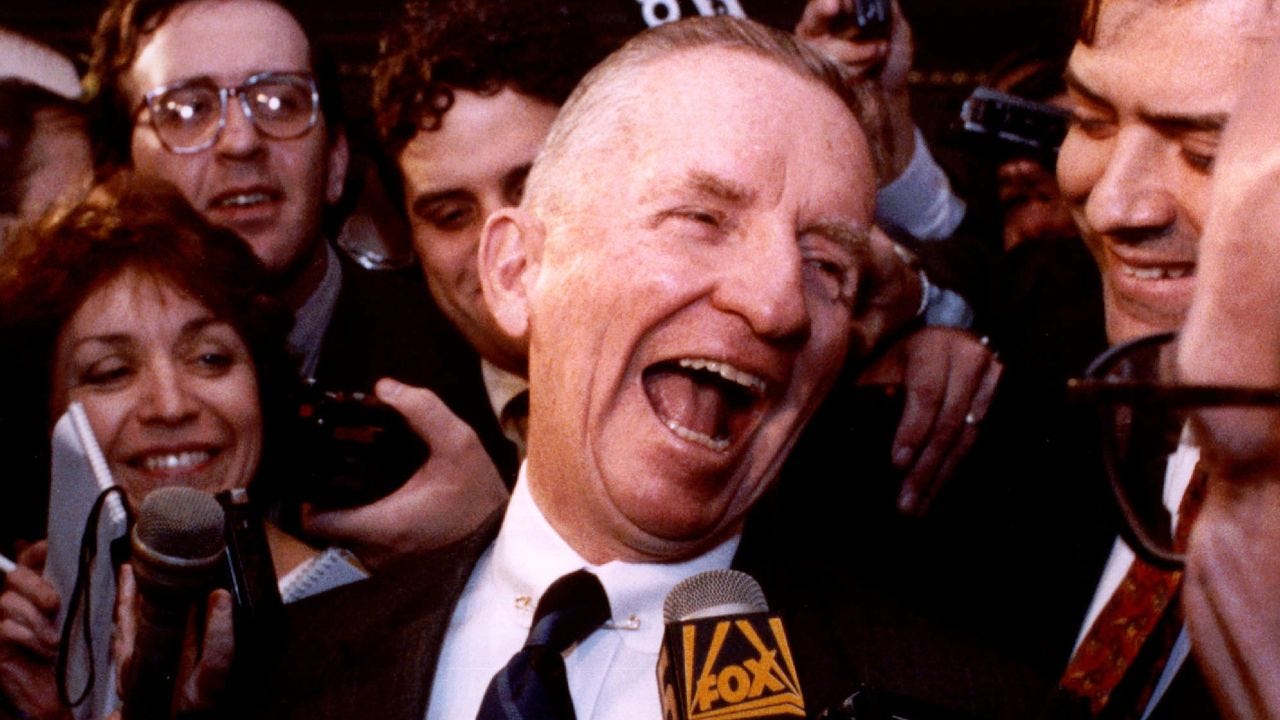
In 1992, Perot ran an anti-establishment, self-funded presidential campaign fueled by idealism and $56 million of his personal fortune. Shockingly he almost won, capturing 19% of the popular vote as a third party candidate in a stunning testament to voter frustration with the political status quo (just for reference, last year, Jill Stein took less than 0.6% of the popular vote). Perot’s ‘92 campaign strategy was as audacious as his margins: while his rivals relied on yacht-rock anthems and snappy 40-second ads, he commandeered prime-time TV with 30-minute infomercials, complete with graphs, pie charts, and a national spending plan as folksy and no-nonsense as balancing the family checkbook. He had conviction, an unlimited budget, and shit to say, and in 1992, America listened.
Four years earlier, self-made drywall entrepreneur Phil Sokolof spent a fortune (literally) on a suite of full-page advertisements in newspapers across the country decrying “the Poisoning of America.” At 35 years old, Sokolof suffered a near-fatal heart attack, prompting him to sell his multi-million dollar company, Phillips Manufacturing Co., and devote himself full-time to crusading against America’s high-cholesterol diet. He thought the dairy industry’s “low fat” 2% milk marketing was bullshit, and lobbied to get child-sized cartons removed from public schools. He rallied against saturated fat in packaged crackers and cookies, demanding that Pepperidge Farm and Keebler change their recipes. It may not be surprising that Sokolof’s biggest enemy in his war against cholesterol was fast food, more specifically McDonald’s, and even more specifically their impossibly yummy french fries. Sokolof cited in his ads that McDonald’s used 90- 95% rendered beef fat in their fryers which, besides being absolutely fucking disgusting, he argued was an unnecessary contributor to America's growing heart disease epidemic. In 1992, perhaps fortified by Ross Perot’s tenacious self-funded presidential run, Sokolof told a reporter: “[I have] enough money to carry on my campaigns as long as I am able. I’ll never retire. I’ll be working until they carry me out feet first.” Sokolof spent an estimated $15 million lobbying against McDonald's. Adjusted for inflation, that's over $24 billion (!!!) today. But if you think that’s the craziest part, you’d be wrong.
The craziest part is that it worked.
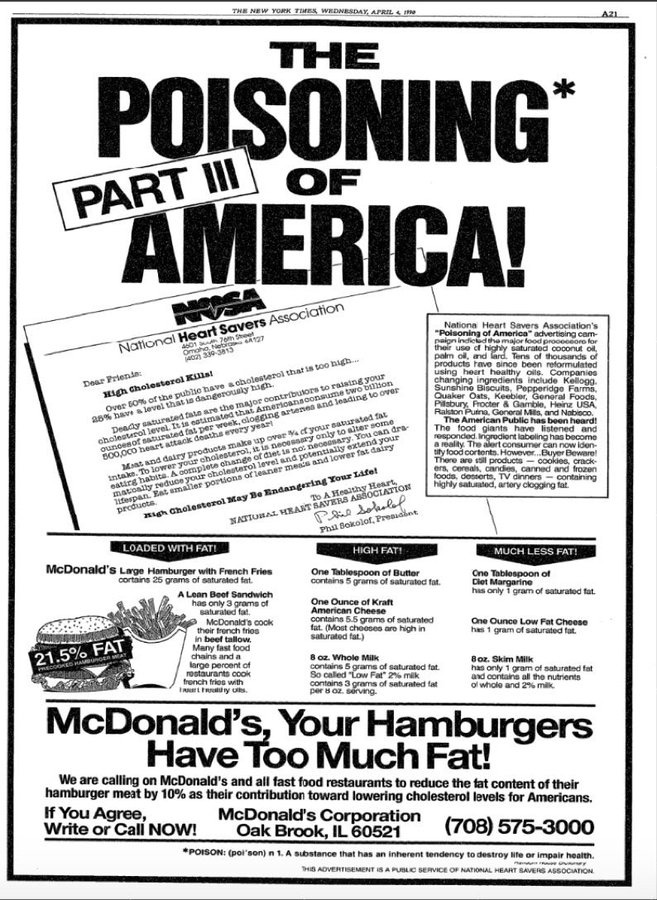
Like Ross Perot, Sokolof’s impact showed that the efforts of a single indignant individual could incite seismic institutional shifts. In 1990 McDonald’s abandoned tallow in favor of a cottonseed/corn oil blend for their fryers, and has continued to dial the knobs on their french fry formula ever since— first adding (then removing) “natural beef flavor” (ew), and reducing, then eliminating trans fats in 2008. While these changes in method inevitably resulted in changes in flavor that may have resulted, anecdotally, in customer dissatisfaction, across 14,000 national McDonald’s locations, there was next to no discernible impact on profits. It’s logical to assume people noticed their fries tasted different, but they simply didn’t care enough to stop eating them.
This historical narrative that casts Sokolof as the triumphant David against McDonald’s Goliath is romantic, but unprovable—in a July 1990 media release, McDonald’s credited “8 years of study” for the switch from tallow to vegetable oil. Call me cynical, but I find it hard to believe that a $45 billion company at its peak would voluntarily overhaul a 50-year-old recipe purely for the public good. Potatoes are a natural ingredient, and just as public health concerns evolve over time, so too does the Russet crop— its yield, sugar and moisture content, terroir, and the surrounding atmosphere all change, and these changes necessitate tweaks in processing and preparation. How could we possibly expect the flavor of fries to stay the same year after year, when the very ingredients and conditions that shape them are continuously shifting? The evolution of McDonald’s french fries is an inevitable consequence of the ever-changing landscape of agriculture, labor, cultivation, and the surrounding natural world. Beyond the inevitability of physical change, time has a way of coloring the past, and it’s impossible to measure McDonald’s previous recipes— the ones we enjoyed after soccer practice with mommy— against the current ones. How to we know to attribute our fondness for them to bygone flavor rather than to bygone memories? Nostalgia is as powerfully delicious as it is immeasurable.
Type “why do McDonald’s french fries taste different” into Google and you will be met will a deluge of Reddit threads, just as you will with “Mugler Angel reformulation,” or “Dior Poison original,” or “Chanel No.5 changed.” While the raw materials that create McDonald’s fries are salt, fat, and the humble potato, these perfumes, some over 100 years old, are composed of hundreds and hundreds of ingredients, sourced from labs, fields, and forests around the world. Some of these materials are synthetic, and subject to shifts in chemical regulations, international safety standards, and technological advancement, and others natural, subject to climate variations, agricultural practices and global trade politics. While formulas inevitably change, perfumes like Poison and Chanel No.5 remain in production, not as a public service, but because they continue to generate profits— that means that some combination of those who wore the originals purchase new bottles, and others who never smelled the first formulation fall in love with the newest versions. It goes without saying that the primary reason formulas change is to reduce costs—this is because the multinational companies that own these trademarks are vast financial ecosystems, and maintaining them demands that their internal mechanisms are constantly, almost microscopically, fine-tuned. This is the way of the world and it’s okay: to love perfume is to respect these changes as inevitable, cyclical, and natural.
It’s also okay to find these changes frustrating. In 1992, Ross Perot told Americans he could balance out-of-control national spending in the same way he did his family budget because he was frustrated. It was a notion as idealistic and inspiring as it was naive, but it forced Americans to confront a two-party system that failed them. In 1990, we were a nation largely unaware of food industry standards, and a vexed Phil Sokolof insisted that the corporations responsible for creating highly processed foods remain accountable to the people who consumed them. It’s likely this muckraking led to industry-wide reform. Sometimes shifts like these happen all at once, and sometimes they’re slow, almost imperceptible. But like nearly everything else, food, politics, and perfume are all governed by natural cycles— to deny this reality is both naive and maddening. Some things are forced to evolve, others we wish never would, but all things, inevitably, must.
***
Thank you to my genius friend Brian Khek, who effortlessly tossed off the french fry-to-perfume analogy (over poolside birthday cake) that inspired this essay.
Comments
Nothing yet. Say the first thing.
Sign in to join the conversation.