
“The three hundred largest yachts in the world emit as much carbon dioxide as the ten million inhabitants of Burundi.” —from Burned by Billionaires
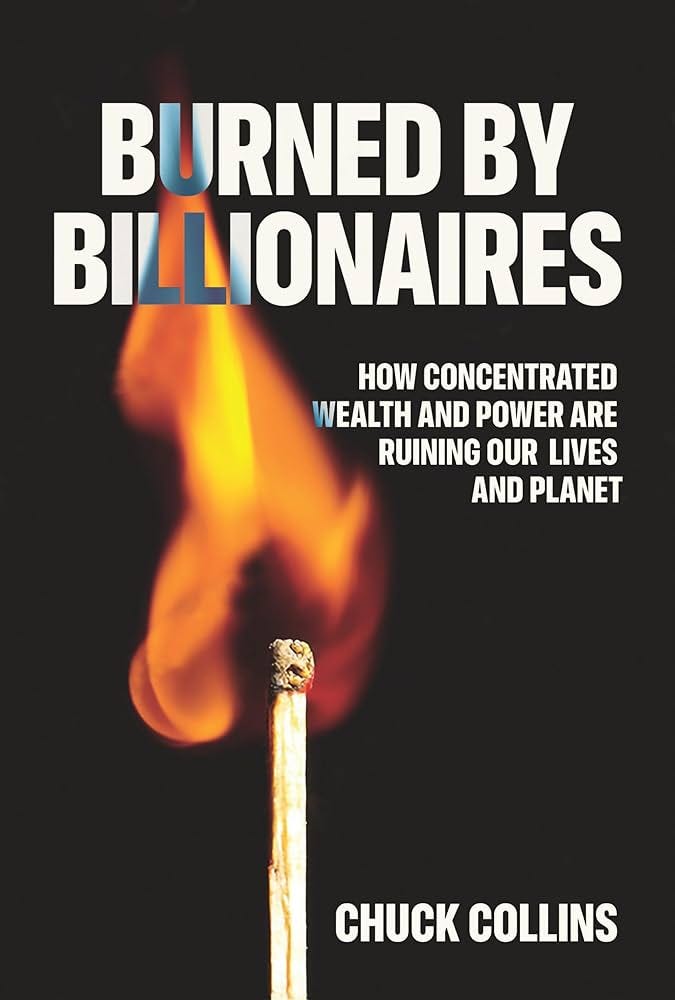
Review of Burned by Billionaires by Chuck Collins
Chuck Collins’s Burned by Billionaires: How Concentrated Wealth and Power Are Ruining Our Lives and Planet offers a compelling and urgent examination of the systemic forces driving wealth inequality in the United States. Drawing from his extensive research and personal experience as a member of the ultra-wealthy class, Collins explores how the top 0.01% have not only amassed unprecedented fortunes but have also engineered a system that perpetuates their dominance at the expense of the broader public.
An economy that funnels wealth to billionaires is bad for your health, your pocketbook, your housing options, and the quality of your environment. It robs you of your political voice while dictating what’s in the news and on your dinner plate. It supercharges and inflames existing divides in our society, and fuels division and civil discord.
Collins delves into the mechanisms by which the ultra-wealthy consolidate and protect their wealth. He highlights how tax policies favoring the rich, deregulation, and the influence of money in politics have created a “wealth defense industry” that shields the affluent from economic and social accountability. This system results in a disproportionate allocation of resources, leading to diminished public services, increased environmental degradation, and a weakened democratic process (Institute for Policy Studies).
Collins’s analysis aligns with and extends the work of other scholars who have explored the dynamics of wealth and income inequality. In Capital in the Twenty-First Century, Thomas Piketty examines the historical patterns of capital accumulation and distribution, arguing that when the rate of return on capital outpaces economic growth, inequality widens. Similarly, in Capital and Ideology, Piketty explores the ideological constructs that justify inequality and the political systems that sustain it. Brooke Harrington’s Offshore: Stealth Wealth and the New Colonialism provides an in-depth look at how the global elite use offshore finance to conceal wealth and evade taxes, further entrenching economic disparities.
As Piketty, Harrington, and now Collins make clear, ultra wealth has created a self-reinforcing system that feeds its own growth. One might think it would eventually collapse on its own, having sucked all the sustenance out of everyone and everything else. Perhaps. But that does not seem to be happening anytime soon. To the contrary, Collins argues persuasively that wealth and income inequality are getting rapidly worse.
In The General Theory of Employment, Interest, and Money (1936), John Maynard Keynes rejected the classical idea that markets are self-correcting and argued that without active government involvement, economies could remain stuck in prolonged recessions or depressions. Keynes emphasized the essential role of government in maintaining economic stability and ensuring that economic systems function optimally and fairly.
Similar to Keynes, Collins underscores the necessity of governmental intervention to rectify economic imbalances.
Collins highlights the role of the “wealth defense industry”—comprising lawyers, accountants, and consultants who assist the ultra-wealthy in minimizing taxes and shielding assets. This industry’s activities result in significant revenue losses for governments, undermining public services and infrastructure. Collins argues that such practices require robust governmental oversight and reform to ensure tax fairness and accountability.
The concentration of wealth among the top 0.01% has led to political capture, where the interests of a few dominate policy decisions. This undermines democratic principles and erodes public trust in governance.
In his book, Collins offers concrete prescriptions for reclaiming power from the billionaire class, advocating for:
Tax Reforms: Implementing progressive tax policies to ensure the wealthy contribute their fair share.
Strengthening Labor Rights: Empowering workers to negotiate better wages and working conditions.
Political Accountability: Enacting measures to reduce the influence of money in politics and enhance democratic participation.
These recommendations underscore the role of government in addressing economic disparities and promoting social equity.

In his twenties, Collins gave away the bulk of the fortune he inherited to progressive causes.1 He has long been an active advocate for addressing wealth inequality. He co-founded United for a Fair Economy, an organization dedicated to raising awareness about the detrimental effects of concentrated wealth and power on democracy and society. Program Director at the Institute for Policy Studies, Collins also co-edits Inequality.org. Through his work, Collins emphasizes the moral imperative for governments to implement policies that promote economic justice and equity.
In this Collins echoes the voices of Senators Bernie Sanders and Elizabeth Warren and Representative Alexandria Ocasio-Cortez, each of whom has long sought to address wealth inequality through legislation. Their efforts resonate with Collins’s call for systemic change, emphasizing that to rectify economic disparities, there must be a concerted political effort to reform the structures that enable and perpetuate them.
Chuck Collins’s work underscores the critical role of government in rectifying economic imbalances. He advocates for systemic reforms that address tax fairness, political accountability, and social equity to combat the detrimental effects of concentrated wealth and power.
Burned by Billionaires is a timely work that illuminates the mechanisms of wealth inequality and serves as a call to action. Collins provides readers with the tools to understand the complexities of economic systems and the importance of political engagement in fostering a more equitable society. By situating his analysis within a broader historical and ideological context, Collins contributes to an ongoing dialogue about the future of economic justice in America.
Comments
Nothing yet. Say the first thing.
Sign in to join the conversation.