
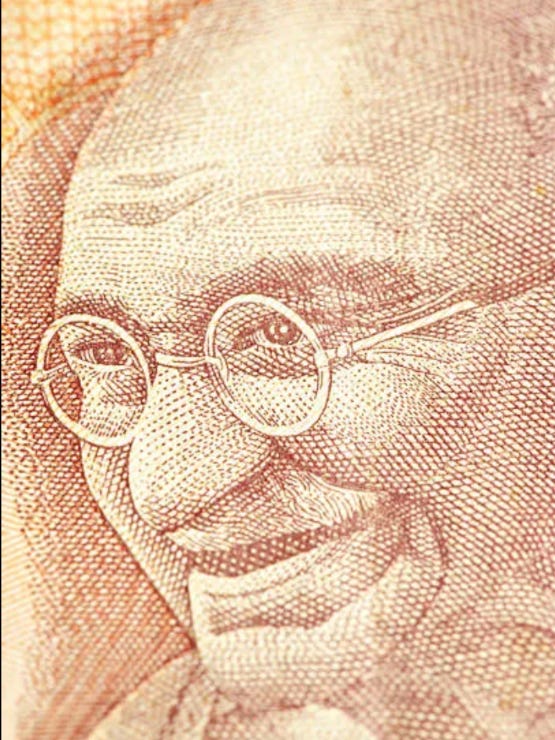
In the presence of one dedicated to non-violence, the heart of the violent can be changed. This is what Gandhi both believed and acted upon, just as his student, Dr. King during the civil rights movement. In fact, I’ve done this myself, when a neighbor came at me with violence. He had been drinking and obviously worked himself up to it, refusing every excuse and apology I offered (despite the fact that the conflict had begun with his actions). When I stepped forward, he thought it was to fight, but I said plainly that I wanted only peace between us and God’s blessing for him.
I did not cower, hide, nor deflect. I stood my ground, but with peace and love for my enemy, not with violence. My neighbor looked down, lowered his fists, and when he looked up again it was like I was looking at a different person. The evil glint of violence had left his eyes entirely. He even apologized for coming at me with violence. I was elated at having turned this enemy to a friend; so much so that when we shook hands I gave him a hug without thinking. I was just so amazed at the moment.
There are many in this time of strife and oppression that seek to respond with violence. I understand this well. The experience that I’ve shared is not how I have always handled violence. I have fought and done great violence that I am deeply ashamed of. Twice I was prevented from becoming a murderer only by God’s grace. So know that everything I say here is from experience.
A quote from Gandhi has been making the rounds again and I want to explain it for those who are categorically misunderstanding what he was actually saying.
“It is better to be violent, if there is violence in our hearts, than to put on the cloak of nonviolence to cover impotence."
Gandhi spoke similar ideas several times, but people mistake this (or misuse it) for a promotion of violence. It is, rather, a denouncement of pacifism. That same denouncement that Dr. King made in his letter from Birmingham jail against his fellow faith leaders that admonished him for his actions. But wait, you ask, didn’t Gandhi and King tach pacifism?
No! Therein lies the problem. People don’t understand what non-violent resistance truly is. That’s why I provided a real-life example of how this can actually play out. The teachings of Gandhi are that of the ahimsa or “truth.” Universal or divine truth might be a more accurate description. It can be defined succinctly thus,
"..in its negative form, [Ahimsa] means not injuring any living being whether by body or mind. I may not, therefore, hurt the person of any wrong-doer or bear any ill-will to him and so cause him mental suffering. In its positive form, Ahimsa means the largest love, the greatest charity. If I am a follower of Ahimsa, I must love my enemy or a stranger to me as I would my wrong-doing father or son. This active Ahimsa necessarily included Truth and fearlessness."1
As you can imagine, this is no easy task in and of itself. Most of us would be pretty hard pressed to treat a member of maga in this way, myself included. Honestly, I’d much rather go punch a Nazi in the face. As a disciple of Christ, however, I am bound by his command to love my enemy and pray for those who persecute me, regardless of what I’d like to do. It’s obvious why people like me and Dr. King resonate with Gandhi’s teaching, but many will respond, “that’s all fine and good for you, but I don’t follow that way.”
I understand completely and I’m not trying to judge here, nor force my philosophy onto others, but I want you all to know that we have actual empirical evidence. Erica Chenoweth’s research on non-violent resistance shows that it is much more effective, both short term and even more so long term.2 Even if you don’t hold to the above philosophy, the satyagraha or “non-violent way,” has still been proven to be effective. The satyagraha is a component of the ahimsa philosophy, similar to the way “love your neighbor as yourself” is a component of the new covenant with Christ. The satyagraha,
“aims at winning the enemy through love and patient suffering. It aims at winning over an unjust law, not at crushing, punishing, or taking revenge against the authority, but to convert and heal it.”3
A lot of people read that and it seems counter-intuitive, even self-deprecating. We must come to understand that if I make my enemy my friend, I have defeated him more completely than aggression and punishment ever could. Even more so when we are speaking of systems. We cannot simply replace one tyranny with another. That which is born of violence will breed violence, just as our violent revolution from England bred a nation dependent on the violence of slavery and capitalist oppression. Despite the founders attempts at creating a democracy, they were not able to overcome that corrupt system, but only co-opted it for themselves.
Consider for a moment, all of the non-violent victories from Gandhi, Dr. King, John Lewis, and recent movements like the Orange Revolution in Ukraine or Otpor in Serbia. We celebrate them because they succeeded through non-violence, not despite of it. When we consider violent insurgencies, we often wonder which side is justified at all. We understand instinctively that the only difference between a terrorist and a freedom fighter is simply which side you’re on.
That violence degrades their own cause. How many otherwise decent Democrat supporters claim that Israel is acting in self defense against the violence of Hamas? It’s an incredibly weak justification for their atrocities, but it wouldn’t be possible at all if Hamas was non-violent. Make no mistake, if Americans rise up against the state with violence, they will be put down as terrorists and criminals; murdered, imprisoned, and defeated. In short, it will fail.
The satyagraha, on the other hand, is not pacifism. It is not cowering and allowing evil to have its way. It is standing up in front of it. The non-violent way declares, “My cause is just.” By standing against oppression and violence in such a way, we prove to the world and even to our oppressor that there is no justification for their actions. This is vital, for most often the sociopaths who revel in killing are actually very few and even hide themselves away so that they will not be in danger. The ones actually ordered to commit violence on the front line are often neighbors and family to those they stand before. If the revolution is peaceful, then they will have no recourse but to know that violent response would be cruel and evil. If the revolution is violent, then those agents of the state can claim—even if just to themselves—that their actions were only self-defense.
We will not defeat the Enemy using his own tools. There is much more that could be said on this, but I will not preach at those who do not follow the Way. If you are interested, then read the philosophies that I have provided. Else read Scripture to understand what Jesus actually taught—you can use the NLT translation if you have trouble understanding a more literal one like the BSB.
Just know that in the coming days there will be a great many people—even otherwise noble and intelligent allies—that suggest we turn to violence. There may even be subversive agents that try to steer us that direction, like they did with the BLM protests. Even so, if we stand together and remain dedicated to non-violent resistance, I believe we can achieve real victory. I’m not looking to just going back to the way things were before the fascists, I want real change for my children’s future. If you want the same, then we have to live out the values that we want to see in that future. As Dr. King famously said, “violence cannot defeat violence, only peace can do that. Hate cannot defeat hate, only love can do that.”
2 Chenoweth presentation, also https://ash.harvard.edu/about/
No posts
Comments
Nothing yet. Say the first thing.
Sign in to join the conversation.