
Uninformed voting costs lives. From destroying people's livelihoods to electing poor leaders, the effects of uninformed voting are severe. This tragedy does countless human damage. Fortunately, it doesn't have to be this way: billions around the world live in countries where people rarely – or never – die senseless deaths from the consequences of uninformed voting. By passing common-sense, research-backed voting laws, we can join them.
A good first step would be to institute age requirements for all voting. Studies show that people aged 18-20 have worse judgment than older adults. Restricting voting to people of age 21 and up, or even 25 and up, would help prevent young people with poor judgement from influencing elections.
But while that change is a step in the right direction, it wouldn't nearly be enough. The only complete solution is to create a voting license program. Let's take a look at how voting licenses would work in practice, and how they'd bring the United States up to par with its global peers.
Voting licenses would be designed to ensure that only informed, engaged citizens who have the ability and desire to vote responsibly are able to get them. To prevent unjustified voting, prospective voters would have to supply a reason for wanting to vote. Legitimate reasons would include foreign policy, environmental issues, and gun control. Some may suggest including the economy in this list, since it affects many people's lives; this would be needlessly dangerous. Studies show that voting on the economy actually makes the economy worse.
To ensure that prospective voters are serious about the reasons they choose, they'd be required to demonstrate deep knowledge and genuine investment, e.g. through long-standing membership in a club that regularly discusses relevant issues, or by taking an expensive state-approved training course. Any past experience as a politician, which obviously confers expertise, would also satisfy this requirement. Additionally, given the unusual needs of politicians, CEOs, and billionaires, some members of their staff and certain government employees would have an expedited process for obtaining special licenses1, which would allow voting on a broader range of issues, including the economy (but only in their professional capacity, not in their personal capacity).
When they read this plan, some uninformed voters will argue that they enjoy their right to vote or find it important to protect themselves, their families, or their country. This is, frankly, somewhat selfish. Obviously, the safety of our country and our children must take priority over these people's preferences. Prioritizing individual preferences over everyone's safety has no place in a civilized society.
Some radicals might reply, "if you want everyone to be informed before voting, why not just teach responsible voting in schools, so that all children can become responsible voters?" I will not dignify this reckless suggestion with a response.
To cover the costs of processing the licenses and raise revenue, a reasonable fee (for example, $1,443) will be required to obtain a voting license. As an added benefit, this further ensures that everyone who votes is seriously invested in doing so properly. Some people might worry about whether this violates section 1 of the 24th Amendment. The Constitution is often misunderstood, so let's take a look at the actual words:
The right of citizens of the United States to vote in any primary or other election for President or Vice President, for electors for President or Vice President, or for Senator or Representative in Congress, shall not be denied or abridged by the United States or any State by reason of failure to pay poll tax or other tax.
Clearly, this does not prohibit imposing reasonable fees for voting licenses. It's well known that none of the rights protected by the Constitution are absolute or without reasonable limits; the Constitution is a living, breathing document, subject to judicial interpretation. It would be silly to suggest an exception for this amendment. Besides, the amendment is describing the rights of electors, not the rights of individuals: "the rights... for electors... shall not be denied".
While the proposals above will eliminate most cases of uninformed or reckless voting, as with any regulatory framework, some cases will slip through the cracks. Therefore, it will sometimes be necessary for authorities to deny voting licenses to dangerous or misinformed people, even if they meet all the listed requirements. This kind of licensing scheme is called may-issue voting, where licensing authorities exercise final judgment over whether to grant a voting license. It's considered a global best practice.
By contrast, shall-issue voting (where anyone who meets the set requirements is allowed to vote) denies authorities the means to selectively deny licenses to dangerous people who manage to meet all the requirements on paper. Even worse, some people argue for the radical idea that any adult American should be allowed to vote without any license, training, or test, sometimes mistakenly called constitutional voting (or, historically, Vermont voting). The term constitutional voting is based upon a common misconception that the Constitution protects an individual's right to vote. The Constitution was never intended to do this. Just look at the nation's history of voting restrictions, usually put in place to prevent irresponsible or uninformed voting.
Obviously, someone who was a responsible voter in the past may not continue to be one in the future. To address this, voting licenses would need to be renewed (including fees, re-taking training courses, etc.) every year or two. Additionally, a Voting Risk Protection Law would allow for indefinite suspension of voting licenses from voters who suddenly become uninformed. Such a law would empower a voter's family, friends, coworkers, employers, ex-boyfriends/girlfriends, police, teachers, prosecutors, and others to request that a judge revoke his or her voting license. This would simply require one of the people above to testify that there's cause for revocation – even a suspicion that someone might vote irresponsibly would be sufficient, since the risk is too high. As an added benefit of this law, people who want to vote maliciously will know that, if they talk to their family or friends about their bad intentions, their voting licenses will be revoked, and everyone will be safer.
While all these precautions would seriously decrease the massive costs of uninformed voting, voting is inherently risky, and they wouldn't totally eliminate the damage – some people would still cast bad votes with real, tangible consequences for people's lives. To ensure that the cost of these votes isn't borne by innocent people, voters would also be required to have voting insurance. When a bad vote could be shown to have caused harm, the insurance would pay out to the victims whom the vote most affected. Some might object that this imposes a cost for exercising a right. Aside from the fact that, as discussed above, the Constitution doesn't actually protect an individual's right to vote, the trouble is that the costs of bad voting are borne by someone regardless. Without voting insurance, victims are forced to sue irresponsible voters personally, so the costs are borne entirely by said voters – or, if they can't pay, by the victims. When voting insurance is mandatory, all voters chip in. Any voter, no matter how responsible, is capable of accidentally casting a bad vote, so it's only fair. As another added benefit, requiring voting insurance would further help to prevent financially irresponsible people from voting.
Many businesses may still be uncomfortable with the massive impact of voting, and may not want voters in their stores. To honor these wishes, “no voting” signs put up by businesses would be legally enforced, and any voters who entered the premises would be sent to jail. Better yet, to ensure that business owners unaware of the law don’t accidentally subject themselves and others to the dangers of voting, the system should be opt-out: unless a business puts up a “voting allowed” sign, entering the premises with a voting license would be a serious felony. The special licenses discussed above would be exempt from this rule.
There's no reason for anyone – even the most trustworthy, well-informed, and responsible person in the world – to do certain kinds of voting. Having a voting license wouldn't allow people to, for instance, vote for extreme candidates. There's absolutely no reason that any normal person needs to vote for extreme candidates, who can inflict massive destruction. Again, some staff of politicians, CEOs, and billionaires, as well as certain government employees, would be exempt from these restrictions on account of their special needs (in addition to being allowed to vote on the economy, as discussed earlier).
Having presented our plan, I should address a few potential counterarguments. Some people might say that our plan imposes a burden on access to a right. There's a small grain of truth here: those looking to vote would be faced with a mild inconvenience. But it wouldn't take away the ability to vote; there is still a clear path to vote for anyone who wants to (excluding dangerous people). Even if we accept a dubious and Constitutionally unsupported individual right to vote, our plan doesn't interfere with it in the slightest. Besides, no one can argue in good conscience that a mild inconvenience isn't an extraordinarily worthwhile tradeoff for the safety benefit of stopping uninformed voting. I really shouldn't have to say this, but people who are willing to endanger children so they don't have to fill out forms or pay fees should not be taken seriously.
Another common counterargument is that voting serves as a check on the power of the government. While this is an appealing argument on the surface, it doesn't stand up to scrutiny. If the government ever became non-democratic, it could simply take away voting rights, and your ability to vote wouldn't do anything to stop it. There isn't a single example of voters successfully stopping a non-democratic regime, or even affecting the government at all – with the obvious exception of wealthy people. Data shows that election results and policies actually only correlate with the preferences of the wealthy; when everyone is able to vote, the wealthy are easily able to use their money to influence elections by advertising to uninformed voters. Under our plan, the wealthy would be stripped of this unfair and undemocratic concentration of power.
This article has been fairly technical, and hasn't addressed the countless human tragedy of uninformed voting. So many people needlessly suffer. Some pretend that there's nothing we can do about it; we've shown beyond a shadow of a doubt that this isn't true. We don't have to endure this senseless tragedy. Many other countries never or almost never suffer from the devastating consequences of uninformed voting; we can change our laws to be more like them. The United States has a civilian voting rate well above the global average – there's no way all those people are voting safely. We should aspire to reduce this as much as possible. By letting go of our dangerous obsession with absolute rights and instead implementing common-sense, research-backed policy, we might one day hope to rid the world of uninformed voting once and for all.
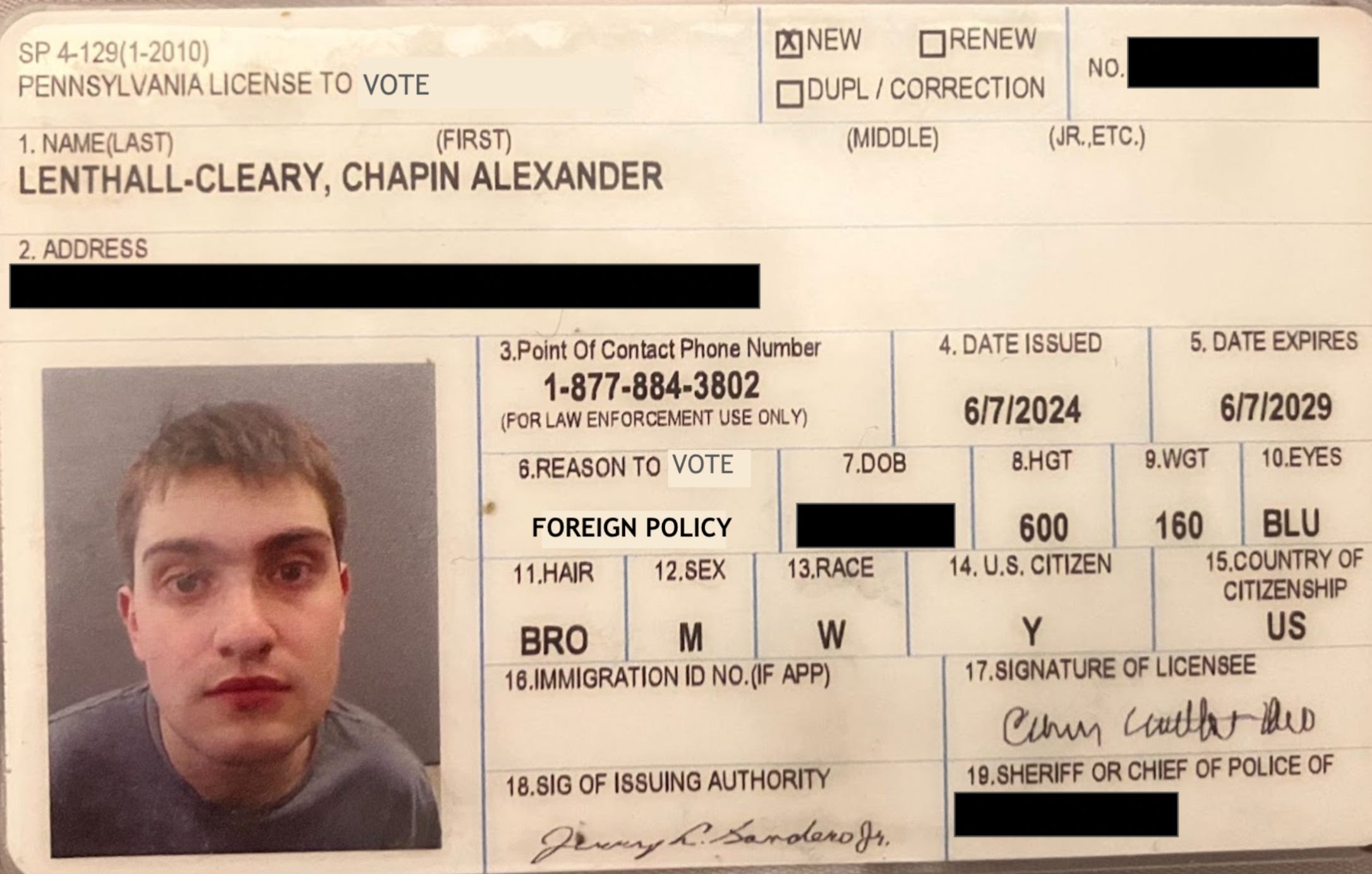
An illustration of what a voting license might look like.
Some jurisdictions may wish to implement an IQ maximum for government employees to receive these special licenses.
Comments
Nothing yet. Say the first thing.
Sign in to join the conversation.