
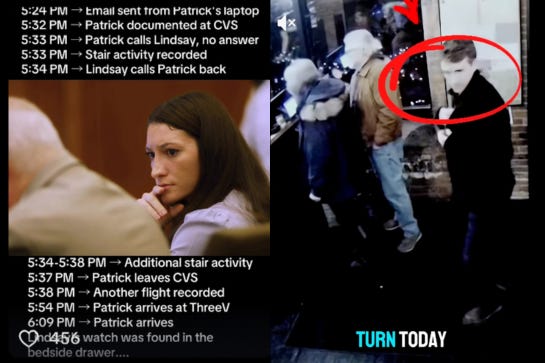
Last week I wrote about Lindsay Clancy’s postpartum psychosis. I was excited about the case because the mental health profession would be challenged. Now, after two weeks of reading transcripts and listening to testimony, I think I missed the most important thing: motive. Her husband, Patrick, was having an affair and three weeks after the killings he vacationed with his girlfriend in Costa Rica.
The trial is two questions: did Lindsay do it, and if she did, could she understand it enough to stop it. Lindsay has pleaded not guilty. She has never said she did it. What she says she remembers is not a confession: she does not remember locking the door, she does not remember moving furniture, she felt like she was watching someone do everything to her. The prosecutors decided it was a confession. I think Patrick killed the kids and he tried to kill her.
Here is the math that convinced me. Patrick says he left the house at 5:25pm and confirmed the kids were alive. A neighbor’s camera shows Lindsay lying motionless in the snow under the bedroom window at 5:50pm. Patrick called 911 at 6:11pm. The paramedics arrived at 6:16pm and all three kids shows signs of strangulation. But one of the three kids was still alive, and according to the forensic pathologist, that child could not have been strangled earlier than 6:11pm — far past the time Lindsay’s neck was broken. Also: The state police analysis did not find Lindsay’s fingerprints on the knife or the bands.
Patrick testified on day one and two for the prosecution and was supposed to come back on day 16 to testify for the defense. The jury arrived, and then the jury went home early, because Patrick didn’t show up.
Only Patrick’s mother showed up that day, and her testimony was the saddest moment of the trial. She said Lindsay was a wonderful mother. She said she texted with Lindsay every day. The prosecution told her Lindsay said she rarely heard from her mother-in-law, and she seldom spent time with the kids. Then the defense showed the mother-in-law the texts. It was clear in that moment that she had been texting with Patrick, posing as Lindsay, and he told her not to come help out. The look on Patrick’s mom’s face was pure devastation.
Millions of people online are more powerful than corrupt police on the scene. Remember the Karen Read case? The internet said the wrong person was being prosecuted because the real murderer was friends with the police. The internet was right. A blogger did an independent investigation every day for years, and the crowd found what Read’s lawyers needed for a not-guilty verdict. Gabby Petito’s case is another example: police treated domestic violence as a minor spat and did not investigate; the internet followed breadcrumbs online to show her boyfriend murdered her.
What about Patrick? Public records show he sold the family house — with everything in it — to a former Plymouth County assistant DA. When prosecutors wanted the jury to view the house, the new owner objected. The internet found that record too. Millions of people, checking each other’s work, are hard to beat.
The hunch is the last legal skill that can’t be automated. Most routine legal filing can already be done with AI. The lawyer AI talks, the opposing AI responds, the court AI confirms everyone did what they were supposed to. But AI cannot investigate crazy theories. AI cannot decide someone is probably lying on a hunch, because most people’s lies are crazy, and there is not enough training data on the crazy ways people kill their families. And AI turns out to be very good at confirming hunches: find every photo on the internet of one hotel on one night in December 2022. Every time new evidence gets released, the crowd extracts more from it than the state did.
Court TV is the new reality TV. Jersey Shore was groundbreaking because the people in it were not self-consciously reality stars; once reality TV became a launchpad for personal brands, it became formulaic. In a courtroom the stakes are real, nobody controls the edit, and we watch the truth unfold at the same time the people in the show do.
Crowdsourced evidence is a new form of participatory democracy. The watchers become investigators. As our power to affect the executive branch wanes, our power to influence the judiciary increases. E. Jean Carroll won against Trump when Congress could do nothing.
Philosophy will replace CS as the go-to major. CS is about facts, and AI does facts now, which is why even at MIT people are walking away from the major. Philosophy is the questions above the facts: what counts as a fact, what a fact weighs, who owns it. The prosecution had every fact in this case — the heart rate, the timeline, the fingerprints — and couldn't string them together, because stringing facts together requires a point of view about which ones matter. The prosecution had the most facts in that courtroom. but the internet had the point of view.
Comments
Nothing yet. Say the first thing.
Sign in to join the conversation.