
In Chicago’s Lincoln Park neighborhood, it’s common for proposed housing developments to spark debate. Such is the case with the proposed Marcey Street development, which would build 615 housing units built on the site of a former office building in the neighborhood. While this development may still ultimately be approved, the journey hasn’t been straightforward: the project has endured months of meetings and discussion, facing substantial opposition from some neighbors and Alderman Scott Waguespack. The development was also previously forced to downsize in an attempt to appease neighbors.
There are multiple reasons that this development is worth supporting, but a striking one is the tax benefits. According to a presentation last January, the development is expected to contribute $248 million in property taxes over the next 30 years, compared to $69 million in the same period if there is no redevelopment. Of course, this only reflects the direct property tax contributions of the new building; there are many knock-on benefits to urban growth that can improve a city’s fiscal situation.
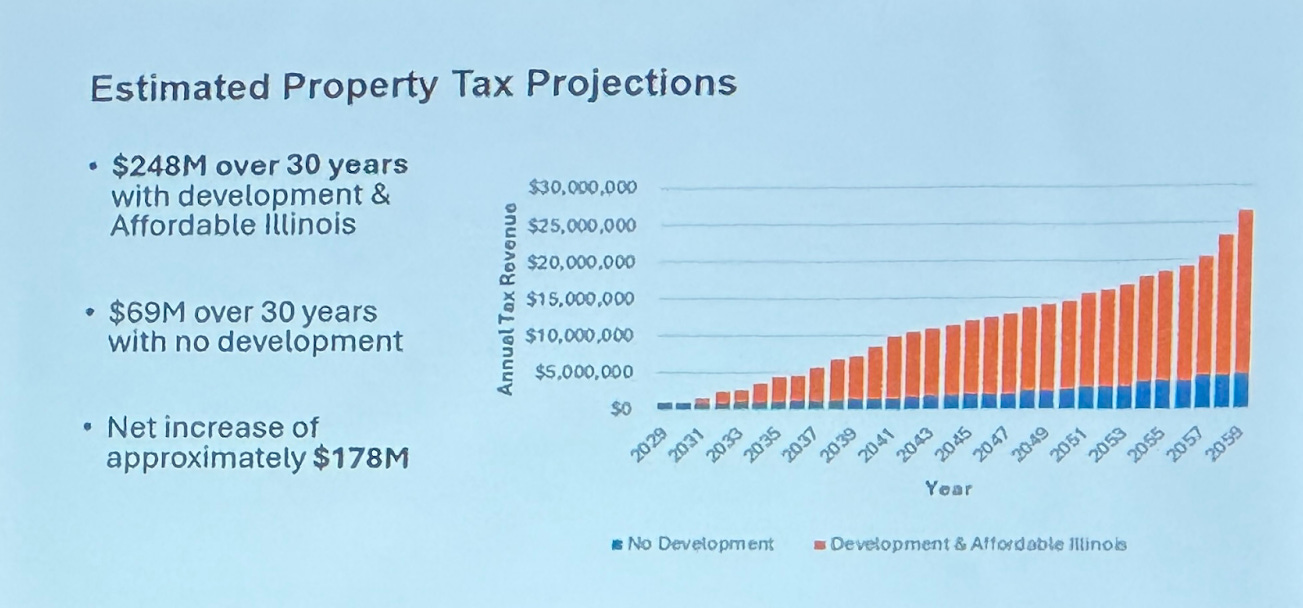
While every city stands to benefit from more revenue, Chicago probably needs this money more than most — it’s facing major long-term debt issues, risking disastrous consequences in the near or medium-term future. Still, projects like the Marcey Street development routinely face vociferous opposition in Chicago. As residents advocate to either shrink or altogether reject new housing, they are effectively diminishing or eliminating the resulting tax benefits.
Other places encounter similar challenges, even if Chicago is uniquely troubled. Consider Saint Paul, which has also been fiscally challenged in recent years. Housing development has recently slowed to a crawl in the city, and one of the city’s bright spots is the modest development of newly legalized “missing middle” multifamily housing. Yet as desperately as the city needs new investment and expansion of their property tax base, there are still local advocates seeking to roll back these reforms in the exact area of the city where these developments have proven most feasible.
If our cities truly need more revenue, then why do our neighbors fight against new housing?
The most fundamental reason is that the fiscal benefits of new housing are extremely diffuse, while the perceived downsides of new housing are very concentrated. This creates a classic collective action problem: the most negatively impacted residents tend to have outsize sway on decision making around new development, while the many modest beneficiaries of new housing development have little procedural engagement. This is only a partial explanation, however — this dynamic is exacerbated by economic inequality, and residents’ uneven exposure to the negative impacts of urban decline.
The end result is a tendency to under-support new housing development, despite the fact that it’s an easy way for cities to improve their fiscal circumstances. But this troublesome dynamic can also be tackled: by systematizing the housing approval process, instead of leaving decisions down to the lowest levels of control, we can help correct this imbalance and tilt our cities towards more pro-housing stances.
Collective action problem
Collective action problems arise when something creates concentrated costs and diffuse benefits. It’s easy to see how housing fits this description (as many commentators have noted before). The neighbors of a proposed housing development bear most of its perceived downsides. They’re often upset about traffic, parking, or excessively tall buildings — impacts which occur at a very local level.
On the other hand, the fiscal benefits of new development are spread across all residents of the city. Since the per-person gains are quite small, it’s easy for neighbors to ignore this benefit, and it’s rare for someone who doesn’t live near a new development to make an effort in support of a new project. That’s true even for very large projects, with sizable potential tax contributions. It’s even more true for a more modest, one-off development — like a new fourplex on a side street or a mid-rise apartment building.
This dynamic makes it easy for residents to pass the buck. Why should we be the neighborhood that has to shoulder new housing to bolster the city’s tax base?
Researchers have shown how this dynamic unfolds at scale. The following graph, from political scientist Alexander Sahn, is based on data from thousands of public comments regarding new housing in San Francisco. As Sahn’s graph shows, all public commenters at housing meetings tend to live relatively close to the project. But those who are opposed to new development are far more likely to live within just a few blocks of the proposed development.
This collective action issue, between new developments’ concentrated costs of development and very diffuse fiscal benefits, is a key explanation that helps to rationalize opposition to new development. But it is not a complete explanation.
How urban inequality worsens this dynamic
A second key dynamic is that cities are a highly uneven playing field. Citizens are not equally exposed to urban decline and governance under tight fiscal constraints, meaning that not all residents have to care equally about the fiscal benefits of new housing.
This occurs by many mechanisms. If schools are crumbling, the privileged can more easily switch to a private school. If transit service must be cut, they have more flexibility to buy a car. If local government cannot perform as much maintenance on neighborhood infrastructure, the privileged may have more resources to commit towards a neighborhood association to invest in upkeep. Generally, a well-enough neighborhood will have an easier time drawing in private investment to the neighborhood, even if public investment falters.
Furthermore, there is always an “outside option”: if things truly fall apart, residents, particularly those who are well-off, can simply leave.
This is the lesson we should take from past instances of urban decline, particularly the struggles of U.S. cities in the 1970s and 1980s. As deindustrialization began devastating urban economies, it also rapidly became much easier for residents to leave, thanks to urban freeways. These freeways measurably caused population decline in urban areas, but it should be no surprise that this outmigration was uneven: residents taking advantage of freeways to move to the suburbs were much more likely to be white and college-educated. Unfortunately, this only accelerates a city’s fiscal challenges, creating an urban doom loop.
Of course, white, well-off residents are not the only people with the option to exit when things get bad in a city. For example, past couple decades have seen Black Americans moving to the suburbs on a scale comparable to the Great Migration. Still, there are fundamental inequalities around how easily residents can escape the problems of urban decline.
This creates an unfortunate contradiction. The nature of housing demand is that development is most likely to happen in the areas that are most expensive. The nearby residents, who have stronger incentives to block new housing, will be relatively better-off. The residents with the time and capacity to show up to public meetings for new housing will be an even more selected, privileged group. These same residents are the least exposed to the negative consequences that accumulate from blocking new housing.
That’s not to say that NIMBYs don’t care at all about their city’s fiscal health. No citizens can entirely escape the problems of a financially struggling city. The decline of schools, the transit system, and local government services have enormous negative implications for the local economy, and would worsen quality of life across all of the city’s neighborhoods.
Nevertheless, when the local government faces fiscal pain, the costs will not be borne equally for all residents. This means that when residents of well-off neighborhoods contemplate new housing development, the potential fiscal benefits will likely fall further down their list of priorities.
Rebalancing the scales
The primary takeaway from this discussion, I think, is pretty simple — the power to permit or veto new housing should be moved up to higher geographic levels, meaning that decisionmakers can give a fairer consideration to the fiscal relief that new development offers. Instead of relying primarily on input from those who live near any given project, we should plan more systematically, zoning for new housing across an entire city or state. Journalist Jerusalem Demsas, who has discussed this issue at length, has forcefully argued for this political restructuring: after all, “the political coalition broadly in favor of new housing, transit, and renewable energy exists, but not at the project-by-project level.”
To demonstrate this point, return to Saint Paul and Chicago. As described above, both cities have fiscal challenges, and both have prominent strains of NIMBYism in the local body politic. Yet in Chicago, individual aldermen typically have control over whether new apartment buildings will receive zoning approval. Consequently, they pay close attention to their constituents regarding every potential development. The loudest among these constituents are frequently opposed to housing.
On the other hand, Saint Paul is not bound to such tight local control over new development. In recent years, the city has successfully implemented the kinds of citywide zoning reforms that have stalled in Chicago, including legalizing ADUs and small multifamily housing throughout the city. While some local groups are upset about this, and indeed are seeking to roll back such zoning reforms in certain parts of the city, it’s not so easy to carve out one neighborhood from citywide zoning laws. By making development often a city-wide focus, Saint Paul can reduce (though not entirely avoid) the faulty dynamics of the collective action problem.
Even without adjusting the levers of planning and power, there is one change that gives me optimism about this issue: the rise of the YIMBY movement as a dedicated interest group supporting new housing. One way to reduce collective action problems is to have political actors with a direct, focused stake in generating the dispersed benefits. An effective interest group can help rebalance the incentives to advocate for new housing. Historically, this type of group hasn’t often existed, but the increasingly influential YIMBY movement seems to be making a real difference here. Even if a city or state is unable to reorient its planning structures for building new housing, this makes a meaningful difference.
With Chicago facing substantial debt issues, and many other cities facing serious fiscal challenges, there are high stakes to figuring out how to support more housing in our cities. Solving this requires us to understand the political incentives and dynamics that make NIMBYism successful. The concentrated costs and diffuse fiscal benefits of new housing create a collective action problem that disfavors new housing, which is further exacerbated by inequality, as opponents to new housing are often insulated from the downsides of their advocacy. We can’t avoid politics around new housing development, but more systematic planning can greatly improve those politics, helping save our cities along the way.
No posts
Comments
Nothing yet. Say the first thing.
Sign in to join the conversation.