
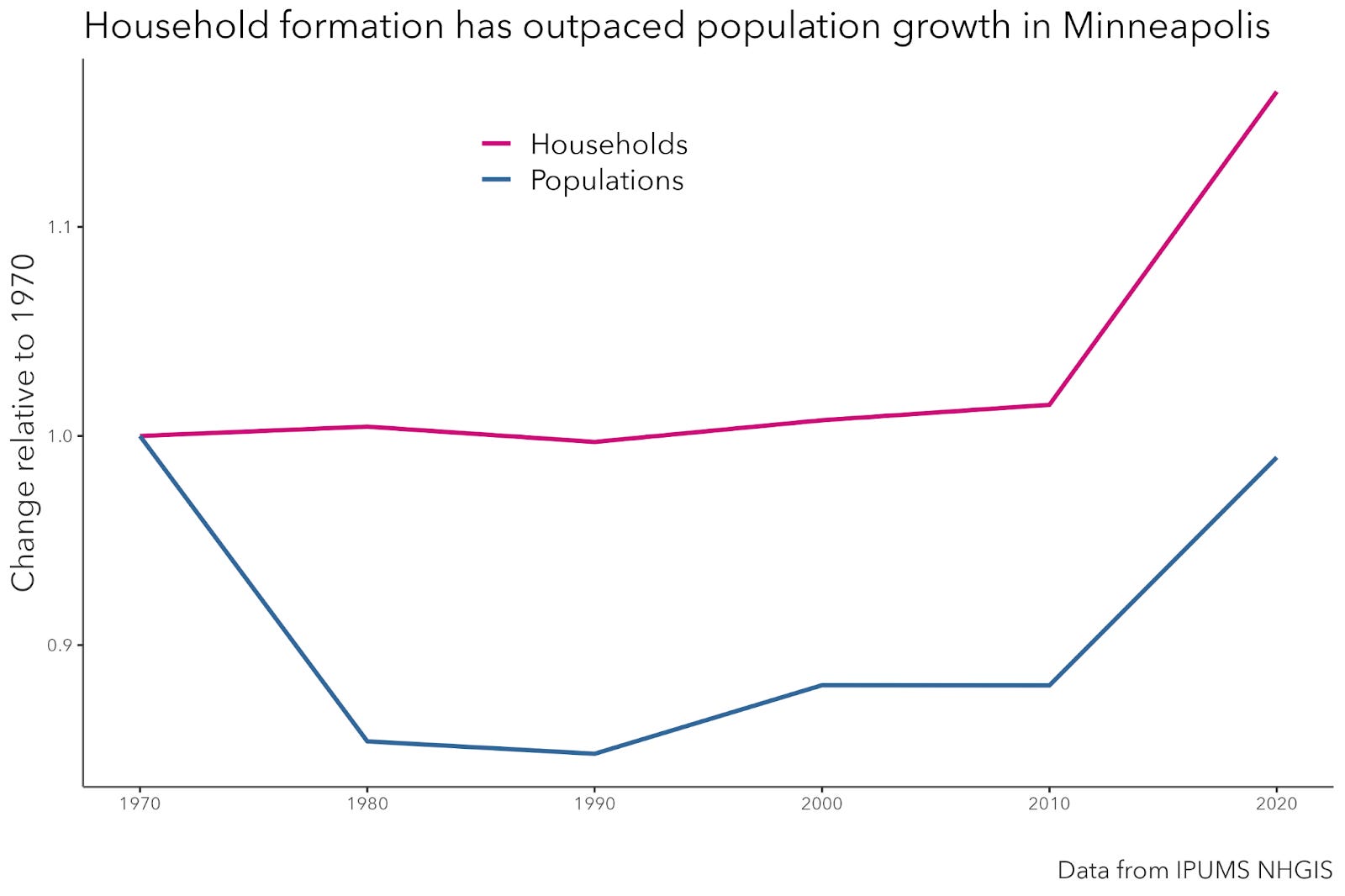
Over in Streets.mn, I have a new article, co-written with fellow Twin Cities urbanist Joshua Christianson, discussing a notable statistic in Minneapolis: although the city’s population is still lower than it was in 1970, the city also has its highest-ever number of households.
As we discuss in the article, this is an important and under-recognized statistic, with meaningful implications for housing supply in our cities. Here’s the key figure, showing how Minneapolis’s number of households in 2020 (187,670) is well above the city’s 161,141 households in 1970.
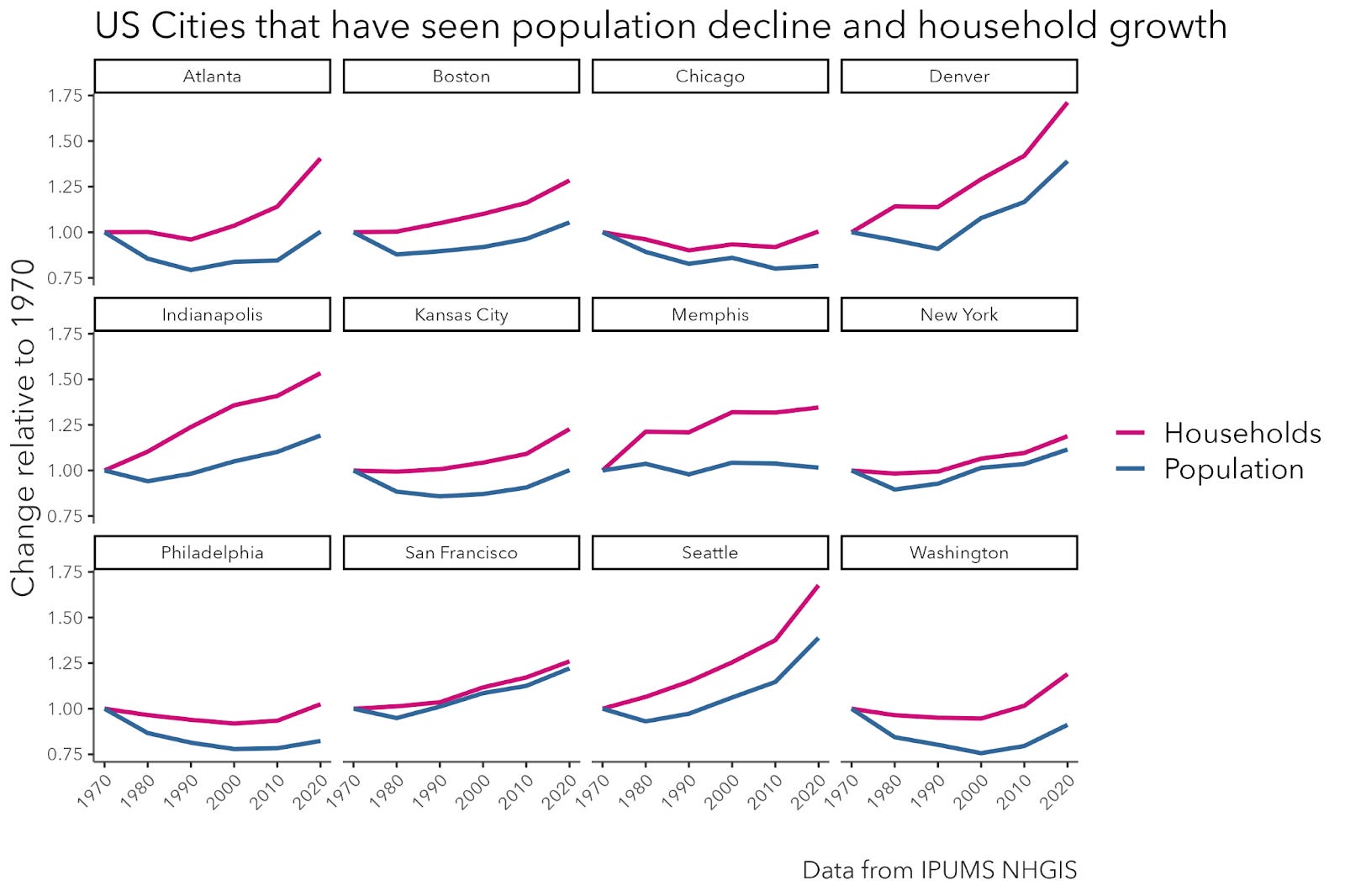
In having its highest-ever number of households, Minneapolis is not unique. Quite a few other American cities also reached peak household counts in the 2020 Census, despite having experienced decade-over-decade population decline at least once since 1970. Here are the 12 largest cities (by 1970 population) that meet this condition.
There are a few reasons for this development.
One is that urban households are increasingly likely to be childless, while more people also live alone than in previous decades. Here’s a graph that I made showing Minneapolis’s rise in childless households (in a previous article, I touched on similar trends in Chicago).
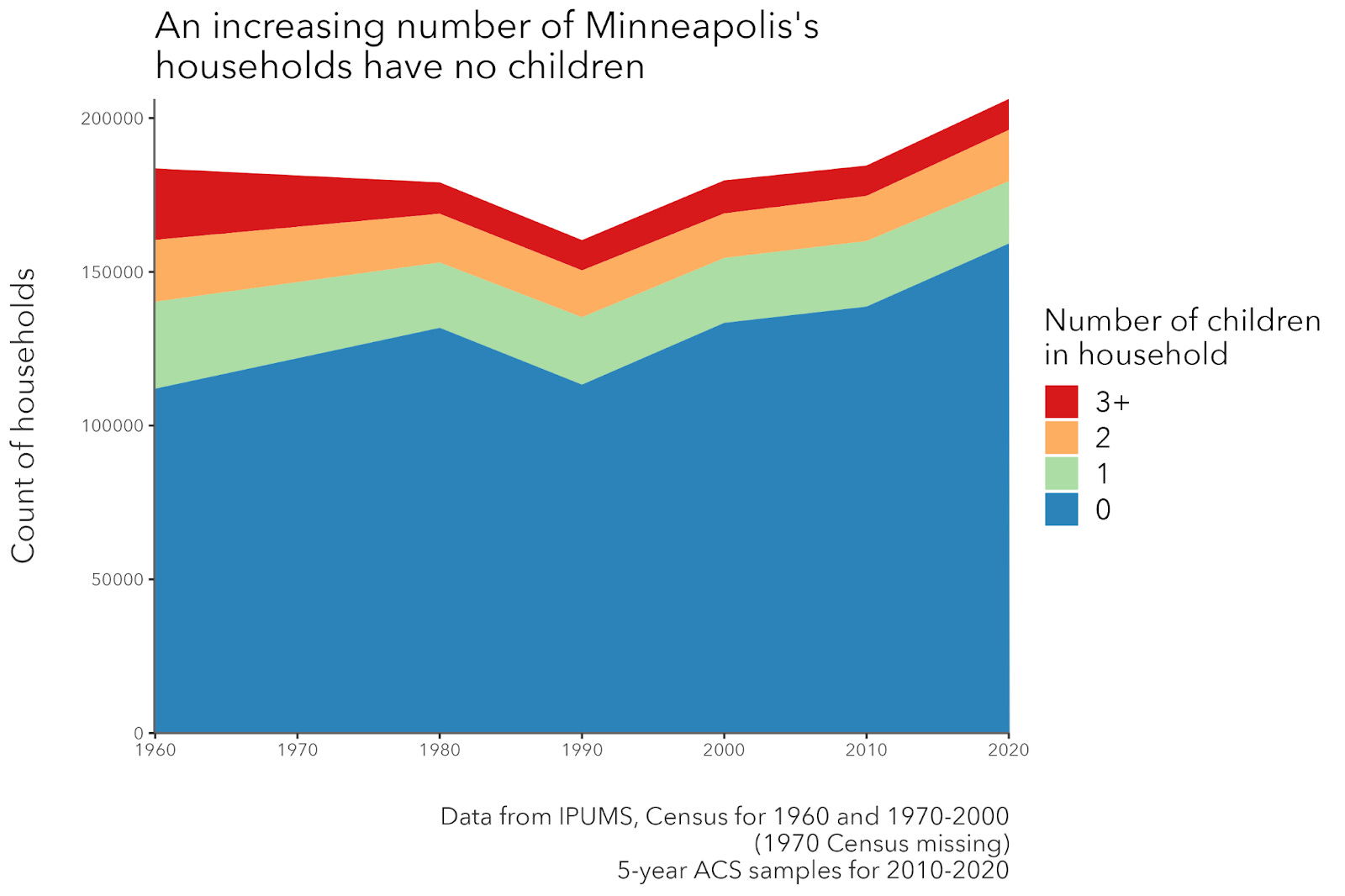
This has to do with both an aging population and an influx of young people. An older population means more households past the point of raising children, and often with just one or two members of the household.
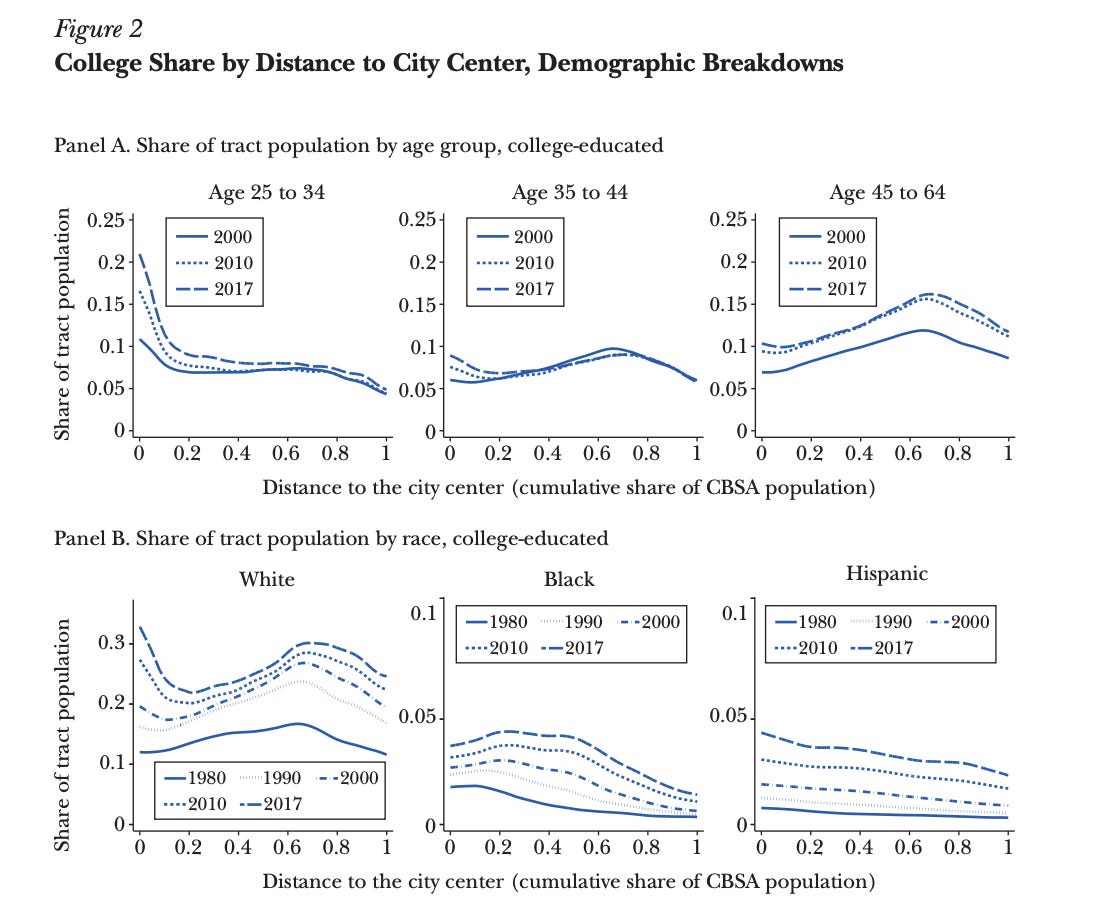
At the same time, cities have also seen large influxes of young professionals over the past couple decades, who are more likely to be pre-childbearing age. For example, see the below figure from a recent economic research summary. College-educated and primarily white young adults have increasingly flowed into urban neighborhoods in recent decades, reversing prior trends of suburbanization.1
There’s an important bigger-picture point to recognize about falling household sizes, too: our society is simply wealthier than we were before. We’re less likely to be forced into overcrowded housing arrangements, and we can generally afford to have a little more living space. As incomes grow over the long-term, it’s not surprising to see household sizes shrink — and this component of falling household sizes is generally a good thing, indicating improved living standards.2
Strong household growth has two meaningful implications for housing supply3. The first implication is straightforward. With more households, cities need more housing. Even in cities like Minneapolis, Chicago, and Philadelphia, where total populations have never surpassed their mid-century peaks, growth in the number of households creates pressure on the housing stock. While these cities might not look as supply-constrained as New York City and Los Angeles, household growth calls for policy that can get more homes built.
A second, closely related implication is that zoning and land use regulations need to work in more flexible ways. Household patterns — and for that matter, most facets of peoples’ demand for housing — are inevitably dynamic, bringing changes in the nature of housing demand. Therefore, we ought to legalize much more variety in housing, and see what gets built as households change over time. ADUs, houses on small lots, and various typologies of apartments and townhomes all have at least some role to play in all of our cities places. Unfortunately, American land use policy is often pretty bad at this.
To be sure, I would recommend these types of reforms under any set of population conditions — even a city with a shrinking number of households could still benefit from ending parking requirements, apartment bans, and high minimum lot sizes. By raising the costs of building housing, these policies are costly and burdensome regardless of a city’s population dynamics.
But these population trends add yet another reason for cities to get themselves unstuck from their restrictive zoning and land use regimes.
This probably slowed a bit amid a COVID-era hit to the demand for living in cities, but over the next couple decades I would still bet on this young professional re-urbanization to pick back up.
The same is true at a neighborhood level: when a neighborhood gentrifies, household sizes tend to fall because new residents can afford to spend more money on living space. I tracked one example of this trend in my blog post on How Logan Square Shrank.
As housing researcher Jens von Bergmann points out, we should be careful about interpreting household growth as the ultimate measure of housing demand. Bergmann's research shows that household growth is itself constrained by high housing costs — if housing is too expensive, you can't afford to start your own household, and instead have to live with your roommates or parents.
No posts
Comments
Nothing yet. Say the first thing.
Sign in to join the conversation.