
I’d like for cities to be great places to raise families. Unfortunately, families themselves frequently don’t find this to be the case. Over the decade or two, American cities have generally seen a declining number of families, a trend which accelerated after the pandemic. To be sure, a nationwide decline in fertility plays a role here, but the number of children living in cities has fallen substantially more. Families can vote with their feet, and they have been casting their vote against urban living.
Chicago is no stranger to this problem. Over the 2010s, Chicago’s population of children fell by nearly 100,000,1 and more families moved out after COVID.
What’s to blame? Many things, probably — safety and schools are surely important factors behind familial exodus in Chicago. But housing is one potential culprit that has received substantial attention lately. Of course, one issue is that urban housing can be too expensive, especially in the most highly-demanded neighborhoods. But our cities might also be building the wrong kinds of housing.
For example, informative new research from Bobby Fijan and Lyman Stone at the Institute for Family Studies shows that both current and potential parents express an overwhelming preference for additional bedrooms. For these households, having a third or fourth bedroom is considerably more valuable than a large yard, short commute, or a bigger kitchen.
Unfortunately, cities haven’t been building much housing to accommodate this preference. A small and decreasing share of new urban apartments have three or even two bedrooms, and Fijan and Stone fear that cities are pushing away families by failing to build family-friendly housing.
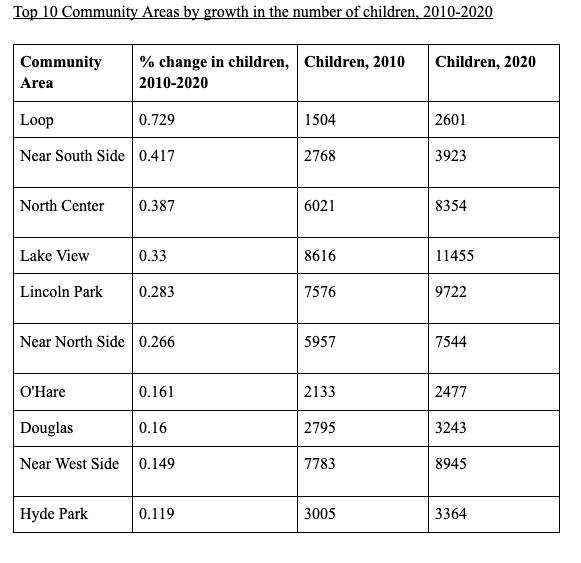
Given this context, Chicago’s population trends over the last 10 years show something surprising: the city’s downtown is the fastest-growing area for families. Among the city’s 77 community areas, the Loop, “Near North”, “Near South”, and the “Near West Side” experienced a major boom in the population of children during the 2010s. In terms of percentage growth in the number of children between 2010 and 2020, all four core neighborhoods were in the top 10 — while the number of children declined in most city neighborhoods.
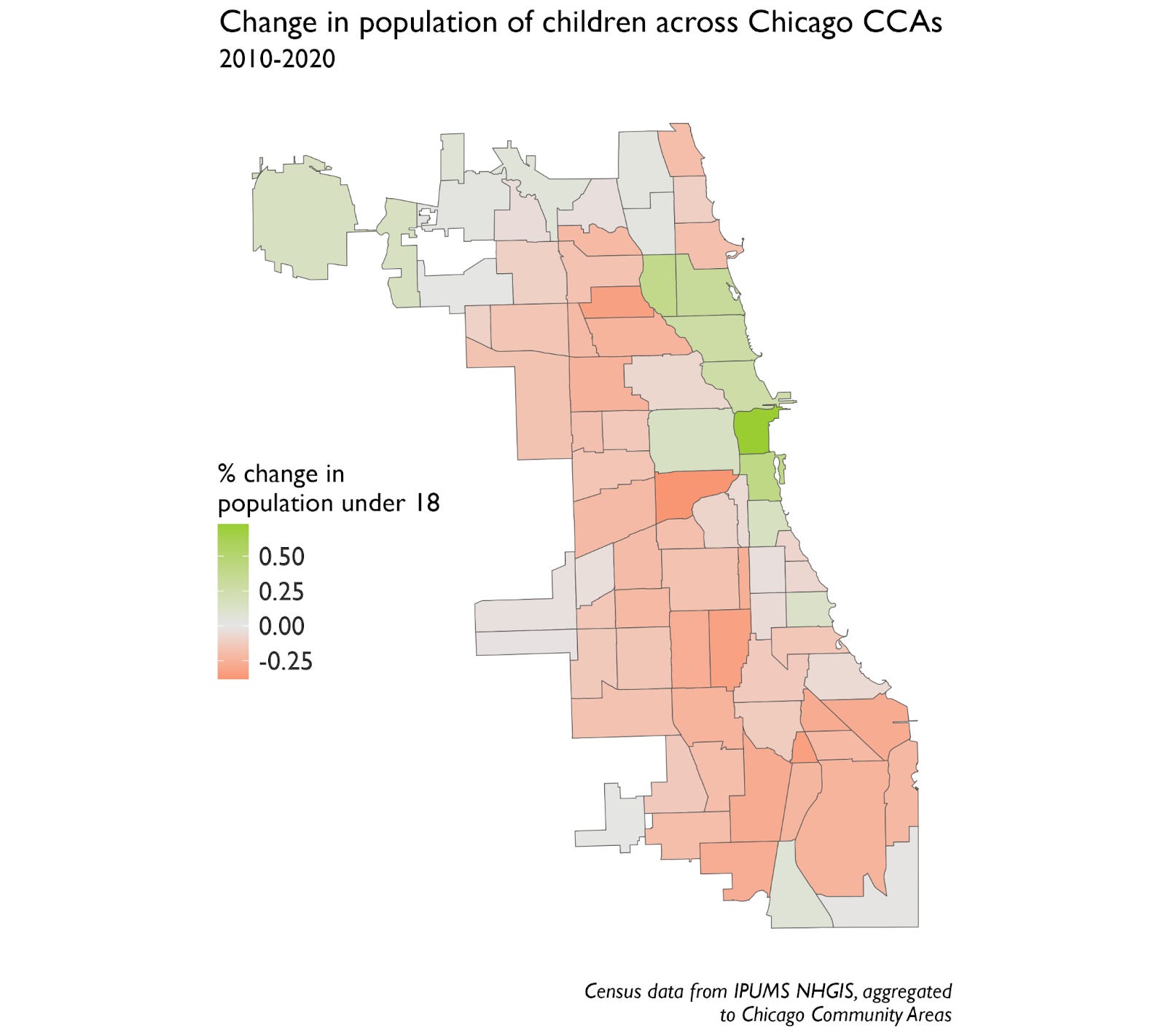
I don’t think that most people would consider these areas to be particularly family-friendly neighborhoods, which overwhelmingly consist of huge apartments with studio and 1-bedroom units.
However, the incredible growth of these neighborhoods seems to have outweighed their relatively unattractive housing characteristics for families. In recent years, the core neighborhoods of Chicago built immense quantities of housing, and their populations have grown commensurately. This has effectively served as a rising tide to lift all boats, regardless of family status: although only a small proportion of households in these areas have children, overall population growth has been enough to increase the absolute quantity of families.
There is an important lesson here. To be sure, families express strong preferences for certain types of housing, and it’s important to figure out how we can build more of the housing types that accommodate these preferences. But larger population growth and increases in housing supply are also crucial to foster a growing number of families in cities — and in some cases, growth could even be more important than building the “right” kinds of housing.
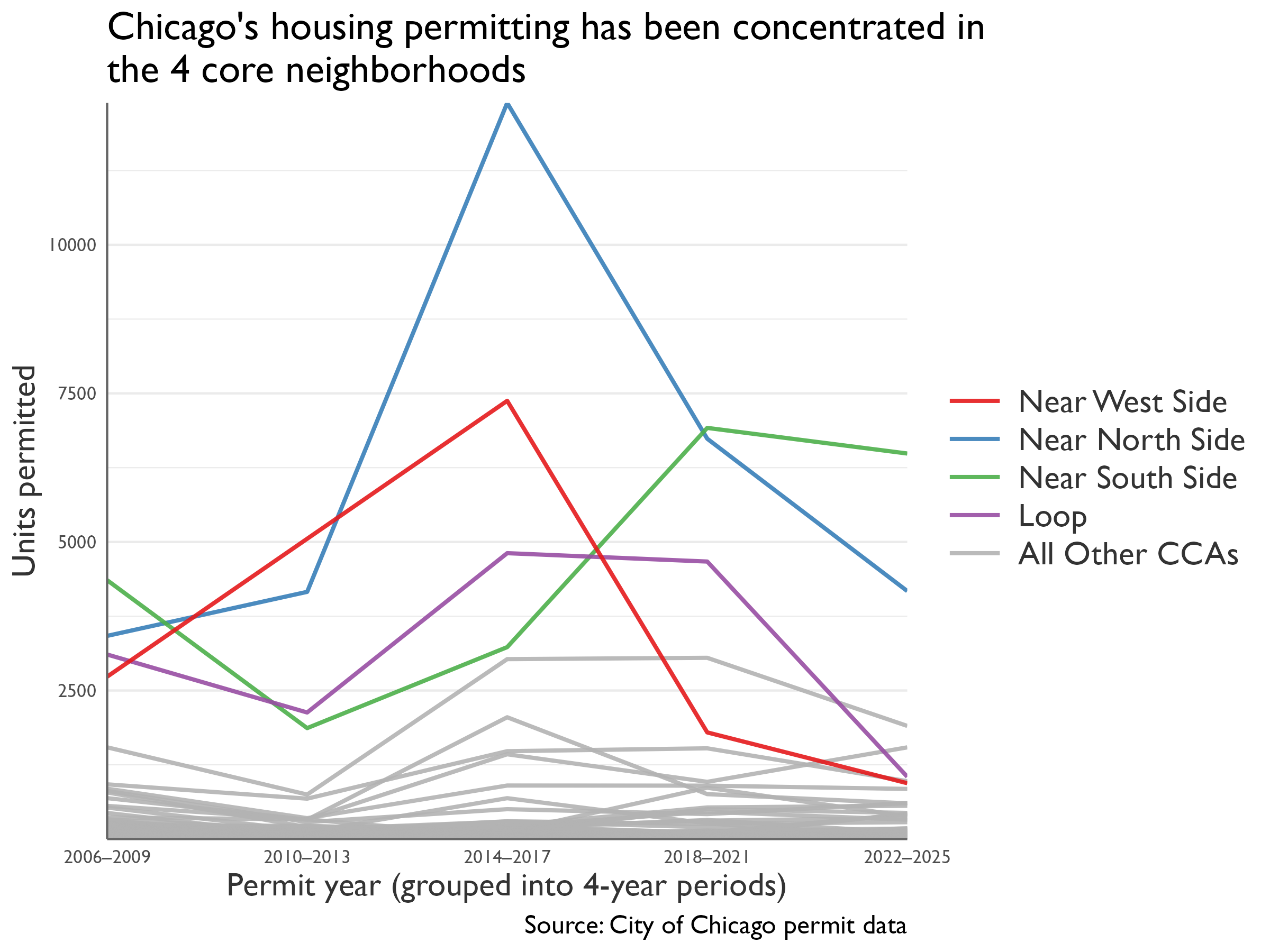
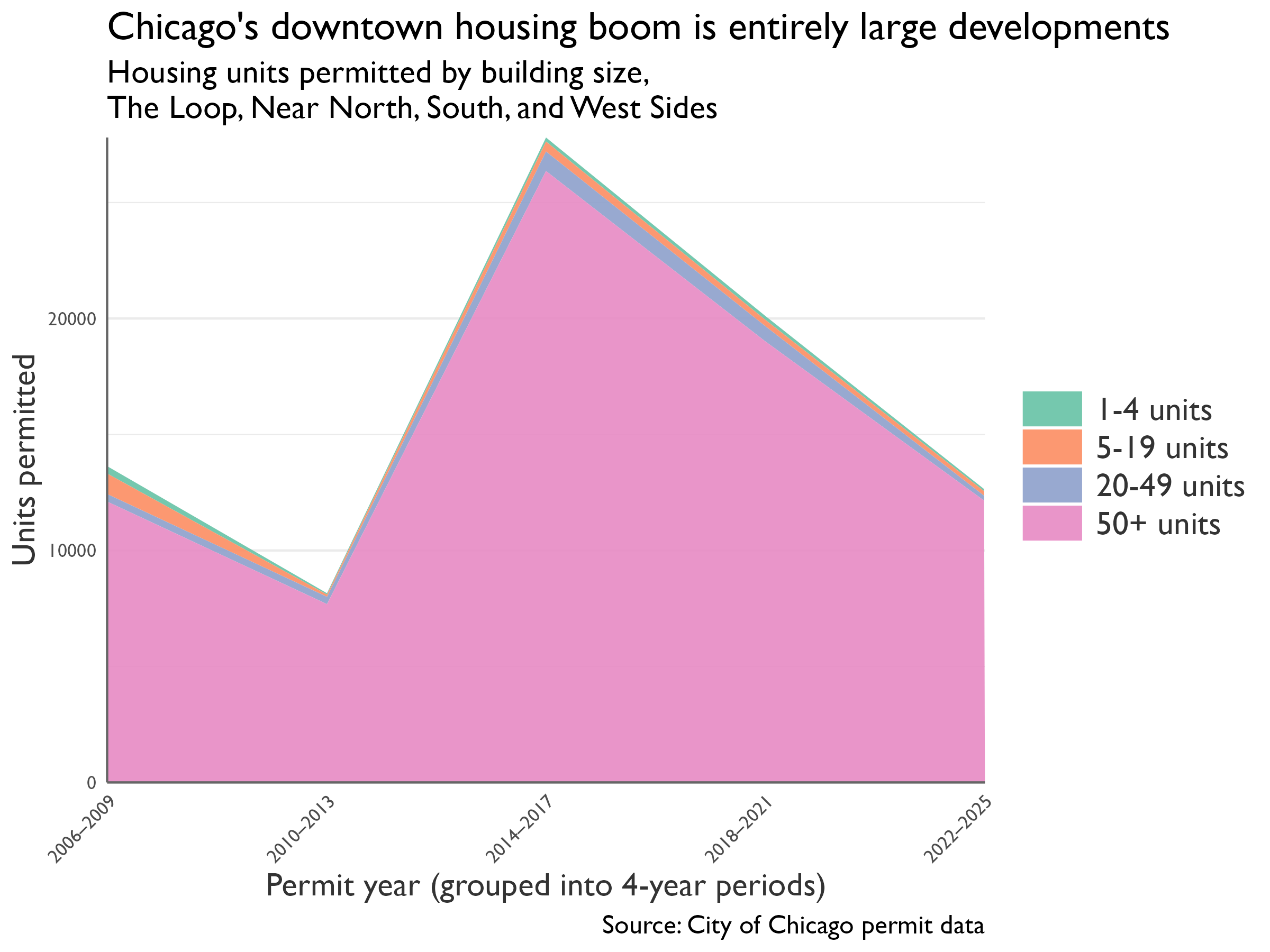
Chicago’s downtown family boom must be understood in the context of these neighborhoods’ incredible net growth over the last twenty years. These neighborhoods have seen a degree of residential development incomparable to any other part of the city. This is evident in the chart below, which shows housing units permitted in Chicago since 2006.2
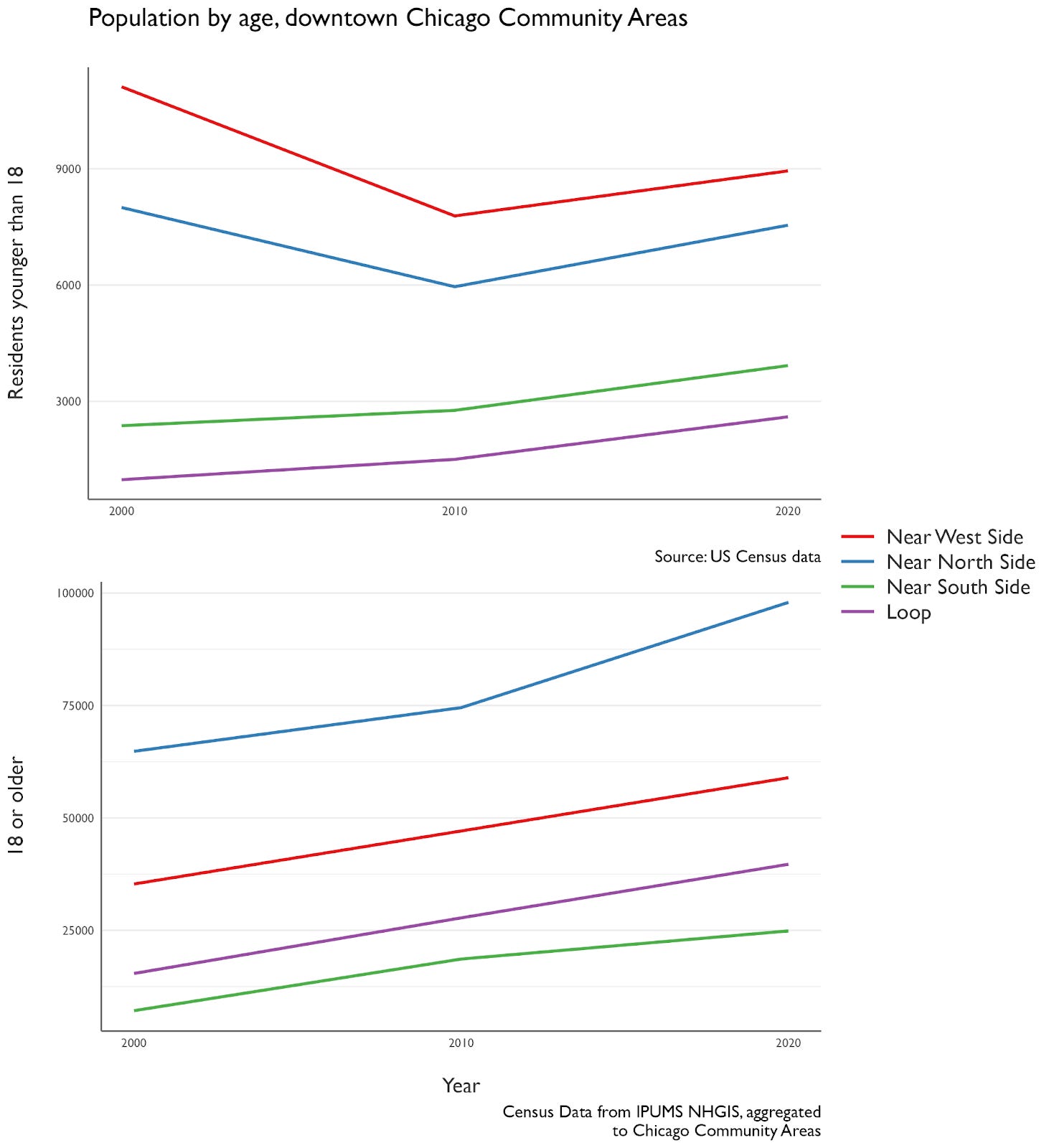
Naturally, downtown’s population has boomed as people have filled these units. But it’s not all childless yuppies: in the past decade, the total population of children has grown considerably in these neighborhoods. In 2020, thousands more children lived in the Loop, and the Near North, West, and South Sides relative to 2010.
A natural question to ask about Chicago’s downtown family boom is whether we can credit these neighborhoods for building the “right kind” of housing for families. Downtown has built a lot of units, but how well do these units appeal to families — and how much does that matter?
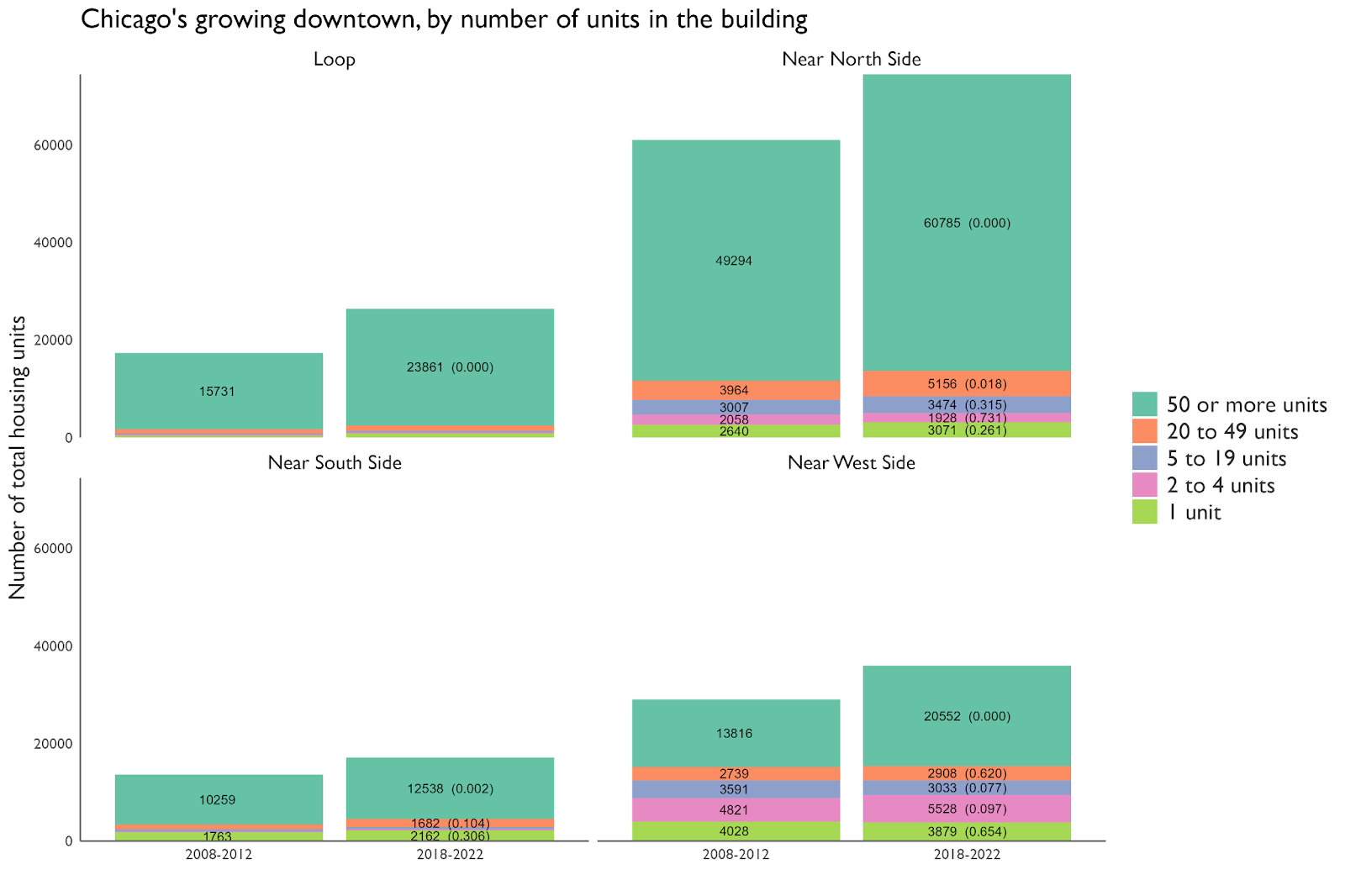
As it turns out, these units have rarely been family-friendly, but aggregate growth has been strong enough to make this irrelevant. We don’t have detailed data on the number of bedrooms in Chicago’s new construction, but we can use data from the American Community Survey to see the 10-year change in housing units in these neighborhoods.
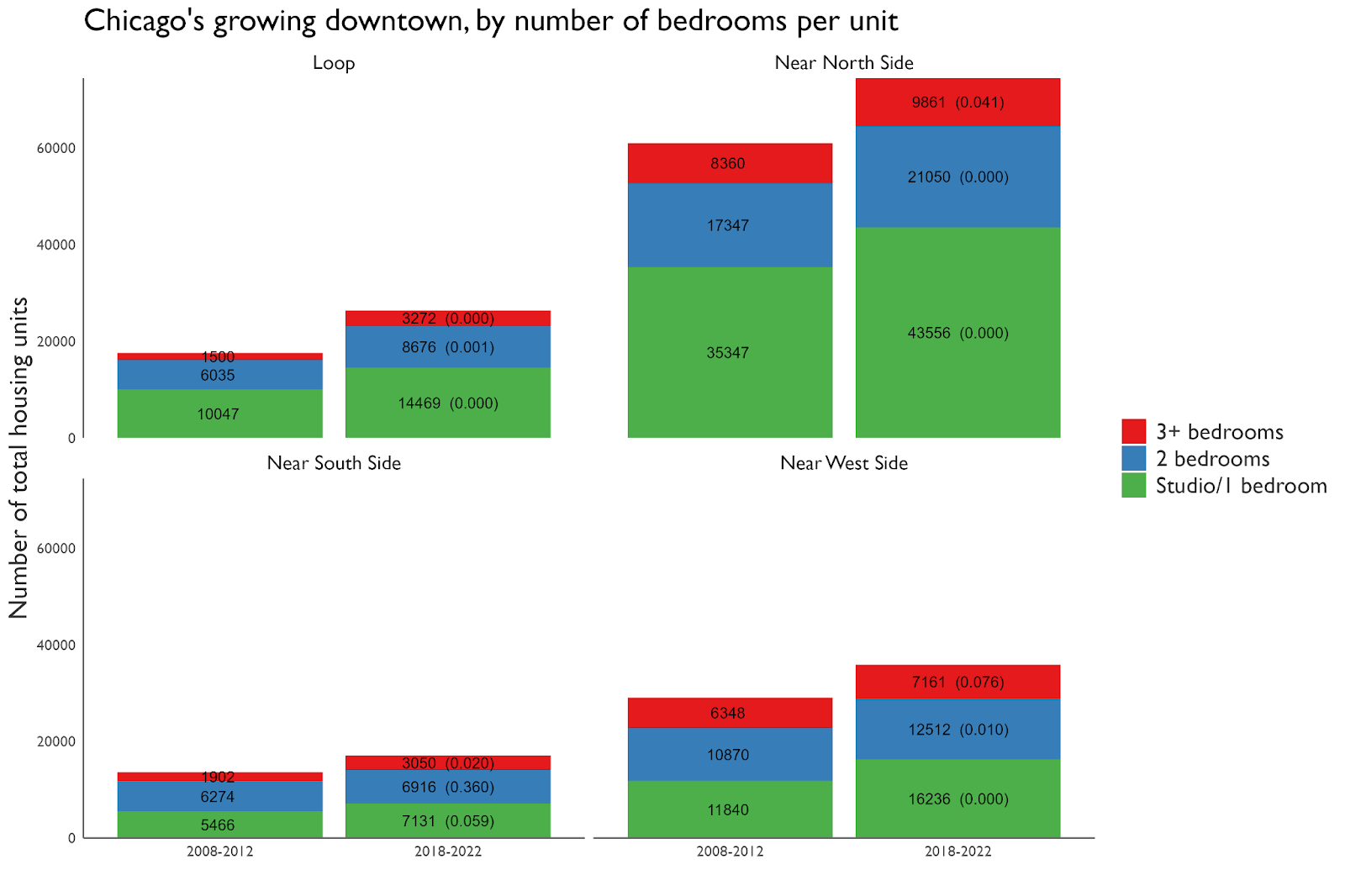
This figure shows that the massive growth in Chicago’s core neighborhoods has been largely driven by 1 and 2-bedroom housing units. More family-friendly units, with 3 or more bedrooms, account for a small proportion of the housing in these neighborhoods, both in 2010 and in 2020.
However, minuscule growth is different from no growth at all. Over the 2010s, all 4 of Chicago’s downtown neighborhoods still had a net increase in housing units with 3 or more bedrooms.
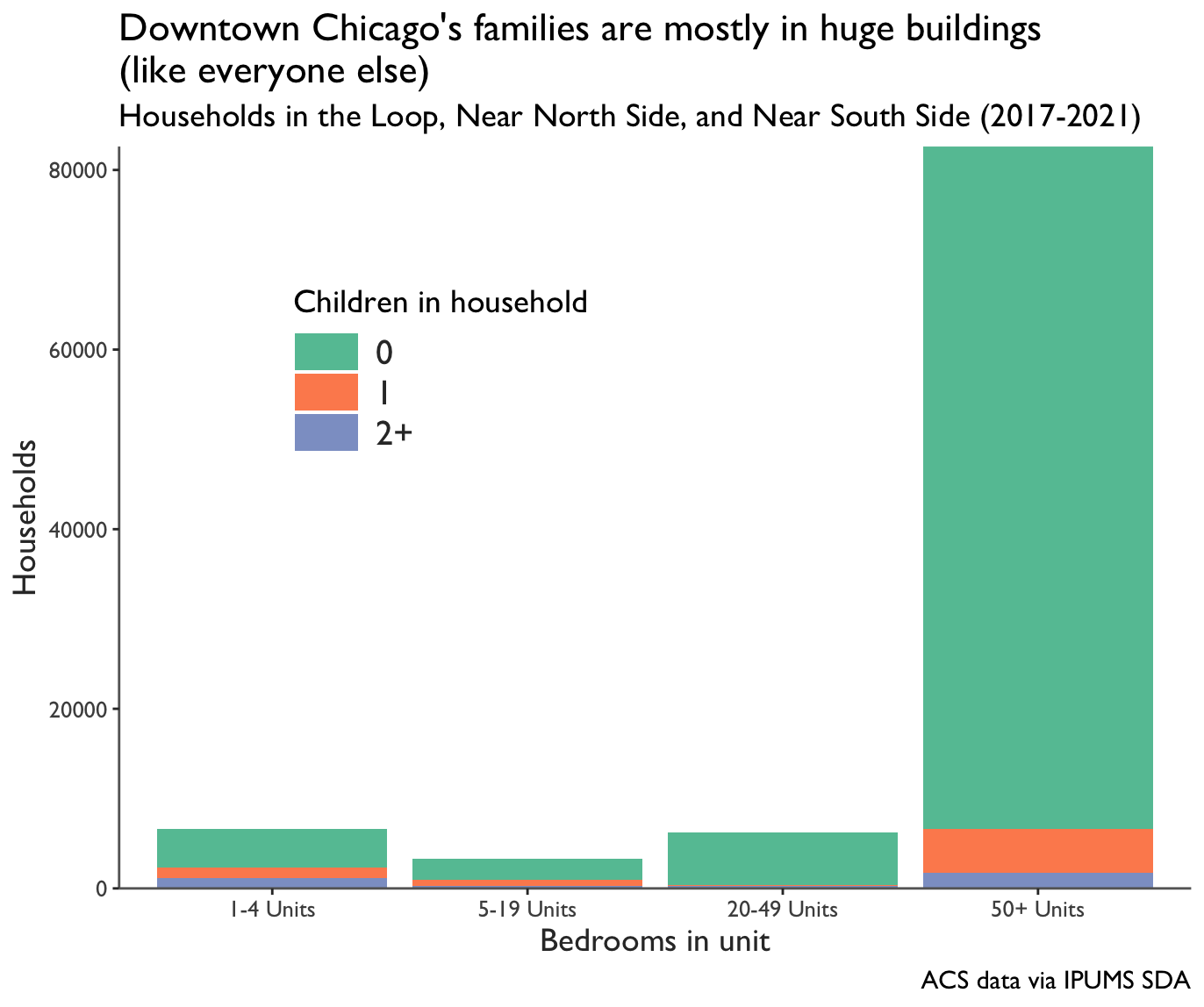
It’s also clear, though hardly a surprise, that nearly all of these new housing units have been built in very large developments, with 50 or more units. We know that families also seem to prefer detached single-family homes over apartments, although Stone and Fijan’s research suggests that this is less important than having additional bedrooms. Either way, Chicago’s core neighborhoods have had no increase in the number of single-family, or small multifamily, homes.
But if most of this new housing does not seem particularly family-friendly, where do the families actually live? The figure below shows the number of children in different households, by the number of bedrooms in their home — in this case, for the combined area of the Loop, and the Near South and North sides.3
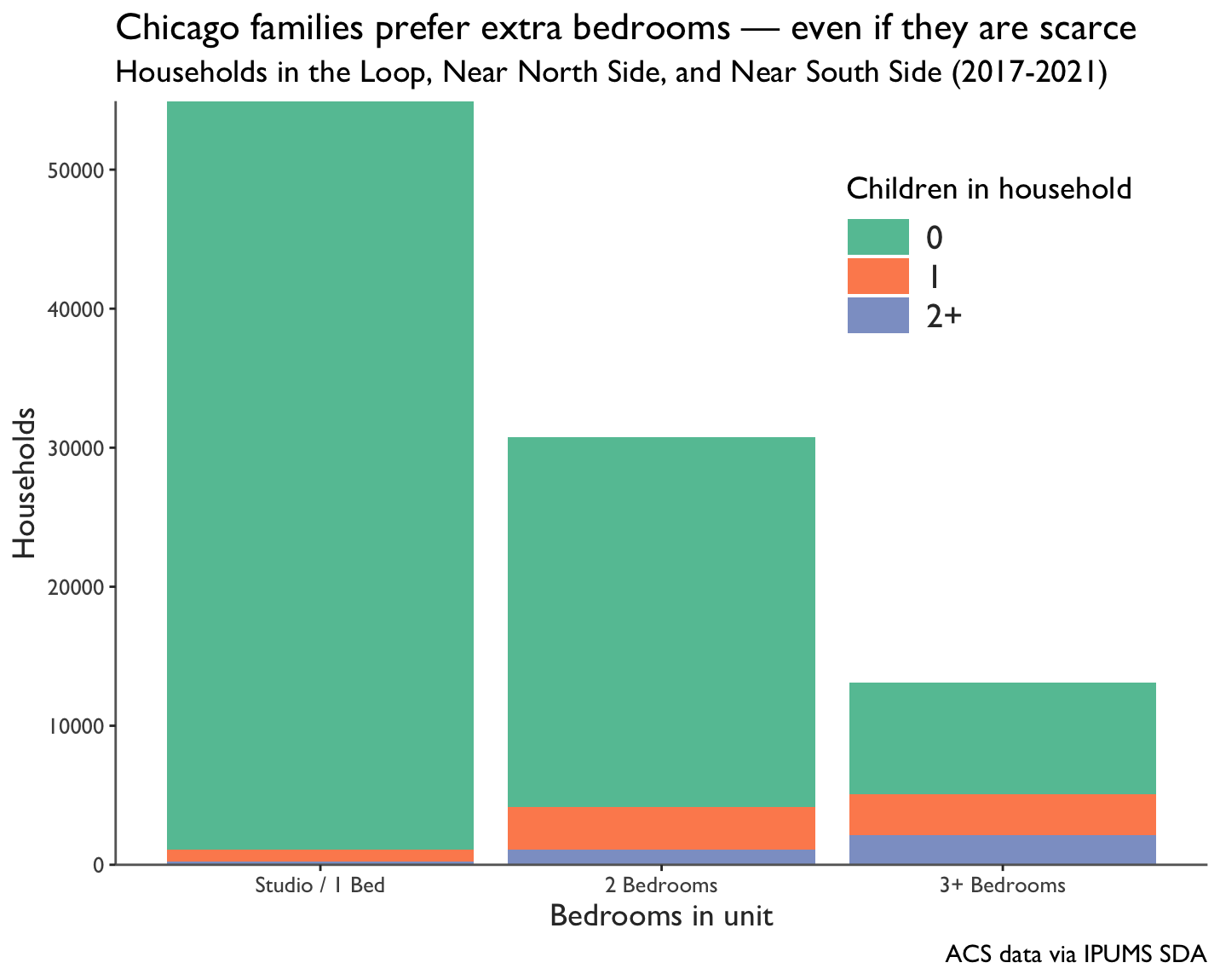
This data aligns with the findings of Fijan and Stone’s recent report: families strongly prefer having more bedrooms. There are nearly zero children living in studios and 1-bedroom units, and less than 15% of 2-bedroom apartments have a child in them. Although 3+ bedroom apartments are scarce in downtown Chicago, families have a strong tendency to select into these larger units.
But as much as families prefer to have more bedrooms, the number of families in downtown Chicago has had remarkable growth. Chicago’s core neighborhoods have experienced little growth in the number of multi-bedroom housing units, but their broad housing boom has been more important for drawing families into the neighborhood.
This is even more noteworthy when considered in Chicago’s broader context – while nearly every single neighborhood in the city was losing families during the 2010s, a bunch of families moved into huge buildings in the city’s densest areas.
What lessons should we take from all of these downtown families? To be clear, I think that Stone and Fijan have a great agenda: we need to figure out how to build more of the housing that families want in cities. Although many families are evidently willing to live in downtown Chicago without much multibedroom housing, families would certainly benefit from more and better options.
But a key lesson is that growth in and of itself is still fundamental for building successful cities. This is also true specifically for building family-friendly cities.
At the very least, this evidence motivates against a hypothesis that dense development could actually be actively unfriendly towards families. This strongest version of this idea, which I’ve seen floated by Stone, economist Tyler Cowen, and online “courtyard apartment” evangelizer Alicia Pedersen, is that building too much high-rise, low-bedroom count housing could actually be a net negative for families, lowering fertility. If high rises replace or crowd out other more family-friendly types of development, might they ultimately discourage childbirth and push away existing families?
While I haven’t presented any evidence on fertility — I’ve only shown where families locate once they already have kids — the case of downtown Chicago should reduce our worry that this “crowding out” effect could act as a net loss for families.
In fact, this finding is reminiscent of recent research from Chicago-based researcher Bo McMillan, who found that West Loop and South Loop were also some of Chicago’s only neighborhoods with an increase in the number of low-income households over the last 10 years. As McMillan’s analysis showed, one of the most powerful predictors of a neighborhood gaining low-income households was having an increase in housing supply. But much like the relatively small proportion of family-friendly units in these areas, relatively little of West Loop or South Loop’s new housing is directly affordable to low-income households4. In this instance, too, building tons of new housing has created a positive-sum outcome for different kinds of households.
It’s also important to recognize that market-wide housing affordability matters for families. As economist Emily Hamilton argued in a recent article, building more housing of all types is important because it increases access across the entire “ladder” of housing options for households at different stages of life.
Indeed, some economic research shows that lower housing costs can increase child-bearing among families. For example, a recent working paper examined housing credit lotteries in Brazil, and found that households that received these credits — making it easier to buy a house — experienced a meaningful increase in fertility. Other research also shows more expensive housing lowers fertility for households that don’t already own their homes. One paper even suggests that more zoning regulations specifically delay and lower fertility.
Therefore, we should also acknowledge the second-order benefits that Chicago’s downtown housing boom has had for the city’s housing affordability, making it easier for families to stay in the city. Chicago’s core neighborhoods are the only real outlet for the city’s growing housing demand — in Chicago’s expensive North and Northwest side neighborhoods, very little housing gets built as a result of restrictive zoning laws and constant local opposition to dense development. Without these new buildings absorbing housing demand — call them yuppie fishtanks — the city as a whole would certainly be more expensive, pushing more families out of the city.
It’s not always easy to figure out what housing policies will support families in choosing to stay in cities. In recent years, we’ve clearly been struggling to do so — families are leaving cities, and we’re rarely building the kinds of housing that families prefer.
But as the family boom in Chicago’s downtown demonstrates, simply letting a city grow to accommodate more residents is a crucial first-order step for encouraging families in a city.
That’s a decline from 659,706 to 564,581. I’m counting this as the population 18 or younger in the 2008-2012 American Community Survey vs. the 2018-2022 American Community Survey, calculated via IPUMS.
Methodological note: this data comes from the city’s permit data. It spans from 2006 up to today, and does not neatly record the number of units. I used a series of regular expression commands to extract the number of units in each new construction project (which is often 0, as in the case of building a new garage or storefront).
I do not know how Yonah Freemark cleaned this data in his recent study using the same permit data, but he reports 120,000 housing units through 2024. I get closer to 140,000. My permit data cleaning may be slightly imperfect, but I do believe that it’s very close to correct.
To do this analysis, we need to expand our analysis to the Public Use Microdata (PUMA) level. This is for PUMA 3525, per 2010 PUMA definitions. This exactly captures all of the Loop plus the Near South and North Sides.
To be fair, we can almost surely give the Affordable Requirements Ordinance, Chicago’s inclusionary zoning policy, a good bit of credit for this result. But even without the ARO, a similar point stands: when neighborhoods don’t grow their housing stock, it’s a zero-sum game for households.
No posts
Comments
Nothing yet. Say the first thing.
Sign in to join the conversation.