
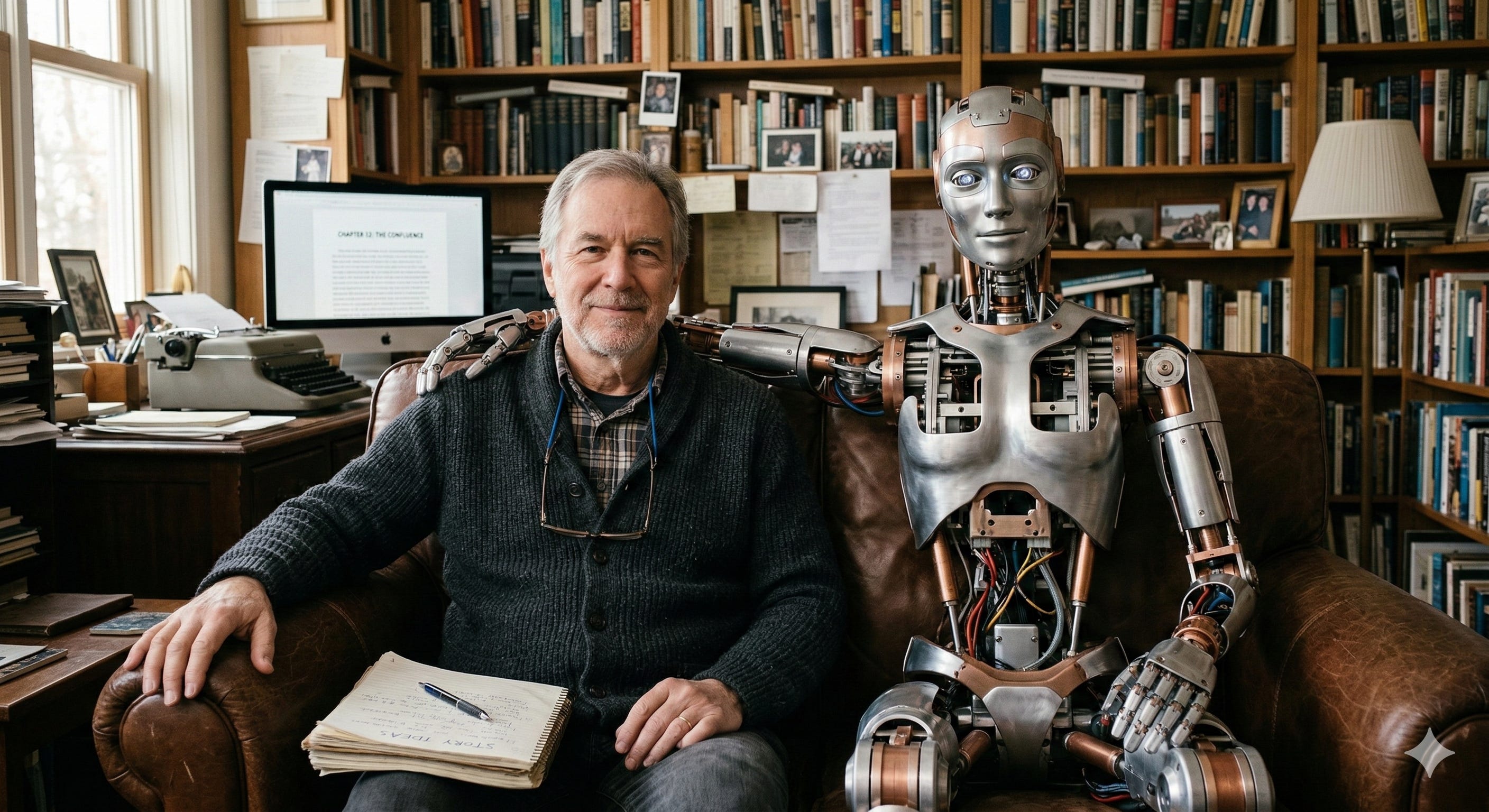
For the past two years, writers have mostly processed the existence of AI in one of two ways.
Camp One: AI is the end of writing. Camp Two: Writers who don’t use AI will be replaced by those who do.
It feels like there is no other frame. Both feel a little overheated—the kind of stances that generate a lot of engagement and not much light. The truth, as usual, is something more interesting and a hell of a lot less dramatic.
Substack writer Nate B. Jones recently offered a framing that struck me as more useful, especially for people who actually make their living with words. His argument is simple: the real skill in the AI era is knowing “when to think for yourself and when to use AI.” If interested, here’s his entire video on the topic—well worth watching.
His idea stuck with me. Because for working writers, the question isn’t really whether AI exists. It’s what role—if any—it should play in the daily grind of doing our writing work.
And that grind is real.
Let me say the obvious thing first, because it keeps getting glossed over.
Writers should not use AI to generate their writing. Not essays, not articles, not the thinking behind them. If a machine produces the ideas and the prose, then the writer has essentially become a copy-and-paste technician, which is not, I suspect, the career arc most of us had in mind.
More importantly, the entire point of writing is that thinking happens through the act of writing. You don’t figure out what you believe and then write it down. You write to figure out what you believe—it happens in the process of writing on an idea. Take that process away, and the whole enterprise collapses into a kind of articulate emptiness.
Jones talks about cognitive offloading, the habit of letting a tool do your thinking for you. It sounds harmless, maybe even efficient. But once it becomes a habit, science sees something predictable following: the human slowly loses the ability to evaluate whether the machine’s output is any good. You stop being a writer and become a proofreader of a robot’s first draft.
Essentially, you can become trapped in an echo chamber that resonates with popular and common collective thinking of a given moment in time. That’s where bots get their ideas, by the way.
The research on this is worth paying attention to. A 2025 study by Michael Gerlich surveyed 666 participants (hmmm, I wonder if that number has significance… ) and found a meaningful negative correlation between frequent AI tool use and critical thinking ability. Cognitive offloading was identified as the key mediating factor.
Heavy AI users were essentially outsourcing the hard mental work, and their ability to think independently was declining as a result. Younger participants, school kids, showed the steepest drop. The findings revealed a significant negative correlation between frequent AI tool usage and critical thinking abilities, mediated by increased cognitive offloading for all ages, adults included.
For writers, that’s not an abstraction. It’s a professional hazard that can tank a career.
For premium content weekly, join us for about $7/mo billed annually.
P2P Academy, with weekly email lessons
Jones uses a comparison worth sitting with. When calculators appeared in classrooms, people worried that students would stop learning math. If machines could do arithmetic, why bother with long division?
But students still learned the fundamentals. Calculators let them move faster once they had those fundamentals. The tool wasn’t the danger. The danger was skipping the underlying skill.
There’s one important difference with AI. Calculators handle arithmetic, a fairly closed domain. AI handles language, wide open and deeply human. The gap between “doing arithmetic” and “thinking clearly about ideas” is significant. One is a procedural skill. The other is the entire job.
Our society is already weakening the concept of critical thinking, and all this is a strong deterrent for thinking critically.
That said, the comparison holds where it matters: the tool amplifies what’s already there. The application of AI does not necessarily damage critical thinking; the way we use and integrate AI is the key. A writer with strong instincts who uses AI selectively will likely be fine. A writer who uses AI to avoid developing those instincts in the first place is in a much trickier spot.
We can all see that happening everywhere that there is a writing component. Two years ago, it seemed cool to generate everything. Now, we have learned that the quality is lame; people don’t read much generated stuff, even if the news media outlets rely on it. And we can instinctively feel when writing is not human. Forget the plethora of checker apps that claim to detect AI. They can’t, and we don’t need them to.
There’s a subtler risk worth naming. Researchers studying AI’s cognitive effects have found that AI’s tendency to align with preexisting beliefs and display human-like social desirability biases can reinforce existing perspectives rather than challenge them, thereby undermining the active engagement with diverse viewpoints necessary for reflective thinking. There’s that echo chamber again. In other words, the AI will often tell you that your half-formed idea is pretty good. A good editor won’t. Neither will the blank page at 7 a.m.
Here’s the more practical question, and the one that tends to get lost in apocalyptic framing.
Writing itself, getting the thoughts and words down, isn’t the most time-consuming part of being a working writer. The time drain lives in surrounding tasks, the scaffolding around the work. Organizing scattered research notes. Summarizing a long document. Checking whether a section is repetitive. Trimming a 1,200-word ramble down to something a reader will actually finish. Generating five headline options so you decide what seems compelling.
And none of that is the creative heart of writing. It’s the administrative friction surrounding the heart.
This is where AI can be useful—not as a ghostwriter, but more like a very fast editorial assistant who never sighs about doing the same paragraph for the fifth time. The writer still produces the ideas, the argument, and the draft. The AI handles mechanical cleanup afterward.
The tidying can be delegated. The thinking cannot.
The distinction matters. Reducing extraneous cognitive load—the unnecessary effort around a task—is beneficial, but technology that reduces germane load, the effort toward actual learning and thinking, has a negative impact on more profound engagement. Helping a writer cut a flabby section is extraneous load. Writing the argument for them is a germane load. One helps. The other quietly hollows out your skill.
Writers who will benefit most from AI tools will probably be the writers who least need them. If you already know how to structure an argument, develop an idea, recognize weak writing, and revise a messy draft—then AI may accelerate parts of that process. You’ll know when its suggestions are good and when they’re off. You’ll use it selectively, for disbursing friction, not for thinking.
But if someone hasn’t built those skills? AI doesn’t supply them. It produces text that sounds plausible for a while before quietly collapsing under its own vagueness. Anyone who has read several pages of pure AI-generated prose knows exactly what that collapse looks like: confident-sounding sentences that add up to nothing in particular.
Writers who will struggle are those who exploit AI to skip their development phase—the years of figuring out our craft. That work is genuinely hard and genuinely unglamorous, and there’s no shortcut. There wasn’t one before AI, and there isn’t one now.
The best thing most writers can do in the current moment is undoubtedly what they should have been doing anyway: read widely, write often, think carefully, and resist the temptation to let a tool do the cognitively uncomfortable parts of their craft.
Share this post with writers (or other creatives) who could benefit
The debate around AI tends to get framed as a binary: use it or don’t. That’s the wrong frame. Ask, instead, which parts of the writing process should remain entirely human.
For serious writers, the answer is clear. The idea, the argument, the voice, and the draft are non-negotiable human territory. You can legitimately delegate—with care—the finishing tasks: editing suggestions, structural feedback, research summarizing, headline brainstorming, trimming, and tightening. But be totally sure you are firmly in charge as a human creative.
AI has made one thing crystal clear. Anyone can produce large quantities of words—text. That’s a real change. What hasn’t changed—and can’t change—is what makes writing actually worth reading.
Clear, critical thinking. An original, creative perspective born of life experiences. A recognizable voice that sounds like a human being with something to say.
Those things still come from writers sitting down and doing the difficult work. Not the tidying—the thinking. The part where you stare at the page and force yourself to work out what you actually believe and then find words precise enough to say it.
If AI occasionally helps reduce the administrative noise around that process, fine. Use it wisely and ignore the hysteria and hyperbole. But the core job hasn’t changed, and shortcuts that effectively replace the human brain don’t exist.
You still have to think.
And then you still have to write.
(There are no workarounds for that. Believe me, we’ve all looked.)
Write what sets you on fire. Edit everything else. Champion fellow storytellers.
Want to know more about how humans will continue to dominate the writing industry? Get to know Pen2Profit’s website and how it can move you forward in multiple ways.
Comments
Nothing yet. Say the first thing.
Sign in to join the conversation.