
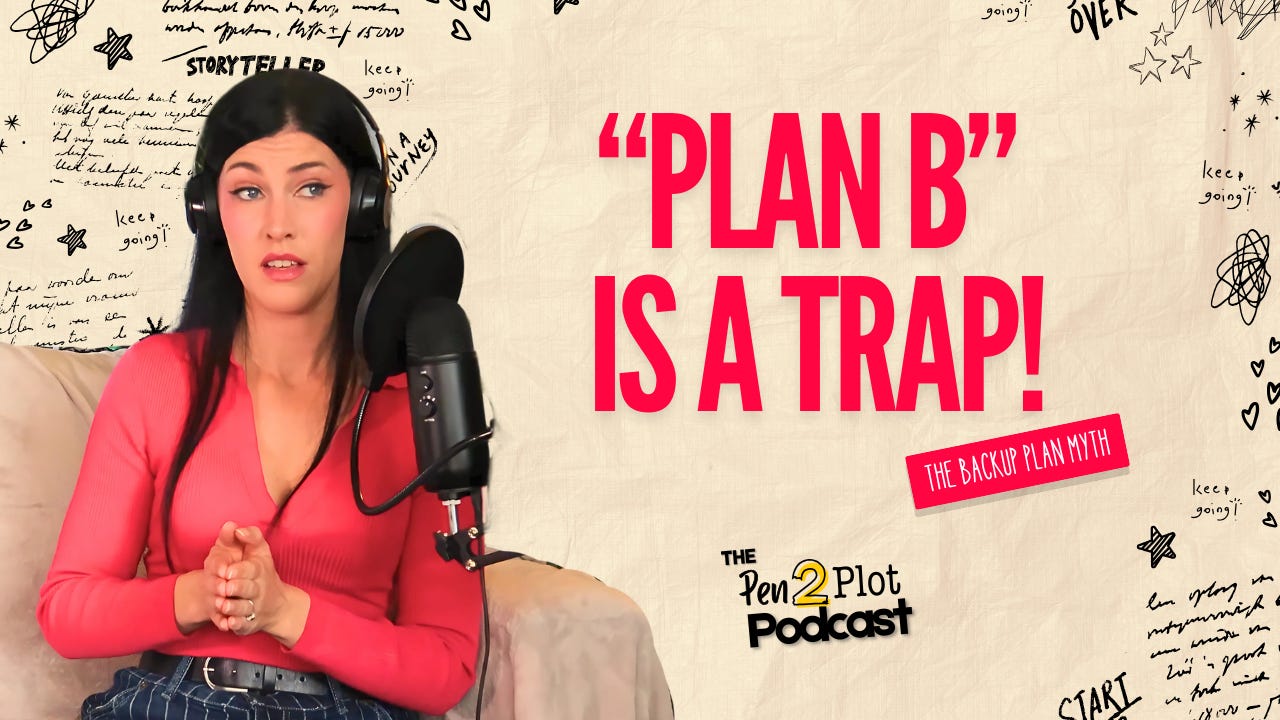
Let’s talk about Plan B’s—the dreaded “day job,” the so-called “back-up plan.” I think we’ve been looking at them all wrong. There’s this deeply ingrained idea that having a “Plan B” somehow protects us, but what if it’s holding us back? That’s what I want to explore in this essay. (If you feel like listening instead, click here to check out the podcast episode)
In my belief and experience, this notion of coming up with a suitable Plan B for our creative goals as storytellers could actually sabotage our creative progress. After years of fumbling in the dark, I’ve realized the real game-changer is having a more intentional mindset when it comes to building financial stability alongside our creative goals.
Here’s the thing: we assume that we need to invest exorbitant amounts of time investing our energy into a career that more often than not is completely misaligned with our goals. This could be for the sake of financial stability, trying to impress our peers, and to be taken seriously, all so we can have a fraction of time with our passion, pursuing what we truly care about.
I know some people may come back and say we can pursue our passion once we’ve made our money. But let’s get realistic. By the time that happens, most of us are already invested. We’ve already made our commitments and locked ourselves into the proverbial ‘golden handcuffs.’ Life is hard enough as it is, pursuing this career is hard enough as it is, but then we make it even harder by putting our ambitions on the back burner for years while we meander off in the opposite direction.
Contingency Isn’t Compromise
Let’s be clear: there’s a difference between a contingency plan and a backup life.
Contingency plans are smart. They exist to support the original mission by finding alternative routes to the goal when the initial strategy doesn’t go according to plan. Businesses use them all the time, not to abandon their goals, but to navigate roadblocks while still aiming for the same target. It’s course correction, not resignation.
But for creatives, entrepreneurs, or anyone daring to walk a road most people avoid, Plan B is rarely that kind of support system. In fact, it’s often a complete misdirect, a total 180° from what we were actually trying to achieve, all in the name of being ‘practical’. It’s a way to calm down the skeptics around us — or the loudest skeptic of all: ourselves. That’s not a Plan B, that’s just creating a brand new Plan A. And it’s going to drive us further away from our creative success.
The Lie of the "Safer" Path:
Here’s the part they don’t tell you:
Plan B is just as hard.
Let’s say you decide to become an accountant as your main hustle while chasing your dream of being a novelist on your downtime. That sounds reasonable, right? It’s stable. Predictable. A “real” job.
Except… becoming an accountant is also a massive undertaking.
You need a bachelor’s degree. You need to complete a professional education program. You need to pass national exams. You need work experience. And if you want to have a solo practice? Now you need clients, marketing, and client management systems. And years of hustle to just build THAT career. And even then, things can still go wrong. You could get fired, you struggle to find clients, and health problems could arise that make you unable to perform your profession. What also makes it a massive undertaking is the amount of emotional labour that goes into doing something that doesn’t light you up, that feels draining to do, for the foreseeable future (assuming accounting is not something you enjoy).
The idea that Plan B is easier or safer is a myth. It’s just difficult in different ways, often in ways that don’t fulfill us as creatives. It still demands time, energy, sacrifice, and consistency — All while pushing us in the opposite direction of our goals by stealing time away we could be putting toward bettering our craft and getting our name out there.
Why Do We Need Money?:
And gurl, I get it—you might be rolling your eyes right now thinking, “Quitting my job to chase my dream isn’t going to pay my bills, K.J. I can’t just leave everything behind.” And you’re right. I’m not asking you to.
But I do want to ask you something: what do you make money for?
I had to sit with that question myself—what do I really need money for? Sure, there are the essentials: food, housing, transportation. All valid. But beyond survival, what role does money play in our lives? Could the income we're earning today be used not only to stay afloat, but to build a bridge toward the life we actually want?
For a long time, I couldn’t see that bridge. I stayed in jobs I didn’t like because I believed they were the only stable option. I figured I’d be stuck in administration, working at a boutique, or behind a café counter forever, while storytelling would remain this unpaid, background hobby I could never hope the make an income off of. I thought, like so many of us do, that was the trade-off of being creative: passion on the side, paycheck up front.
But then life happened. I quit—or got fired—for one reason or another, and suddenly the illusion of “job security” crumbled. That’s when I realized: everything is temporary. Even the “safe” jobs. So why not treat them that way to begin with?
Our day job doesn’t have to be a Plan B—it can be a strategic, temporary funding source. If our ultimate goal is our creative work, then we should build our entire plan around that. We don’t need to frame it as “settling,” we can frame it as fuel. Plan to make money with intention. Then, plan our exit.
Maybe that looks like saving enough to fund that first big marketing push. Or stacking cash to take a sabbatical and finally go all in. Whatever it is, work toward that number. That timeline. That goal.
And here’s the thing—if it doesn’t work out right away, that’s not failure. That’s feedback. We’ve gained experience, learned what needs to be adjusted, and now can come back stronger and wiser than before.
The only real failure is giving up. As long as we’re still trying, still learning, still showing up—then we're still in the game. It’s not a “no.” It’s just a “not right now.”
What If You Actually Want the So-Called "Plan B"?
Here’s a caveat: if you’re hearing all this and thinking, “Actually… accounting sounds kind of awesome,” then guess what?
That is your Plan A.
And that’s beautiful.
The point here isn’t that there’s only one kind of dream or only one right path — it’s that we need to be honest with ourselves about what matters to us. If accounting makes you feel alive, fulfilled, and excited, that’s not your fallback — that’s your purpose. You can build your creative practice on the side (if you like), and that balance might be exactly what you need.
Here’s the thing. I’m going through all of the hullabaloo, assuming that everyone watching wants to be a full-time creative and that that is the only way to be. But here’s the beauty of it: You're under no obligation to make money off of your art. It can be just for you if you want it, and/or for the select few people you choose to share your work with.
What I love about living a creative life is that the work in and of itself is fulfilling enough. It ignites the soul, can bring comfort, reflection, authenticity, connection, just through the act of doing, and that in and of itself is powerful, meaningful, and worth doing. We don’t have to have any grand scheme in mind for our practice to be valuable and important. Creative work is like going to the gym, it’s exercise for the soul. And that in and of itself holds value. So we can make time for it for our own benefit.
Not Everyone Wants This — and That’s Okay
Contrary to popular belief, a lot of people don’t want to be artists. Some people just enjoy art in its many forms. They like consuming it, supporting it, and being part of the audience. And that’s amazing. Without them, there’s no ecosystem for any of this.
This path isn’t for everyone, and once people realize the emotional toll, the self-doubt, the sheer persistence required, many will opt out. That isn’t failing, that’s growing and knowing ourselves! And I mean, come on, we’re human beings, we’re allowed to change our minds, and we’re all going to do a lot of that as we go through life.
But if you do want this? What if you’ve got that fire in your gut that won’t go away?
Stop treating your ambition like a hobby you’re eventually going to outgrow.
You’re Not Stealing from the World — You’re Giving It Something Real
Something else I’ve come to recognize in my own journey is the quiet, persistent presence of creative guilt — and I know I’m not the only one. It’s almost embedded in us as creatives, this belief that our ambition is selfish. That we "don’t need any more artists in the world," that "our work isn’t valued compared to other professions," and that "we’re robbing society of another skilled or essential worker."
I’ve seen people shame creatives for using the very tools and resources that allow us to do our work, as if we should feel guilty because we didn’t personally invent the software we write on, or manufacture the paints, canvases, or textiles we use to create. The argument goes that we’re creating “on the backs” of other labourers who may not feel as passionately about their jobs — and that somehow, that diminishes the value or integrity of our work. And while I absolutely believe in the importance of ethical and responsible sourcing, the idea itself is, honestly, kind of absurd.
That’s like saying Gordon Ramsay shouldn’t be a chef because he doesn’t grow or harvest the ingredients himself, or that Coco Chanel shouldn’t have been a clothing designer because she didn’t weave her own fabric. I mean, it’s great if you can do both, but why is it necessary? The end result can still hold just as much value.
Let me let you in on a little secret: there will always be people who are more than happy to take on the roles society deems “acceptable.” And guess what? Some of them genuinely love that work. There are people out there who are passionate about being doctors, lawyers, accountants, even tax preparers, because that’s the kind of work that lights them up. And they’re allowed to love it. Passion isn’t exclusive to the creative industries.
This essay is for those of us who carry that thing deep down in our hearts — that fire that can’t be extinguished, that yearns and aches for a different way of life because it’s what we were made for. And the truth is, it’s completely possible to achieve with a simple shift in mindset: the realization that what we want to pursue is worthwhile. We don’t have to push it aside to meet others’ expectations or treat it as our only shot at financial stability. The only way we’re truly robbing the world, or our communities, is by hiding the light within us. The light that could ignite the same spark in other artists who still doubt themselves.
So I say go all in. Build strategically. Create contingencies that support, not replace. And work toward your goal like it’s the only one you’ve got.
Because if you’re serious about building a meaningful life, there’s only ever been one plan.
And it’s always been Plan A.
Our Pen2Plot newsletter is always free, but if you’d like to support the growth of our podcast and creative company, you can buy us a coffee below. Every little bit helps us keep creating!
Comments
Nothing yet. Say the first thing.
Sign in to join the conversation.