
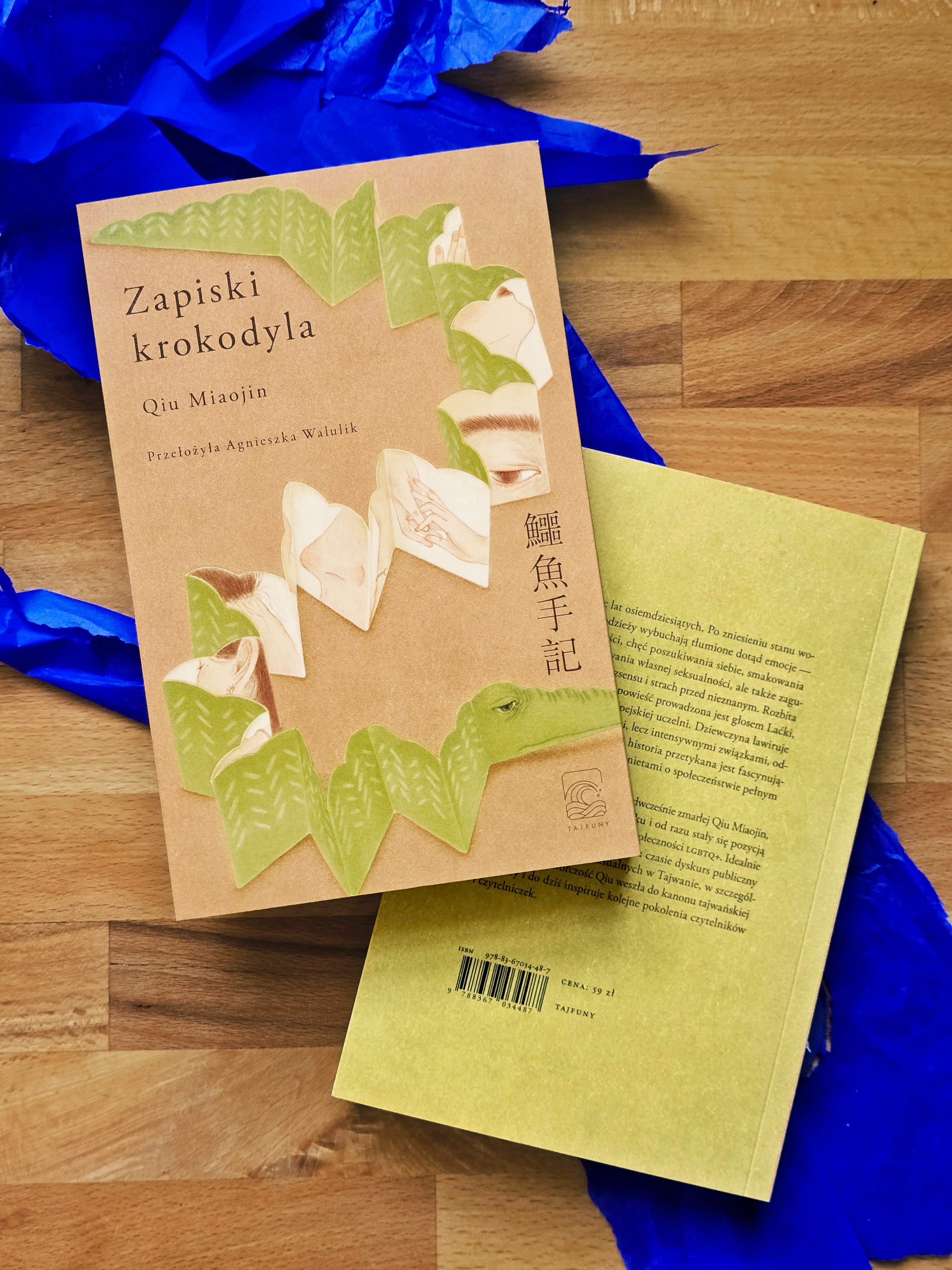
One of the most exciting projects I worked on last year was illustrating the cover for the Polish edition of Notes of a Crocodile by Taiwanese author Qiu Miaojin, published by Tajfuny, a Polish publishing house specialising in Asian literature in translation.
I was excited but hesitant to say yes, as I felt the weight of it. I hadn’t read the book before, but I knew its importance and how widely it has resonated emotionally and culturally. In the end I did say yes (how could I not?), knowing that I needed to approach it with extra care.
Written in the 1990s, Notes of a Crocodile is often described as a pioneering work in Taiwan’s LGBTQ+ literature. It explores loneliness, desire, and self-fragmentation through an intimate, episodic voice. The main character is nicknamed Lazi, a term that later entered Mandarin slang as a word for lesbian. These facts are often mentioned when the book is introduced, but they don’t quite describe what it feels like to read it.
It felt more like reading a diary than a novel. There is no clear timeline but that never seemed important. What stayed with me were the raw emotions. They felt exposed, unadorned, and heavy. I often had to stop after a few chapters, because the weight of the character’s struggle lingered in me longer than the words on the page.
As I began thinking about the cover, I felt nervous. I was aware that this was an experience I was entering from the outside. I didn’t want it to feel superficial, or to flatten the book into a symbol, or to speak in the wrong register. Over time, I found myself returning to one recurring thought while reading: the crocodile is Lazi, and Lazi is the crocodile.
They mirror each other as figures trying to adapt and camouflage in order to exist. I wanted the cover to hold a sense of being partly hidden, and of fragility.
What stayed with me most were the moments of desire and longing. Compared to other emotions in the book, these are less explicitly described. They appear in subtle interactions, in gestures that hesitate or withdraw. They felt timid, restrained, vulnerable, and deeply tender. That was the quality I wanted the illustration to carry.
Comments
Nothing yet. Say the first thing.
Sign in to join the conversation.