
It’s been a while since we’ve updated everyone!
We have developed a Unix instance type, and it’s running in the BevelCloud Labs. It will enable us to handle larger distributed workloads, and our next milestone is to deploy these servers at the three zones where we already have our Android instance types.
We have two objectives for these servers. On the cardiac imaging front, this will enable the deployment of EP2, a neural network that measures ejection fraction in real time. Once in place, we plan to use a few federated learning frameworks to push the state of the art, making a small deployment available before funding at scale.
With the above infrastructure in place, we have built individual patient digital twins. Today, they are trained on the complete EMR record, but our goal is to include all the additional data that goes from the “post code to the genetic code,” a phrase coined by Ronald Cohn, CEO at Sick Kids, in our recent podcast here.
Patient Digital Twins initiative will open the opportunity to deploy Disease-Precise AI agents - or what Dr. Harlan Krumholz at Yale calls “Computable Diagnostics” in his editorial Computable Diagnosis as a Moral Imperative (published here).
We began with nephrology and have built and vetted FSGS, iGAN, aHUS, APOL1 and C3G -precise AI agents. These agents run in the background and ask the patient's digital twins a series of questions. Depending on the response, confidence points are added. In the end if the patient's score is 90+ a note can be placed in the medical record with the specific reasons (in the case of FSGS this is 34) the patient has the condition and here are the approved therapeutics. Scores between 50 and 90 will result in a note saying it might be possible, and here is the next most expensive test to run. Our plan is to begin a small-scale test of these agents on 1200 patient digital twins across the 3 sites.
As you all know, we launched a $50M fundraising campaign. While we welcome a $50M check, we’re asking sponsors to help us build the AI supercomputer one brick at a time.
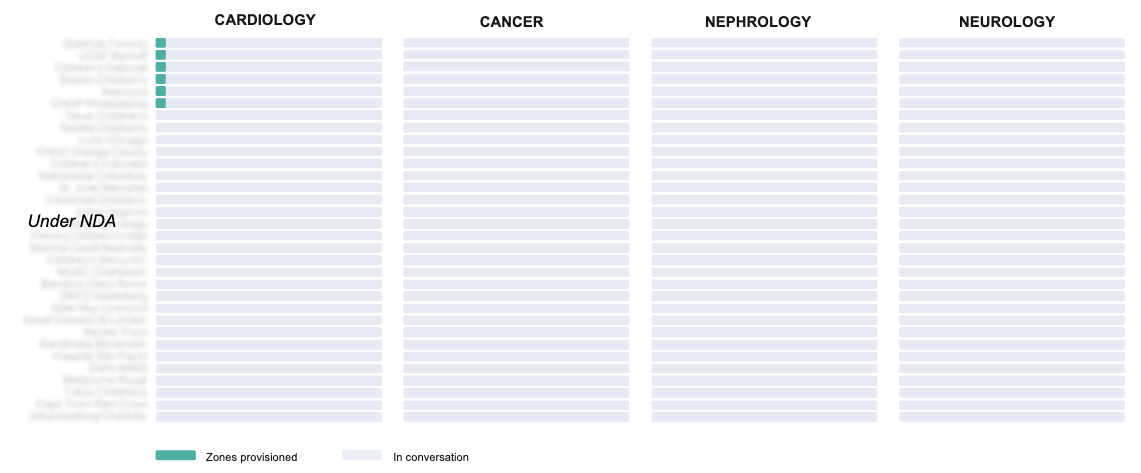
Sponsoring a brick deploys privacy-preserving AI infrastructure into a site focused on one of four specializations: cardiology, oncology, nephrology, and neurology. Furthermore, 26 specialized AI agents will be deployed on that infrastructure for each brick already running. Sponsoring each brick is $250K, and will enable all of the above.
Do you know anyone interested in helping with fundraising one of the bricks? Please reach out!
No posts
Comments
Nothing yet. Say the first thing.
Sign in to join the conversation.