
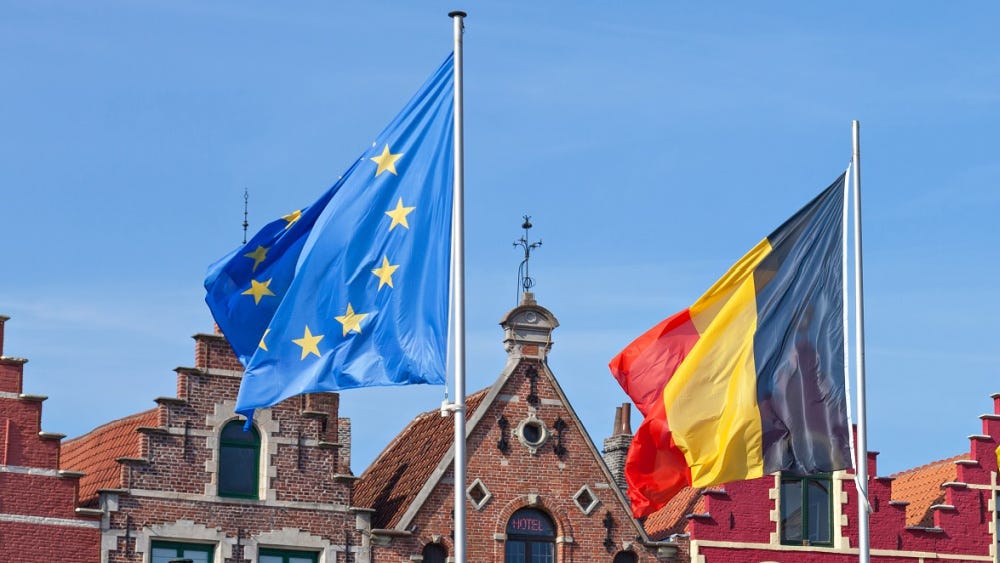
Can a functional democracy form out of many different linguistic nations?
It’s a question that has tickled political theorists for hundreds of years, ever since John Stuart Mill reflected on the question in Considerations on Representative Government in 1861. He wrote “Among a people without fellow-feeling, especially if they read and speak different languages, the united public opinion necessary to the working of representative government cannot exist.”
But Belgium proves Mill wrong — and the reasons why reveal important lessons for the European Union.
After all, the problem Mill first identified (and later expanded upon by Belgian philosopher Phillippe Van Parijs) is one of the central challenges facing the EU, which has placed a respect for language and the cultural differences of 27 European nations at the core of its raison d’être. Over decades and in fits and starts, the EU has tried to create a pluralistic democratic space that respects the sovereignty of the different linguistic nations that fall within it.
But little Belgium — and especially the city of Brussels — has done this sort of sensitive work for centuries. Belgium’s remarkable ability to celebrate and empower different linguistic nations within a single federal system could provide a roadmap for the EU’s own tentative efforts to do the same.
Belgium is home to three different linguistic nations, the Dutch-speaking Flemish region to the north, the French-speaking Walloon region to the south, and a small German speaking enclave to the east. Smack in the middle of it all (but surrounded by the Flemish region) is the legally bilingual region of Brussels.
When Belgium was founded in 1830, the language of government and elite business became French. In the following 190 years, Dutch-speaking Flemings have accrued more and more power within Belgium. The country is now legally trilingual, with Dutch, German and French speakers all formally represented across seven different governments. After a series of student protests in the 1960s, Belgium’s oldest university KU Leuven was literally split in two, with the French speakers (and half the library collection) sent off to Louvain-la-Neuve, just south in the Walloon region.
It’s an inefficient, fiscally bloated, beautiful mess, with many of the most important government functions such as education, transportation and ever-sensitive cultural policy happening on the level of the regions, and not the federal government. The federal government is responsible for defense and military matters, the judicial system, social security, public finance and taxation, immigration and foreign affairs. Oddly enough, those are many of the fundamental responsibilities that a more muscular EU might take on.
While there are plenty of people eager to attack Belgium and paint the country as a bureaucratic disaster, the reality is that the delicate arrangement between the different regions largely works. In fact, Belgium’s framework should qualify as a miracle, considering the deep linguistic and (especially in recent decades) political divides that have riven the country. Placing respect for the language communities at the center of the political agenda means that Belgium has created a pluralistic democratic space, without undermining its linguistic nations, and while still creating the conditions for a working state.
For example, while other countries such as France or the United States have long operated on a nation-state model built around a common language, nation, and state, since the 1960s reforms Belgium has gone in a very different direction. Instead of forcing assimilation into one language or culture, a moral and political impossibility, Belgium decided to split its sovereignty into overlapping pieces.
Upon closer look, it’s no coincidence that Brussels — the city at the center of Belgium’s linguistic compromise — became the capital of a political project trying to do the same across a continent.
Phillippe Van Parijs is a Belgian philosopher who has long celebrated, as well as criticized, the Belgian model in the wider context of Europe’s integration efforts and linguistic diversity. He’s pointed out that Belgium’s system of proportional representation, the first in the world, means that coalitions are critical to forming governing majorities, and have contributed to a culture of political compromise in the country that’s nearly unheard of.
There are other remarkable aspects of Belgium’s governance that Van Parijs celebrates too, such as the sensitivity towards language and culture that’s embedded deeply into the country’s constitutional framework, and the linguistic diversity of Brussels, which on a per-capita basis is one of the most diverse cities in the world.
In recent years, Van Parijs has argued that the country has grown more effective in building a common political demos to cut across the “two democracies” that have formed separately in the French and Dutch speaking regions due to the rapid evolution of translation technologies and — most importantly — the rapid rise of English as a lingua franca within the country. In 2023, more Belgians reported speaking English well or very well (60%) than French or Dutch. English, not French nor Dutch, is quickly becoming the country’s most widely spoken tongue.
Of course, the increasing use of English is a sensitive topic too. Belgian Prime Minister Bart de Wever’s party has expressed concern about proposals to use English as an administrative language in Brussels.
Yet, there are challenges too to Belgium’s — and especially Brussels — attempt to build a pluralistic linguistic nation. The two-year period with no government in Brussels can largely be chalked up to a broken system in which coalitions must be formed within the the Dutch and French-speaking electoral colleges before a broader coalition can be formed.
Van Parijs and a group of fellow academics have proposed a number of reforms to this system to make it easier to form a government in Brussels and better represent the international population of the city.
Of course, the election of Flemish nationalist Bart de Wever has complicated the story a bit, but not entirely. That de Wever, who wants stronger powers for the Flemish region within Belgium’s constitutional framework, was able to form a governing coalition, pass a budget and generate remarkably widespread political support shows the resiliency of Belgium’s federal system.
Belgians are notoriously humble (and at times, cynical) but they should celebrate and share lessons with their European partners about their success in crafting a multi-lingual, multi-national democracy.
Why is Belgium’s experiment in pluralistic and language-attentive governance so important for Europe? Because it’s a linguistic blueprint for how a more muscular, federalized EU could still respect the nations within it.
Belgium’s story shows that democratic systems across linguistic divides can work in Europe. If European countries are to maintain national identity within a stronger EU, then Belgium’s case is instructive. By only placing critical functions in the hands of the federal government, it’s possible to maintain national sovereignty within a federal framework.
The evolving language politics within Belgium, and the increasing emergence of English as a common tongue, also strengthen the idea that English could become the European continent’s common political language. That would help create the conditions for the European political and cultural demos that is desperately needed to mitigate American cultural influence over Europe.
In short, listen to the Belgians. They have more to say about how to build a stronger, multi-lingual and multi-national Europe than we think.
The EU welcomes France’s nuclear turn, but questions remain - The Parliament - March 12
A feature with my colleague Paula Soler on Emmanuel Macron’s recent nuclear doctrine speech, and what it means for the future of nuclear weapons in Europe.
How housing became a central political issue in the EU - The Parliament - March 11
A short feature on the Dutch party D66, how they made housing central to their political agenda, and how it’s being replicated across Europe.
The EU’s space ambition has a rocket problem - The Parliament - March 9
A look at the EU’s rocket launcher ecosystem, and how it’s fallen far behind the US.
Anthropic employees say they’ll give away billions. Where will it go? - Celia Ford / Transformer - March 12
A primer on how the effective altruists at Anthropic may transform giving to EA-related charities after a possible IPO.
It’s the Music You Hear All Day, Without Ever Noticing - Ryan Francis Bradley / The New York Times Magazine - March 10, 2026
A bizarre little feature on the music we hear everywhere but never realize.
No posts
Comments
Nothing yet. Say the first thing.
Sign in to join the conversation.