
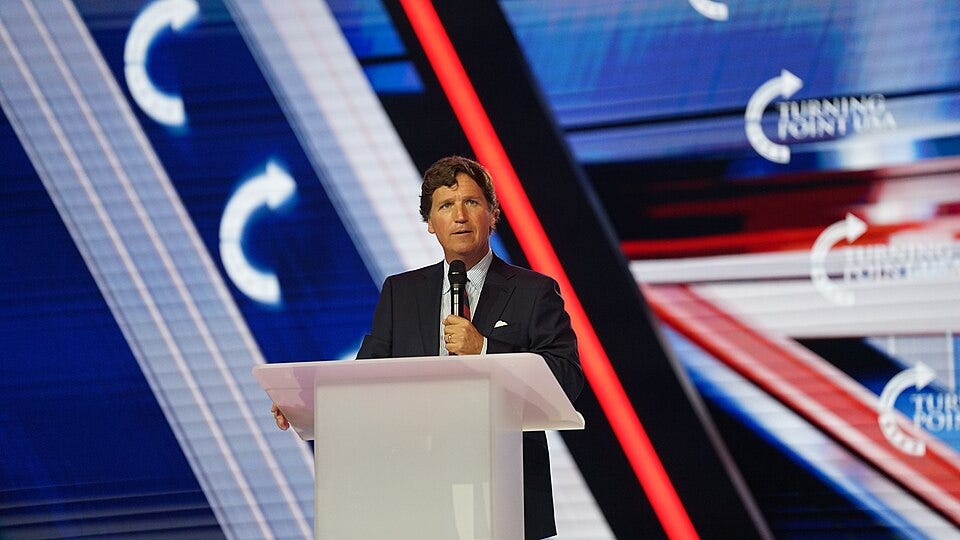
Last month, MAGA star Tucker Carlson broke with the Trump administration in an interview with The Economist, arguing that “Europe is our ally on the deepest possible levels, and no one in the United States wants to admit that.”
The clip shows that MAGA is splitting into two camps on Europe: strategic realists who see Europe as necessary to advance American interests versus ideological actors waging a cultural confrontation. Carlson argues for doubling down on a relationship with Europe to create a unified front against China, while the Trump administration has pushed an aggressive culture war involving a strategy of intervention and coercion in European politics.
What’s going on here?
Carlson’s MAGA-heterodox remarks to The Economist editor-in-chief Zanny Minton Beddoes have two roots. The first is a realist orientation to geopolitics. In November 2024, Carlson interviewed Elbridge Colby, Trump’s national security advisor who now holds a senior role in the Pentagon. Colby is perhaps the most influential China hawk — or prioritizer, in national security parlance — in the United States today. He believes that a rising China is America’s biggest threat, and that all of America’s foreign policy should be organized around keeping China from regional hegemony in Asia.
However, to keep China from dominating the region, it could be useful to have Europe as an ally, rather than a foe. Carlson argues that the world is cleaving into hemispheres, and that America is putting Europe “in a position where they have no choice but to look for other alliances… I assume China.”
“Why would we want that?” he says, while dismissing Trump’s designs on Greenland and the Iran War’s impact on energy prices as damaging to joint transatlantic interests.
Carlson places himself among the thinkers that believe Europe could play an active role in deterring China, rather than simply taking the burden of defense in Europe from the U.S.
The second element of Carlson’s remarks have to do with culture, and are more revealing. Carlson says that “Europe produced us” and that it’s the “global center of beauty,” something that he cares deeply about. “Why would you want to accelerate the death of the people you have the most in common with?” he says.
Here cultural politics come to the fore, a field which Carlson has long waged war, but apparently not, in this case, with Europe. Some of America’s top diplomats and its strategy documents have sought to frame America’s aggressive attacks on Europe as a war against woke, couching transatlantic politics as an ideological struggle over free speech and liberal ideology. But Carlson doesn’t take this line, even though it’s right in his typical wheelhouse. Instead, he plays up the history and traditions connecting both sides of the Atlantic. Where much of MAGA frames Europe as ideologically hostile, Carlson frames Europe as foundational to American identity and interests.
Oddly enough, in this he sounds much more like Joe Biden than Donald Trump, echoing the former president’s emphasis on history and tradition in the transatlantic relationship. Carlson says in the interview that he literally can’t understand the raw hatred for Europe that some in the Trump administration share.
Let’s be fair. Carlson has also made plenty of claims which undermine Europe too — among them his longstanding admiration for Putin. He may no longer reflect the center of MAGA either, attracting attacks from Trump for opposing the Iran War, for example.
However, he still demands a huge audience among U.S. conservatives and his outspokenness about the importance of the transatlantic relationship show that MAGA politics are certainly not monolithic on the issue. In Carlson’s view, the U.S. risks pushing Europe toward strategic autonomy — or even alternative alignments — at exactly the moment Washington needs it most.
Europe’s invisible hand in the chip race - The Parliament - April 17
A look at how Europe’s prowess in semiconductor research and lithography machine production make it indispensable to the global tech supply chain.
The 27-Year-Old Diplomat Waging Trump’s Cultural War With Europe - The New York Times - April 17
A profile of Samuel Samson, the 27-year-old helping to run America’s current culture-war focused policy towards Europe.
The Car-Crash Conspiracy - Patrick Radden Keefe / The New Yorker - April 13, 2026
A feature on the slammers, people who intentionally crash into tractor trailers for insurance payouts.
No posts
Comments
Nothing yet. Say the first thing.
Sign in to join the conversation.