
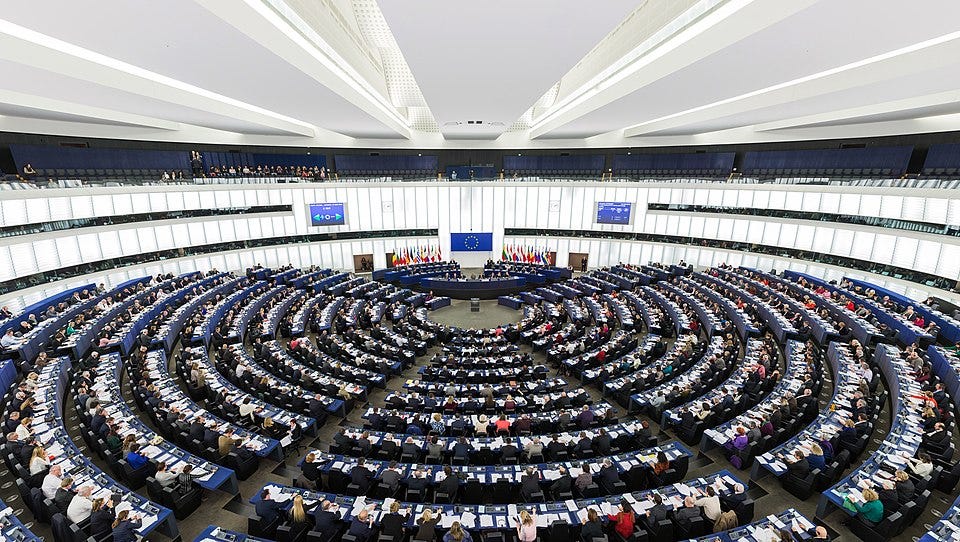
For decades, the US Senate was called the “greatest deliberative body on earth.” It was the Senate, the thinking went, where the policy decisions of 19th and 20th century America were made. Think Lyndon B. Johnson and Ted Kennedy for the Democrats, or on the Republican side, John McCain and Hubert Humphrey.
But in recent decades, the reputation of the Senate as a great lawmaking body has tanked. Now, the US Senate is the place where legislative proposals go to die. In Trump’s America, it’s the presidency, not the Senate, that’s the heart of political power.1 In fact, Biden’s loss of the presidency in 2024 can be interpreted as a repudiation of the kind of deliberative, consensus politics the US Senate was once known for.
When searching for the world’s greatest lawmaking body, we should instead cast our eyes across the Atlantic — not to the longstanding national lawmakers of Germany, France, or the United Kingdom, but instead to the European Parliament.
The European Parliament, yes!
For those reading from outside of Europe, I punctuate thus because the European Parliament is an institution much-maligned in Brussels, and Europe more broadly. Over the nearly 70 years since its founding, the European Parliament has gradually clawed more power away from the European Council and Commission — the institutions of the member states and the European Union’s executive. The European Parliament is often looked down on as a marginal institution — a kind of angry, outspoken child compared to the mature adulthood of the Council and Commission.
But a closer look shows how the European Parliament truly is fast becoming one of the great deliberative bodies in the world — and an EU treaty change that would give the European Parliament the power of legislative initiative would solidify that place.
The European Parliament represents 375 million voters across Europe, the second-largest democratic electorate in the world. (India is top.) Speakers can address the Parliament in any of the EU’s 24 national languages, with simultaneous translation that is truly a sight to behold in action. (Even if the lingua franca is most definitely English.) The Parliament is home to eight political parties that make up the range of the European political spectrum, from the far-right Europe of Sovereign Nations, to aptly named The Left. (There are scores of non-attached MEPs too, and some with non-traditional backgrounds, such as Cypriot social media star Fidas Panayiotou.)
In recent years and even months, the European Parliament has also begun to flex what political power it has more aggressively. In the past few weeks the European Parliament killed the EU-US trade deal in the wake of Trump’s aggressive posture towards Greenland,2 deferred the Mercosur trade agreement to the Court of Justice of the European Union, and has continued to threaten European Commission President Ursula von der Leyen with censure for her handing of trade deals.
All the while, the European Parliament continues to work as a highly functional, deliberative, and dynamic political body that far more than any other European institution is closest to representing the voices of citizens. As the EU continues to deal with a deficit of democracy in pivotal institutions such as the Council and Commission, where there are no direct EU-wide elections, it’s the European Parliament that has become the most important vector for citizen voice and representation.
Whereas so many policy issues in the US are quickly turned into partisan punching bags, whether it be climate, taxation, foreign policy, defense, or health, the European Parliament’s comparative dispassion means that policy debates are actually about policy — not politics.
For example, new coalitions often form around each policy issue, as MEPs largely have the initiative to support legislation as they see fit, rather than always comply tightly with the party line.3 That’s in marked contrast to the US, where partisanship has risen to such heights that to vote against the party line on a close vote is interpreted, literally, as treason.
And how about the elections themselves? Members to the European Parliament are selected every five years by voters from across the EU. Much of the funding for those campaigns comes from the EU itself, with private donors playing a much more marginal role. In comparison, the American system — and especially Senate elections — are awash in dark money and private donors.
While it’s hard to get exact numbers due to European Parliament elections occurring largely within each national ecosystem, funding is clearly a fraction of that in the US. During the 2024 election cycle, US Congressional candidates spent 3.7 billion on their campaigns, and that figure doesn’t come close to capturing the huge amount of independent expenditures and spending by parties. The comparative lack of money in European politics means that policy discussions are much more deliberative than they would be in a political system awash in money.
Of course, there are many ways in which the European Parliament is still quite limited in its powers. The lack of power of legislative initiative means that the European Parliament is constantly responding to proposals from the Commission or Council. Another challenge is the limited role the European Parliament has in overseeing the European Commission president. As former MEP Sophie in t’ Veld explains, it’s important that the European Parliament gain more powers after any possible treaty change to create a directly elected European Commission President. She calls for a parliament system like the one used in most European countries, rather than a presidential system as used in the US and France.
If we define a ‘great deliberative body’ as one that represents a huge swath of diverse peoples, has and uses intelligently legitimate means of political power, and then actually deliberates on lawmaking decisions, then it’s increasingly clear that we should consider the European Parliament as one of the great deliberative lawmaking bodies of our age.
How the EU became a digital colony — and how it might break free - The Parliament - January 26
A deep dive into how Europe became so dependent for digital technologies on the US, and how a proposal called EuroStack could help the continent become independent.
China’s genius plan to win the AI race is already paying off - Zijing Wu / Financial Times - January 31 (gift link)
A fascinating look into ‘genius’ classes in China and how they’re helping China to compete in the AI race, from a writer who was in one of them herself.
Why it’s so hard to write for magazines now - Calder McHugh - January 28
A fun read on the challenges of doing magazine journalism, and how a digitized world is making it more difficult to find the scenes that make for great long-form features.
Of course, an exception that proves the rule can be seen in the presidency of Joe Biden, when the longtime senator was able to usher large domestic policy packages such as the CHIPS Act and Inflation Reduction Act through the US Senate.
Although that deal may be going ahead after Trump backed down.
Although some parties are more effective at enforcing party-line voting than others, such as the European People’s Party under Manfred Weber.
No posts
Comments
Nothing yet. Say the first thing.
Sign in to join the conversation.