

The great transatlantic economic debate of 2026 has continued this week with another series of posts from Paul Krugman and Garicano et al. and assorted commentary from Brad DeLong and others.
For those who didn’t get to read part one of this debate on comparing the U.S. and European economies (but in particular, productivity) I encourage you to read my post last week on the topic.
It’s a complicated economic debate, but here’s the central question at the heart of the tension this week: Do the benefits of technology-driven productivity growth accrue to producers or users? That question matters because it impacts quality of life between the U.S. (a producer of tech) and Europe (a consumer of tech). That’s the real issue that this entire debate started around many weeks ago.
Krugman and DeLong argue that (European) users of initially (American) technology benefit from big welfare increases, even if firms in (typically) Silicon Valley develop it.
Meanwhile, Garicano et al. argue that this is not really the case, and that European productivity has fallen far behind the U.S. with downstream problems for the European way of life.
While a close reading of all the economics here gets into heady territory quickly (as I did last week) it’s so important because of the huge policy implications it has for economic policy on both sides of the Atlantic. Is Europe’s lack of tech industry leaving it far behind? Could the U.S. cut-off tech users in Europe? What would be the implications?
My headline takeaway from the back and forth is that a much larger portion of the economic benefits of tech accrues to users (in this simple formulation, Europe) than we typically acknowledge. That means Europe may be losing out less than it thinks economically from being behind in cutting-edge technology.
However, that realization has really important second-order implications for Europe — European economies are highly dependent on technology services coming from the U.S.; Europe is missing out on huge stock market / wealth / capital gains that come from collecting rents / profits for these kinds of services; Europe should de-risk its economy to make sure it can continue to be a user of these services, or develop its own solutions for its own sovereign purposes.
Into the debate, briefly:
In a May 29 post on Project Syndicate later republished on Silicon Continent, Philippe Aghion, Antonin Bergeaud, and Luis Garicano take issue with Krugman’s analysis of the economic data on transatlantic productivity.
I’m going to avoid getting into the nitty gritty economics here, but the debate hinges around using sequences of purchasing power parity indexes over time to measure productivity versus constant prices. Sequences over years do a poor job of measuring economic productivity, the authors argue, as the prices change over time, missing the actual additional productive capacity of an economy over time. As covered in my last post, this numbers debate matters because PPP productivity comparisons show that Europe is not falling behind, while productivity comparisons at constant prices do.
The core of the piece is this chart, which the authors argue shows that across a wide range of different data sets, U.S. growth has far outpaced France, for example. Meanwhile, at PPP comparisons, they look nearly same.
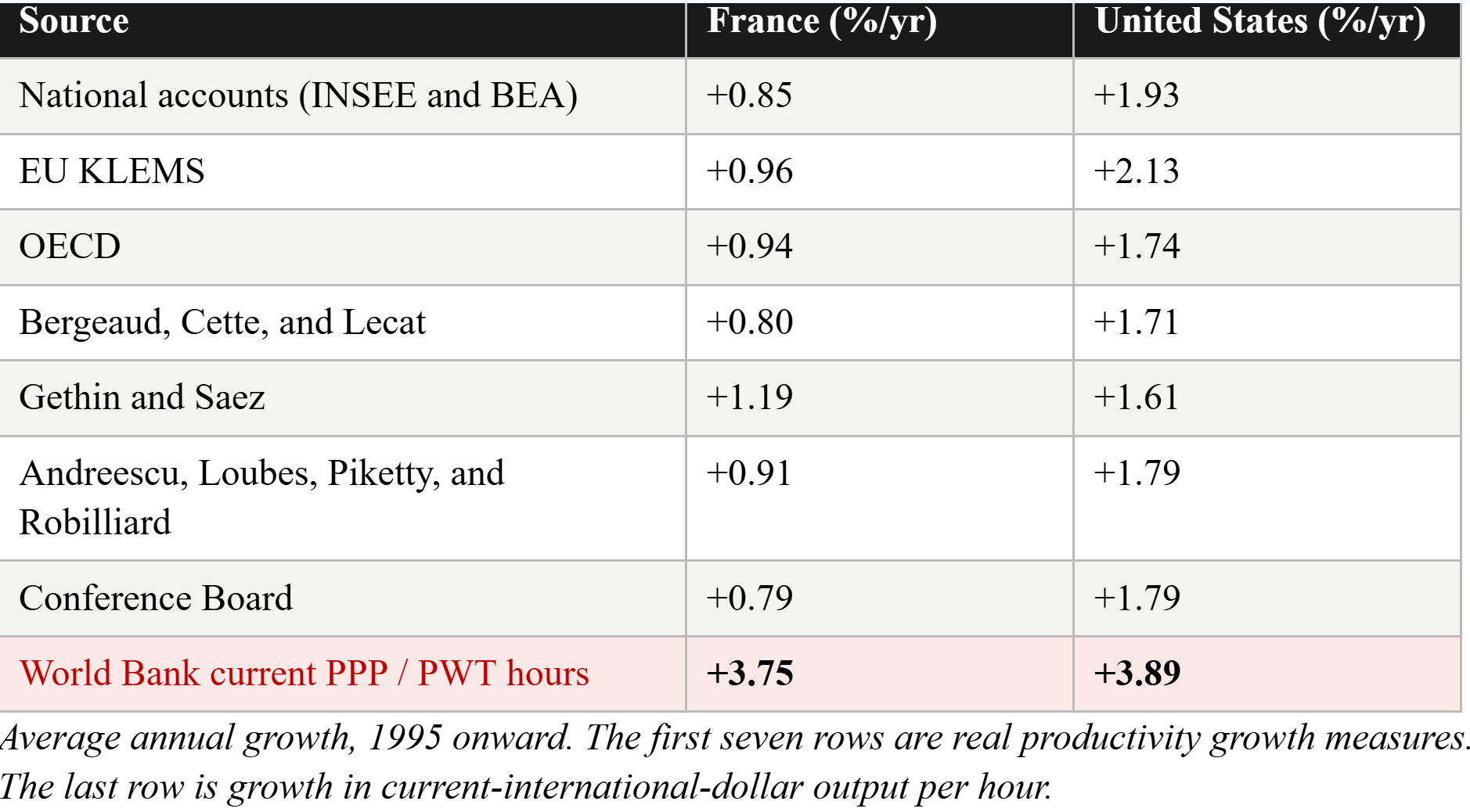
The authors conclude: “Contrary to Krugman’s argument, the US lead in technology and innovation is not helping America and Europe in the same way. It has led to higher US wages and profits, and the gap is widening each year.”
Krugman disagrees voraciously.
Yesterday, he published his response, in which he argues that the rejoinder (of European economists) to his argument missed the bigger picture and the initial reason why he started in on this debate: what do transatlantic productivity comparisons mean for the standard of living?
Krugman writes: “I am not arguing that European productivity is mismeasured, and never said that. I am, instead, arguing that standard measures of productivity do not have the implications for cross-country comparisons of living standards and economic welfare that many people – including many economists – think they have.”
What does Krugman mean here?
He means that we should be very careful about how we think about constant price productivity and how it relates to actual PPP output per hour — what he believes is a proper measure of economic welfare. (I went into this in much more detail in my last post on the debate, so I’ll skip over the nuances of the comparison here.) Garicano et al, argue that this productivity gap “has led to higher US wages and profits, and the gap is widening each year.”
Krugman says that is incorrect and off base, meaning the productivity gap is not having the economic impact at the level of GDP per capita (a decent proxy for overall economic welfare). He shows this graph, which at a PPP level actually shows the EU catching up to the U.S.:
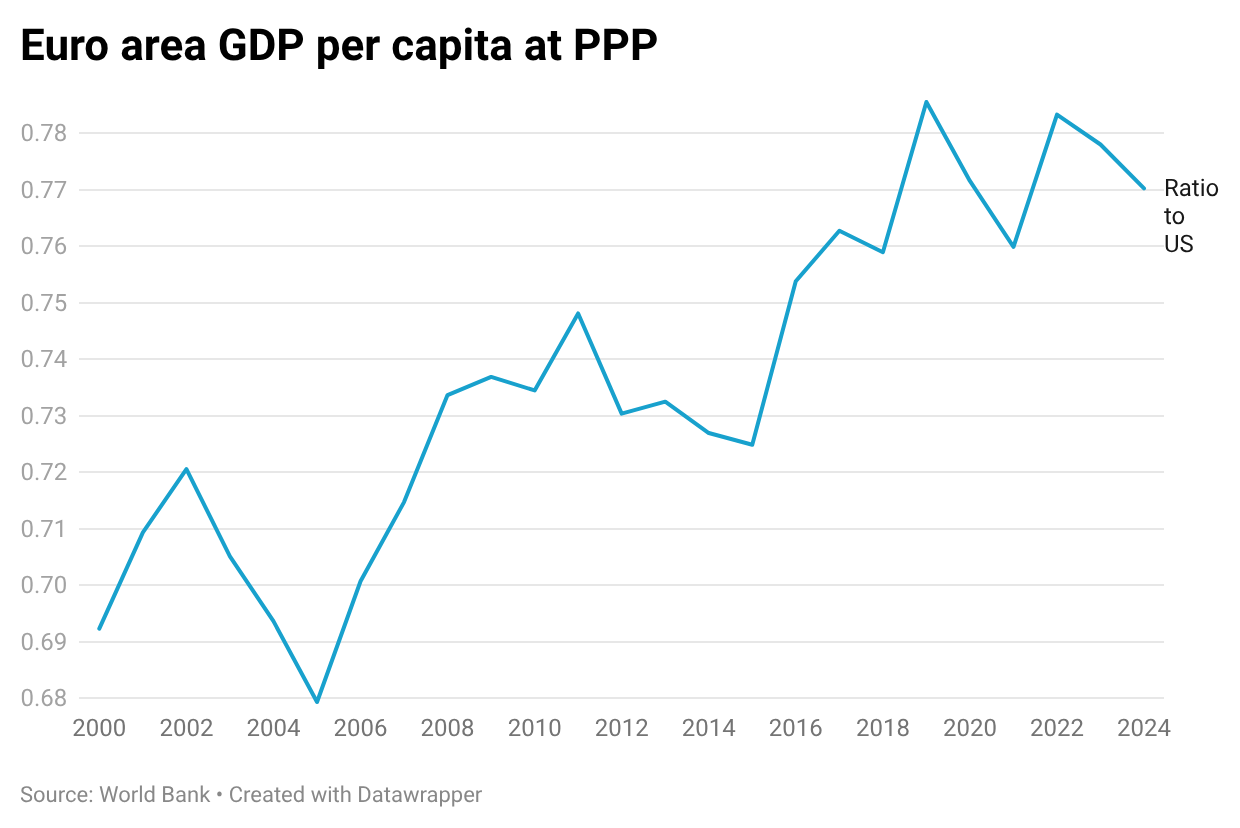
In short, Krugman says that Garicano et al. fail to explain the paradox between measuring transatlantic productivity at constant and PPP prices, and that their assertion it leads to a widening between U.S. and EU economic outcomes is false.
(I’m really skipping over the nuances of this important economic debate about the paradox between the constant and PPP productivity measurements, but as I’ve mentioned elsewhere read my prior post or did into Krugman and Garicano’s writing on this topic for more. This is good enough for our purposes.)
As I mentioned in my last post, there are important answers to that paradox tied to the dispersion of technology initially developed in the U.S. to other parts of the world. In short, uptake of technology is incredibly important for economic welfare, meaning countries such as those in Europe can capture many of the benefits of a technology even if they didn't develop it.
That’s important to understand because it can help explain why at a PPP level the EU seems to be keeping pace with the U.S., while at constant prices it’s not.
That’s what the economic historian Brad DeLong argues in a post backing up Krugman’s argument. I think it’s the most important analysis for understanding why this entire debate matters and the takeaways for non-economists:
DeLong says that the real question is who benefits from technological growth, producers or users. The most important paragraph of DeLong’s excellent note on the topic is here:
It is is fact not the case that “the US lead in technology and innovation… has led to higher US [real] wages” relative to Europe. (Profits are a different story, and that I will give you.) European users of high-tech have seen their real earnings rise about as fast as American users have. And while the product wage of US producers has risen enormously in the high-tech sector, the user-consumption wage has not as the relative prices of high-tech goods have collapsed.
What’s going on here?
Simply, the benefits of technology have accrued to users in Europe as the costs of accessing digital services has collapsed. That allows Europe to keep up high living standards and wage growth, even though the technology is not initially European.
Of course, the snafu here (as DeLong clearly identifies) is that American Big Tech firms and those working in that sector are still able to reap huge profits, leading to outsized wage and productivity growth in that portion of the economy.
In short, the gains from American tech innovation are spreading to Europe, helping maintain Europe’s standard of living vis a vis the U.S.
This analysis of users and producers helps to answer the paradox between measuring productivity at constant and PPP prices. However, it also calls into question another key factor — the benefits of being a producer.
Clearly, the U.S. is the producer for tech in this market. That has huge benefits that the great transatlantic economic debate of 2026 still hasn’t fully grappled with, such as huge stock market gains and later capital that can circulate into other industries. (Of course, that has huge downsides too, like tech billionaires having a corrosive impact on U.S. democracy.)
For policymakers, I think the takeaway of this simple but nuanced finding is rooted in geopolitics more than anything else: the problem for Europe is still that Europeans largely participate as users rather than producers. That means Europe must find ways of maintaining cheap access to American tech services, or else develop its own. It means Europe is still very dependent on the U.S. for its relative economic position, which can be dangerous in the age of Trump.
That’s why the tech sovereignty package being developed by the EU and set for release next week is so important. Watch this space…
No posts
Comments
Nothing yet. Say the first thing.
Sign in to join the conversation.