
I was largely inactive on social media before becoming involved in gender-critical activism. My personal accounts had only a few hundred followers, and I rarely posted. That changed quickly after I published my first two essays on gender and appeared on Jack Jewell’s YouTube channel.
Within a short period of time, I was invited onto nearly every gender-related podcast, began speaking at events, gave public testimony, and developed a modest following, especially on Twitter/X. (Still small by social media standards, but a following nonetheless.) Suddenly, thousands of people were interested in what I had to say. They complimented me, encouraged me, and told me how much they appreciated having a brave, gender-nonconforming gay man in the movement.
With my growing social media audience came a new understanding of the forces that make social media so addictive and the powerful incentives that reward certain kinds of posts over others. When I repeated the correct group slogans and criticized the correct enemy group, I was rewarded with likes, retweets, follows, and complimentary comments. This can be especially intoxicating for those speaking out against gender ideology, since trying to help protect women and children can even have you celebrated as a “hero.” But when I was equally critical of my own group and offered constructive criticism of weak arguments or bad behavior—with the sole intention of making our side stronger and more persuasive—the post was either ignored completely or I was criticized, lectured, and treated to a chorus of “I’m unfollowing you” announcements.
Having a large following is not important to me, so I have been able to brush off most of these reactions. But I can easily understand how these incentives push people toward tribalism and encourage them to post only The Correct Opinion. Even for me, it was exciting the first few times a tweet I posted recieved thousands of likes, and overwhelming the first few times I was piled on for saying the wrong thing. I can understand why people end up squeezing their views into a box of pre-approved opinions to avoid the latter experience and enjoy more of the former. Getting lots of “likes” provides a small dopamine hit, and like any rewarding experience, it creates a natural desire to recreate that feeling. The natural tribal instincts most people seem to have are also amplified by the inherent “us versus them” nature of online political discourse. Unfortunately, this often leads to people become take-sellers.
When a person gains a following due to their connection with one specific political topic or activist movement, they have to post constantly to maintain their relevancy in that space. Every tweet soon becomes a “hot take” about whatever news story happens to be related to the group’s issue that week. It doesn’t matter how trivial or unimportant the story is. If it’s the only gender-related news item making the rounds, every niche internet micro-celebrity on Gender Critical Twitter feels obligated to deliver their Take. It starts to resemble a competition: who can produce the wittiest take, the most outraged take, the most vicious attack on the enemy group, the most devastating dunk.
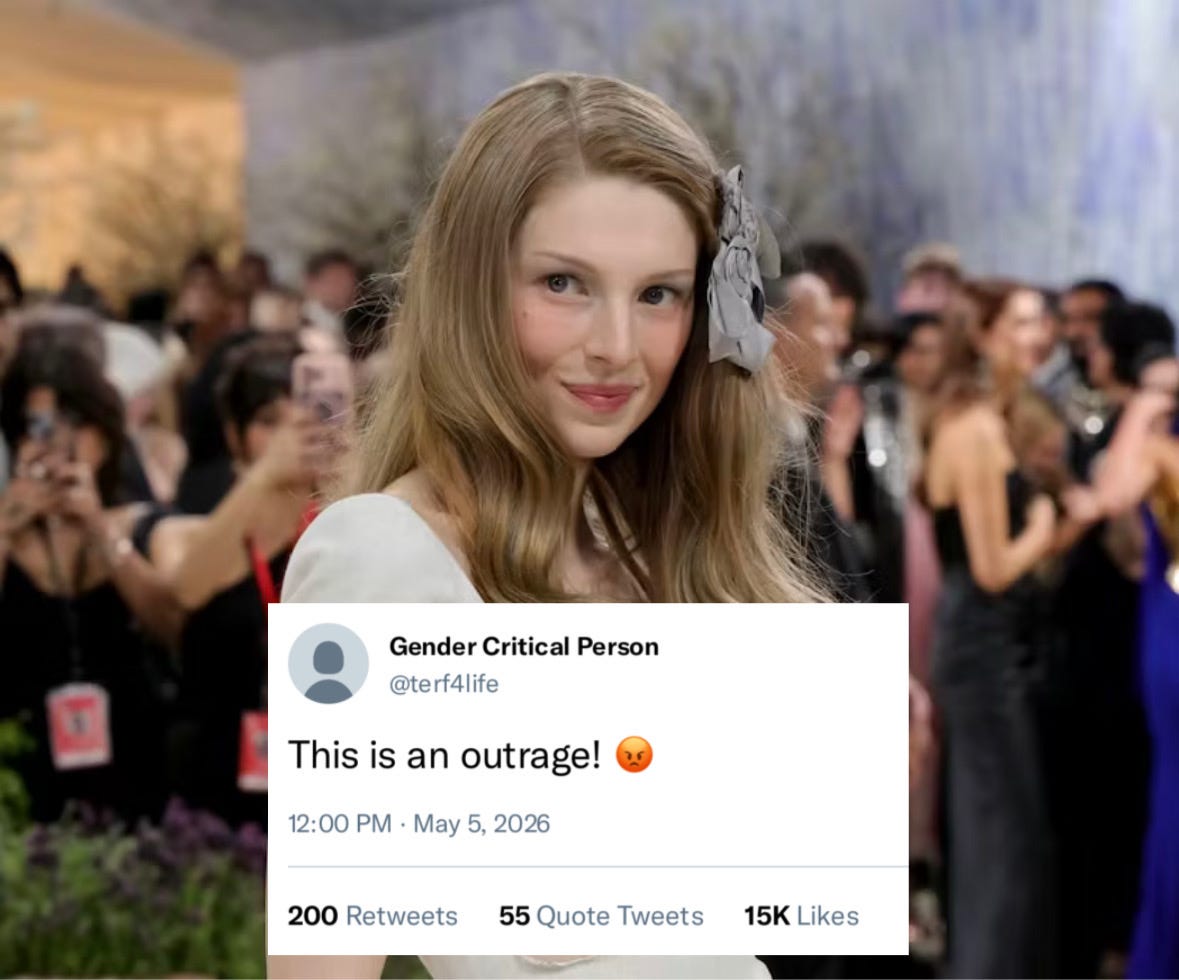
It’s a slow news week in gender world. Then Hunter Schafer appears on a red carpet. Thousands of Hot Takes ensue.
“They’re trying to tell young girls that this is the beauty standard. This is outrageous!”
“Look at his AGP smirk. Every woman around him is an unwilling participant in his sexual fetish. He’s getting off on it.”
“He stole an opportunity from a woman. Every time he appears on screen, remember that a woman who deserved that role isn’t there instead.”
“Look at this photo where I zoomed in on his face from a bad angle. You can clearly see he’s a man.”
Must we do this? What is the point?
Hunter Schafer is male. I don’t think he should use female-only spaces. I think it was wrong that he was allowed to medically transition at fourteen years old. But weren’t gender-critical people supposed to have compassion for gender-confused minors? Aren’t we supposed to be concerned when this is done to teenagers? Are we only allowed to be compassionate when they are teenagers, but then expected to place them in the “evil perverted fetishist” category the moment they turn eighteen? Why is so much anger directed at him rather than the medical professionals who facilitated his transition, the therapist who affirmed him, or perhaps even the parents who consented to it?
An old Instagram post of Schafer’s goes viral on GC Twitter every few months. The post is troubling: a scribbled journal entry in which he wrote that his gender was heavily influenced by a “need to be used by men,” alongside a stream-of-consciousness reflection questioning his sexuality, his attractions, and why he wanted to transition in the first place. This post is often used by GCs to justify their attacks against him. Admittedly, parts of it are disturbing, and several lines are difficult to read.
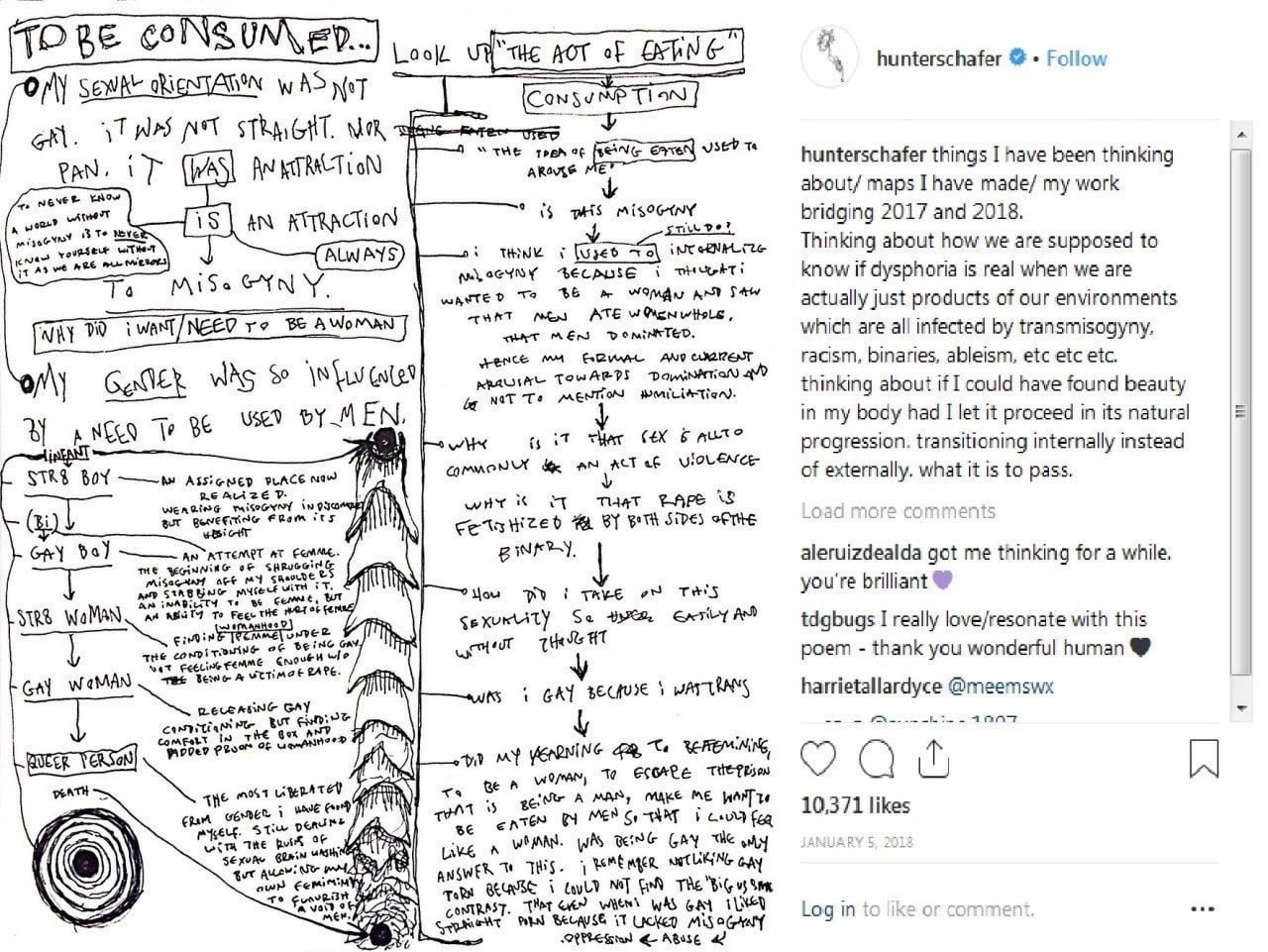
What is rarely—if ever—discussed is the caption he wrote alongside it, which includes the following line:
“Thinking about if I could have found beauty in my body had I let it proceed in its natural progression.”
Is that not heartbreaking? He was asking the same question that gender-critical people ask all the time: How do we know that teenagers who are irreversibly medicalized would not have grown into happy adults in their naturally sexed bodies. He was questioning what had been done to him. The thoughts he was exploring in that journal entry are precisely the kinds of thoughts that should have been explored more deeply with a therapist when he was fourteen, rather than having his trans identity affirmed.
But what’s done is done. He transitioned at fourteen. He does not want to detransition. Why should I hate him? Why should I convince myself that he is secretly “getting off” while posing on a red carpet, just to become angry about a fictional scenario I invented in my own head?
I wish Hunter Schafer well. I think he looks good. I hope he finds love. I hope he enjoys a successful career in Hollywood.
That’s my Take.
Of course, it isn’t one that would earn much praise or reward me with many “likes” on GC Twitter.
The point isn’t whether Hunter Schafer is a good person or a bad person. I don’t know him. The point is how quickly social media trains us to stop seeing human beings and start seeing opportunities for content.
Even people who enter a movement as intelligent individuals with legitimate concerns often become intellectually lazy take-sellers. Their focus shifts away from solving a cultural problem or ending a medical scandal and toward harvesting engagement, provoking outrage, and chasing the dopamine rush that comes with going viral.
Schafer could be a useful case study for people concerned about youth transition. His writings offer a glimpse into the kinds of thoughts, desires, insecurities, and confusion that can lead some adolescent males to identify as transgender. They raise questions worth exploring if the goal is to better understand the phenomenon and help young people navigate these experiences without irreversible medical interventions.
But nuance doesn’t perform well on social media, and compassion for members of the enemy group performs even worse. What does perform well is outrage, certainty, creating a villain, and delivering a clever, vicious, shareable Take.
And so we end up with thousands of people talking constantly, generating endless culture war content, yet understanding almost nothing. We don’t get any deeper insight or come any closer to solving the problems we claim to care about.
We just get more Takes.
No posts
Comments
Nothing yet. Say the first thing.
Sign in to join the conversation.